

Last week a PGY‑1 hopeful forwarded me an email from a program: “Please confirm via email that we are your top choice and that you will rank us #1.” She liked the program. She did not want to lose the spot. And she also did not want to get slapped with an NRMP violation that could nuke her match chances everywhere.
If you’re staring at one of those “commitment” emails right now, you’re not alone. Programs are not supposed to do this. Some still do. The key is how you respond—because you can protect yourself, stay NRMP‑safe, and still keep the program interested.
First: Understand What’s Actually Illegal Here
Let’s get the lay of the land straight, because the rumors among applicants are usually half‑wrong.
Under NRMP rules, programs cannot:
- Ask you to state how you will rank them (“Promise you’ll rank us #1”)
- Require a “commitment” as a condition for ranking you
- Pressure you to share your rank list or agreement to rank them in a certain order
- Make any deal that sounds like “If you rank us #1, we will rank you to match”
You, as an applicant, can:
- Express strong interest
- Tell a program they are your “top choice” or “highly ranked on my list”
- Send post‑interview communication (thank‑you notes, update letters)
- Change your mind later when you submit your actual rank list
Where people get burned is when they put something in writing that looks like a binding agreement or quid pro quo. The NRMP doesn’t care if you like a program. They care if anyone is trying to game the algorithm with side deals.
So when a program demands a “commitment email,” your job is to:
- Not sign yourself up for an NRMP violation.
- Not ghost them and tank your chances.
- Keep maximum flexibility for your actual rank list.
Let’s walk through how.
The Main Scenarios You’ll Face (And Exact Scripts)
You’re going to see variations on a theme. Here are the big four versions I’ve seen over and over.
Scenario 1: The Explicit “Rank Us #1” Request
Example email (paraphrased from real life):
“We enjoyed meeting you and think you’d be a great fit.
To help us finalize our rank list, please confirm via email that you intend to rank our program #1 and will come here if you match with us.”
This is the clearest violation on their side. Do not answer “yes” to this question in the way they’re asking.
Here’s a safe, respectful reply that keeps the door open:
Script 1: Strong interest, NRMP‑safe
Dear Dr. [Last Name],
Thank you again for the opportunity to interview at [Program Name] and for your follow‑up email. I was very impressed by the training environment, the residents I met, and the program’s focus on [specific thing you liked – e.g., resident teaching autonomy, global health, etc.].
I remain very interested in [Program Name] and I will be ranking your program highly on my list. In keeping with NRMP policy, I will finalize and certify my rank list independently through the NRMP system.
I appreciate your consideration and the time you and your team have invested in my application.
Sincerely,
[Your Name], [AAMC ID or NRMP ID]
That line—“In keeping with NRMP policy…”—is intentional. It politely signals: I’m not going to break the rules with you.
If this program really wants you, this is enough. If they’re trying to collect a roster of applicants who will violate rules for them, you don’t want to be on that list.
If they push back with a second email, like:
“We specifically need to know if we are your #1 choice.”
You can tighten the boundary:
Script 2: Clear boundary, still interested
Dear Dr. [Last Name],
I understand the importance of building a rank list, and I truly appreciated my interview day at [Program Name]. At this time, I can say that I’m very interested in the program and anticipate ranking it highly.
NRMP policy asks that both applicants and programs avoid asking for or making commitments about specific rank order, so I’m not able to provide a statement beyond that.
Thank you again for your consideration.
Best regards,
[Your Name]
If they’re still not satisfied after this, that’s a red flag about their culture.
Scenario 2: “If You Rank Us #1, You’ll Match Here”
Sometimes the program doesn’t ask you to promise anything. Instead they say a version of:
“If you rank us #1, you will match here.”
That’s also not allowed on their side—because it’s essentially an assurance of match if you perform some action.
Your response here depends on how much you care about this place.
If you like them and want to keep things positive:
Script 3: Acknowledge, don’t reciprocate
Dear Dr. [Last Name],
Thank you for your note and for the information about your rank list. I’m glad to hear I’m being seriously considered by [Program Name].
I remain very interested in the program and plan to rank it highly. I’ll be finalizing my rank list in the NRMP system based on overall fit and my career goals.
I appreciate the transparency and the time your team has put into my application.
Sincerely,
[Your Name]
Notice what you did not say:
- You didn’t say “I will rank you #1.”
- You didn’t enter into any deal.
If the email makes you uncomfortable enough that you’re rethinking the program, your reply can be cooler and shorter:
Script 4: Neutral, non‑committal
Dear Dr. [Last Name],
Thank you for the update. I appreciate being considered by [Program Name] and I will be submitting my rank list through the NRMP system once I’ve completed my decision process.
Best,
[Your Name]
Scenario 3: “We Need a Commitment Email By X Date”
The artificial deadline tactic. Something like:
“We are very interested in you as a candidate.
Before we finalize our list on [date], please send an email confirming that you intend to rank our program #1. Without this confirmation, we may not be able to rank you to match.”
This is manipulative. Also dumb, because the NRMP algorithm doesn’t need their “pre‑agreement” to match you.
Here’s how to push back without setting yourself on fire.
Script 5: Reframe and hold your ground
Dear Dr. [Last Name],
Thank you for reaching out. I’m glad to hear that I’m being considered strongly by [Program Name]; I enjoyed my interview day and was particularly impressed by [specific detail].
I’m not able to provide a commitment regarding specific rank order before I finalize my list in the NRMP system, but I can say that your program will be ranked very competitively on my list.
Thank you again for your time and consideration.
Sincerely,
[Your Name]
If you’re absolutely certain this is your top choice and you want to tell them that, you still need to keep it NRMP‑safe.
Script 6: They really are your #1, NRMP‑safe wording
Dear Dr. [Last Name],
Thank you for your message. After completing my interviews, I can say that [Program Name] stands out as my top choice based on [brief reason – e.g., training environment, mentorship, location].
I will be submitting my certified rank list through the NRMP system when it opens for certification, and your program will be ranked accordingly.
I’m grateful for the opportunity to be considered.
Best regards,
[Your Name]
You’re telling the truth: they’re your #1 right now. You’re not entering a deal. The decision still happens through NRMP.
Scenario 4: You Don’t Want Them, But You Don’t Want Drama
Sometimes the program demanding a “commitment email” is one you already know will be low on your list. Or not on your list at all.
You don’t owe them a fake love letter.
Script 7: You will rank them, but not high
Dear Dr. [Last Name],
Thank you for the follow‑up and for the opportunity to interview at [Program Name]. I enjoyed meeting the faculty and residents.
I will be submitting my rank list through the NRMP system after I’ve completed my decision process.
I appreciate your time and consideration.
Sincerely,
[Your Name]
That’s it. No promise. No enthusiasm you don’t feel.
Script 8: You already know they won’t be on your list
This one people overthink. You’re not required to tell programs you’re not ranking them. Silence is a perfectly acceptable answer.
If you still feel compelled to respond (maybe because a small specialty, or you know these attendings by name), keep it neutral:
Dear Dr. [Last Name],
Thank you for your email and for the consideration throughout this process. I appreciate the opportunity to have interviewed at [Program Name].
I’ll be submitting my final rank list through the NRMP system. I’m grateful for your time and support.
Best,
[Your Name]
It says nothing about how you will rank them. Which is the point.
What You Should Never Put in Writing
A quick list of phrases that make my skin crawl when I see them in applicant emails—because they can be misinterpreted in an NRMP investigation:
- “I promise to rank you #1.”
- “I commit to coming to your program if we match.”
- “You have my word that I will rank [Program] first.”
- “If you rank me to match, I will rank you to match.”
- “This email serves as my formal commitment…”
Do not write anything that sounds like a contract or a trade.
Express interest? Yes. Say “top choice”? If true, that’s allowed. But don’t bleed into legalistic or transactional language.
How NRMP Actually Enforces This Stuff
Applicants worry that if they say the wrong thing, NRMP will drop from the ceiling like a SWAT team. That’s not how it works.
Usually what triggers an investigation:
- A pattern of complaints about the same program
- An email chain where a program clearly pressures for rank info and dangles promises
- Actual agreements in writing (“If you rank us #1, we guarantee you a spot”)
If an investigation happens, NRMP looks at both sides’ communications.
That’s why your wording matters. You want to be the one who:
- Referred to NRMP policy
- Refused to make a specific commitment
- Kept everything framed around “I’ll submit my list through NRMP”
If the program is in the wrong, that’s on them. Your emails can literally be your protection.
Quick Comparison: Safe vs Risky Phrases
| Situation | Safer Phrase | Risky Phrase |
|---|---|---|
| Expressing interest | "I will rank you highly." | "I will rank you #1." |
| Signaling preference | "You are my top choice right now." | "I promise I will match there." |
| Talking about ranking | "I’ll submit my list through NRMP." | "This email is my commitment." |
| Responding to pressure | "NRMP discourages rank discussions." | "If you rank me, I’ll rank you." |
When (And How) To Report a Program
Now the uncomfortable part. Sometimes what they’re doing is not just annoying; it’s a straight‑up NRMP violation.
You should seriously consider reporting if:
- They threaten consequences if you refuse to commit (“We will not rank you without a promise”)
- They explicitly offer a guaranteed spot in exchange for ranking behavior
- They repeatedly badger you after you set boundaries
You have two main reporting routes:
Your med school’s dean’s office / student affairs
Show them the emails. They can guide you, and sometimes they’ll escalate quietly on your behalf.Directly to NRMP
You can file a report on the NRMP site. They can keep your identity confidential in terms of what they share back to the program.
Important: Reporting does not blacklist you. NRMP’s entire job is to enforce fairness. If anything, programs get nervous about retaliating because that’s an even bigger violation.
Handling Phone Calls or In‑Person Pressure
Not all pressure comes through email. Some PDs call you. Or corner you on a second look.
You still have to protect yourself, but obviously you can’t pull out a written script. So you memorize 1–2 phrases you can repeat.
Here’s a verbal loop you can use:
“I really appreciate your interest and I’m very excited about the program. I’ll be ranking programs based on overall fit and will submit my list through the NRMP. I’m not able to discuss specific rank order, but I can tell you I’m very interested.”
If they keep pushing, you repeat the middle:
“I understand, and I’ll be submitting my final rank list through NRMP. I’m not able to share specific rank order.”
They’ll get the message.
If the call becomes uncomfortable, you end it:
“Thank you again for calling and for your interest. I need to get back to [clinic/rounds/studying], but I really appreciate you reaching out.”
Immediately after, write yourself a brief note of what was said, with date and time. If anything crosses a line, that contemporaneous note is helpful if you later decide to report.
Visual: Typical Post‑Interview Communication Flow

| Step | Description |
|---|---|
| Step 1 | Interview Day |
| Step 2 | Thank you email |
| Step 3 | Optional updates |
| Step 4 | Program sends interest email |
| Step 5 | Reply with interest |
| Step 6 | Use NRMP safe script |
| Step 7 | Move on and rank honestly |
| Step 8 | Discuss with dean or NRMP |
| Step 9 | Demands commitment? |
| Step 10 | Pattern or threats? |
How This All Plays With the Match Algorithm
Quick reminder: the algorithm favors the applicant’s preferences.
That means:
- You should rank programs in your true desired order.
- You do not need to “game” your list based on program interest.
- Telling someone “you’re my top choice” will not magically increase the number of spots they have.
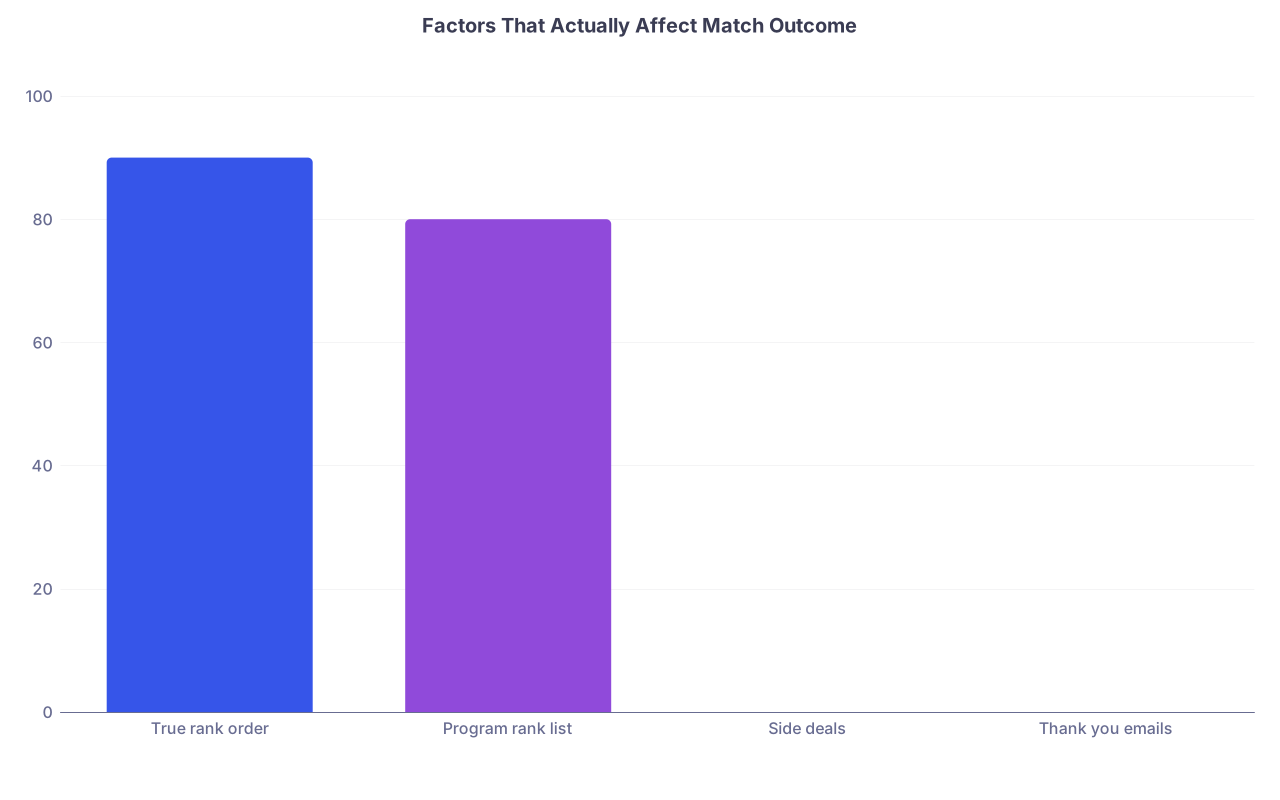
| Category | Value |
|---|---|
| True rank order | 90 |
| Program rank list | 80 |
| Side deals | 0 |
| Thank you emails | 0 |
Side deals and weird emails? They don’t change how the algorithm runs.
Your best strategy is boring and effective:
- Be honest on your rank list.
- Communicate interest without entering agreements.
- Let the algorithm do its job.
When Your Anxiety Says “Just Tell Them What They Want”
That’s the real enemy here: your fear that saying “no” will blow your chances.
I’ve watched applicants cave to pressure emails. I’ve watched others hold the line with the kind of scripts above. Over time, the ones who protect themselves do not match worse. But the ones who over‑promise end up in moral knots, worried they “lied,” or exposed if an investigation happens.
If a program only wants you if you’re willing to skirt rules, that’s not a healthy place to spend the next 3–7 years of your life.
You can be enthusiastic. You can be clear that you’re very interested. Just don’t sell your integrity—or your NRMP record—for a pseudo‑commitment that the algorithm doesn’t even use.
FAQs
1. Is it an NRMP violation if I tell more than one program they’re my “top choice”?
No. The NRMP doesn’t police your adjectives. Is it misleading? Yes. Is it smart? Usually not. Programs do talk, especially in small specialties or regions. If two PDs compare notes and both think they’re your “top choice,” you look dishonest. A safer approach: reserve “top choice” for one program if you really mean it, and use “very highly” or “very interested” for others.
2. Can I change my rank list after I’ve told a program they’re my top choice?
Yes. You’re allowed to change your mind until you certify your list. The NRMP cares about what’s on your certified list, not what gushy email you wrote two weeks earlier. That said, don’t throw around “top choice” casually. Use it sparingly, and only when it’s true at that point in time. Your email is not a contract, but your integrity still matters.
3. What if a program explicitly writes “This is not an attempt to violate NRMP rules” and then asks for a commitment anyway?
Slapping that sentence on doesn’t magically make their request compliant. If they still ask you to commit to ranking them #1 or promise to rank you to match, the substance is the problem, not the disclaimer. Treat it exactly the same way: respond with one of the NRMP‑safe scripts, reiterate that you’ll submit your list through the NRMP, and, if the pressure continues or feels threatening, consider talking to your dean’s office or reporting to NRMP.
Open your email drafts right now and paste in the script that fits your situation. Edit the program name and one specific detail from your interview day. Then send it—and move your energy back where it belongs: building a rank list that reflects what you actually want.


