

The quickest way to get in real trouble with the Match is to switch specialties mid-cycle and pretend the NRMP rules do not apply to you.
They do. And programs will report you if you cross the line.
If you’re thinking about pivoting specialties this season—after you’ve already applied or interviewed—you’re in a high‑risk zone. You have more constraints than most applicants, but you still have options. The key is knowing exactly what you can and cannot do under NRMP policy, and then staying ruthlessly inside those lines.
What follows is a practical, situation-based compliance checklist. Not theory. What to actually do when you’re three interviews into General Surgery and suddenly realize you belong in Anesthesiology. Or you’re already signed to a program and want out.
First: Know Which Situation You’re Actually In
Before you touch ERAS, email a PD, or mention anything to a friend, you need to classify your scenario. NRMP rules change depending on where in the process you are.
Here are the main buckets people fall into:
| Status | What It Means | NRMP Risk Level |
|---|---|---|
| Not registered | You haven’t signed NRMP agreement | Low |
| Registered, no rank list yet | You signed NRMP but haven’t certified a list | Moderate |
| Certified rank list (pre-Match) | You’re fully bound to results | High |
| Matched this year | Contractually bound for PGY-1 | Very high |
| In training now | Already under contract in a program | Very high |
Now layer your specialty situation on top:
- Category A: You want to apply to a second specialty this same cycle, in addition to your original one.
- Category B: You want to abandon your original specialty and switch to another this cycle.
- Category C: You want to leave a program you’ve already matched to (or started) and re-enter the Match.
Different rules. Different landmines. I’ll walk through each.
Step 1: Understand the NRMP Rules That Actually Matter Here
You do not need to memorize the whole NRMP rulebook. But there are a few rules that will wreck you if you ignore them.
Core NRMP concepts you must respect
Match Participation Agreement (MPA)
Once you register for the Match and click through that long agreement, you’ve accepted legally binding terms. This is not “terms of service” you can ignore. Program directors and GME offices know it very well.You cannot back out of a matched position without a formal NRMP waiver
If you match and then just… fail to show up in July? That’s a reportable violation. Same for starting and then leaving to jump into another program via Match without a waiver.No “secret deals” or guarantees outside the Match
Programs can’t promise you a spot if you rank them first. You can’t promise you’ll rank them first in exchange for anything. Same applies when you’re jumping specialties. Back-channel “we’ll take you if you drop your other specialty” conversations are dangerous if they cross the NRMP line.You can apply to more than one specialty in one cycle
NRMP doesn’t care what you apply to or how many specialties. They care about how you conduct yourself once you’re in the Match and once you bind yourself with a rank list.Once matched, NRMP can sanction you for violations
Sanctions can include: being barred from future Matches, flagged in the R3 system, your med school being notified, your program notified. I’ve seen people spend years digging out of this hole. It’s not theoretical.
Step 2: If You Haven’t Registered for the Match Yet
You’re in the easiest situation.
Maybe you applied to IM early, started interviews, and now realize you want EM instead—and you haven’t actually registered with NRMP yet.
Here’s your compliance checklist:
You can:
- Apply to a new specialty through ERAS.
- Cancel or accept existing interviews in your original specialty.
- Register for the Match later and rank any combination of programs you’ve interviewed with.
You must:
- Be honest during interviews. Do not tell a program they are your “top choice IM program” when you’re already half-committed in your mind to EM.
- Avoid any promises about rank order.
You do not need:
- A waiver.
- NRMP permission.
The only real risk here is reputational, not regulatory. But reputational damage is enough. Small specialties talk.
Step 3: Registered for the Match, But Haven’t Certified a Rank List Yet
This is where most mid-cycle switchers are when panic sets in.
What you are allowed to do
You can:
- Apply to an entirely new specialty through ERAS.
- Keep or cancel your existing interviews.
- Attend interviews in both specialties.
- Ultimately decide to rank:
- Only your new specialty,
- Only your old specialty, or
- A mix of both.
NRMP does not restrict your specialty mix on your rank list. You can rank Psychiatry and Radiology and OB/GYN all on the same list if you interviewed there. It might confuse your story, but it doesn’t violate rules.
What you must not do
Here’s where people slip into NRMP violation territory:
- You cannot:
- Withdraw from the Match entirely in order to take a promised off-cycle spot that should properly go through the Match, if that involves breaking the spirit of NRMP rules.
- Negotiate “if you rank me number 1, I’ll rank you number 1” deals.
Also, once you’re registered:
- Do not misrepresent your intentions to programs in writing.
Saying “I will be ranking you first” to multiple programs is not only unethical but can be interpreted as bad faith use of the Match.
Practical move if you’re pivoting specialties here
- Add the new specialty on ERAS.
- Let some—but not all—original specialty programs go if you’re clearly done with that path.
- In interviews for the new specialty, say something like:
- “I started the season in [Specialty A] because of X. Over the last [rotation/experience], I realized [Specialty B] is a better fit because Y. I’m now focusing my list on programs in [B], and I’m being very deliberate about where I interview.”
- Don’t submit a rank list until you’re clear on your plan.
You still have flexibility. Use it without lying.
Step 4: If You’ve Certified a Rank List and Now Want to Switch
This is where it gets ugly.
Once you have certified a rank list, you are bound to accept your match result. You do not get to:
- Change specialties this cycle after the list deadline, or
- Decide on Match Day that you don’t like what you matched to and jump to something else.
NRMP compliance here is simple but brutal:
You must:
- Accept whatever you match into.
- Honor the contract for the full first year (usually PGY‑1), unless you obtain an NRMP waiver.
You cannot:
- Ask another program in a different specialty to “hold a spot” for you if you break contract or don’t show up.
- Secretly plan to no-show and then scramble into something else.
If you’re truly in crisis before the rank list deadline, you need to either:
- Re-do your rank list to reflect your true preferences (even if that means ranking only prelim or transitional programs), or
- Withdraw from the Match entirely before the certification deadline and pursue non-Match options. But that comes with its own chaos.
Step 5: If You Already Matched and Now Want to Switch Specialties
Now we’re in high‑risk NRMP territory.
You matched last March into, say, Pediatrics. You’ve started your PGY‑1 year. It’s October. You now want to switch to Anesthesiology next cycle.
Here’s the rule: you cannot re-enter the Match for a new residency position without a waiver from NRMP if you are still under contract to your current program.
The waiver reality check
The NRMP waiver is not a casual form. It’s a formal process and they grant them for specific reasons:
- Serious health issues.
- Unanticipated personal or family circumstances.
- Situations where the program cannot provide required training.
They are less sympathetic to:
- “I changed my mind.”
- “I like procedures more than clinic.”
- “I don’t get along with my PD.”
Not impossible. But not easy.
The compliant path if you want to switch after matching
Have a brutally honest conversation with yourself.
Is this truly a speciality misfit, or a bad rotation, bad attending, or intern-year fatigue?Talk confidentially to someone who knows NRMP rules.
Ideally:- Designated institutional official (DIO) at your hospital.
- GME office.
- A trusted faculty advisor outside your program. Do not start by making threats or ultimatums to your PD.
Figure out timing for Match re-entry.
There are three generally compliant routes:Route 1: Complete your current contract year, then re-apply
You finish PGY‑1 in Pediatrics, then apply to Anesthesiology with a start date after your contract ends. Some programs will accept you into PGY‑2; some want you to repeat PGY‑1.Route 2: Obtain an NRMP waiver mid-training
You request release from your current contract so you can enter the Match this cycle. If NRMP grants it, you can apply and rank as normal. If they deny it, you’re still bound to your current program.Route 3: Transfer outside the Match
Rare, but sometimes a spot opens in your desired specialty and a direct transfer can be arranged with both programs and GME approval, usually off-cycle. This is less about NRMP and more about ACGME & institutional rules.
Never, ever no-show on July 1 or walk out without a plan.
That’s how you get reported, sanctioned, and possibly barred from the Match entirely.
Step 6: If You’re Already in Training and Want to Switch Next Cycle (Planned, Not Panic)
This is more controlled.
You’re a PGY‑1 in IM, you kind of know you want to try Derm or Radiology next cycle. That’s not an NRMP emergency yet, but you need to line up your process.
Here’s the clean, compliant approach:
Finish your current contract year unless:
- You obtain an NRMP waiver, or
- You and your program agree on an early release that doesn’t conflict with the MPA.
Align your timeline:
- Check when your current contract officially ends (often June 30).
- Make sure any new program’s start date doesn’t overlap your contract period.
Communicate:
- Eventually you will need your current PD’s or program’s verification of training and possibly a letter. Timing that conversation is delicate but unavoidable.
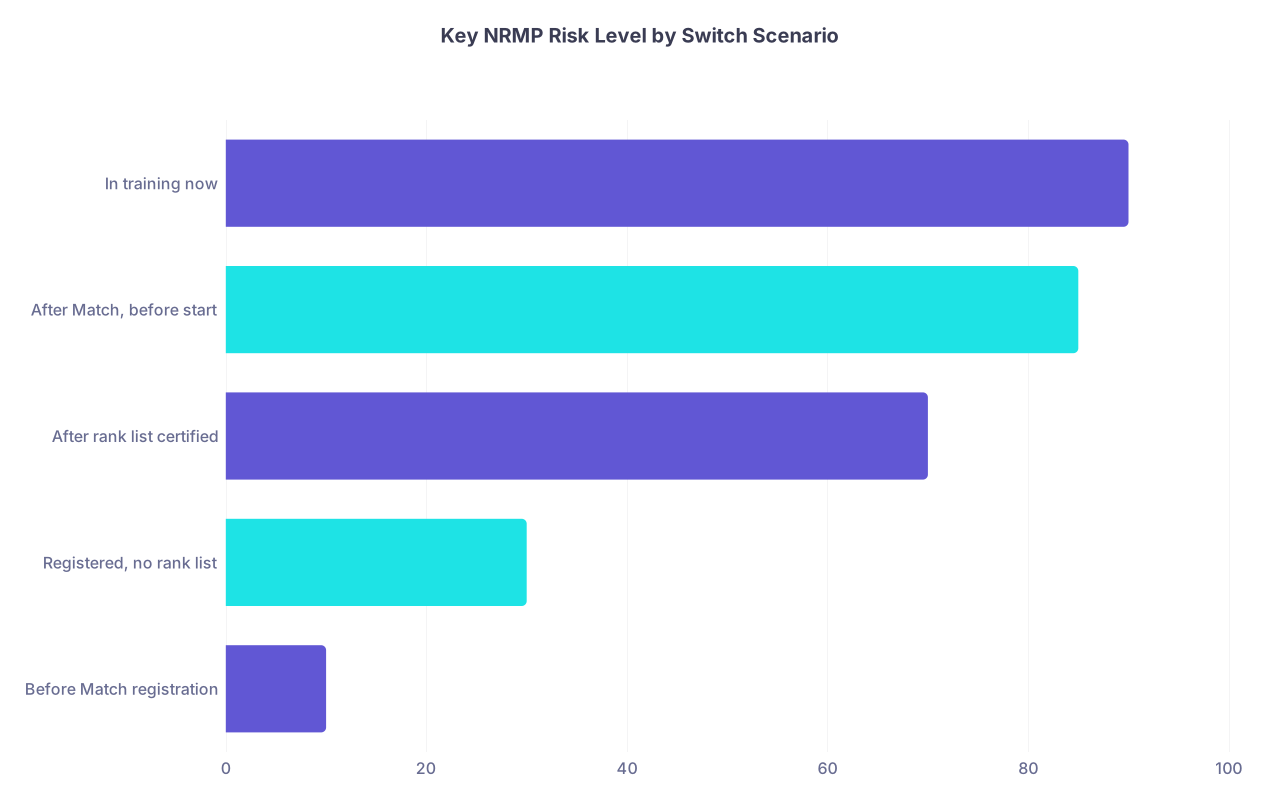
| Category | Value |
|---|---|
| Before Match registration | 10 |
| Registered, no rank list | 30 |
| After rank list certified | 70 |
| After Match, before start | 85 |
| In training now | 90 |
Step 7: Communication Scripts That Keep You Out of Trouble
A lot of NRMP problems start as email problems. People overshare, lie, or accidentally promise things.
Here are straightforward, compliant ways to handle common conversations.
Telling an original specialty program you’re pivoting away
Do not ghost them. You might run into these people at conferences for the rest of your career.
You can say:
“Thank you again for the opportunity to interview. After further reflection and some additional clinical experiences, I’ve decided to focus my rank list on a different specialty this cycle that better aligns with my long-term goals. I’m grateful for your time and consideration and did not want to leave you uncertain about my plans.”
Short. Honest. Not dramatic.
Telling a new specialty program about your switch
Programs do not like hearing: “I realized last week I don’t like Surgery.” They want a more coherent story.
Try:
“I entered the cycle applying to [Specialty A] because I valued [X and Y]. During my sub-internship and early interviews, I realized the parts of the work that energized me most were [Z], which align more closely with [Specialty B]. I’ve since redirected my applications and plan to build my career in [B]. I’m committed to this path and have been intentional about where I’m interviewing.”
You are not required by NRMP to explain every detail of your internal struggle. You just need to be honest enough not to mislead.
Talking to your current PD if you’re already in training
This is the hardest conversation, but avoiding it usually leads to rumors and escalation.
Something like:
“I want to discuss something important with you. Over the past several months, I’ve realized that my long-term clinical interests align more with [New Specialty]. I want to do this in a way that’s professional and compliant with NRMP and institutional rules. I’d appreciate your guidance on how best to approach timing, contracts, and what it would look like if I apply to [New Specialty] for a future start date.”
Do not present it like a done deal or an ultimatum. You’re asking for a path, not announcing a departure.
Step 8: Document What You Do and Who You Talk To
If you’re anywhere near an NRMP gray zone, keep a simple record:
- Dates of key conversations (PD, DIO, GME, NRMP).
- Copies of NRMP communications or waiver decisions.
- Any written agreements from programs about releases or transfers.
You do not need a massive spreadsheet. One text file is enough. But if later someone alleges you broke the rules, having a documented timeline of “I asked, I clarified, I followed instructions” can save you.
Step 9: When You Should Directly Contact NRMP
Most applicants never email NRMP. If you’re switching specialties after matching or while under contract, you might need to.
Contact NRMP directly if:
- You’re considering a waiver to leave a matched position for another specialty.
- You’ve been told you can start in another program while still under contract and it feels off.
- You’re getting conflicting answers from your program and your institution.
Do not email them with vague “hypothetical questions.” Be concrete:
- Your Match year and specialty.
- Your current status (matched, PGY‑1, PGY‑2, etc.).
- What you want to do and when.
- Whether your current program is aware/supportive.
They’re not your therapist, but they will tell you where the guardrails are.
Quick Specialty Switch Compliance Checklist
If you’re mid-cycle and considering a switch, walk through this list:
What is my NRMP status?
- Not registered / registered no rank list / certified rank list / matched / in training.
Am I under any current NRMP binding obligation?
- Matched contract year? In training from a Match position?
Am I planning to enter the Match again for a new specialty while still under contract from a previous Match?
- If yes → you probably need a waiver or carefully timed contract end.
Am I making any promises to programs about rank lists or showing up that I can’t keep?
- If yes → stop. Rewrite your emails. Be non-committal but respectful.
Have I talked to an institutional grown‑up (DIO, GME, experienced faculty) who understands NRMP?
- If not → that’s your next step before making moves.
Do I have a paper/email trail showing I tried to stay compliant?
- Start one now.
The Emotional Side (And How It Affects Compliance)
People blow up their NRMP standing when they act from panic.
- You have a bad month on nights and decide you “hate” your specialty.
- A friend in another field seems much happier.
- A single toxic attending makes you think the entire discipline is broken.
So you look for the fastest escape hatch. That impulse—speed over structure—is exactly what the Match system is designed to prevent.
I’m not telling you to stay in a specialty that’s wrong for you. I’m telling you to:
- Decide deliberately.
- Move on a clear timeline.
- Use official channels.
You can absolutely rebuild your path. Plenty of excellent physicians switched fields. Many did so within NRMP rules and are now attendings who barely talk about their first specialty.
The ones who ignored the rules? They’re the cautionary stories PDs tell in closed-door meetings.
Final Hard Truths (So You Don’t Get Burned)
If you’re switching specialties mid-cycle, here’s what matters most:
NRMP cares less about your indecision and more about your integrity.
You’re allowed to change your mind. You’re not allowed to break binding commitments or cut side deals.Once you’re matched and under contract, your freedom to jump is limited.
Waivers are possible but not guaranteed. Plan your switch on a realistic timeline—often one year out.Communication and documentation are your safety net.
Talk to your GME/DIO, be honest with programs, keep a simple record of what you were told and when. That’s how you stay on the right side of NRMP—and keep your future options open.


