

43% of residents who report NRMP violations never realize that they could be sanctioned along with the program.
That gap—between what people think the National Resident Matching Program (NRMP) polices, and what it actually does—is where careers get burned. Quietly. Sometimes permanently.
Let me break this down specifically: the NRMP punishes institutions and individuals differently, under different parts of its policies, and the fallout for you as an applicant is not symmetrical at all. You can walk away with a clean conscience and still end up with a contract voided, a multi‑year Match ban, and a “Match Policy Violation” letter following you to every program director who ever reads your file.
You need to know the difference between institutional vs individual NRMP violations, who gets punished, and how that punishment really plays out on the ground.
1. The NRMP Rulebook: Who Is Actually Bound By What
First, the architecture.
The Match is governed by two core agreements:
- Match Participation Agreement for Programs and Institutions
- Match Participation Agreement for Applicants
Each side—institutions and applicants—signs its own legally binding contract with the NRMP. That is not just a formality. It is the foundation for how sanctions get applied.
Who counts as “institutional” vs “individual”
Institutional parties under the NRMP include:
- Sponsoring institutions (teaching hospitals, health systems)
- Programs (e.g., “Internal Medicine – University Hospital Program 140-12-21-123”)
- Program directors and institutional officials acting in their official capacity
Individual parties include:
- Applicants (US MD, DO, IMGs, and physician re‑entry candidates)
- Occasionally, faculty or PDs acting as applicants in fellowships
The mistake students make: assuming that if “the program” violated something, only the program is at risk. Not true. The NRMP can—and does—sanction both program and applicant for the same incident if each party breached its own agreement.
That is why you never, ever rely on “the program told me it was OK” as protection.
2. The Core NRMP Violations: What Actually Gets People in Trouble
Before you can separate institutional vs individual penalties, you need to know what the NRMP cares about. This is not about clinical performance. It is about process integrity.
At a high level, NRMP violations cluster into:
- Improper offers / acceptances outside the Match
- Contract issues: not honoring a match, coercing resignations
- Premature or prohibited communication about ranking and commitments
- Confidentiality and data misuse
- Match process games: SOAP manipulation, coordinated boycotts, etc.

Typical institutional violations
Common program/institution violations I have actually seen or had reported:
- Asking applicants to commit to rank them first, or promising to rank them first
- Requiring post‑interview “letters of intent” as a condition for ranking
- Withholding a contract after Match Day or altering key terms (salary, start date, position type)
- Pressuring a matched applicant to resign before starting so the program can fill the slot with someone else
- Making pre‑Match offers in “All-In” specialties or violating the All-In Policy in other ways
- Interview day scripts or emails that obviously violate “no commitments” rules (“If you tell us you will rank us highly, we will do the same”)
All of those fall primarily on the institution, though individual PDs can get named.
Typical individual (applicant) violations
On the applicant side, the patterns look different:
- Signing/accepting a position outside of the Match in a Match‑participating program in violation of the rules
- Failing to start a matched position without a waiver
- Starting but then walking away from a matched position without proper NRMP waiver
- Submitting false information during registration (graduation status, prior training, ineligibility)
- Unauthorized sharing or misuse of NRMP data (e.g., taking screenshots of rank lists or outcome lists and distributing them)
So: same ecosystem, different landmines.
3. Enforcement Logic: How the NRMP Decides Whom To Punish
The NRMP does not think in terms of “who is more at fault.” It thinks in terms of “who violated their signed agreement.” Those are different questions.
Parallel tracks: institutional vs applicant enforcement
The NRMP maintains separate violation processes:
- Institutional violations → reviewed by the NRMP’s institutional review bodies, sanctions applied to programs and/or sponsoring institutions.
- Applicant violations → reviewed by the NRMP Violations Review Committee (VRC), sanctions applied directly to individuals.
For a single event—say, a program pressures an applicant to withdraw after the Match—this can produce:
- An institutional violation (program tried to circumvent the binding nature of the Match)
- An individual violation (if the applicant actually withdraws without a waiver, or colludes in an improper arrangement)
Applicants often think: “I was pressured, so I am safe.” That is not how contract law works, and the NRMP process is closer to a quasi‑legal administrative proceeding than a counseling session.
The NRMP will look at:
- Who signed what
- Who took which actions
- Whether each party had reasonable knowledge of the rules
“I did not read the agreement” carries zero weight. You clicked “agree” at NRMP registration. You are held to it.
4. Institutional Violations: What Programs Actually Face
Let us get concrete. What happens when a program breaks the rules?
| Sanction Type | Practical Effect |
|---|---|
| Match Participation Bar | Program cannot participate in upcoming Match cycles |
| Length of Bar | Often 1–3 years, sometimes limited to a specialty or track |
| Public Listing | Program listed on NRMP site as having violated policy |
| Remedial Action | Required policy changes, training, or monitoring |
| SOAP Restrictions | Limits on participation in SOAP for a period |
1. Participation bar
The heaviest hammer: banning the program from participating in the Match for a defined period.
I have seen:
- 1‑year bars for relatively contained but clear violations
- 2–3‑year bars when there is a pattern or blatant disregard
- Specialty‑specific bars: e.g., the categorical IM program barred, but prelim surgery unaffected
This is not theoretical. Programs suddenly discover they cannot list positions in the next NRMP cycle, scramble for alternative pathways, and watch their reputation tank.
2. Public violation report
The NRMP publishes sanction summaries on its website. Program names, institution, and the nature of the violation.
Program directors hate this more than they admit. Applicants, especially those clued‑in, search those lists. A “Match policy violation” tag makes recruitment harder for years, even after the bar is lifted.
3. Conditional participation and monitoring
Sometimes the NRMP lets a program continue in the Match but under conditions:
- Mandatory training on Match rules for PDs and GME staff
- Submission of revised communication templates (interview invites, post‑interview letters)
- Periodic reporting or audits
From the inside, this feels like probation. PDs get skittish. Institutional officials start hovering over every applicant email.
Do institutional sanctions hurt current or prior residents?
Indirectly, sometimes. For example:
- If a program is barred, they may shrink size, cut tracks, or merge services
- Funding may be reallocated; leadership might be replaced abruptly
- The program’s external reputation dips; fellowship directors gossip
But: the NRMP does not “unmatch” already matched residents because of institutional violations. Your existing contract stands unless the program breaches it separately.
5. Individual Violations: What Happens to You
Now the part you actually care about.
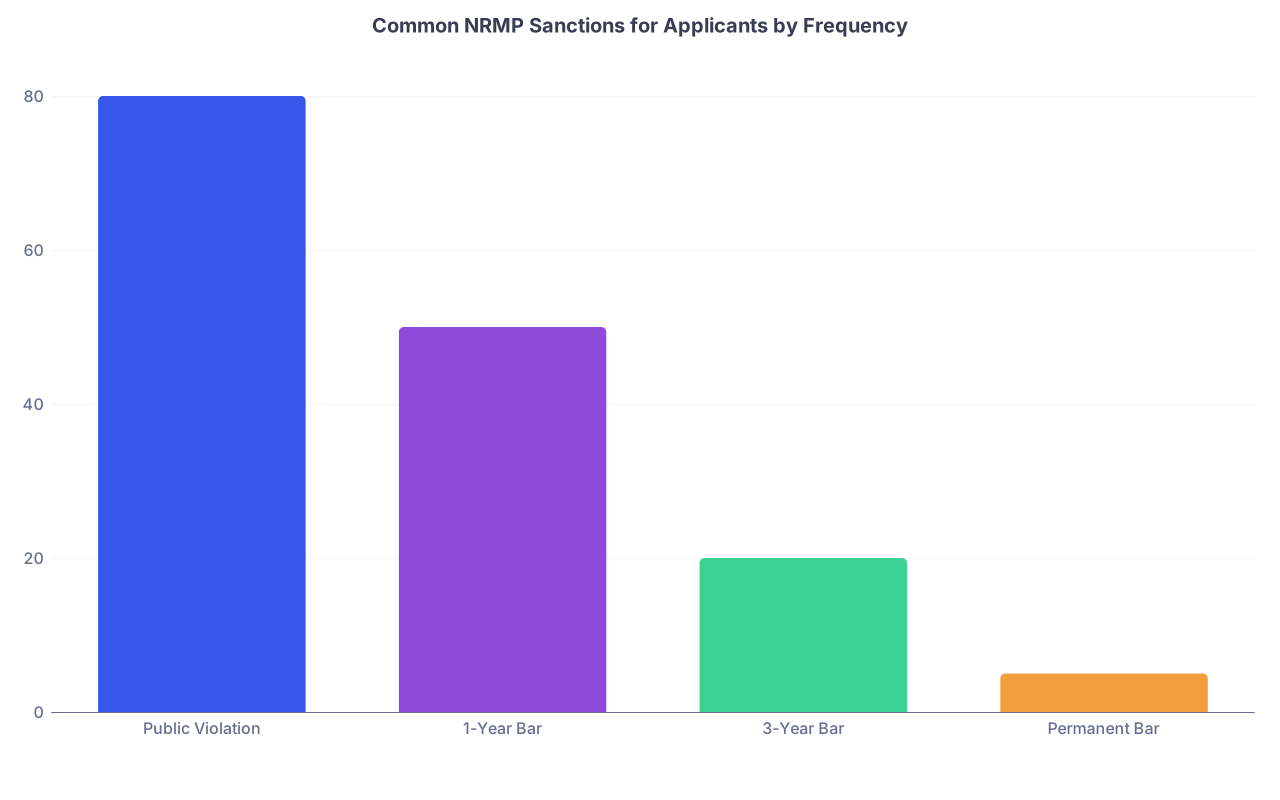
| Category | Value |
|---|---|
| Public Violation | 80 |
| 1-Year Bar | 50 |
| 3-Year Bar | 20 |
| Permanent Bar | 5 |
The NRMP VRC can impose a range of sanctions on individuals. The main categories:
1. Match participation bar (time‑limited or permanent)
The most obvious one: you may be prohibited from participating in:
- All NRMP Matches
- Or specific Matches (e.g., fellowship vs residency)
for a set number of years, or permanently in extreme cases.
Typical ranges I have seen:
- 1‑year bar: first‑time, single‑event violation with some mitigating factors
- 3‑year bar: walking away from a matched position without waiver, or serious misrepresentation
- Permanent bar: egregious, repeated, or fraudulent behavior
If you are a graduating MS4 and you earn a 3‑year bar, that can mean: no NRMP residency until three cycles later. Yes, that can end a career before it starts.
2. Public policy violation annotation
The NRMP publishes individual violation decisions with:
- Your name
- Medical school
- Year of graduation
- Nature of violation
- Length and type of sanction
Programs absolutely search this list. I have sat in rank meetings where PDs pulled it up on the projector. A public NRMP violation is a huge red flag for future training applications, even after a bar expires.
3. Communication to future programs
The NRMP can (and often does) notify programs or institutions when you match later that you had a prior violation.
So you do not just “serve your time” and reset. It shadows you:
- ERAS asks about prior NRMP violations
- Credentialing forms ask
- PDs ask you to “explain what happened”
A credible, coherent story can salvage things. But the hill is steeper.
4. Impact on current match outcome
For active cases decided close to Match Day, the NRMP can:
- Invalidate your rank list in that Match
- Void an obtained position if the violation undercuts the integrity of the match agreement
This is less common but very real. Usually tied to situations like:
- Simultaneous acceptance of out‑of‑Match positions that are prohibited
- Misrepresentation that rendered you ineligible for that Match
6. Concrete Scenarios: Who Gets Punished and How
This is where people get tripped up. Let me walk you through specific, realistic cases and exactly how the NRMP looks at them.
Scenario 1: “Rank us first and we’ll rank you first”
You are on a cardiology fellowship interview. The PD says over lunch:
“If you can promise you will rank us number one, we can assure you that you will be ranked to match here.”
Who violated what?
- Institution: Clear violation. Programs are prohibited from requesting or requiring information about applicants’ rank preferences or making contingent rank promises.
- Applicant: If you simply listen and say noncommittal things (“I really like your program”), no violation on your side.
If you, however:
- Agree explicitly, and
- Then alter your behavior with other programs (“I told them I would rank them first, so I’m going to tell others I will not rank them high”)
you are still generally not in violation, because the NRMP does not prohibit you from expressing preferences. It prohibits the program from soliciting or conditioning decisions on them.
Likely sanctions
- Program: Could face a citation and possible Match participation bar (depending on pattern and evidence). PD may be required to undergo education; there might be institutional monitoring.
- You: No NRMP penalty as long as you did not engage in something like collusive withdrawal or false statements in the process.
Key point: Program at risk. You are okay, unless you cross into more formal misconduct.
Scenario 2: Reneging on a Match to take a different job
You match into a categorical IM residency in City A. Two weeks later, a program in your home city (that did not rank you) offers you a “prelim + future categorical promise” if you will back out of your current match.
You accept and send a resignation letter before even starting in City A.
Who violated what?
- You (individual): You violated the Match Participation Agreement by failing to honor the binding commitment to start training at your matched program and complete at least 45 days (unless waived).
- Home city program: If they are NRMP‑participating and used an out‑of‑Match arrangement to circumvent the process, they also violated the program agreement.
The original matched program did not violate anything. They are the injured party.
Likely sanctions
For you:
- 1–3 year Match participation bar, often 3 years for walking away without waiver.
- Public listing with details of the violation.
- Requirement that any future Match participation is reported with your violation history.
For the home city program (if they are under NRMP jurisdiction):
- Match participation bar (length depends on prior behavior and scope)
- Public program violation listing
- Potential conditions on future participation
This scenario is where applicants often try to argue “but I had strong personal reasons.” The NRMP does allow for waivers before you break the contract. You must apply for a waiver and receive NRMP approval first. Skipping that step is the violation.
Scenario 3: Program pushes you to resign after starting
You started at your matched surgery program. After two months, they decide they overmatched or “fit is not right” and ask you to resign “voluntarily” so they can open your slot in SOAP next year.
They hint that if you agree, they will “support your future applications.”
Who violated what?
- Program: This is dicey. If the program is pushing you out for non‑performance reasons or as a way to game the Match, they may be skirting NRMP policy and ACGME/ACGME‑RRC expectations.
- You: If you resign under pressure without seeking a waiver, you have technically left your matched position before completing 45 days / without approved waiver.
From the NRMP’s perspective, the key question: was there a valid waiver process or documented just cause for termination?
Likely sanctions
- If the program constructs a performance‑based termination that holds up under institutional review, the NRMP may not sanction them.
- If it looks like a pretext to free a spot or avoid their obligations, the program risks an institutional violation.
- For you, if you can show that you were pushed to resign and you promptly sought guidance from NRMP / your dean / GME office, you are in a better position. But if you quietly sign papers and walk away, you may still be viewed as having breached your agreement.
This is where you must stop, get advice, and potentially contact the NRMP before signing anything.
Scenario 4: SOAP games – parallel offers and commitments
During SOAP, you receive multiple offers in different waves. A program calls and says:
“We need to know right now if you will accept. If you say yes, we will tell other programs we are done.”
You verbally accept, then later accept a different SOAP offer because you think “nothing is official until I click in ERAS/NRMP.”
Who violated what?
- You: If you accepted an offer in the NRMP system, that is binding. Accepting a second offer violates the rules. Even a clear verbal acceptance that leads the program to stop offering may be considered in bad faith if documented.
- Program: Programs must follow SOAP procedures; they cannot require commitments outside the NRMP SOAP acceptance system. If they are pressuring you outside of official means, they can also fall into violation territory.
Likely sanctions
- You: Very likely an applicant violation if you accepted and then reneged in the formal SOAP portal. Match bar and public listing are realistic.
- Program: If they deviated from official communication and offer processes, they may face institutional sanctions as well.
Again: the NRMP does not care that “the program started it.” It cares what you did after you knew (or should have known) the rules.
7. How Investigations Actually Unfold
People imagine NRMP enforcement as some mysterious black box. In reality, there is a defined sequence.

| Step | Description |
|---|---|
| Step 1 | Possible Violation Reported |
| Step 2 | NRMP Initial Review |
| Step 3 | Case Closed |
| Step 4 | Information Gathering |
| Step 5 | Notify Parties |
| Step 6 | Written Responses |
| Step 7 | Committee Review |
| Step 8 | Case Closed - No Action |
| Step 9 | Sanction Decision |
| Step 10 | Notification and Publication |
| Step 11 | Jurisdiction? |
| Step 12 | Violation Found? |
Step 1: Report
A violation gets reported by:
- Applicants (often through their dean’s office)
- Program directors or GME offices
- NRMP internal audits (less common)
Anonymous reports are possible but harder to act on.
Step 2: Jurisdiction check
NRMP asks:
- Did the incident occur during a Match that falls under NRMP?
- Were the involved parties signatories to the appropriate Match Participation Agreements?
If yes, case proceeds. If no, NRMP may still provide guidance but not sanctions.
Step 3: Requests for information
NRMP contacts:
- The applicant(s)
- Program director(s)
- Institutional official(s)
They collect:
- Emails, letters, contracts
- Timelines of events
- Any internal institutional documentation
You are given a chance to provide your side. If you ignore this or provide vague responses, do not expect sympathetic treatment.
Step 4: Committee review and decision
- Applicant cases → Violations Review Committee (VRC)
- Institutional cases → relevant institutional oversight committees
They determine:
- Was there a violation?
- Who violated which clauses?
- What sanctions are proportionate given precedent?
Step 5: Appeal (limited)
You can appeal, but the grounds are narrow (procedural error, new material evidence, etc.). “I do not like the outcome” is not grounds.
8. Practical Survival Guide: How Not To Become a Case Example
You are not going to memorize every clause of the Match Participation Agreement. You do not need to. But you do need a few hard rules.
, Saying a program is your top choice, Signing an outside contract with a Match program, Walking away after matching, Accepting two SOAP offers](https://cdn.residencyadvisor.com/images/articles_svg/chart-risk-level-of-common-nrmp-situations-for-applicant-2358.svg "Risk Level of Common NRMP Situations for Applicants")
| Category | Value |
|---|---|
| [Post-interview thank you notes](https://residencyadvisor.com/resources/nrmp-match-rules/the-post-interview-thank-you-mistakes-that-trigger-nrmp-problems) | 5 |
| Saying a program is your top choice | 15 |
| Signing an outside contract with a Match program | 70 |
| Walking away after matching | 90 |
| Accepting two SOAP offers | 95 |
1. Never sign anything that looks like a position commitment with a Match‑participating program before the Match, without confirming it is allowed
Some pre‑Match positions in non‑NRMP specialties are okay, but:
- Check if the specialty/program is in an “All‑In” policy
- Confirm with your dean’s office or NRMP directly if in doubt
Verbal “we want you here” is fine. Written “we offer you this PGY‑1 spot contingent on you not entering the Match” is a giant red flag.
2. Treat your Match as a binding contract, not a suggestion
Once you match:
- Start the position, complete at least 45 days
- If you absolutely cannot (catastrophic circumstance, family emergency, major mismatch discovered), talk to NRMP and your school/GME office about a waiver before you resign or accept anything else.
Going silent, no‑showing, or informally “agreeing to leave” with your PD is how you end up on the violation list.
3. Do not rely on “the program told me it was okay”
This is the most dangerous myth.
Programs sometimes:
- Do not understand the rules fully
- Know the rules and choose to dance near the edge
- Assume you know your own obligations
The NRMP will not accept “they said it was fine” as a defense if your actions clearly violated the applicant agreement.
If you are offered something that feels too good or too convenient, you pause. You contact:
- Your student affairs dean
- Your institutional official if you are already a resident
- NRMP support (yes, you can email them anonymously to ask about hypotheticals)
4. Carefully manage email and documentation
If you ever need to defend yourself:
- Keep copies of key emails where programs asked for commitments, pressured you, or offered side deals
- Save the exact wording of SOAP offers and acceptances
- Document dates and times of problematic calls (even in a simple text note to yourself)
This is not paranoid. This is professional self‑defense.
9. Institutional vs Individual: Where the Lines Actually Sit
Let me draw the boundary one more time, clearly.
- If the action is something only a program can do (e.g., altering contracts after Match, making pre‑Match offers, misrepresenting positions listed), that is institutional.
- If the action is something only you can do (e.g., walking away from a matched spot, double‑accepting positions, lying on your NRMP registration), that is individual.
- If the action requires both parties (e.g., a quiet side deal to leave a matched position for another NRMP program), you can both be sanctioned.
Who gets punished harder?
From what I have seen:
- Programs get punished in ways that hurt recruitment and reputation, but they often recover.
- Individuals get punished in ways that can end their ability to enter organized graduate medical education through standard channels.
Programs can wait out a one‑year bar. A fourth‑year medical student with a three‑year bar faces an entirely different mountain.
That is why your threshold for risky behavior must be far lower than the program’s. They have more cushion. You do not.
10. Red‑Flag Phrases You Should React To Immediately
You will hear a lot of scripted nonsense during interview season. Some of it is fine. Some of it is NRMP‑violation adjacent.
Phrases that should make you stop and think (and maybe document):
- “If you can commit to ranking us first, we can guarantee you a spot.”
- “We need to know if you will rank us highly before we decide where to put you.”
- “Let us know if you plan to rank us low so we do not waste a rank.”
- “If you withdraw from your matched position, we will make sure you have a spot here.”
- “Sign this letter confirming you will rank us first; it’s just part of our process.”
If you see those, the program is flirting with or crossing into violation territory. If you engage in a way that changes your contractual commitments, you can now be pulled in.
11. Final Distinctions You Should Not Forget

Let me strip this down to the essentials you should carry into your Match season and early residency.
The NRMP has separate agreements and enforcement tracks for institutions and individuals. Programs can violate their side, you can violate yours, and you can both be sanctioned for the same episode.
Institutional sanctions mostly hit program participation and reputation. Individual sanctions hit your ability to enter or re‑enter the Match and follow you publicly for years.
“The program told me it was okay” is not a defense. Your safest move whenever something feels off is to pause, get an independent opinion (dean, GME office, NRMP), and avoid signing or accepting anything until you understand your obligations.


