

The idea that “everyone breaks NRMP rules a little” is a lie people tell themselves when they are scared.
Not a gray area. Not “how the game is really played.” A straight-up myth that survives because most applicants do not actually know what the NRMP enforces, how they enforce it, and what happens when someone files a complaint.
If you’re in the middle of residency applications, you’re probably hearing some version of this:
- “Just tell them they’re your number one; everybody does it.”
- “Programs always pressure for a commitment; that’s just how it works.”
- “Handshake deals aren’t real violations. It’s fine.”
- “Nobody reports anything. The NRMP is toothless.”
Wrong, wrong, wrong, and wrong.
Let’s dismantle this systematically and replace the folklore with what the data and enforcement history actually show.
What NRMP Rules Actually Say (In Plain English)
Before we talk about breaking rules “a little,” you need to know the rules you’re supposedly bending.
The key NRMP Match Participation Agreement terms that matter for you as an applicant:
You are not allowed to:
- Solicit or accept a binding commitment (verbal or written) from a program before the Match.
- Make a binding commitment to any program before the Match.
- Misrepresent your intentions about ranking (e.g., saying “I will rank you #1” when you know you won’t).
Programs are not allowed to:
- Ask you how you will rank them.
- Ask you to commit to ranking them first.
- Say that you must rank them first to be ranked.
- Threaten to rank you low or not at all based on your answers.
Everyone is allowed to:
- Express general interest.
- Tell the truth about preferences if they want to (e.g., “You are my top choice” when it is actually true).
- Send thank-you notes and updates.
- Stay silent about rank intentions.
The core idea: no pre-Match commitments and no coercion. The algorithm is supposed to do its job without you or the program gaming it through promises, threats, or pressure.
“But Everyone Breaks the Rules” – What the Data Actually Shows
People love saying “everyone” to justify their own behavior. The NRMP actually surveys this stuff.
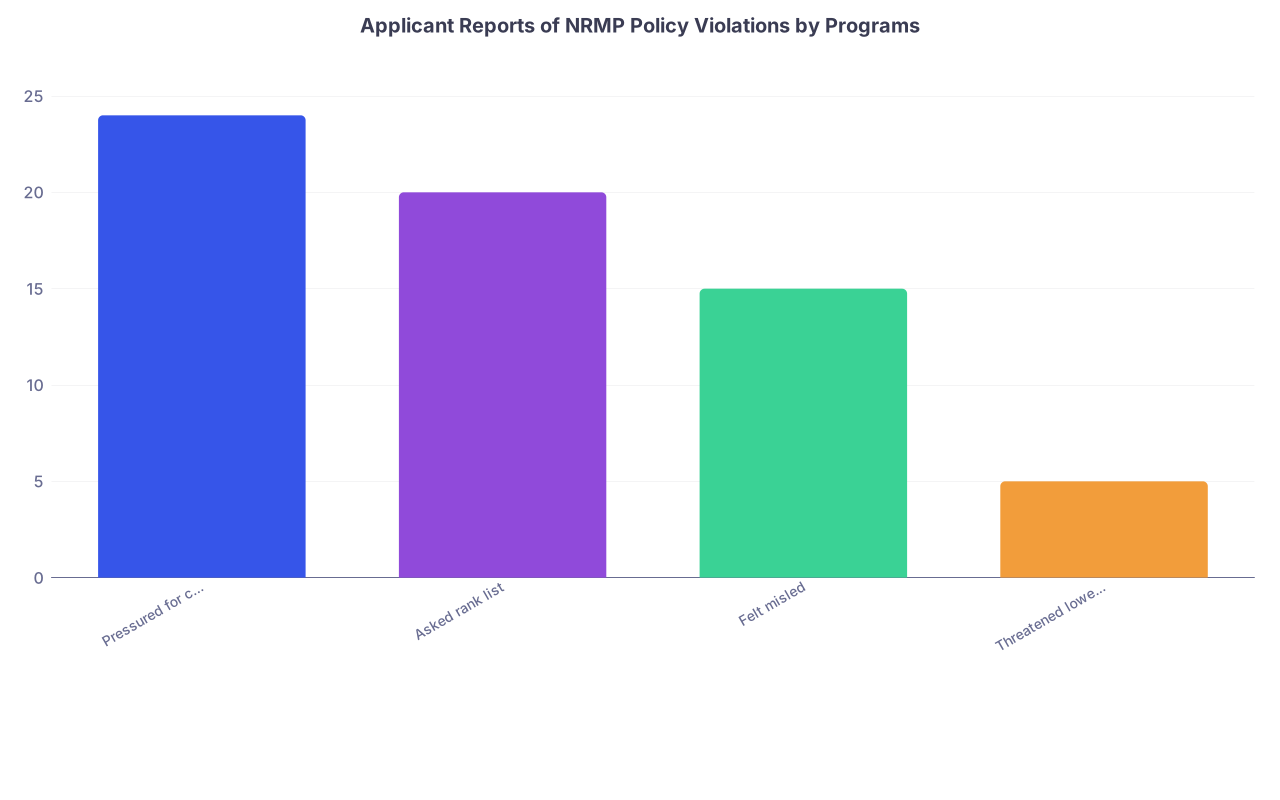
| Category | Value |
|---|---|
| Pressured for commitment | 24 |
| Asked rank list | 20 |
| Felt misled | 15 |
| Threatened lower rank | 5 |
Numbers vary by year, but the pattern is consistent: a minority of programs and applicants report questionable behavior. Not “everyone,” not even close.
NRMP’s “Program Director Survey” and “Applicant Survey” regularly show:
- A noticeable but not universal group of applicants report:
- Being asked for ranking intentions.
- Feeling pressured to commit.
- A lot of applicants do not experience this.
- A non-trivial number of programs and applicants report that they changed rank lists after post-interview communication. That is not automatically illegal—but coercive communication around those changes often is.
Translation: there are violators; there is pressure. But the claim that “everyone” is cheating the system is mathematically false and ethically lazy.
Most importantly, NRMP logs real violations every single year, and real people pay for them with lost positions, barred participation, or institutional sanctions.
How NRMP Enforces Rules (And Why “You Won’t Get Caught” Is Fantasy)
I’ve heard this line from attendings, residents, and applicants: “Sure, technically it’s a violation, but nobody reports it.” Another myth.
NRMP has a formal violations process. It’s not theoretical; they publish case outcomes.
| Type of Party | Violation Pattern | Typical Sanction Pattern* |
|---|---|---|
| Applicant | Premature contract / off-cycle deal | Banned from NRMP for 1–3 years |
| Applicant | Misrepresentation / falsified info | Match voided, future ban |
| Program | Coercive commitment, rank threats | Public listing, probation |
| Institution | Systematic off-Match agreements | Sanctions, oversight, probation |
| Program | Failure to honor matched contract | Required remediation, sanctions |
*Patterns, not legal guarantees. Details vary case by case.
Key myth-busting points:
- They do investigate. NRMP has a violation-reporting portal and a Violations Review Committee. Complaints trigger document review, emails, phone logs, and interviews.
- They do sanction. Every year, individuals and programs are publicly named in NRMP’s “Violations Report.” It is searchable. Hospitals and GME offices actually read it.
- Evidence is easier than you think.
- Emails.
- Screenshots of texts.
- Notes from calls.
- Multiple applicants reporting the same program pattern independently.
The “they’ll never know” logic is the same logic people use before they’re in a PDF titled Match Violations – Sanctions Summary that lives on the internet forever.
The Most Common Myths About “Little” NRMP Violations
Let’s go myth by myth.
Myth 1: “It’s Fine to Tell Multiple Programs ‘You’re My #1’ – Everyone Does That”
This is the classic applicant-side rationalization.
NRMP’s stance is not ambiguous: knowingly misrepresenting your ranking intentions is a violation. You’re allowed to keep your list private. You’re allowed to say “I’m ranking you very highly” if that’s true but vague. You’re not allowed to lie.
One program? Probably no one will know. But applicants absolutely do get reported when:
- A PD hears from another PD that the same applicant told both programs “you’re my #1.”
- Faculty who rotate at multiple sites talk to each other.
- An applicant brags about “gaming it” in writing (yes, people still put this in emails and group chats).
Does every lie get caught? Obviously not. But “I probably won’t be caught” is a very different claim than “It’s allowed” or “Everyone does it.”
Here’s the real question: are you willing to stake your entire Match on the hope that no one forwards that email?
Myth 2: “Handshake Deals Aren’t Real; They’re Just Verbal, So Not Binding”
Wrong in two ways.
First, NRMP rules explicitly cover verbal commitments. The agreements talk about “statements of intent” and “commitments” broadly, not just signed contracts.
Second, the idea that “verbal isn’t binding” collapses the moment someone reports it. What matters for enforcement is:
- Did a program say or imply: “If you commit to us, we will rank you highly / guarantee a spot”?
- Did you agree to something that functions as a pre-Match contract?
- Is there evidence (email follow-up, notes sent by the program, multiple witnesses)?
I’ve seen applicants told: “If you cancel your other interviews and promise to rank us first, you will match here.” That’s a violation. If reported, that program is in trouble. And the applicant might end up in no-man’s-land if the NRMP decides the match result arises from a tainted process.
The idea that handshake deals are harmless folklore is exactly how people end up with:
- “But I thought we had a deal” on Match Day.
- No recourse, because they broke the rules too by participating.
Myth 3: “Programs Have All the Power; If They Ask, You Have To Answer”
No, you don’t. And the NRMP explicitly backs you up.
Programs are not allowed to:
- Ask you how you plan to rank them.
- Ask you to reveal your full rank list.
- Tell you that you must rank them #1 to be ranked.
If they do, they’re in violation. Full stop.
You’re allowed to respond with:
- “NRMP policy actually prohibits both of us from talking about rank lists or commitments, so I’d rather not go there.”
- “I’m still finalizing my list. I appreciated the interview and I’m very interested, but I’m going to keep my ranking private.”
Will that hurt you at that specific program? Possibly. But think about what you’re saying when you obey: I’ll comply with a program that is already willing to break enforceable rules to get what it wants.
Those are not the people you want controlling your schedule, your letters, and your evaluations next year.
Myth 4: “NRMP Can’t Do Anything After the Match Is Over”
Also false.
NRMP can:
- Void a match if it was obtained through a rule violation.
- Bar an applicant from:
- Future Matches.
- Supplementary Offer and Acceptance Program (SOAP).
- Sanction programs and institutions, including:
- Publication in violation reports.
- Restrictions on future participation.
- Required compliance plans, monitoring, or probation.
They have done all of these things. Some cases have involved off-cycle contracts, pressure to sign non-NRMP agreements, or post-Match manipulation.
The Match is not a one-day event. Your vulnerability to NRMP enforcement spans the entire cycle.
What Actually Is Allowed (That People Confuse With Violations)
Let’s be clear: the NRMP isn’t trying to ban human emotion. A lot of harmless, normal communication gets mislabeled as “against the rules” by anxious students.
You can:
- Send thank-you notes.
- Tell a program: “I really liked your residents and curriculum.”
- Say: “I’m very interested in your program and could see myself thriving there.”
- Respond if a program says: “We were impressed by you and think you’d be a good fit.”
You can even say (if it’s true): “I plan to rank your program first.” The rule is not “never say it.” The rule is “do not lie or solicit commitments.”
The problem is not honesty. The problem is:
- Lying about your intentions.
- Pressuring someone else (or being pressured) to commit.
- Conditioning rank behavior on forbidden questions.
A simple mental test: If the NRMP transcribed this email or call into a public report, would it sound like an attempt to bypass the algorithm?
If yes, don’t do it.
The Real Risks of “Breaking the Rules a Little”
People tend to focus on the headline risk: NRMP investigation and sanctions. That’s real, but there are quieter, uglier consequences that happen far more often.
1. Reputational Burn That Follows You
GME is a small world. Program directors talk. Clerks talk. That APD who heard you lied this year might be on the fellowship selection committee in four years.
You don’t want to be known as:
- “The applicant who told everyone they were #1.”
- “The one who tried to leverage fake offers.”
- “The one who pushed for a side deal.”
Medicine already has enough cynicism. Don’t feed it with your name.
2. Emotional Whiplash on Match Day
The people who suffer the most from rule-bending aren’t usually the ones doing the bending. They’re the ones who believed it.
- Applicants who cancelled other interviews after “you have a spot here” conversations.
- People who ranked a program higher than they wanted because they felt threatened.
- Applicants who relied on promises that were never enforceable.
The Match algorithm rewards true preferences, not bluffing. When you let illegal or unethical communication rewrite your list, you’re gambling with your own future based on someone else’s willingness to lie.
3. Power Imbalances That Get Harder to Escape
If a program is willing to break NRMP rules to get you in the door, what do you think they’ll do with duty hours, evaluations, remediation, or promotion?
You’re getting a preview. Believe it.
How to Stay Aggressive Without Breaking NRMP Rules
You don’t need to passively float through Match season clutching the rulebook. You can be strategic and assertive and still play clean.
Here’s how.
Communicate Interest – Honestly and Precisely
- Use phrases like:
- “You are one of my top choices.”
- “I will be ranking your program highly.”
- “I feel a strong fit with your training model and location.”
- Only say “I will rank you first” if it is 100% true and you’re comfortable explaining that to the NRMP later if needed.
- Never promise multiple programs they’re #1. Ever.
Shut Down Inappropriate Questions
You are allowed to push back. Calmly.
Sample responses:
- “I’ve been advised to keep my rank list private to keep the process fair, but I really appreciated the interview here.”
- “I’m still finalizing my list. I can say that I’m very interested, but I’d like to avoid specific rank discussions because of NRMP guidelines.”
If they keep pressing, that tells you more about them than any resident lunch ever could.
Document Problematic Behavior
If something clearly crosses the line:
- Write down:
- Date, time, and who was present.
- Exact or near-exact language used.
- Save:
- Emails.
- Texts.
- Voicemails.
You don’t have to decide immediately whether to report. But future-you will be grateful to have the record if the pattern gets worse.
Use the Algorithm As Designed
The only “hack” that works is the boring one:
- Rank programs in true order of preference.
- Ignore:
- “We’ll rank you highly if you…”
- “You have a spot if you commit.”
- “We expect you to rank us first if you’re serious.”
NRMP’s own match data and algorithm design back this up. Applicants who play “loyalty games” with their lists lose out more often than they win.
The Quiet Reality: Most People Follow the Rules More Than You Think
The loud voices are usually the ones boasting about bending rules. The silent majority:
- Sends normal, polite thank-yous.
- Keeps rank lists private.
- Rolls their eyes at sketchy emails and moves on.
- Matches just fine without lying to programs or other applicants.
The myth that “everyone breaks NRMP rules a little” survives because:
- The people who got burned are often embarrassed to talk about it.
- The ones who cheated and got away with it love to brag.
- The enforcement actions are public, but most students never read them.
If you actually look at NRMP’s own reports, survey data, and violation publications, you see a much more boring, reassuring picture: a small but real fraction of people misbehave, some get sanctioned, and the system mostly functions when applicants do the straightforward thing—tell the truth, protect their autonomy, and let the algorithm work.
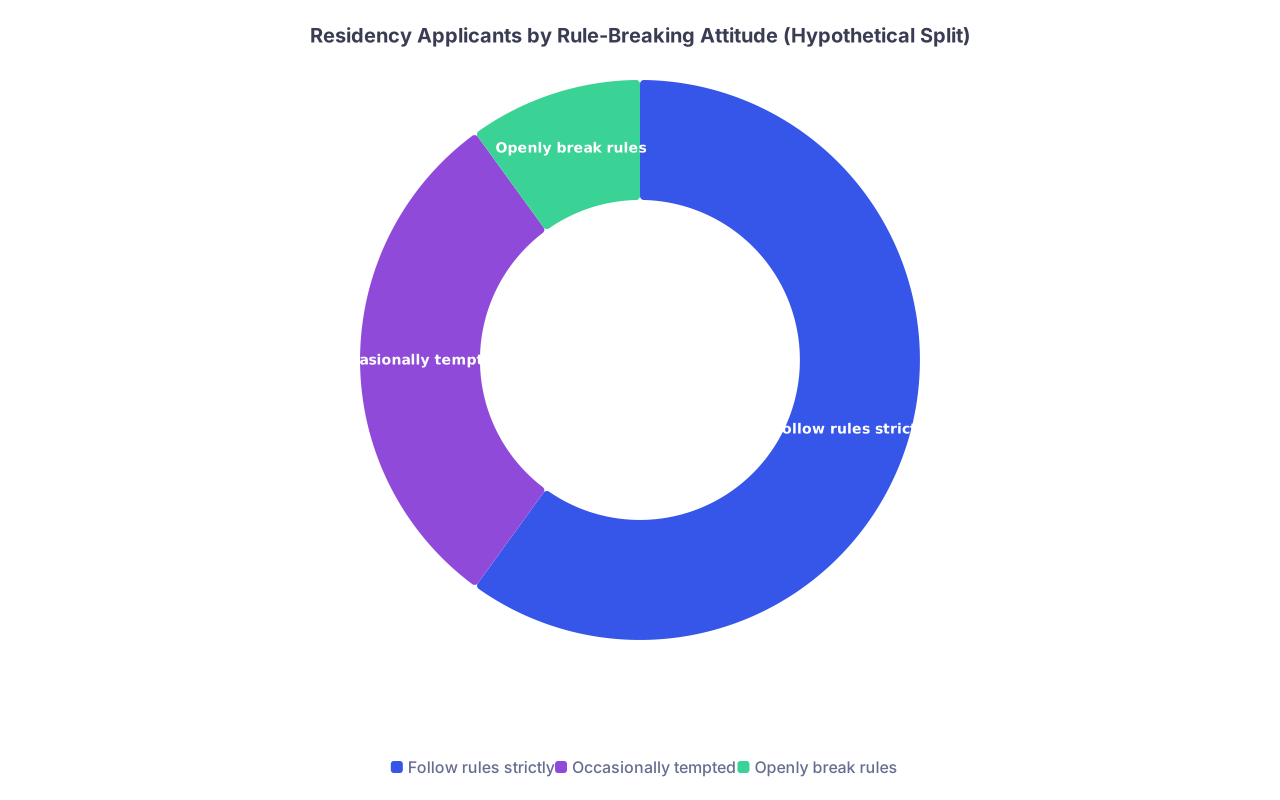
| Category | Value |
|---|---|
| Follow rules strictly | 60 |
| Occasionally tempted | 30 |
| Openly break rules | 10 |
You want to be in the first group. At worst, the second—tempted, but self-controlled. The third group looks clever at brunch and very stupid in an NRMP PDF.
Years from now, you won’t remember the exact wording of that sketchy email or how nervous you were on that one Zoom interview. You will remember whether you could look back at your Match season and honestly say: “I did it the right way, and I didn’t sell my integrity for a slot.”
The rules are not the enemy. The myth that “everyone breaks NRMP rules a little” is.


