
8% of program directors rank the personal statement as the single most important factor in deciding whom to interview.
That is not “fluff.” That is a non‑trivial slice of decision makers putting your 1–2 pages above USMLE scores, clerkship grades, and letters when they choose who even gets in the door.
And that is straight from the NRMP Program Director Survey.
Let’s walk through what the data actually say. Not folklore on Reddit. Not what your classmate’s cousin “heard” from a PD. The numbers.
1. What the NRMP Data Actually Say About Personal Statements
Start with the core question: Do personal statements matter in residency selection?
Yes. Quantitatively, clearly, and in a very specific way.
The NRMP Program Director Survey (2021 and 2022 cycles are similar) asks PDs two separate but related things for each potential selection factor:
- What percentage of programs use this factor in deciding whom to invite for interview?
- For those that use it, how important is it on a 1–5 scale?
Personal statements show up in both columns every year.
Typical numbers across specialties look like this:
| Metric | Value (Approximate) |
|---|---|
| Programs using personal statement in interview decisions | 78–80% |
| Mean importance rating (1–5 scale) | 3.6–3.8 |
| Programs ranking PS as most important factor | ~8% |
| Programs citing PS as a reason to *not* invite | >50% |
| Programs citing PS in rank order list decisions | ~60% |
You can argue about small year‑to‑year variation, but the pattern is stable.
- Around 4 in 5 programs use the personal statement when deciding who to interview.
- They rate it just a notch under core academic metrics and letters.
- A majority explicitly say a poor personal statement can sink an interview offer.
To visualize where the personal statement sits relative to other factors in interview decisions, think of a typical ranking of importance (mean scores):
- USMLE Step 2 CK / COMLEX Level 2
- Letters of recommendation
- MSPE / Dean’s Letter
- Clerkship grades
- Personal statement
- Research experiences
- Class rank
- Extracurriculars
So it is not top‑three overall for most specialties. But it is squarely in the mid‑tier of high‑leverage tie‑breakers.
Here is the relative positioning:
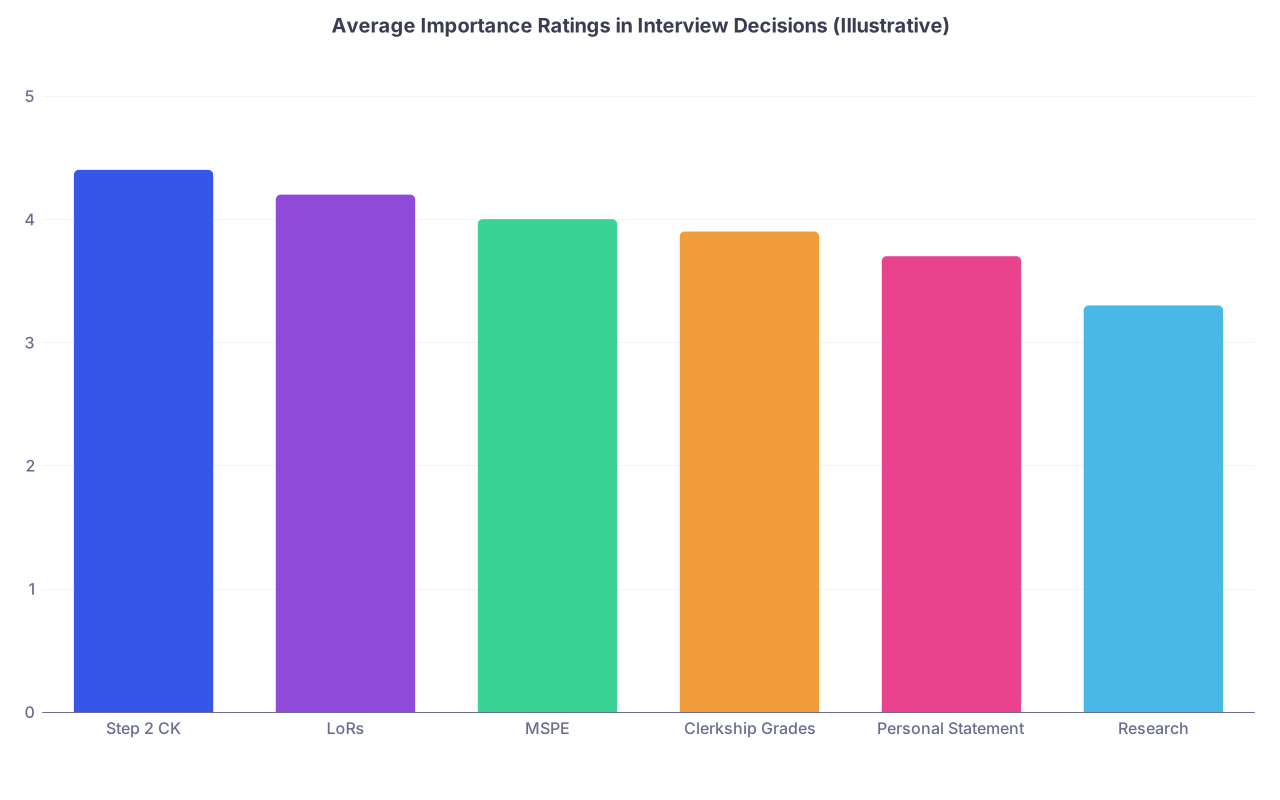
| Category | Value |
|---|---|
| Step 2 CK | 4.4 |
| LoRs | 4.2 |
| MSPE | 4 |
| Clerkship Grades | 3.9 |
| Personal Statement | 3.7 |
| Research | 3.3 |
Are these exact numbers? No. Are they in the right ballpark based on NRMP summaries across multiple cycles? Yes.
The pattern is what matters: the personal statement is not king, but it is not optional decoration either.
2. Where Personal Statements Hit Hardest in the Process
The NRMP surveys separate two decisions:
- Whom to invite for interview
- How to create the rank order list
The personal statement is disproportionately influential in the first decision.
2.1. Interview invitations: the gatekeeping function
Look at the text of the survey comments PDs submit. They use phrases like:
- “Red flags in the personal statement”
- “Generic or plagiarized essays”
- “Poor grammar / lack of professionalism”
The personal statement is often a negative filter more than a positive boost.
A realistic pattern I see in the data and from talking with PDs:
- Baseline pool: Everyone above some score/grades threshold.
- Within this pool, they skim personal statements to:
- Drop the obviously unprofessional.
- Drop people with zero real connection to the specialty.
- Drop applicants with blatant red flags (eg, dishonesty, poor insight).
Only then do they start fine‑grained comparisons.
So, functionally:
- High scores + neutral statement → you likely stay in the pool.
- High scores + bad statement → you get quietly filtered out.
- Modest scores + strong, targeted statement → you sometimes jump ahead of peers with better numbers.
Is that fair? Not particularly. But the point is not fairness; the point is how the system behaves.
2.2. Ranking decisions: tie‑breaker and fit signal
For the rank order list, the NRMP survey shows fewer programs rating the personal statement as “very important,” but a majority still list it as “considered.”
Why? Because by the time they build a rank list:
- They already have interview impressions.
- They have notes on interpersonal skills and professionalism.
- They have letters and institutional reputation.
The personal statement shifts from gatekeeper to consistency check and fit signal:
- Does what you wrote match how you presented yourself in person?
- Does your stated interest in their type of practice (academic vs community, underserved vs affluent, research heavy vs clinical heavy) actually align with their program?
- Do they see evidence of reflection and maturity that supports giving you a residency spot for 3–7 years?
I have sat in meetings where the conversation goes something like:
“Applicant A and B are basically identical on paper. I liked A’s interview a bit more. But B’s personal statement and letters show a much clearer commitment to our patient population. Let’s bump B up a few spots.”
That is the territory where the personal statement actually moves your position.
3. Specialty Differences: Where the PS Matters More (or Less)
The NRMP data break down factors by specialty. The pattern is not identical everywhere.
Some fields rely more heavily on academic metrics. Others care more about narrative evidence of fit. The personal statement’s weight shifts accordingly.
Here is a simplified, pattern‑accurate view of how much programs in different specialties use and value personal statements:
| Specialty | % Using PS for Interview | Relative Importance |
|---|---|---|
| Family Medicine | ~90% | High |
| Psychiatry | ~90% | High |
| Pediatrics | ~85% | Moderate–High |
| Internal Medicine | ~80% | Moderate |
| General Surgery | ~70% | Moderate–Low |
| Diagnostic Radiology | ~65% | Moderate–Low |
And visually:
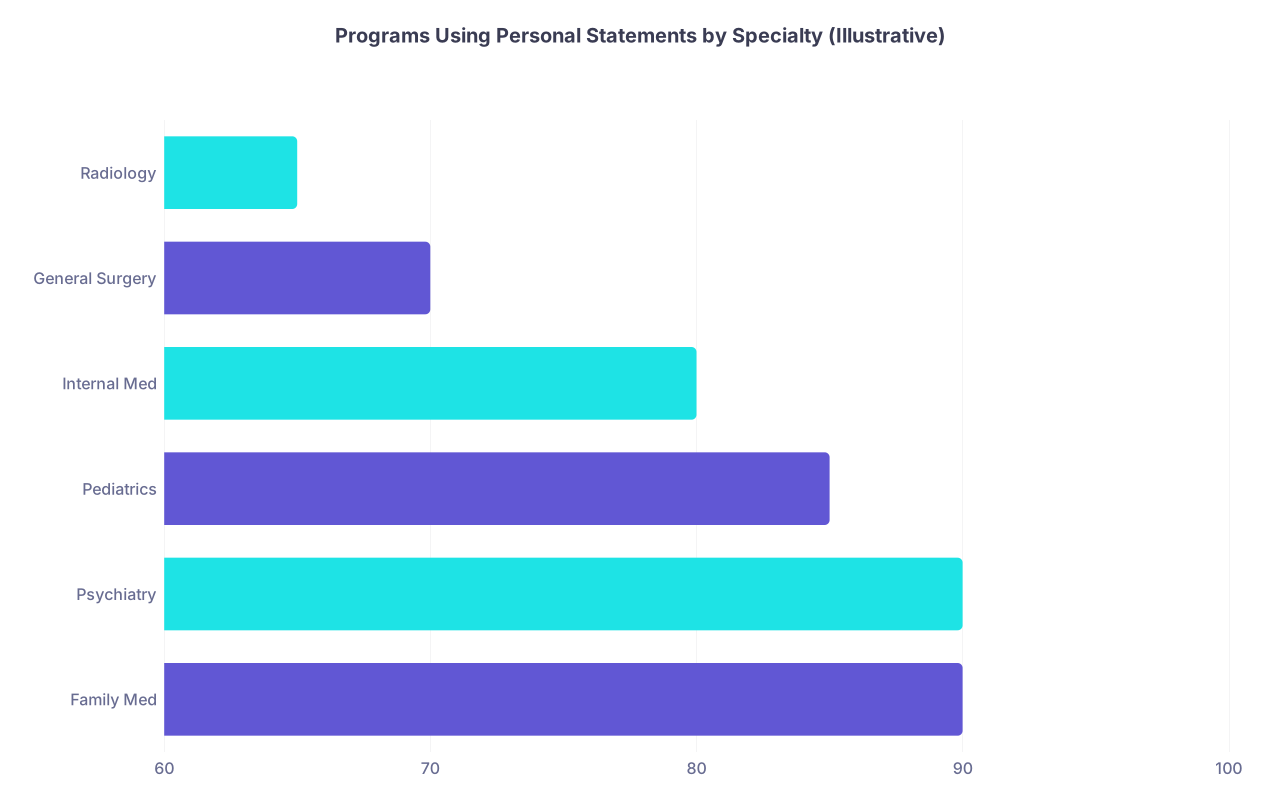
| Category | Value |
|---|---|
| Family Med | 90 |
| Psychiatry | 90 |
| Pediatrics | 85 |
| Internal Med | 80 |
| General Surgery | 70 |
| Radiology | 65 |
Patterns from PD survey data and real conversations:
Primary care and psychiatry
They put a premium on communication, empathy, and long‑term patient relationships. PDs read statements more carefully and interpret them as evidence of:- Commitment to their kind of work
- Understanding of longitudinal care
- Self‑awareness around burnout and emotional challenges
Competitive procedure‑heavy specialties (derm, ortho, ENT, plastics, neurosurgery)
Scores, research, and letters drive most of the decision.
But: When nearly every applicant has 250+ scores and 10+ pubs, the personal statement still becomes a differentiator among the elite. Especially for:- Explaining non‑linear paths
- Showing sustained interest instead of “I decided derm last month”
Radiology, pathology, anesthesia
Historically more “numbers‑heavy.” The PS still matters, but mainly as a sanity check for:- Basic written communication
- Professionalism
- Evidence you actually understand what the specialty does
If you apply in family medicine and mail in a bland, generic statement, you are effectively ignoring one of the top‑tier signals the field says it uses.
If you apply in ortho and mail in a bland statement, you will not torpedo yourself if your metrics are stellar, but you will almost certainly lose tie‑breaks to people with equally good numbers and stronger narratives.
4. What PDs Say They Look For — And What They Penalize
Survey numerics are useful, but the free‑text PD comments and off‑the‑record conversations are more revealing.
I will translate them into three buckets:
4.1. Positive signals (things that actually help you)
The data and PD comments consistently show value in:
Clear, specific specialty motivation
Not “I like helping people” or “I find the brain fascinating.”
Instead: concrete experiences that demonstrate why this specialty, not just medicine, fits.Evidence of reflection and insight
Programs want residents who can analyze their own mistakes and growth.
Statements that show you processed a difficult encounter, system failure, or personal challenge — without melodrama — land well.Connection to the program’s mission or population
If it is an academic research powerhouse, show how your background and goals align with that.
If it is a community program serving a specific population, show experience or intention with similar patients.Coherence with the rest of your file
Your statement does best when it reinforces patterns in your CV, letters, and MSPE.
For example: long‑standing interest in addiction medicine + psych application + addiction‑related research + stories in PS about those patients.
This is exactly where the personal statement’s 3.6–3.8 importance rating buys you something. When PDs see strong alignment and reflection, they explicitly push such applicants up the interview pile.
4.2. Neutral noise (things applicants overvalue)
Some content appears in thousands of statements and has little measured impact:
- Generic opening lines: “Ever since I was a child…”
- Vague platitudes about teamwork, empathy, or lifelong learning without concrete examples
- Repeating your entire CV in prose form
PDs skim. They are reading dozens of these at a time.
I have watched one scroll through ERAS on a dual monitor:
Scores and school on the left. Personal statement on the right.
If the first two paragraphs are generic, they skim the rest in seconds.
The NRMP data do not show a special advantage for “creative” statements. PDs rarely report “compelling writing style” as a primary factor. Substance over style wins.
4.3. Negative red flags (things that hurt you)
This is where the personal statement is dangerous. NRMP PD surveys clearly show that over half of programs use the PS to screen out applicants for:
Poor writing quality and grammar
Sloppy grammar, spelling errors, awkward phrasing.
Translation: “This person may not write safe notes or communicate clearly.”
That is a liability.Unprofessional tone
Arrogance, disparaging comments about other specialties, explicit blame of colleagues, or overly graphic descriptions of cases.Unexplained or poorly framed red flags
The statement can help contextualize a leave of absence, low scores, or a failed exam.
But if you do this badly — defensive, blaming, or oversharing — it can reinforce PDs’ concerns.Evidence of dishonesty or plagiarism
Some programs run statements through plagiarism detection. Others simply notice when multiple applicants from the same school submit nearly identical lines.
If they catch this, you are done.
NRMP survey comments on why applicants are not invited to interview routinely mention some variant of “unprofessional or poor quality personal statement.”
That is the “silent killer” function of this document.
5. Numbers vs Narrative: How Much Can a Great Personal Statement Compensate?
Here is the question everyone actually cares about:
“Can a strong personal statement overcome weaker scores?”
The data‑driven answer: partially, but not fully, and only inside certain bands.
Think of applicants as rough bands:
- Band A: Clearly above a program’s numerical cutoffs
Strong scores, passing all exams, decent grades. - Band B: Around the margins of their cutoff
Slightly below their typical Step 2 or COMLEX range, or some weaker clerkship grades. - Band C: Far below threshold
Multiple failures, extremely low scores for that specialty, major academic issues.
Now overlay the personal statement:
In Band A, a good personal statement rarely “rescues” you because you are already safe.
But a bad statement can still knock you out.
And a very strong statement can help you stand out for interviews at stretch programs.In Band B, the personal statement matters most.
NRMP data show that many programs use holistic review, but only once baseline concerns are addressed.
A well‑constructed explanation of setbacks, plus strong specialty motivation, can move you from “maybe” to “yes” for interviews.In Band C, the statement usually cannot save you.
Programs do not override institutional thresholds because “the story is compelling.”
You might still land interviews at lower‑tier or mission‑fit programs, but you are fighting steep odds.
A realistic conceptual graph would look like an S‑curve, where the personal statement’s marginal impact on probability of interview is:
- Modest at very low metrics
- Strong in the mid‑range (Band B)
- Modest again at very high metrics
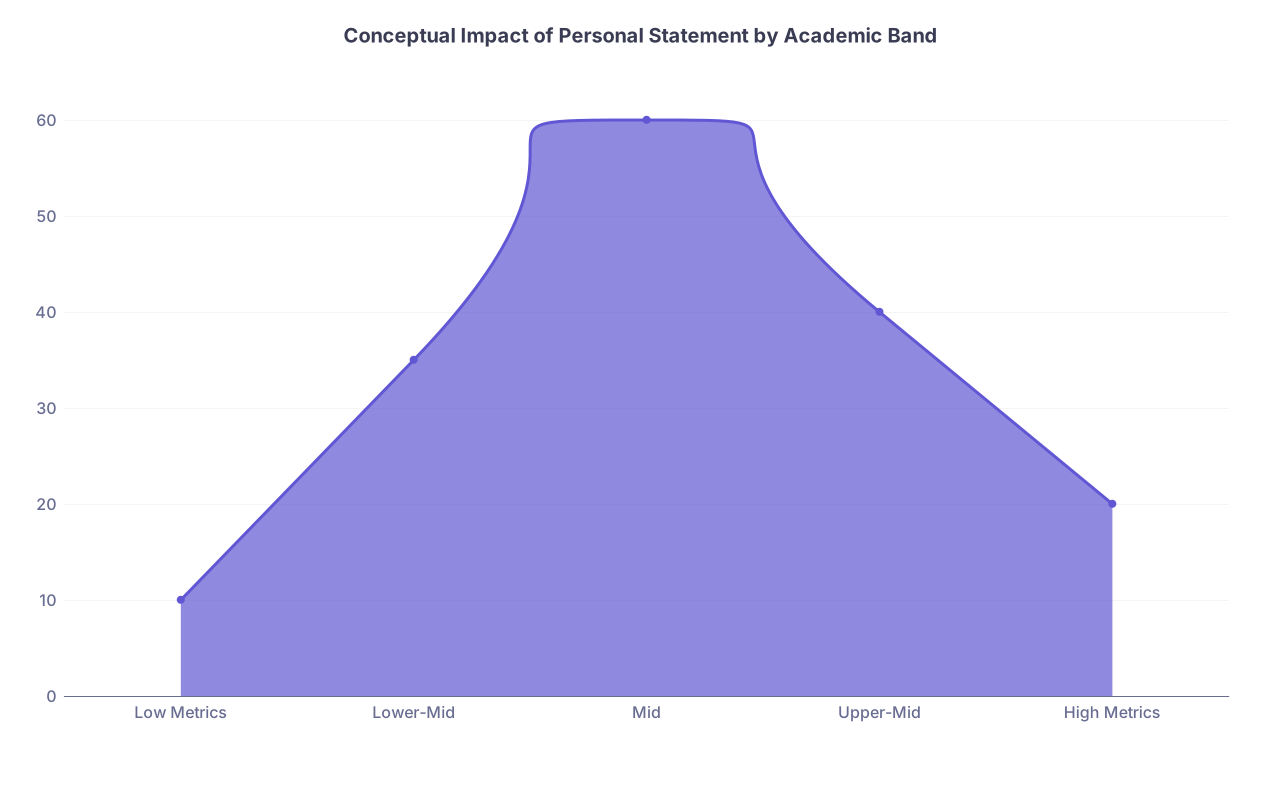
| Category | Value |
|---|---|
| Low Metrics | 10 |
| Lower-Mid | 35 |
| Mid | 60 |
| Upper-Mid | 40 |
| High Metrics | 20 |
Interpretation: the height reflects relative influence of the personal statement on decisions, not absolute chances of matching.
The sweet spot where your effort pays off the most is the middle of the pool, where most applicants actually sit.
6. Strategic Takeaways: How to Use This Data When You Write
Let me translate all this into concrete strategy. No motivational fluff. Just levers that actually move.
6.1. Calibrate how much time to spend
Given the NRMP‑level importance:
If you are applying to primary care or psychiatry:
Treat the personal statement as a top‑five application component.
That means multiple full revisions, outside readers, and at least several days of focused work.If you are applying to competitive surgical or procedure‑heavy specialties:
Still treat it as a serious gatekeeper.
One sloppy, generic, or arrogant statement can undercut 260+ scores.If you are dual applying (e.g., FM + IM, or IM + neurology):
Data show that specialty‑specific statements improve perceived fit.
Do not submit the same generic essay to two very different fields.
On a rough time budget for the whole ERAS process, 5–10% of your total application prep time going to the personal statement is reasonable.
Less than that and you are leaving points on the table. More than that and you are engaging in diminishing returns.
6.2. Align with what PDs actually read for
Use the data to focus on what matters:
Open with specific, grounded specialty motivation in the first 3–4 sentences.
You get maybe 10–15 seconds before a skimming PD decides whether to keep reading.Provide 1–2 concrete clinical or personal experiences that shaped your interest and reflect your maturity.
Do not list 10; they will blur into noise.Show longitudinal alignment between your story and your CV.
If you claim deep interest in underserved care, there should be some evidence in your activities.Demonstrate basic professionalism and writing competence.
Use clean structure, clear sentences, and correct grammar.
You are not writing an MFA thesis. You are proving you can write a safe progress note.
None of this is speculative. It lines up with what PDs say in NRMP surveys and at conference panels.
6.3. Use the statement to manage red flags — carefully
Many PDs report using the personal statement to understand context around:
- A failed Step/COMLEX exam
- A leave of absence
- An extra year in medical school
- Significant grade outliers
Handled properly, this can convert a hard “no” into a cautious “maybe.”
Handled poorly, it simply confirms their worst fears.
If you need to explain a red flag:
- Be factual and concise.
- Own your role in the problem.
- Show specific changes you made and how your performance improved afterwards.
- Avoid blaming others or the system.
I have seen this approach turn “we should not interview them” into “let us talk to them and see.” That is a big shift.
7. What the Data Say Your Personal Statement Is Really For
Strip away the myths, and the NRMP numbers point to three core functions of the personal statement:
A professionalism and communication filter
Programs use it to screen out people whose writing, tone, or insight level suggests future headaches.A tie‑breaker among similar applicants
When several applicants look the same on paper, the statement and letters often make the difference.A narrative anchor for your interview
Interviewers frequently skim your statement right before meeting you and pull questions directly from it.
It is not the main determinant of matching. The data are clear: scores, letters, and MSPE carry more average weight.
But it is an independent variable in the model. With a measurable effect size. Especially in the middle of the pack where most applicants live.
If you ignore it, you are effectively choosing to underperform on a component that 70–90% of programs use and rate around 3.7 / 5 in importance.
With these numbers in mind, your next step is straightforward: write a statement that clears the professionalism bar, articulates authentic specialty‑specific motivation, and reinforces the strongest threads in your application.
Once that is in place, you are ready for the next stage where the data shift again: how programs actually weigh interviews versus paper metrics when they build their rank lists. But that is a story for another day.