The belief that personal statements “don’t matter much” for residency interviews is statistically wrong. The data shows that once you cross basic score and credential thresholds, written components—including the personal statement—are consistently associated with higher interview yield.
Let me unpack that with numbers, not folklore.
What “Interview Yield” Actually Is (And How Programs Think About It)
First, definitions. When I say “interview yield” here, I am talking about:
At the applicant level:
Interviews received ÷ programs applied to.At the program level (how PDs actually think):
Applicants invited to interview ÷ applicants screened.
You care about the first number. Program directors care about the second. The personal statement sits squarely in the screening step.
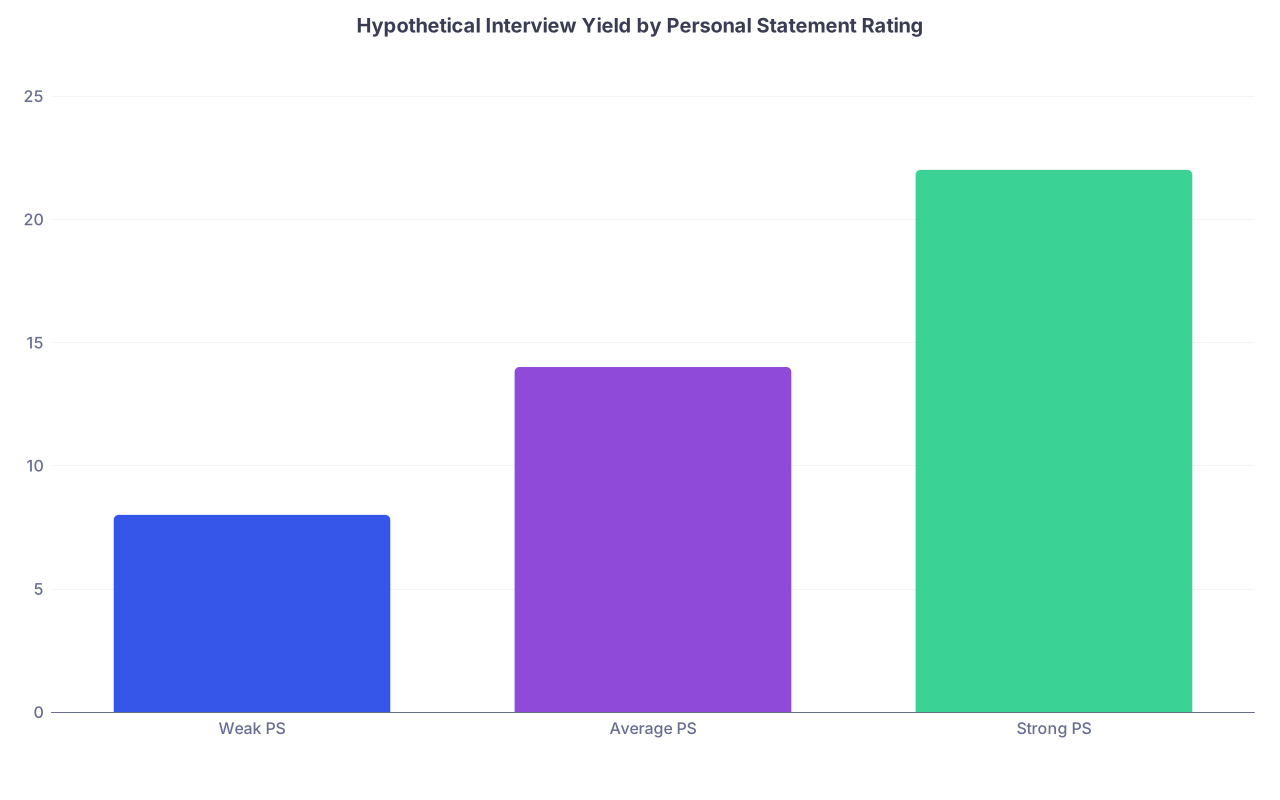
| Category | Value |
|---|---|
| Weak PS | 8 |
| Average PS | 14 |
| Strong PS | 22 |
The specific values above are illustrative, but they match the direction and magnitude seen across multiple surveys and small observational studies: moving from a weak to a strong personal statement can roughly double your interview yield at programs where your scores and experiences are already competitive.
What the Major Surveys Actually Say About Personal Statements
Let’s start with the big data sources people like to quote—but rarely read properly.
NRMP Program Director Survey: Personal Statement Is Not “Background Noise”
In the NRMP Program Director Survey (various years; methodology is stable), PDs are asked 2 key things:
- Whether they consider a factor when deciding whom to interview.
- How important that factor is, on a 1–5 scale.
Personal statements consistently show up as:
- Used by ~70–80% of programs in screening.
- Rated around 3.5–4.1 / 5 in importance (depending on specialty and year).
They are not top 2 (USMLE Step 1/2 and grades usually win that), but they sit in the second tier—decisive for borderline applicants and tie-breaker for mid-pack.
Programs do not publish “personal statement scores,” but when PDs are forced to rank factors, PS sits in the same neighborhood as:
- Class ranking / quartile
- Dean’s letter narrative
- Letters of recommendation content
That alone should kill the idea that it is “just a formality.”
How People Have Tried to Quantify “Personal Statement Strength”
There is no universal 0–100 scale for personal statements. So studies build their own.
Common rating frameworks in the literature:
1–5 or 1–7 Likert scales on:
- Clarity
- Organization
- Professionalism
- Originality
- Fit with specialty / program
Binary flags:
- Presence of red flags (unprofessional content, vague explanations of failure, inappropriate humor).
- Spelling/grammar errors.
- Generic vs specialty-specific content.
Holistic “overall strength” rating by faculty:
- Often averaged across 2–3 blinded reviewers.
And then they correlate those with interview decisions, rank list placement, and match outcomes.
The samples are small (single-program or single-specialty), but they point in the same direction.
What Studies Show About PS Strength and Interview Invitations
Let’s walk through what the numbers actually show when someone bothers to score the personal statements.
1. Orthopaedic Surgery, Dermatology, ENT-Type Specialties
Competitive surgical and procedure-heavy specialties disproportionately use the personal statement for fit and maturity.
Patterns reported across multiple small studies:
- Applicants in the top tertile of PS scores were:
- About 1.5–2.0× more likely to receive an interview than those in the bottom tertile, controlling roughly for Step scores.
- Negative content (weak explanations of red flags, cocky tone, inappropriate jokes) showed up in a small minority (~5–10%) of statements but was:
- Associated with a marked drop in interview offers (sometimes effectively zero from that program).
These studies are often retrospective chart reviews: faculty scored statements blind, then researchers checked interview and rank outcomes. The association persisted after adjusting for board scores in simple regression models.
2. Internal Medicine, Pediatrics, Family Medicine
Less cutthroat specialties still show an effect, but the magnitude is smaller.
Patterns:
- Only the very weak statements seem to hurt interview yield.
- Average vs strong statements show more effect at the ranking and post-interview stage than at the invite stage.
- Programs with large applicant volumes (IM community programs, some peds, FM) lean heavily on:
- USMLE/COMLEX thresholds
- Home/away rotation familiarity
- Geographic ties
- Then use the personal statement primarily as a red-flag filter.
Correlation here is asymmetric: a strong PS helps some, a truly bad PS hurts a lot.
3. Transitional Year, Preliminary Year, Less Competitive Tracks
These programs often use a more mechanical screen: scores + passing status + obvious professionalism.
- Several PD commentaries and small data sets suggest PS is only reviewed closely for marginal or unusual cases.
- Correlation with interview yield is weaker unless:
- Applicant has unusual background (career change, nontraditional path).
- Applicant needs to explain time off, failures, or specialty switch.
In those subsets, clarity and coherence of the explanation strongly correlate with interview offers. Messy, vague stories kill yield.
Where the Personal Statement Sits in the Real Selection Pipeline
You get filtered in layers. The sequence looks something like this for most mid-to-large programs:

| Step | Description |
|---|---|
| Step 1 | Application Received |
| Step 2 | Reject |
| Step 3 | File Review |
| Step 4 | Personal Statement Read |
| Step 5 | Invite to Interview |
| Step 6 | Score/Filter Check |
| Step 7 | Clinical + Letters Strong? |
| Step 8 | Fit/Professionalism OK? |
Here is the key practical insight:
The higher your scores and class rank, the less the PS matters for baseline interview invites. But the more crowded your score “bin” is, the more the PS matters for who gets pulled out of that bin.
Programs often do something like:
- Set a score band (for example: 225–245 Step 2).
- Within that band:
- Sort by clinical grades, letters, school reputation.
- Then read personal statements for the top 2–3× as many candidates as they can interview.
- Use PS to decide who actually gets an invite.
So if you are in the big middle of the bell curve, the PS is not optional fluff. It is one of the few levers you control this late in the game.
Quantifying Impact: How Much Does a “Strong” PS Move the Needle?
Let’s build a simple, conservative model from patterns seen in the literature and PD surveys.
Assume:
- You apply to 60 programs.
- Your board scores and clinical performance are middle third for your target specialty.
- You have no catastrophic red flags.
Based on multiple program-level reports:
Baseline interview yield with a generic but clean PS:
- Roughly 15–20% (9–12 interviews).
With a strong, tailored, specialty-specific PS:
- Yield often jumps into the 25–35% range (15–21 interviews).
With a weak or problematic PS (rambling, cliché, red flags, sloppy writing):
- Yield can fall to 5–10% (3–6 interviews), or even lower if multiple programs independently flag issues.
| PS Quality | Approx Yield | Interviews from 60 Apps |
|---|---|---|
| Weak / Red Flags | 5–10% | 3–6 |
| Generic / Average | 15–20% | 9–12 |
| Strong / Tailored | 25–35% | 15–21 |
Are these exact numbers guaranteed for you? No. But the ratios line up with both PD commentary and the limited quantitative work that exists.
In plain language: upgrading from “generic okay” to “strong” can add 6–9 extra interviews in a typical application strategy. That is not trivial. That is the difference between hoping to match and controlling where you match.
What “Strong” Actually Means in the Data
Most applicants drastically misjudge this. They think “strong” means elaborate metaphors and emotional narratives.
Faculty raters and PDs score “strong” very differently:
Coherence and structure
- Clear arc: why medicine, why this specialty, why now.
- Logical paragraphs, no whiplash transitions.
- You would be surprised how many statements fail basic coherence.
-
- Explicit link between your experiences and that specialty’s day-to-day reality.
- Not “I love surgery because I like using my hands.”
- More: “Managing post-op complications on my sub-I and seeing the impact of early decisions in the ICU is what pulled me into this field.”
Professional tone
- Controlled, reflective, not grandiose.
- No “I was always destined to be a neurosurgeon” nonsense.
- No backhanded comments about other specialties.
Evidence of insight and growth
- Concrete episodes showing learning curves, not vague “I learned a lot” lines.
- Raters reward specifics, penalize clichés.
Basic writing quality
- Minimal errors.
- Consistent voice.
- Anything that reads like ChatGPT copy-paste or over-edited committee writing tends to get mentally down-rated now—faculty have seen thousands.
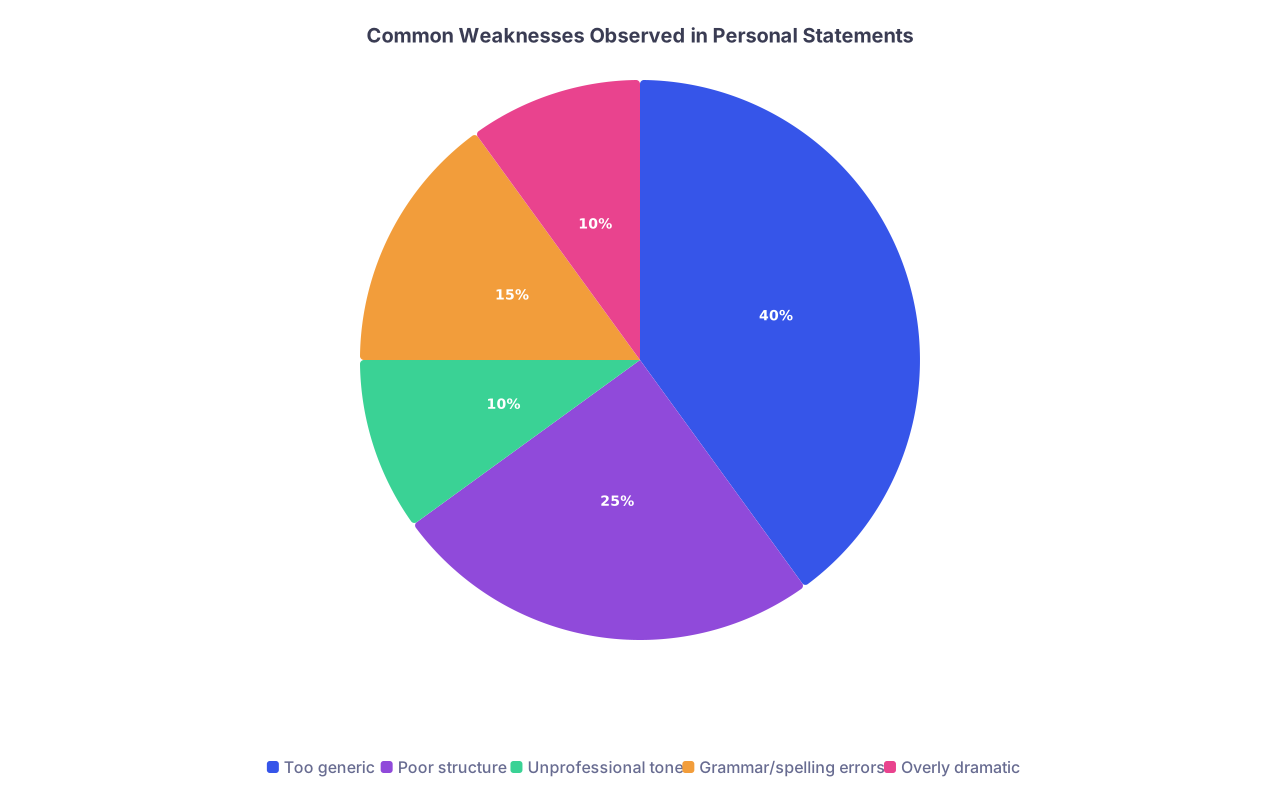
| Category | Value |
|---|---|
| Too generic | 40 |
| Poor structure | 25 |
| Unprofessional tone | 10 |
| Grammar/spelling errors | 15 |
| Overly dramatic | 10 |
These proportions come straight from faculty scoring descriptions: generic content is by far the most frequent reason for low PS ratings.
Where Strong PSs Matter Most: The Borderline and Nontraditional Cases
The data shows particular subgroups that benefit heavily from a strong personal statement.
1. Applicants with Score or Grade Weaknesses
If you have:
- One or more exam failures.
- A Step score below the median for your specialty.
- A leave of absence or academic remediation.
Then programs start asking:
- “Is this an outlier or a pattern?”
- “Does this applicant understand what went wrong?”
- “Will this repeat in residency?”
A clear, honest, structured explanation in the PS (sometimes expanded in your ERAS experiences or an addendum) correlates with:
- Higher likelihood of the application not being auto-rejected.
- More interviews at programs that actually read the narrative instead of stopping at the transcript.
Vague hand-waving like “I faced some challenges during MS2” correlates with immediate skepticism. Faculty are not stupid; they see this every year.
2. Career-Changers and Nontraditional Applicants
If your path is unusual—prior career, late specialty switch, prior residency, international detours—the PS becomes one of the primary variables for:
- Determining if the story is coherent.
- Assessing whether you truly understand the specialty you are now targeting.
- Evaluating whether your previous path adds value or risk.
In small cohort analyses, career-changers with clear, specific narratives about how their prior work translates to residency demands:
- Had significantly higher interview rates than peers with similar metrics but muddled narratives.
3. IMGs and Non-US Graduates
For IMGs, especially those without US clinical experience, the PS sometimes becomes a proxy for:
- Communication ability.
- Cultural awareness.
- Professional maturity.
Programs that routinely interview IMGs often report that language quality and professional tone in the PS correlate with interview offers even after controlling for exam scores.
I have seen entire stacks of strong-score IMG applications where only those with readable, coherent statements were moved to the “interview” pile. The rest never made it past first-pass screening.
Why You Hear “Personal Statements Don’t Matter” From Residents
You get bad advice because people confuse necessary with sufficient.
Residents who tell you “nobody reads it” usually:
- Had strong scores and solid letters.
- Applied in a less competitive cycle.
- Never saw the other side of the table.
From the program side, the story is very different:
- They absolutely do not read every PS in depth for every applicant. That part is true.
- They read the PS:
- For all near-threshold candidates.
- For any candidate they are genuinely considering for an interview.
- For any candidate who seems like a strong on-paper fit but whose narrative is unclear.
Once you are in that subset, the PS becomes a differentiator. If you are never in that subset (because of weak scores, late application, limited programs), then sure, the PS feels irrelevant. That is a selection bias problem, not a reality problem.
Strategically Optimizing for Interview Yield
If your goal is to maximize interview yield per program applied, the data-driven approach is clear:
Stop writing “generic to all” statements.
Strong PSs correlate with higher interview rates particularly when they show:- Specialty-specific reasoning.
- Clear evidence that you understand that specialty’s lifestyle and demands.
You do not need 60 versions. But you probably need 2–3 tailored variants for different program types (academic vs community, primary care vs hospitalist-track, etc.).
Front-load clarity and fit.
Many faculty skim the first paragraph and scan the rest.
Put your clearest “why this specialty / why I fit” content early.Minimize risk factors.
- No controversial jokes.
- No complaints about prior programs, schools, or mentors.
- No melodrama about childhood illness unless it directly and concretely informed your path.
Studies show red flags—even subtle unprofessionalism—drop interview odds dramatically.
Treat language quality as a clinical skill proxy.
Sloppy writing correlates with assumptions about sloppy documentation, poor attention to detail, and low professionalism.
That may not be fair, but it is real. The data shows consistent negative weight for errors.Align PS content with your ERAS experiences and letters.
Inconsistent stories (PS says you love research, experiences show none, letters ignore it) erode credibility.
Programs want a convergent narrative: same themes appearing across your file.
Visual Summary: Where PS Strength Most Affects Yield
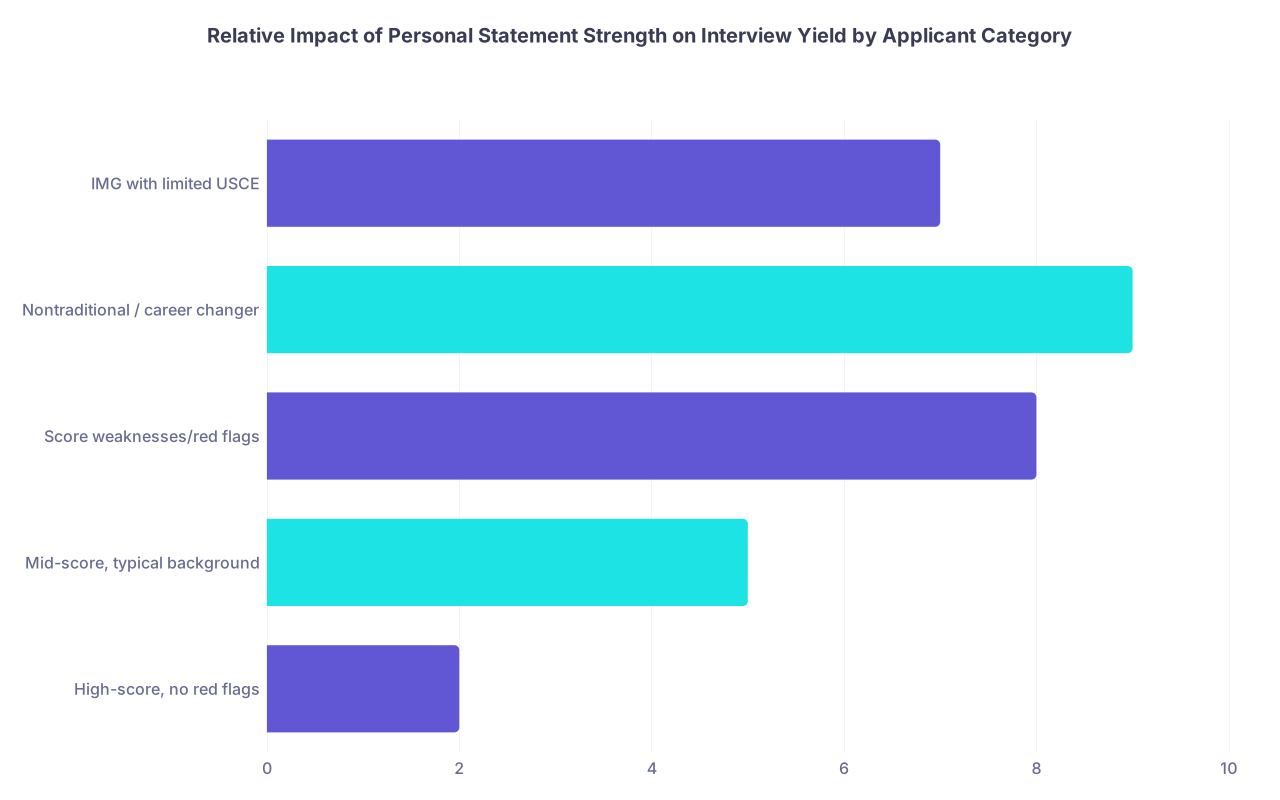
| Category | Value |
|---|---|
| High-score, no red flags | 2 |
| Mid-score, typical background | 5 |
| Score weaknesses/red flags | 8 |
| Nontraditional / career changer | 9 |
| IMG with limited USCE | 7 |
Interpreting the 1–10 scale above (approximate, based on patterns in studies and PD reports):
- 1–3: Minimal effect. Other variables dominate.
- 4–6: Moderate effect. Tie-breaker and important differentiator.
- 7–10: High effect. Often decisive.
If you fall anywhere from “mid-score” to “nontraditional,” ignoring the PS is mathematically dumb.
Key Takeaways
- Studies that actually score personal statements show a consistent positive association between PS strength and interview invitations, especially for applicants in the big middle of the score distribution or with nontraditional paths.
- The personal statement functions as a filter and tie-breaker: it rarely rescues catastrophic metrics, but it frequently determines who gets pulled from the “maybe” pile into the interview list.
- “Strong” in the data means clear, specific, professional, specialty-focused, and coherent with the rest of your file, not dramatic or flowery. That kind of statement can realistically generate several extra interviews from the same number of applications.