
The Great Debate: PhD vs. MD – Which Healthcare Career Path Is Right for You?
Choosing between a PhD and an MD is one of the most consequential decisions for students interested in Medical Education, Biomedical Sciences, and Healthcare Careers. Both paths can lead to impactful, intellectually stimulating work—but they differ dramatically in day‑to‑day responsibilities, training structure, financial implications, and long‑term Career Pathways.
This guide breaks down the PhD vs MD decision in a pragmatic, residency-focused way: what each degree actually prepares you to do, how the training feels from the inside, and how to align your choice with your personality, goals, and tolerance for uncertainty.
Understanding the Fundamentals: What PhD and MD Degrees Really Mean
What Is a PhD in Biomedical Sciences or Related Fields?
A PhD (Doctor of Philosophy) is a research-focused doctorate designed to train you to generate new knowledge. In the context of Biomedical Sciences and healthcare, PhD trainees:
- Ask and test original scientific questions
- Design and execute experiments (in vitro, in vivo, computational, clinical, or population-based)
- Analyze and interpret data using advanced statistics and methods
- Disseminate findings through publications, conferences, and sometimes patents
- Teach and mentor students and trainees
Common PhD fields for students interested in healthcare include:
- Molecular biology, biochemistry, and cell biology
- Neuroscience and cognitive sciences
- Immunology and microbiology
- Epidemiology and public health sciences
- Biomedical engineering and translational sciences
- Health services research and outcomes research
Primary career outcomes for PhDs in these areas often include:
- Academic research positions (postdoc → faculty)
- Industry research (pharma, biotech, medtech)
- Government or nonprofit research institutes
- Scientific consulting, regulatory affairs, or data science
- Medical writing, policy analysis, or science communication
The emphasis is on creating knowledge and tools that clinicians, health systems, and the scientific community will ultimately use.
What Is an MD (Doctor of Medicine)?
An MD is a professional doctorate that prepares you to practice clinical medicine. MD training focuses on:
- Understanding human biology in health and disease
- Diagnosing and treating patients in diverse clinical settings
- Developing clinical reasoning and decision-making
- Communicating with patients, families, and teams
- Navigating health systems, ethics, and professionalism
MDs typically pursue:
- Residency and fellowship training in clinical specialties (e.g., internal medicine, surgery, pediatrics, psychiatry, anesthesiology)
- Primary care or subspecialty practice
- Hospital-based roles (e.g., hospitalist, intensivist)
- Leadership in healthcare administration, quality, and safety
- Public health, global health, or health policy roles
The core of MD training is direct patient care and managing real-time clinical decisions that impact individual lives.
Clarifying Your Career Goals: How Do You Want to Help People?
Choosing between an MD and PhD is ultimately about matching your daily work to your motivations. Both degrees contribute to healthcare—but in very different ways.
Key Reflective Questions to Ask Yourself
Do you want daily, direct patient interaction?
- Enjoy taking histories, performing physical exams, and building long-term patient relationships?
- Are you motivated by seeing immediate effects of your decisions on someone’s health?
- Can you handle uncertainty, emergencies, and emotionally intense situations?
If this resonates, an MD pathway is often a better fit.
Do you feel most energized by questions and experiments?
- Love troubleshooting experiments, writing code, or analyzing data sets for patterns?
- Get excited about mechanisms (“why does this happen?”) more than symptoms (“what is this patient experiencing?”)?
- Prefer deep focus time over constant interruptions?
If yes, a PhD in biomedical sciences or related fields may align more closely with your personality.
Do you want to change the system or the science behind it?
- MDs often change healthcare at the point of care or at the system level (quality improvement, policy, leadership).
- PhDs often change healthcare by discovering new therapies, technologies, or understanding disease mechanisms.
Real-World Day-to-Day Differences
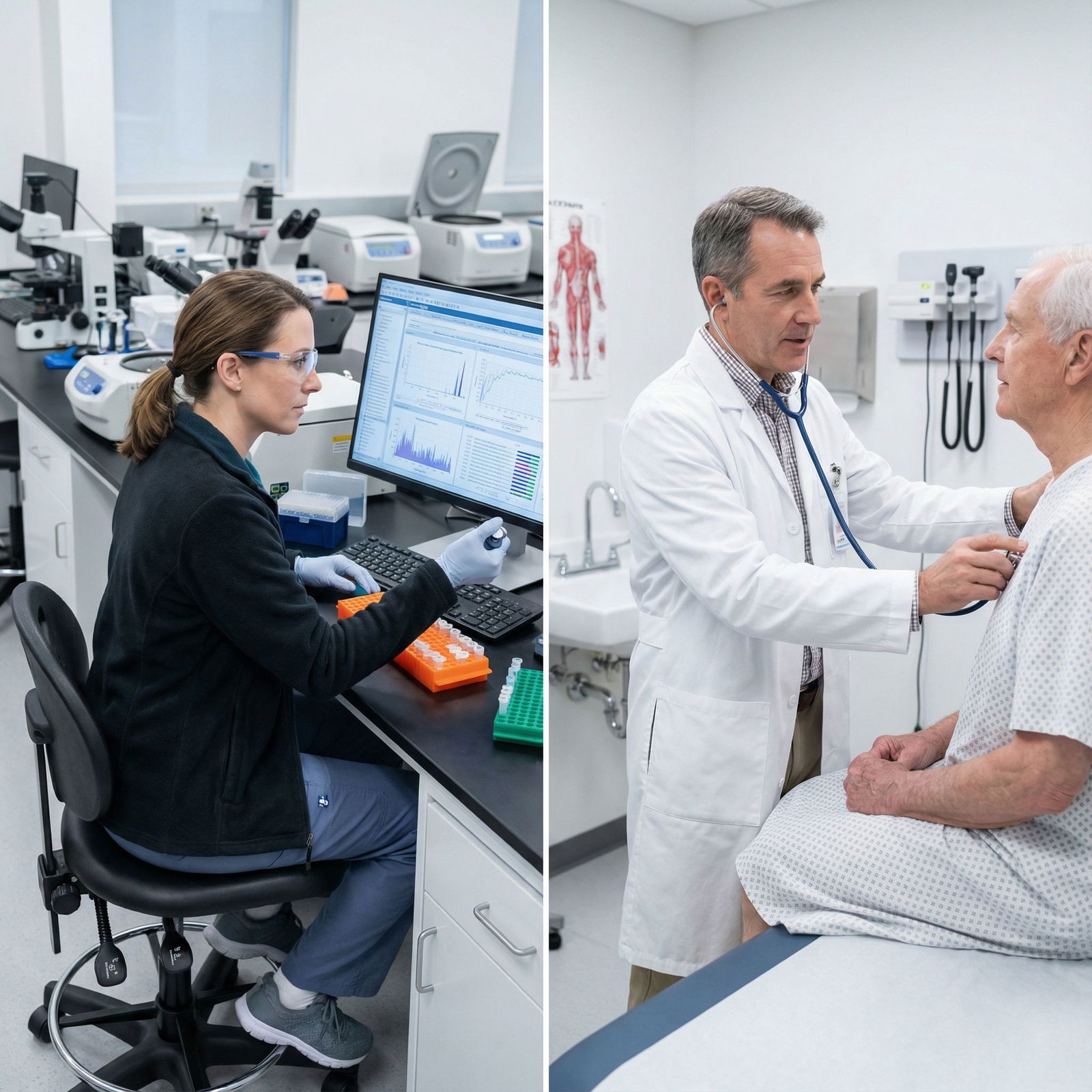
Typical PhD Roles and Applications
Bench Research Scientist
Designing experiments on cancer cell lines, CRISPR editing, or pharmacokinetics, analyzing data, supervising research techs, and writing manuscripts.Epidemiologist or Public Health Researcher
Using large datasets to understand disease trends, disparities, and outcomes; developing models to inform prevention strategies and policy.Biotech / Pharma Scientist
Working on target identification, preclinical testing, clinical trial design support, or biomarker development.Academic Faculty Member
Leading a lab, applying for grants, teaching courses, mentoring students, and serving on committees.
Typical MD Roles and Applications
Clinical Specialist or Primary Care Physician
Diagnosing, treating, and following patients in clinics, hospitals, or emergency departments; performing procedures when applicable.Hospitalist or Intensivist
Managing acutely ill inpatients, coordinating multidisciplinary care, working in high-acuity settings like ICUs.Public Health or Global Health Physician
Leading vaccination campaigns, policy initiatives, or health systems strengthening projects.Physician Executive or Medical Director
Shaping healthcare delivery, quality, and strategy within health systems, insurance, or public agencies.
Comparing Training Pathways: Structure, Duration, and Curriculum
How Long Does It Take? Training Timelines for PhD vs MD
PhD Programs (Biomedical Sciences and Related Fields)
- Typical duration: 4–6 years post-bachelor’s
- Structure:
- 1–2 years: coursework + lab rotations (in many programs)
- 3–5 years: full-time research, dissertation, publishing
- Post-PhD: Many graduates complete 1–3 postdoctoral fellowships (especially for academic careers), adding additional years of training before securing a permanent position.
Total time from undergraduate to stable research role can realistically be 8–10+ years, depending on:
- Field and complexity of project
- Funding environment
- Publication expectations
- Career goals (academic vs industry)
MD Programs and Clinical Training
- Medical school: 4 years
- Residency: 3–7 years depending on specialty (e.g., family medicine ~3, surgery ~5–7)
- Optional fellowship: 1–3 additional years for subspecialization (e.g., cardiology, GI, oncology)
Total time from entering medical school to independent practice is usually 7–11+ years.
Key difference: MD training has a fixed, structured path from medical school to residency, whereas PhD timelines are more variable and heavily influenced by research progress and funding.
Curriculum and Learning Style: Research vs Clinical Focus
PhD Curriculum (Biomedical / Health Sciences)
Common elements:
- Advanced coursework: molecular biology, biostatistics, bioinformatics, epidemiology, systems biology, ethics
- Core skills: experimental design, quantitative methods, scientific writing, grant writing, critical appraisal of literature
- Major milestones: qualifying exams, candidacy, dissertation proposal, dissertation defense
Learning style:
- Self-directed, project-based, and iterative
- Progress measured by publications, presentations, and thesis milestones
- Heavy emphasis on problem-solving under uncertainty, learning to handle failed experiments and negative data
MD Curriculum (Medical Education and Clinical Training)
General structure (in many systems):
Preclinical years (MS1–MS2):
- Fundamental sciences: anatomy, physiology, biochemistry, pharmacology, pathology, microbiology
- Early clinical exposure, standardized patient encounters
- Heavy exam preparation (e.g., USMLE Step 1 or equivalent)
Clinical years (MS3–MS4):
- Core rotations: internal medicine, surgery, pediatrics, OB/GYN, psychiatry, family medicine, emergency medicine
- Electives, sub-internships, and residency interviews
- Licensing examinations (e.g., USMLE Step 2)
Learning style:
- Structured, schedule-heavy, and clinically driven
- Constant evaluation through exams, OSCEs, and direct observation
- High emphasis on communication, teamwork, time management, and resilience
Financial Considerations: Cost, Funding, and Long-Term Earning Potential
Cost of Education and Debt Burden
PhD in Biomedical Sciences
- Tuition: Frequently fully or largely waived in funded doctoral programs
- Stipend: Many programs provide a modest living stipend (varies by region and institution, often ~$25,000–$40,000/year in the U.S.)
- Debt: Lower educational debt on average, though living expenses may require loans if stipends are limited
Trade-off:
- Financial burden during training is lower, but earning power during trainee years is modest.
MD (Medical Degree)
- Tuition and fees: Substantial, especially in the U.S.
- Average debt: Often exceeds $200,000 in U.S. graduates, though this varies by country, public vs private institutions, and scholarships
- Income during residency: Residents earn a salary, but it’s modest relative to hours worked and debt burden
Trade-off:
- High initial debt load, but significantly higher earning potential after training compared with most PhD roles.
Earning Potential and Career Trajectories
PhD Career Earnings (Approximate Ranges)
- Academic postdoc: ~$55,000–$75,000/year (varies by location and funding)
- Assistant/Associate Professor: ~$80,000–$150,000+, often influenced by grants, institution, and field
- Industry scientist (biotech/pharma): ~$100,000–$180,000+ with experience and leadership roles
- Alternative careers (consulting, data science, regulatory): Often competitive with or higher than academic salaries
Overall, PhD-trained professionals can achieve comfortable incomes, especially in industry or specialized roles, though typically below most practicing physicians.
MD Career Earnings (Approximate Ranges)
- Primary care physicians: Often ~$200,000–$280,000+/year depending on region and payment model
- Specialists (e.g., cardiology, orthopedics, radiology, dermatology): Commonly in the $350,000–$600,000+ range
- Academic physicians: May earn somewhat less clinically but can combine salary with admin or research support
Caveats:
- Income varies widely by specialty, practice setting, country, and work hours.
- Higher income can come with more demanding schedules and responsibilities.
Work-Life Balance, Personality Fit, and Long-Term Satisfaction
PhD: Pros, Cons, and Personality Fit
Pros:
- Greater flexibility in daily schedule (especially outside of rigid lab or teaching times)
- Opportunity for deep, uninterrupted focus on complex problems
- Intellectual autonomy: you define your research agenda as you advance
- Potential for remote or hybrid work in data-heavy or analytical roles
- Direct contribution to scientific discovery and long-term impact on healthcare
Cons:
- High pressure to publish and secure funding (grants)
- Job market uncertainty for tenure-track positions
- Research can be slow, with delayed gratification and frequent setbacks
- Possible isolation, especially in niche subfields or long data-analysis stretches
Best suited for:
- Individuals who love problem-solving, critical thinking, and tinkering with ideas
- Those comfortable with ambiguity, trial-and-error, and long timelines
- People motivated by intellectual curiosity more than external validation or immediate impact
MD: Pros, Cons, and Personality Fit
Pros:
- Direct, tangible impact on patients’ lives and communities
- High job security and consistent demand across regions
- Strong earning potential and clear, structured career progression
- Diverse career options: clinical care, leadership, education, research, policy
- Built-in opportunities for teaching, mentoring, and advocacy
Cons:
- Long training hours, including nights, weekends, and on-call time
- Emotional toll of caring for critically ill or dying patients
- Risk of burnout, compassion fatigue, and moral distress
- Administrative burdens (documentation, insurance, regulations)
Best suited for:
- Individuals who thrive in fast-paced, interpersonal environments
- Those able to make decisions under pressure and tolerate imperfect information
- People who derive meaning from service, teamwork, and relationship-building
Hybrid and Alternative Pathways: MD/PhD and Allied Degrees
The MD/PhD: Combining Clinical Medicine and Research
If you are deeply drawn to both patient care and research, a combined MD/PhD program (often in the Physician-Scientist or Medical Scientist Training Program track) may be worth exploring.
Key features:
- Duration: typically 7–9 years total
- Structure: 2 years MD → 3–4+ years PhD → 2 years MD clinical rotations
- Funding: many MD/PhD programs in the U.S. offer tuition waivers and stipends, making them financially attractive for research-oriented candidates
- Career outcomes: academic physician-scientists, translational researchers, leaders in industry R&D, or clinical trialists
Caution:
This path is not a shortcut; it is longer and more demanding than either degree alone and is best suited for those with a sustained, clear commitment to an integrated research-clinical career.
Other Degrees to Consider in Healthcare Careers
For students interested in healthcare impact without full medical or PhD training, consider:
- MPH (Master of Public Health): Population health, epidemiology, policy
- MS in Biomedical Sciences or Clinical Research: For translational or industry research roles
- MHA / MHM (Health Administration/Management): Leadership in healthcare systems
- PA (Physician Assistant) or NP (Nurse Practitioner): Direct clinical care with shorter training timelines
These offer flexible Career Pathways within Medical Education and Healthcare Careers, particularly if you value patient impact but want different training length or responsibilities.

FAQs: Common Questions About PhD vs MD Career Decisions
1. Can I switch from a PhD to an MD (or vice versa) after I start?
Yes, but transitions require careful planning:
PhD to MD:
- Some PhD graduates apply to medical school after completing their doctorate, especially if they discover a passion for direct patient care or clinical translation.
- Your research background can strengthen your application, particularly for research-heavy schools or programs.
- Expect to complete the full MD and subsequent residency; prior degrees do not shorten clinical training.
MD to PhD:
- Practicing physicians sometimes pursue PhDs (or research-focused master’s degrees) in fields like epidemiology, health services research, or basic science.
- Alternatively, MDs can build research careers through fellowships, mentored research programs, and grants without formal PhD training.
Switching is possible but time-intensive, so early, honest reflection is valuable.
2. Do I need the same undergraduate preparation for PhD and MD programs?
There is overlap, but some differences:
MD prerequisites (varies by country and school):
- Typically: biology, general and organic chemistry, physics, sometimes biochemistry, statistics, and behavioral sciences
- Strong emphasis on clinical exposure and service in your application
PhD prerequisites (biomedical sciences):
- Strong background in relevant sciences (biology, chemistry, math, statistics, computer science for some fields)
- Research experience is critical—lab work, independent projects, or publications are major assets
Many students major in biology, chemistry, neuroscience, or related fields and keep both options open by combining research experience with clinical or volunteer experience.
3. Which degree offers more opportunities for interdisciplinary work?
Both MDs and PhDs can build rich, interdisciplinary careers, but the contexts differ:
PhDs often collaborate across departments and disciplines:
- Engineering, computer science, statistics, public policy, business, and more
- Common in systems biology, bioinformatics, health economics, and implementation science
MDs often collaborate across healthcare sectors:
- Nurses, pharmacists, social workers, therapists, administrators, and researchers
- Increasingly engage in quality improvement, digital health, and innovation teams
If you enjoy bridging disciplines, both paths can support that—your choice should hinge on whether you want your anchor identity to be clinician or scientist.
4. How do residency programs view applicants with a PhD or substantial research background?
In research-oriented specialties and academic programs, a PhD or strong research record can be a major asset:
- Demonstrates persistence, critical thinking, and scholarly productivity
- Can make you competitive for research tracks or physician-scientist pathways
- May open doors to early leadership in research or QI projects during residency
However:
- Clinical performance and exam scores still matter greatly (e.g., clerkship evaluations, standardized tests).
- Programs want evidence that you can function effectively on the wards, communicate with patients, and work well in teams.
A PhD is best viewed as a complement, not a substitute, for strong clinical preparation.
5. If I want to innovate in healthcare, which path is better: PhD or MD?
You can innovate from either side—but the mode of innovation differs:
MD pathway:
- Innovate in clinical workflows, patient experience, and delivery models
- Lead trials testing new therapies or devices
- Identify unmet clinical needs that spark startups or device development
- Drive policy changes and system-level reforms
PhD pathway:
- Innovate in fundamental science, drug discovery, biomarker development, or AI tools
- Develop new diagnostic technologies or therapeutic platforms
- Build algorithms, models, or interventions that clinicians then validate and use
- Participate in translational teams bridging bench to bedside
If your vision of innovation centers on treating patients differently tomorrow, MD may resonate more. If it centers on discovering new tools that will change treatment over years to decades, PhD may be a better fit. Many high-impact innovations emerge from teams that include both MDs and PhDs.
Final Thoughts: Choosing the Path That Fits Your Life, Not Just Your Résumé
The PhD vs MD decision is less about which is “better” and more about which is better for you:
- If you imagine yourself happiest in a clinic or hospital, making real-time decisions with and for patients, leaning into human connection and responsibility—MD training likely aligns best.
- If you imagine yourself in a lab, at a computer, or in a research institute, pushing the boundaries of what we know, comfortable with delayed gratification—PhD training may be ideal.
- If you feel an enduring pull toward both, look into MD/PhD and physician-scientist pathways, and seek mentors who are living those careers.
Spend time shadowing physicians, volunteering in clinical settings, joining research projects, and talking with current MD, PhD, and MD/PhD trainees. Their lived experience will often clarify more than any brochure or ranking.
Whichever route you choose, you will be contributing to healthcare and the Biomedical Sciences in meaningful ways—either at the bedside, at the bench, or at the interface between the two.