
It’s 11:30 pm. You just got off a brutal call shift, your inbox has a “please call risk management” email, and now your brain is doing the thing: spiraling.
“If I get sued… can they take my rental properties? The house I bought for my parents? The duplex that’s supposed to be my retirement plan? Can one bad outcome wipe all of it out?”
You’re not thinking about “justice” or “the system.” You’re thinking: am I one lawsuit away from losing everything I’ve built outside of medicine?
Let me be blunt: this fear is not crazy. I’ve seen it up close with attendings who thought they were “fine” because they had malpractice insurance, and then learned—too late—that insurance is not a magic force field.
But you’re also not powerless. There are rules. There are protections. And if you understand the basics, you can stop catastrophizing at 2 am and start structuring things so one bad case doesn’t blow up your entire real estate portfolio.
Let’s go step by step.
1. Can a malpractice lawsuit actually reach my rental properties?
Short answer: yes, it can, in the worst-case scenario. But that’s not the default outcome, and there are a lot of layers in between “I got sued” and “they’re taking my fourplex.”
Here’s the real chain of events you’re secretly scared of:
- You’re sued for malpractice.
- The plaintiff wins a judgment bigger than your malpractice policy limits (or there’s some coverage issue).
- They go after your personal assets to satisfy the judgment.
- Your rental properties are part of those personal assets.
Is this common? No.
Is it impossible? Also no.
The risk depends on three big things:
- How your properties are owned (in your own name vs LLC, etc).
- What state you live in (some are much more asset-protection-friendly than others).
- Whether there are other easier assets to grab (bank accounts, brokerage, etc).
Think like a plaintiff attorney for a second. They’re not emotionally attached to “ruining you.” They’re financially motivated. They go after:
- Whatever is easiest to find.
- Whatever is easiest to collect.
- Whatever the law clearly allows them to touch.
If your rentals are in your personal name, show up on a simple public record search, and there’s a big judgment that exceeds insurance… yes, those properties are exposed.
If they’re in well-structured entities, financed, and protected by state law and liens… they’re much less appealing as a target, even if technically not bulletproof.
So: your fear isn’t ridiculous. But it’s also not a guarantee. You’re in danger by default if you’ve done zero planning. You can change that.
2. What actually protects me first: malpractice insurance limits and reality
Before we get lost in LLC rabbit holes, zoom out for a second. Most physician-net-worth-destroying scenarios never happen because insurance and settlements handle the damage.
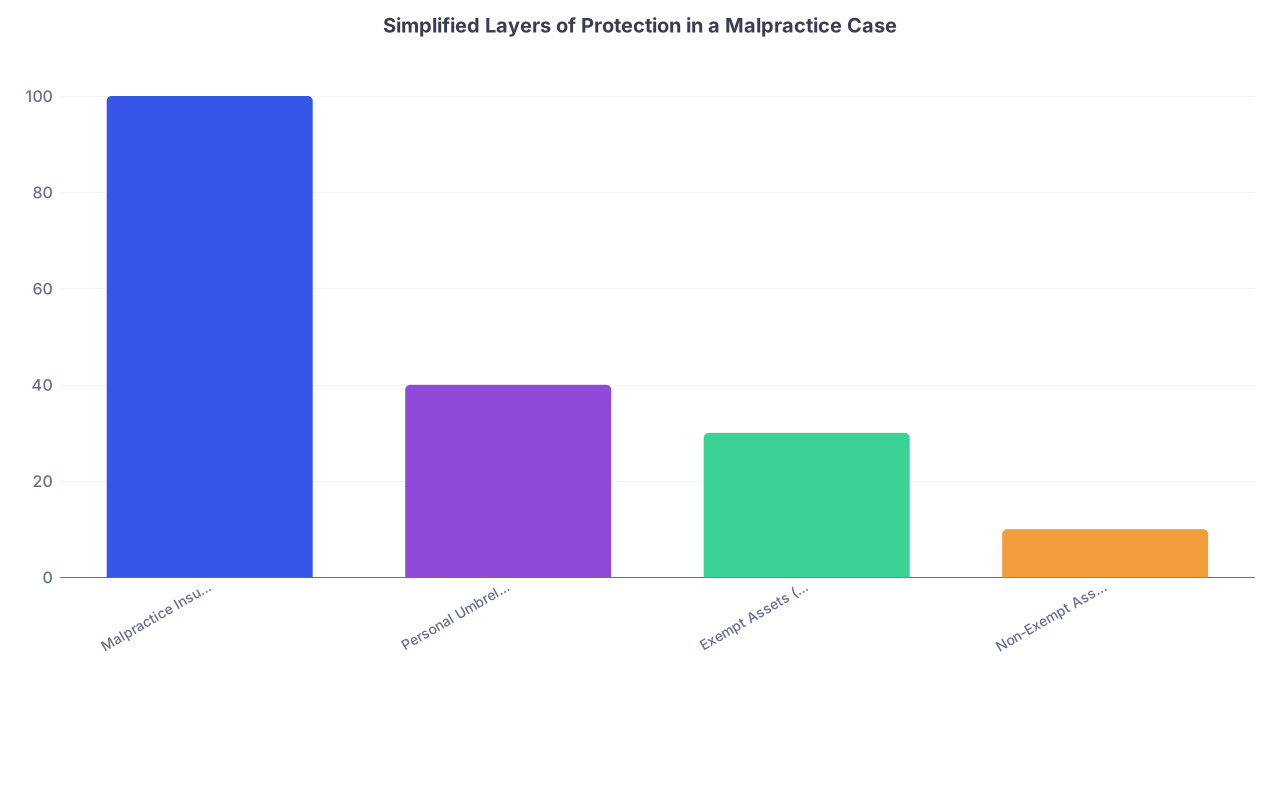
| Category | Value |
|---|---|
| Malpractice Insurance | 100 |
| Personal Umbrella Policy | 40 |
| Exempt Assets (home/retirement) | 30 |
| Non-Exempt Assets (rentals) | 10 |
Those numbers aren’t dollar amounts, just a rough sense of “who gets hit first”:
Malpractice insurance policy
This is the first and main shield.
If you have, say, $1M / $3M coverage, the carrier is usually highly motivated to settle within policy limits and avoid exposing you personally. Why? Because once personal exposure is on the table, you and your own lawyer get a say, and that gets messy for them.Things get dangerous when:
- Liability is clear.
- Damages are massive (e.g., lifelong care of an injured child).
- Your policy limits look small relative to the harm (e.g., $1M policy vs $10M injury).
Excess / umbrella policies (if you have them)
Most docs think of umbrella insurance for car accidents and slip-and-fall at your house, but some advanced setups also have excess malpractice or other layers. Many don’t. You should know which camp you’re in. If you don’t know, that’s… not great.Your own assets, split into:
- Protected (exempt) assets – depending on your state:
- Retirement accounts (401k, 403b, many IRAs) often have strong protection.
- Primary residence (homestead protection) in some states can be massive (e.g., Florida, Texas).
- Unprotected (non-exempt) assets – where your rentals usually sit, especially if they’re in your own name.
- Protected (exempt) assets – depending on your state:
So realistically, a malpractice lawsuit doesn’t jump straight to “let’s take their rental duplex.” There’s a whole negotiation dance around policy limits and settlement first. But if that fails and a huge judgment drops? Yes, they can go hunting.
3. How ownership structure changes the risk (your name vs LLC vs more)
This is the part that keeps people up at night: “If I put my rentals in an LLC, am I safe?”
Answer: safer. Not safe.
Case 1: You own properties in your personal name
Worst-case structurally. If there’s an excess malpractice judgment against you personally, any real estate titled in your name is fair game (subject to mortgages and state exemptions).
Judgment creditor can:
- Record the judgment as a lien.
- Potentially force sale / foreclosure to satisfy debt.
- Or at minimum, hang that judgment over the property until you pay or settle.
Is it guaranteed they’ll go after each property? No. But they can, and the threat alone gives them leverage.
Case 2: You own properties in a single-member LLC, and you’re the only owner
Better, but not magical.
Here’s what this usually means in the malpractice context:
- The malpractice lawsuit is against you, not the LLC.
- The plaintiff can’t just say “I’m suing the LLC” because the LLC didn’t commit malpractice. You did, in your capacity as a physician.
But once there’s a judgment against you:
- They can try to collect against your ownership interest in the LLC.
- Depending on state law, they may:
- Get a charging order (rights to distributions, not control), or
- In some states, potentially reach the assets more directly.
It’s not binary “protected / not protected.” It’s “how annoying can you make it for them to get to your stuff?”
Case 3: You own through multi-member LLCs or more advanced structures
Generally stronger. If there are multiple members (e.g., you and spouse, you and another investor), some states treat the LLC interest more like a partnership. That can limit what a creditor can practically force.
Still:
- Courts don’t love obvious sham structures thrown together after trouble starts.
- Judges hate clearly abusive “I’m hiding everything” games.
So yes, an LLC helps. Especially if:
- It was formed early, not right after a bad outcome.
- It’s properly maintained (separate bank account, operating agreement, records).
- It’s used consistently as a real business, not a cosmetic shell.
But no, it’s not a force field.
4. What actually protects what: state laws, exemptions, and what’s realistic
This is the unsexy part: your protection depends a ton on which state you live in. Some are basically physician-hostile; others are quietly friendly if you set things up early.
Here’s a rough, oversimplified snapshot to show you how variable this gets:
| State | Homestead Protection | Retirement Protection | LLC/Charging Order Strength |
|---|---|---|---|
| Florida | Very strong | Strong | Generally strong |
| Texas | Very strong | Strong | Generally strong |
| California | Weak/limited | Good (federal ERISA) | Mixed / weaker |
| New York | Moderate | Good | Mixed |
| Nevada | Strong | Strong | Very strong (popular choice) |
You know what almost no one tells you in med school or residency? That picking a state to practice in is also picking a legal risk environment. Same bad outcome, very different financial consequences.
In many states:
- Qualified retirement accounts are basically untouchable to most creditors.
- Primary residences have some protection, but it might be capped or weak.
- Rental properties have little to no automatic protection unless they’re inside entities or subject to other planning.
So yes, if you’re in a state with weak exemptions and you’ve piled up multiple rentals in your own name, and you take a big, uninsured hit… those properties are in the blast radius.
5. Concrete stuff you can actually do to protect your rentals
Let’s get practical. You don’t need a JD/CPA/LLM cocktail to do better than nothing.
Here’s what moves the needle:
1. Stop owning rentals in your personal name
If you’re early, fix it now. If you already have 5 properties titled in your own name, it’s not hopeless, but don’t DIY this blindly.
Typical plan:
- Form an LLC (or series structure where legal in your state).
- Work with a real estate attorney in your state to:
- Deed the properties into the LLC correctly.
- Review loan documents (some banks get twitchy about transfers; you don’t want to trigger due-on-sale carelessly).
- Keep clean separation:
- Separate bank accounts.
- Actual lease agreements in LLC name.
- Rents in LLC account; expenses from LLC account.
Will that 100% protect properties from a nuclear malpractice judgment? No.
Will it dramatically improve your position vs “everything is in my own name”? Yes.
2. Don’t put all properties in one big LLC blob
You’re probably worried about two kinds of lawsuits:
- From your medical practice (malpractice).
- From your rentals (tenant falls, contractor injury, etc).
If all your properties are in one LLC and something goes wrong at one property, the others are at risk from that too.
More resilient setups often use:
- Separate LLCs for higher-risk or higher-value properties.
- Or at least a rational segmentation (by geography, property type, or size).
Yes, it costs more in fees and admin.
No, you do not need 17 LLCs for your first three doors. But one giant catch-all LLC for 20 units is not ideal either.
3. Get adequate malpractice limits and actually know what they are
This is low-hanging fruit and way too many docs are fuzzy here.
- Know your per-claim and aggregate limits.
- Ask: “How do my limits compare to typical large-verdict ranges in my specialty and state?”
- Ask your carrier or broker directly: “If there was a catastrophic case, what circumstances would realistically put my personal assets at risk?”
If they hand-wave, push. You’re literally betting your rentals on the answer.
4. Consider a personal umbrella policy (but don’t over-trust it)
Umbrella ≠ malpractice.
Umbrella sits over your home/auto liability, not over your malpractice policy.
Still useful because:
- It protects against other big personal liability events (bad car accident, injury on your property).
- Those non-malpractice lawsuits can also target your rentals. Why give them another easy path?
But don’t confuse it with “extra malpractice coverage.” It’s not.
5. Plan when the sky is blue, not after you get a letter
Big legal principle: fraudulent transfer.
If you wait until:
- You had a terrible outcome,
- Family is angry,
- Risk management is involved,
- You’ve been informally told “this might become a claim”…
…and then you suddenly start moving all your stuff into LLCs and trusts, courts can absolutely unwind that.
You want your structure to look:
- Boring.
- Old.
- Ordinary business planning.
Not “panic mode asset dump after a bad case.”
6. The ugly “what if” scenario you’re picturing
Let’s play out the nightmare, because that’s what your brain is doing anyway.
You’re an attending hospitalist in California.
Policy limits: $1M / $3M.
You have 3 rentals in your name, total equity maybe $800k. No special structures. You’ve done exactly zero asset protection planning.
Catastrophic case. Birth injury. Jury verdict: $5M.
Insurer pays the $1M policy limit. That still leaves $4M.
What can happen?
- Plaintiff can go after your:
- Non-exempt bank/brokerage accounts.
- Non-protected real estate (your rentals).
- Future wages (to some extent, via garnishment, depending on state rules).
Will they get all $4M? Maybe not. But can they lean hard on your properties as part of collecting? Yes.
Now change one thing: you live in Texas, your primary home is heavily protected, your rentals have been in separate LLCs for years, your retirement accounts are substantial, you carry higher malpractice limits, and you’ve consulted asset-protection counsel.
Same bad outcome. Same verdict.
Your collectible world looks very different. You still won’t sleep great, but you’re not wondering whether every door you ever bought is about to be fire-sold at auction.
7. The mental side: how to stop spiraling every time you get a complaint
Look, the background anxiety of “one mistake and they’ll take everything” is corrosive. It makes you defensive with patients, paralyzed with money decisions, or even avoid investing at all.
You’re not going to fix the U.S. tort system. You can fix your personal exposure.
Once you:
- Have properties out of your own name,
- Know your malpractice coverage cold,
- Understand your state’s exemptions,
- Set up a sane LLC structure and basic legal hygiene,
…your “what if they take my rentals?” thought quiets down. It never totally disappears, but it becomes background noise instead of full-volume panic.
You want to reach a point where, when your brain whispers: “What if you get sued and lose everything?”, you can calmly answer yourself:
“I’ve done reasonable planning. Could I get hurt? Yes. Could I be totally wiped out and homeless with zero assets? Very unlikely. My rentals aren’t just sitting there naked anymore.”
That’s the goal. Not invincibility. Just not naked.

| Step | Description |
|---|---|
| Step 1 | Malpractice Lawsuit Filed |
| Step 2 | Insurance Pays Defense |
| Step 3 | Case Resolved Within Limits |
| Step 4 | Plaintiff Looks At Assets |
| Step 5 | Check Exempt Assets |
| Step 6 | Check Non Exempt Assets |
| Step 7 | Rentals in Personal Name |
| Step 8 | LLC Owned Rentals |
| Step 9 | Higher Risk of Direct Collection |
| Step 10 | Harder To Collect - Depends On State |
| Step 11 | Judgment > Policy Limits? |
FAQ (exactly 4 questions)
1. If I put all my rentals in an LLC, am I completely protected from malpractice lawsuits?
No. An LLC helps, but it doesn’t make you untouchable. A malpractice judgment is against you, not the LLC. The plaintiff generally can’t sue the LLC for your medical act, but they can potentially go after your ownership interest in the LLC to satisfy the judgment. How much they can practically do with that depends on state law (charging order protections, etc.), the operating agreement, and how cleanly you’ve maintained the entity. Think of an LLC as “raising the difficulty level” for creditors, not as a permanent invisibility cloak.
2. Can I move my rentals into an LLC after I’ve already had a bad outcome or a claim filed?
You can attempt it, but it’s dangerous and often counterproductive. If a court decides you transferred assets to dodge an existing or reasonably anticipated creditor, that’s called a fraudulent transfer. Judges can unwind those moves and, frankly, get pretty irritated. The right time to structure your assets is before there’s smoke, not after the fire has started. If you’re already in a high-risk situation, talk to an actual asset-protection lawyer before you move a single title.
3. Are my rentals safer if I live in a state with strong homestead protection like Florida or Texas?
Your primary residence is safer in those states, often dramatically so. Your rentals? Not so much by default. Homestead laws generally protect your main home, not investment properties. Those still need intentional structuring (LLCs, proper titling, possibly equity stripping with mortgages or lines of credit) to reduce their attractiveness as collection targets. Don’t confuse “great state for protecting your house” with “I can ignore planning for my rentals.”
4. Is it even worth investing in real estate if I’m this exposed to malpractice risk?
Yes, but not blindly. The answer isn’t, “don’t build wealth because someone might sue you.” The answer is, “if you’re going to build wealth, structure it intelligently.” Real estate is one of the best tools physicians have to escape total dependence on clinical income. That’s exactly why you should care about protecting it. If you’re too anxious to invest at all, that’s a sign you need a clean legal/asset-protection plan more than you need another podcast or BiggerPockets episode. Once that’s in place, the anxiety drops to a manageable hum instead of a siren.
Key points to walk away with:
- Yes, in a big enough malpractice judgment that exceeds insurance, your rental properties can be at risk—especially if they’re in your personal name and you’ve done no planning.
- Proper ownership structure (LLCs, separation, timing) and understanding your state’s exemptions dramatically changes how exposed you really are.
- The goal isn’t perfection. It’s to stop being an easy target so one lawsuit doesn’t erase everything you’ve built outside of medicine.