Most physicians buying Airbnbs have no idea how close they are to getting shut down, sued, or both.
Let me break this down specifically. Short‑term rentals for physicians are not “just another side hustle.” Once you mix (1) medical professional status, (2) higher‑value properties, and (3) patient or traveling clinician guests, your risk profile is completely different from a casual host with a spare bedroom.
You want the cash flow. Fine. But you also want to keep your license, your assets, and your malpractice carrier off your back. That means zoning, licensing, and insurance are not optional footnotes – they are the backbone of whether this strategy is even viable in your city.
We will walk through this like a deal review I would do with a physician client before they buy:
- Can you legally operate a short‑term rental (STR) at this address?
- What licenses, registrations, and taxes will the city demand?
- What insurance stack do you need so one bad guest does not take out your entire net worth?
Let’s go step by step.
1. Zoning Reality Check: Can You Even Do This Here?
For STRs, zoning is not “background noise.” It is binary. Either your property use is allowed, or the city can fine you, shut you down, and refuse your license renewal. And they actually do it.
Start with three layers, not one
Most physicians stop after checking Airbnb’s “Is hosting legal here?” page. That is lazy and sometimes flat‑out wrong. You need to check three separate layers:
- City / county zoning and STR ordinances
- HOA / condo rules
- Lease terms (if you are master‑leasing instead of owning)
If any one of those three says “no STR,” you are done. There is no clever workaround that survives scrutiny.
How zoning codes usually treat STRs
Different cities label STRs differently: “short‑term rentals,” “transient occupancy,” “tourist homes,” “bed and breakfast,” “hotel / lodging use.” The label dictates where you are allowed to operate.
Typical patterns:
Single‑family residential (R‑1, R‑2):
Some cities totally ban STRs in these zones. Others allow “host‑occupied only” (you must live there and rent out a room). Some limit the number of nights per year.Multifamily (R‑3, R‑4) and mixed‑use:
More often STR‑friendly, but may require special permits or treat you as a “hotel” or “boarding house.”Commercial / downtown zones:
Often broadly allowed for STRs or “transient lodging,” but still may require licensing and building code upgrades (sprinklers, ADA, fire systems).
Do not guess. Look up the actual zoning map and code.
How to do the zoning homework like an adult
Process I recommend:
Pull the property’s zoning designation
Use the city’s online GIS / zoning map (most mid‑sized and large cities have one). Look up the parcel and see the zoning label, e.g., “R‑1B” or “C‑2.”Download the zoning code and STR ordinance
Look for a “short‑term rental” or “transient lodging” ordinance. Then cross‑reference the zoning section to see where that use is permitted, conditional, or prohibited.Call or email the planning or zoning department
Give them:- The property address
- The zoning designation
- What you actually plan to do (e.g., “rent entire house to guests for fewer than 30 days, no owner occupancy”)
Ask: “Is this use allowed by right, by special permit, or prohibited?” Get their answer in writing (email) if possible.
Save everything
Screenshot or download:- Zoning map page for your parcel
- Relevant code sections
- Any email from planning/zoning confirming your interpretation
If this sounds like overkill, you are underestimating how quickly cities now move to shut down illegal STRs after neighbor complaints.
Common zoning traps physicians walk right into
I see these repeatedly:
- “It’s allowed county‑wide” – but the property is inside a city overlay that bans them.
- “My agent said it would make a great Airbnb” – your agent is not the zoning authority. Many do not read ordinances; they just see high nightly rates on Airbnb.
- “It’s a duplex, so multifamily must be OK” – some cities treat smaller multifamily more like single‑family for STR purposes.
- “I will just call it a ‘mid‑term rental’” – if you are under the city’s threshold for a “short‑term” stay (often <30 days), you are in STR territory whether you like the label or not.
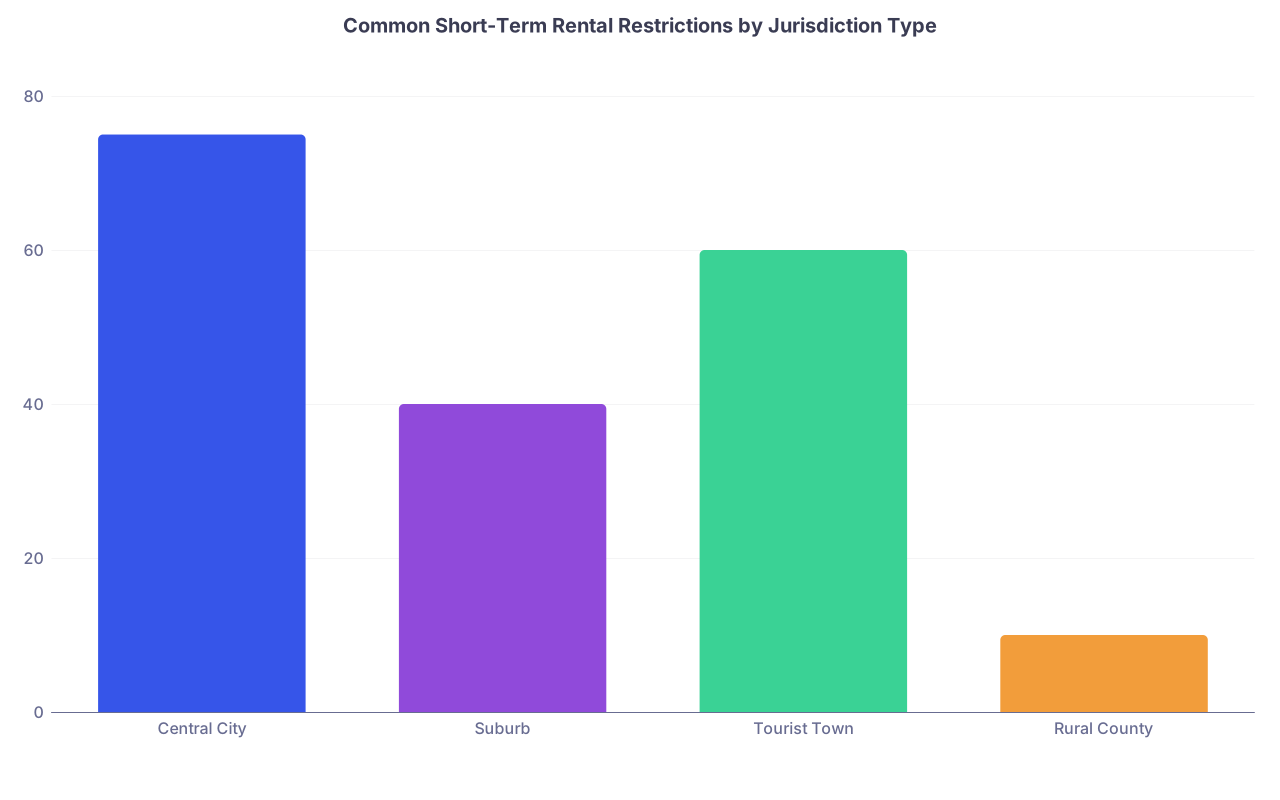
| Category | Value |
|---|---|
| Central City | 75 |
| Suburb | 40 |
| Tourist Town | 60 |
| Rural County | 10 |
(Think of those values loosely as “percent of jurisdictions with meaningful STR restrictions.” Urban cores are far more regulated than rural counties.)
Overlay districts: the silent killer
Many cities now use overlay districts:
- “No STR overlay” – total or partial bans in defined neighborhoods
- “Cap zones” – limit on number of STR permits within a radius or neighborhood
- “Primary residence overlays” – you can only STR your primary residence
You might have the right base zoning, but the overlay still blocks you from getting a license. That is why you never stop your review at “R‑3 = multifamily, I’m good.”
2. Licensing and Registration: The Paper Trail That Pays (or Sinks) You
Once you confirm zoning allows the use, licensing is where most professionals either get sloppy or overwhelmed. You cannot do that as a physician with high visibility and assets.
Licensing has three main buckets:
- STR permit or license
- Tax registrations (occupancy / hotel / sales)
- Ancillary registrations (business license, state entity, etc.)
Short‑term rental permits: what cities actually want
Most city STR programs now require:
- Application form (online or paper)
- Proof of ownership or lease and owner consent
- Floor plan with bedroom count and exits
- Proof of parking spaces (yes, including driveway vs street)
- Local contact who can respond 24/7 (often within 1 hour)
- Proof of insurance meeting specific minimums
- Safety attestations (smoke/CO detectors, fire extinguisher, egress windows)
- Neighbor notifications in some markets (Portland, parts of California, etc.)
Some also require:
- Inspection by fire or building department before license issuance
- Occupancy limits based on square footage or bedrooms
- Noise and trash plan
And they absolutely charge fees. The range I see:
- Application fee: $100–$800
- Annual renewal: $100–$1,000+ depending on city and unit count
- Per‑night or per‑bedroom surcharges in some tourist cities
Owner‑occupied vs non‑owner‑occupied categories
Many cities now split STRs into:
- Owner‑occupied (you live there most of the year) – more lenient rules
- Non‑owner‑occupied (classic “Airbnb investment property”) – heavily capped or banned in residential zones
If your property is strictly an investment, do not bank on owner‑occupied rules. Some physicians try to game this by claiming it as “primary residence” on paper while actually living elsewhere. That is a fantastic way to create insurance, tax, and fraud problems all at once.
City vs platform: do not confuse the two
Airbnb, Vrbo, and similar platforms may:
- Collect and remit local occupancy taxes on your behalf
- Provide a “host guarantee” (which is not actual insurance, by the way)
- Require certain safety features
None of that replaces:
- City STR permits
- State business registrations
- Federal / state tax reporting
Platforms make it easy to host. Cities make it hard. You answer to the city, not Airbnb.
3. Taxes Attached to STRs: Different from Long‑Term Rentals
You are already thinking about income tax, depreciation, maybe real estate professional status. Good. But STRs bring separate transaction‑level taxes you have to register for.
Typical tax categories:
- Transient occupancy tax (TOT) / hotel tax / room tax
- Local sales tax on lodging (in some states)
- State sales tax on lodging (e.g., Texas, Florida, etc.)
- Business personal property tax (furniture, fixtures, equipment) in some counties
| Location | Primary STR Tax Type | Typical Rate Range | Collected by Platform? |
|---|---|---|---|
| Austin, TX | State + city occupancy | 13–17% | Partially |
| Orlando, FL | State + county tourist | 11–13% | Often |
| Denver, CO | Lodger's + sales tax | 14–15% | Often |
| Nashville, TN | Hotel + local surcharge | 13–16% | Varies |
| Phoenix, AZ | Transient + sales tax | 12–15% | Often |
You must:
- Determine which taxes apply to you based on location and stay length
- Register for any accounts the platform does not handle
- File returns, even if the tax is fully remitted by Airbnb (some jurisdictions still want a “zero due” return)
Do not assume “Airbnb takes care of all of that.” In some jurisdictions they do, in others they only collect part of it, and in some they do nothing.
4. Insurance for Physician‑Owned STRs: Not Optional, Not Basic
Physicians have two big blind spots with STR insurance:
- Thinking the platform “guarantee” is real insurance
- Thinking a normal homeowners or landlord policy still covers them
Both are wrong once you run a real short‑term rental business.
The bare minimum coverage stack for a physician STR
You should be thinking in layers, not one policy.
Layer 1 – Property and liability at the property level
Layer 2 – Entity‑level liability (if you use an LLC)
Layer 3 – Personal umbrella coverage (for what still leaks through)
Layer 4 – Disability / income protection (because if something ties you up in litigation or wipes you out, you still need to pay your own bills)
Let’s break down the STR‑specific pieces.
4.1 Homeowners vs landlord vs STR‑specific policies
Standard homeowners (HO‑3) policies:
- Usually exclude “business use” where you charge guests to stay
- Often exclude any rental periods under 30 days
- Can cancel or deny claims when they discover STR activity
Traditional landlord policies:
- Designed for long‑term tenants, not transient guests
- May explicitly exclude STRs or “hotel / motel” type uses
You want one of:
- A true commercial policy (for larger buildings or multiple units)
- A specialty STR policy (a number of carriers now cater to Airbnb hosts)
- An endorsement specifically adding STR coverage to a landlord policy
The coverage has to match the reality: multiple unrelated guests per year, shorter stays, higher property turnover, higher liability risk (stairs, pools, alcohol, parties, etc.).
4.2 Liability limits: physicians need to think bigger
I rarely see a strong case for less than:
- $1,000,000 per occurrence / $2,000,000 aggregate general liability on the STR property
- $1,000,000–$5,000,000 personal umbrella on top of your base policies
You are a high‑earning professional. Plaintiffs’ attorneys know how to pull your NPI, see your specialty, and infer your income. You do not want to be sitting with $300k liability coverage on a property where someone ends up with a spinal injury in your pool.
4.3 Business income / loss of rents coverage
If you are counting on this STR to cover a mortgage and it goes offline for 6 months after a fire, you want business income coverage:
- Replaces lost rental income during the “period of restoration”
- Often optional – do not assume it is included
- Must be sized based on realistic occupancy and ADR, not wishful thinking
Most physicians are comfortable with disability insurance. Think of business income in the same way but for your rental.
4.4 Platform “Host Guarantee” and “AirCover”: Treat as icing only
Airbnb’s Host Guarantee / AirCover is:
- Not a regulated insurance policy
- Subject to unilateral changes in terms
- Full of exclusions (pets, fine art, cash, some liability scenarios)
I have seen too many hosts realize after a major event that Airbnb will not pay what they thought. Your real carrier should be the primary defense; platform programs are backup at best.
5. Physician‑Specific Risks: Where Medicine and STRs Collide
You have one extra layer that a regular host does not: you are a physician. That interacts with STRs in messy ways.
5.1 Guests who are patients or become patients
Scenario I have seen:
You own a nice STR near your hospital. Traveling nurses, visiting specialists, and occasionally patients’ families stay there. One night you get a message: “My dad is short of breath and has chest pain. You are a doctor, can you come look at him?”
This is a professional liability trap.
You are not operating under your hospital’s malpractice umbrella in your personal STR. If you give medical advice on site, you risk:
- Blurring boundaries between host and treating physician
- Creating the appearance of a doctor‑patient relationship in a non‑clinical setting
- Triggering questions about coverage if anything goes badly
Your house rules should be explicit: no medical advice, no representation that this is a medically supervised environment, call 911 / go to the ED for emergencies. And you should stick to that.
5.2 Branding and advertising: do not medicalize the property
Avoid:
- Marketing your STR as “physician‑supervised,” “ideal for recovery,” or “post‑operative stay friendly”
- Implying any level of medical oversight or safety beyond a normal residence
Once you start tying your medical license and medical role into your STR marketing, you invite plaintiffs’ attorneys to argue that you held yourself out as providing a certain level of care or safety.
If you deliberately want to operate a medical lodging business (e.g., step‑down or recovery housing), that is a different regulatory world altogether: health facility licensing, ADA, CMS issues, etc. Do not stumble into it by accident.
5.3 Asset protection structure: LLCs for STRs
No, an LLC is not magic. But combining:
- Correct zoning and licensing
- Proper STR insurance
- Thoughtful entity structure
creates multiple layers between a bad incident and your personal bank accounts.
Common structures physicians use:
- Single‑member LLC per property (or per group of properties in one market)
- Holding company that owns membership interests (for more complex portfolios)
- Separate professional corporation / PLLC for your medical practice, kept distinct from real estate entities
You need a local attorney who understands both real estate and asset protection. Generic “form an LLC online” advice is not enough at your level.
6. Operational Guardrails that Support Your Legal and Insurance Position
This last piece is where many hosts cut corners. Your day‑to‑day operations determine how strong your defense looks if something goes wrong.
Key elements to formalize:
- Written house rules that are specific and enforceable
- Documented safety measures:
- Working smoke and CO detectors on every level
- Fire extinguisher in kitchen and mechanical areas
- Clear emergency exit instructions
- Pool / hot tub rules posted visibly
- Regular documented inspections (e.g., between each guest or monthly) to catch hazards
- Guest screening practices (no discrimination, but no blind acceptance of obvious party risks either)
- Noise and occupancy monitoring that does not violate privacy but helps you keep control

| Step | Description |
|---|---|
| Step 1 | Identify Property |
| Step 2 | Check Zoning and Overlays |
| Step 3 | Review HOA and Lease Rules |
| Step 4 | Walk Away |
| Step 5 | Apply for STR Permit |
| Step 6 | Register for Taxes |
| Step 7 | Set Up STR Insurance |
| Step 8 | Form LLC and Align Ownership |
| Step 9 | Install Safety Features |
| Step 10 | Publish Listing with Clear Rules |
| Step 11 | Ongoing Inspections and Renewals |
When an insurer or city investigator looks at your operation, they see either:
- A physician running a well‑documented, compliant business, or
- A high‑net‑worth individual treating this like a casual side gig
You want to be the first one.
FAQs
1. Can I list my home on Airbnb occasionally without changing my insurance?
If you are truly “occasional” – a few weekends per year – and you live there as your primary home, some carriers will endorse the policy to permit this, or they will quietly tolerate it. Many will not. You need to call your carrier and ask explicitly about “short‑term rental to paying guests.” If they say no or hedge, you need an STR endorsement or a different policy. Do not assume silence equals coverage.
2. If my city bans STRs, can I do 30+ day “mid‑term rentals” instead?
Often yes, but you must verify the definition of “short‑term” in that jurisdiction. Many cities define STRs as stays under 30 days, 28 days, or even under 90 days. If you are consistently above that threshold, you are usually in long‑term / mid‑term territory and outside the STR ordinance. However, zoning could still limit “boarding houses” or “rooming houses,” and your insurance policy still must match the actual use. Again, you read the code, not Reddit.
3. Do I really need an LLC if I carry a $5M umbrella policy?
You could operate without an LLC and rely entirely on insurance and proper operations. Many small hosts do. For a physician with higher income and non‑retirement assets, I consider that a poor risk choice. LLCs add nuisance value: they make it harder to reach your personal balance sheet and sometimes improve settlement dynamics. Ideally you have both: strong insurance and a reasonably designed entity structure. It is not either/or.
4. How risky is it to run an unlicensed STR “until the city notices”?
High and getting higher. Cities now use scraping tools, public Airbnb data, and neighbor complaints to identify unlicensed STRs. Common consequences: daily fines, forced shutdown, and, in some cases, ineligibility for future licensing at that address. If your name is tied to a medical license, you also do not want your name in local news as part of an “illegal Airbnb crackdown.” If the numbers only work by dodging licensing, the deal is bad. Walk away.
5. If a guest sues me, will my malpractice insurer get involved?
Generally no. Malpractice coverage responds to claims arising from professional medical services. Hosting someone at a rental property is not medical care. Unless you are doing something truly reckless like providing medical procedures there, your property and liability policies would respond, not malpractice. Which is exactly why you must separate your doctor role from your host role and avoid anything that looks like providing care at the STR.
Key points:
- Zoning and overlays decide if a short‑term rental is even possible; you verify them directly with code and the planning department, not by vibes or your agent’s opinion.
- Licensing, tax registration, and STR‑specific insurance form the non‑negotiable compliance stack; platforms do not replace any of them.
- As a physician, your risk surface is larger – you need clear boundaries between your medical practice and your STR business, robust liability coverage, and usually an LLC structure to justify playing in this space.