Cost segregation is the most underused tax weapon in a physician real estate investor’s arsenal. Most high-income doctors are overpaying six figures in taxes simply because nobody ever explained this one concept properly.
Let me fix that.
I am going to walk through cost segregation the way I would with a cardiologist in private practice who just bought a $3M medical office building and is tired of wiring $400k+ to the IRS every year. No fluff. Just what it is, when it works, when it backfires, and how to actually execute it without getting burned.
1. The Core Idea: What Cost Segregation Actually Does
Straight to it:
Cost segregation is an engineering-based tax strategy that accelerates depreciation on parts of a building by reclassifying them from “real property” (39-year/27.5-year life) to shorter-lived “personal property” (5, 7, 15-year lives).
Why you care: shorter life = bigger depreciation deduction right now instead of slowly over decades.
Here is the rough breakdown for a typical commercial building (e.g., medical office) bought for $2,500,000 (excluding land):
- Without cost segregation: almost all of that $2.5M is depreciated over 39 years.
- With cost segregation: you carve out portions as:
- 5-year property (carpet, cabinetry, specialty lighting, certain electrical)
- 7-year property (some office furniture/equipment if included in purchase)
- 15-year property (land improvements: parking lot, sidewalks, landscaping)
- Remaining 27.5 or 39-year building structure.
Instead of writing off ~2.5–3.6% of the property value each year, you may front-load 20–40% of the value into the first 5–15 years. And with bonus depreciation, a huge chunk can come even in year 1.
For a high-income physician, that timing difference is everything.
2. Why Cost Segregation Is Different for Physicians
You are not a typical investor. Your constraints are different:
- You already sit in the top tax bracket.
- You have high, relatively stable W-2 or 1099 income.
- You often invest late (mid-30s to 50s), so compounding time is shortened.
- You may have your own building (office, surgery center) and/or LP stakes in syndications.
The twist: depreciation from real estate is usually “passive.” Physician income is usually “non-passive.” The IRS treats them differently. That is where a lot of doctors get tripped.
Three key questions you must answer before going wild with cost seg:
- Are your real estate losses passive or non-passive?
- Do you or your spouse qualify as a Real Estate Professional (REP)?
- Even if passive, can you still use the losses to offset other passive income?
Let me break these down.
3. Passive vs Non-Passive: The Real Bottleneck
If you ignore this section, you will misunderstand your cost segregation benefit by a factor of 10. I have seen that happen more than once.
The basic rules
- Passive income: from rental real estate or businesses you do not materially participate in.
- Non-passive income: W-2 physician salary, 1099 locums, practice income where you materially participate.
Default IRS rule: rental real estate = passive.
Passive losses can only offset passive income, not W-2/1099 income… unless:
- You qualify as a Real Estate Professional AND
- You materially participate in those rental activities.
Otherwise, your big juicy cost seg–generated losses mostly get trapped as passive losses that carry forward to future years.
Are they worthless? No. But they are not “I wiped out $400k of my W-2 income” magical either—unless you plan for it.
4. The Real Estate Professional Status (REPS) Problem
For most full-time physicians, YOU will not qualify as a Real Estate Professional. The hours requirement kills that dream.
To qualify for REPS (under IRC §469):
- More than 50% of your personal services performed in trades or businesses must be in real property trades or businesses; and
- You must perform more than 750 hours of services in real property trades or businesses during the year.
If you are working 2,000+ clinical hours as a hospitalist or surgeon, you are not going to hit the “more than half of your time” in real estate. That is reality.
The workaround that actually shows up in real life:
Your spouse qualifies as a Real Estate Professional, and you file jointly. Then their REPS status applies to both of you as a unit.
This is very common among dual-career couples where:
- Physician spouse: full-time clinical, high income.
- Other spouse: flexible schedule, shifts into managing rentals / acquisitions / construction oversight.
When the spouse qualifies as REP and materially participates in specific rentals, the losses from those “grouped” rentals can become non-passive and offset your combined W-2/1099 income.
That is when cost segregation turns into a six-figure tax swing.
5. The Mechanics: How Cost Segregation Is Actually Done
Let’s get specific. This is not “my CPA does something.” Here is what actually happens.
Step 1: Identify a qualifying property
Basic requirements:
- Depreciable property: typically a building (residential rental, medical office, surgery center, mixed-use, short-term rental in some cases).
- Held for business or income production (not your primary residence).
- Acquisition usually above $500k–$750k for cost-effectiveness (there are exceptions).
Step 2: Hire a cost segregation firm
And yes, the vendor matters. The IRS expects:
- An “engineering-based” study, not a swag estimate.
- Detailed component breakdown: electrical systems, flooring, millwork, plumbing, site work, etc.
- Supporting documentation: plans, invoices if available, photos, inspection notes.
Cheap, back-of-the-envelope “studies” prepared by someone with no engineering methodology are precisely what get shredded in audits.
Costs:
For a $1–5M property, I commonly see fees range from $5,000–$15,000. For larger portfolios, it can go higher, but often per-building costs drop with scale.
Step 3: Property analysis and site visit
A legitimate study typically includes:
- Review of:
- Closing statements
- Appraisals
- Construction costs if it was a build-out
- Architectural/engineering drawings where available
- Site visit:
- Visual inspection
- Photos
- Confirmation of building use and components
- Engineering-based cost breakdown:
- Allocation of total purchase price (minus land) into:
- 5-year personal property
- 15-year land improvements
- 27.5/39-year structural components
- Allocation of total purchase price (minus land) into:
Step 4: Report delivered to your CPA
They generate a formal report that:
- Summarizes total reallocation
- Lists detailed component categories and lives
- Provides depreciation schedules by year
- Cites relevant IRS guidance and case law
Your CPA then uses this to:
- File Form 4562 (Depreciation and Amortization)
- Potentially file Form 3115 (Change in Accounting Method) if the property was placed in service in a prior year and you are doing a “look-back” study (more on that in a bit).
6. Bonus Depreciation: Where the Big Numbers Come From
The phrase you are probably hearing from syndication webinars and “doctor real estate masterminds” is “bonus depreciation.”
Here is what that actually means and how it changed:
- Historically, MACRS assets with recovery periods of 20 years or less could qualify for bonus depreciation.
- Under the Tax Cuts and Jobs Act (TCJA):
- 100% bonus depreciation applied to qualifying property placed in service after 9/27/2017 and before 1/1/2023.
- Phase-out schedule after 2022:
- 2023: 80% bonus
- 2024: 60% bonus
- 2025: 40% bonus
- 2026: 20% bonus
- 2027+: 0% bonus, unless law changes
What matters:
The 5-year and 15-year property identified in a cost segregation study often qualifies for bonus depreciation. So a large chunk of that can be written off in year 1.
Example with a $2,500,000 building (excluding land), 39-year life, placed in service in 2024:
- Cost seg results:
- 20% as 5-year property → $500,000
- 10% as 15-year property → $250,000
- 70% as 39-year property → $1,750,000
In 2024 (bonus at 60%):
- Bonus-eligible portion of the 5- and 15-year property:
- 60% of $750,000 = $450,000 year-1 deduction from bonus
- Remaining of that $750,000 is depreciated on normal 5/15-year schedules.
- Plus your normal 39-year depreciation on the $1,750,000.
So your year-1 depreciation might look like:
- Bonus: $450,000
- Normal depreciation on short-life property (prorated): say ~$60,000
- Normal depreciation on 39-year portion: ~$44,872 (1.5 months convention aside, roughly 1/39)
Year-1 total: roughly $550,000 of depreciation.
Without cost seg + bonus: maybe ~$64,000 total.
That is the delta you are playing with.
7. Numeric Case Study: High-Income Physician and Medical Office Building
Let’s walk a realistic scenario.
- Physician: Orthopedic surgeon, married, MFJ, combined taxable income pre-depreciation ~$900,000.
- Marginal tax rate federal + state: ~45% all-in.
- Purchase: $3,000,000 medical office building in 2024.
- Allocate $600,000 to land, $2,400,000 to building.
- Cost seg study:
- 22% 5-year property → $528,000
- 13% 15-year property → $312,000
- 65% 39-year property → $1,560,000
2024 bonus depreciation = 60%.
Bonus-eligible:
0.60 × ($528,000 + $312,000) = 0.60 × $840,000 = $504,000
Regular depreciation 2024 (simplified):
- Remaining 40% of 5-/15-year property:
- 0.40 × $840,000 = $336,000 spread over 5 and 15 years
- Year 1 portion maybe around ~$45,000 (rough estimate)
- 39-year portion: 1/39 × $1,560,000 ≈ $40,000 (simplified)
Total year-1 depreciation: ~$504,000 + $45,000 + $40,000 = ~$589,000
Now, what happens depends on passive vs non-passive classification.
Scenario A: No REPS, no material participation
- Rental activity is passive.
- That ~$589,000 becomes a passive loss (or reduces passive income from that property if it is cash-flow positive).
- If the building throws off, say, $80,000 of net positive rental income pre-depreciation:
- Taxable result: $80,000 income – $589,000 depreciation = $509,000 passive loss.
- That $509,000 passive loss:
- Cannot offset W-2/1099 physician income.
- It carries forward to future years to offset:
- Future passive income, and
- Gain upon sale of this building.
- Tax impact now: lower passive tax, but your main wage income is unchanged.
Still not bad, but not explosive.
Scenario B: Spouse qualifies as Real Estate Professional and materially participates
Now the rental losses can become non-passive and offset your joint income.
Same numbers:
- $589,000 depreciation
- $80,000 rental income
- Net $509,000 loss
Effect:
- $900,000 ordinary income – $509,000 = $391,000 taxable income.
- At 45% marginal rate, that $509,000 loss saves roughly $229,000 in taxes in that one year.
That is what people mean when they say, “We bought a building and knocked $200k off our tax bill.”
You do not get that without REPS + material participation.
8. Where Cost Segregation Fits in a Physician’s Overall Strategy
You should never view cost segregation in isolation. It is one lever inside a broader plan.
Here is how it usually fits:
High clinical income phase (early-mid career)
- Goal: aggressively reduce current tax liability while building a real estate base.
- Tactics:
- Spouse obtains REPS.
- Acquire 1–3 sizeable properties (or LP positions) that can support cost seg.
- Use bonus depreciation to offset W-2/1099 income.
Growth/scale phase
- Goal: stack assets and passive income.
- Tactics:
- Reinvest tax savings into more properties.
- Consider periodic cost seg on new acquisitions or major renovations.
- Start planning exit timing for harvesting or managing suspended losses.
Late-career / pre-retirement
- Goal: transition from high income to flexible work / partial retirement.
- Tactics:
- Use existing passive loss carryforwards to offset capital gains on sales.
- Intentionally time dispositions of highly appreciated properties in years when you have large suspended passive losses.
Retirement / reduced clinical work
- Goal: tax-efficient drawdown.
- Tactics:
- Levels of W-2/1099 drop.
- Real estate income (some still partially sheltered by remaining losses) becomes core.
- Potential for 1031 exchanges to continue deferring.
| Career Phase | Primary Benefit | REPS Needed for Max Impact? |
|---|---|---|
| Early High-Income | Current tax reduction | Yes, ideally spouse |
| Mid-Career Growth | Reinvestment of savings | Strongly beneficial |
| Pre-Retirement | Using suspended losses | Helpful but not required |
| Retirement / Low Income | Shelter passive income | Less critical |
9. Using Cost Segregation in Syndications and Funds
Most physicians are not buying $5M buildings directly. They are wiring $50–250k into syndications or funds.
Here is how cost segregation plays out there:
- The sponsor (GP) orders the cost segregation study on the property.
- The bonus depreciation and accelerated deductions flow proportionally to LP investors on the K-1s.
- If you invested $200,000 in a deal, you may see year-1 paper losses of 50–80% of your invested capital, sometimes more.
For example:
- $200,000 in a multifamily syndication.
- Year-1 K-1 shows a passive loss of -$140,000.
That can:
- Offset passive income from other rentals or syndications.
- Carry forward if you do not have enough passive income to absorb it.
- Offset W-2/1099 income only if you or spouse has REPS and you have appropriately grouped the activities and materially participate where required (this part is more nuanced and must be coordinated with a good CPA).
Watch the marketing. If a syndicator is telling you, “This will wipe out your clinical income taxes,” and they are not walking through REPS, passive/non-passive rules, and material participation thresholds, that is a red flag.
10. Short-Term Rentals: A Special Corner Case
Short-term rentals under certain conditions can generate non-passive losses without REPS. This is one area many physician investors are actively exploiting.
Very high level:
- If average guest stay is 7 days or less (or under 30 with substantial services), the activity may not be treated as a “rental activity” under §469.
- Then you look at material participation tests instead of REPS.
- You can have a non-passive business that is a short-term rental and still do a cost seg study, use bonus depreciation, and offset non-passive income (clinical) if you truly materially participate.
Caveat: this area is aggressively marketed, frequently misunderstood, and increasingly scrutinized by the IRS. The documentation and participation logs need to be real, not fabricated post hoc.
But yes, for some physicians, cost segregation on a well-run short-term rental portfolio can generate massive tax offsets even without REPS.
11. Risks, Traps, and Why the IRS Actually Cares
This is where most glossy podcast conversations go silent. Cost segregation is powerful, but it is not free money.
Three big risk categories:
- Poor-quality studies
- “Rule-of-thumb” allocations with no engineering basis.
- No site visit, no documentation, vague component descriptions.
- Aggressive classification of obviously structural components as 5-year property.
This is what tanks in an audit. If a firm cracks a $5,000 fee by sending you a 10-page PDF with no detail, you got what you paid for.
- Misunderstanding passive loss rules
- Physicians assuming the depreciation will crush W-2 taxes when they do not have REPS or material participation.
- Ending up with large suspended losses they were not expecting.
Suspended losses are not bad, but they are not what you thought you were buying.
- Depreciation recapture at sale
- When you sell, the IRS may “recapture” depreciation at higher ordinary rates on personal property components.
- Accelerating depreciation now can increase the portion subject to recapture later.
This does not make the strategy “bad.” It just means you are trading timing and rate arbitrage. You get a huge deduction now (at high income, high marginal rate), in exchange for potentially higher recapture later, often at a time when:
- Your overall income is lower.
- You may use 1031 exchanges.
- You might harvest losses elsewhere.
But if someone tells you, “This is free; there is no downside,” that is wrong.
12. Look-Back Studies and Form 3115
You do not have to do cost segregation only in the year you buy.
If you bought a building 3–10 years ago and never did a study, you can do a “look-back” cost segregation and file a change in accounting method via Form 3115.
Mechanics:
- Cost seg firm does the same type of study.
- They calculate what depreciation you should have taken if you had done cost seg from year 1, versus what you actually took.
- The difference is a “catch-up” deduction (Section 481(a) adjustment), taken all at once in the current year.
That can produce a large one-time deduction without amending prior-year returns.
This is often fantastic for physicians who:
- Bought their office building years ago.
- Recently became very high income (new partnership, ASC ownership, etc.).
- Now want a large deduction in a particular year.
Again, the passive vs non-passive framework still applies.
13. What a Good Execution Plan Looks Like (Step-by-Step)
Let me outline a clean, no-drama approach for a high-income physician couple.

| Step | Description |
|---|---|
| Step 1 | Assess Current Income and Rentals |
| Step 2 | Evaluate REPS for Spouse |
| Step 3 | Use for Passive Income and Future Gains |
| Step 4 | Acquire Target Property or Syndications |
| Step 5 | Order Engineering Based Cost Seg Study |
| Step 6 | Coordinate With CPA for Bonus Depreciation |
| Step 7 | Monitor Passive Losses and Recapture |
| Step 8 | Need to Offset W2 Income? |
| Step 9 | Can Spouse Meet REPS Hours? |
Practically, your sequence:
- Sit with a tax-focused CPA who understands physicians and real estate.
- Decide if REPS is realistic for you or spouse in the next 1–3 years.
- Size your acquisitions:
- If spouse will have REPS: aim for properties large enough that cost seg meaningfully reduces your joint tax bill (often $1M+ per property, or multiple smaller ones).
- If no REPS: still worthwhile, but goal is sheltering passive income and planning future exits.
- Select quality properties, not just “tax plays.”
- Engage a reputable cost seg firm:
- Ask if their studies have survived audits.
- Ask about their methodology, site visits, detailed reporting.
- Time your acquisitions strategically:
- High-income year? Push one or two big properties into service before year-end.
- Build an internal “ledger” of:
- Depreciation taken
- Passive loss carryforwards
- Anticipated recapture exposure on each property
- Reassess annually with your CPA:
- Are you using losses effectively?
- Any upcoming sales that will trigger recapture?
- Any need to pair sales with new acquisitions or with other harvested losses?
This is what real planning looks like, not just “I heard cost seg saves taxes.”
14. How Much Should You Expect to Pay and Save?
Let me anchor expectations with a simple comparison.
| Building Cost (Excl. Land) | Study Cost | Year-1 Extra Depreciation | Approx. Tax Savings (45% Rate) |
|---|---|---|---|
| $1,000,000 | $6,000 | $200,000 | $90,000 |
| $2,500,000 | $10,000 | $500,000 | $225,000 |
| $5,000,000 | $18,000 | $1,200,000 | $540,000 |
Does it always work out this cleanly? No. But if your savings are not at least 10x the study cost over the first couple of years, something is off:
- Wrong property
- Poor study
- No REPS when you assumed otherwise
- Or your CPA is not applying it properly
15. Documentation and Audit Defense
If you are going to swing for six-figure tax reductions, behave like someone who expects the IRS might look.
What I want to see in a physician client’s file:
- Full cost segregation report (not just summary tables).
- Evidence of:
- Site visit (photos, notes, signatures).
- Engineering methodology, not just “percent allocations.”
- REPS documentation (if applicable):
- Detailed time logs
- Description of activities performed
- Supporting calendar entries, emails, contracts
- Material participation evidence:
- Management decisions
- Communications with contractors, tenants, PMs
- Records of hours spent on each property
- Short-term rental logs (if using that route):
- Guest stays, average nights
- Services provided
The goal is simple: if an auditor asks, you hand over a binder (physical or digital) that looks boringly thorough. Boring wins audits.
16. Visualizing the Tax Impact Over Time
Here is a conceptual view of tax liability with and without cost segregation for a high-income physician owning a large building.
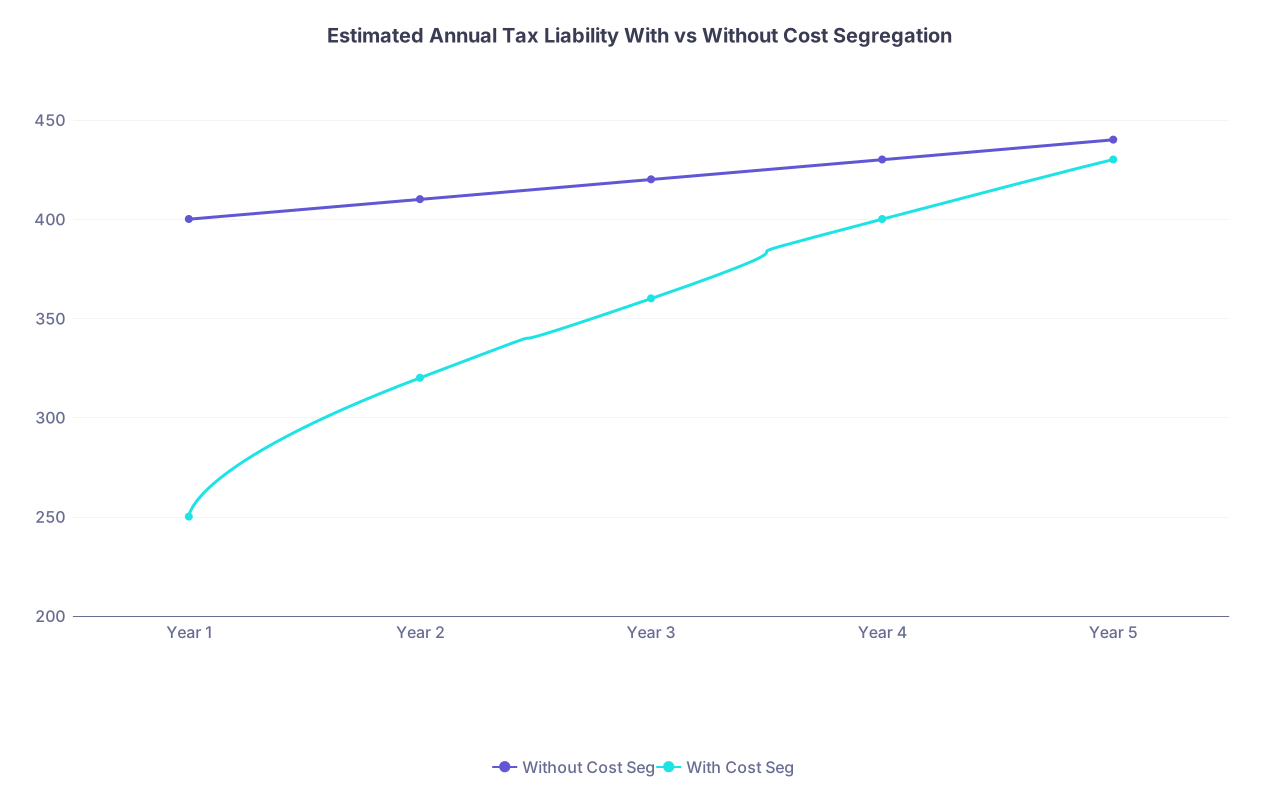
| Category | Without Cost Seg | With Cost Seg |
|---|---|---|
| Year 1 | 400 | 250 |
| Year 2 | 410 | 320 |
| Year 3 | 420 | 360 |
| Year 4 | 430 | 400 |
| Year 5 | 440 | 430 |
Numbers here are just directional, but the pattern is real:
- Large front-loaded savings.
- Gradually converging lines later as depreciation “catches up.”
- Potential bump at sale from recapture, which you plan for.
17. When Cost Segregation Is a Bad Idea
Yes, there are times it is dumb. Use some judgment.
Situations where I either skip it or think very hard:
You plan to sell the property in 1–3 years
- Accelerating depreciation then triggering quick recapture can be a wash or worse, depending on rates and timing.
You are in a low tax bracket now but expect much higher income later
- Example: still in training or early attending year, planning big jumps.
- Taking huge deductions now when your rate is 24% instead of 37–45% may not be optimal.
Highly leveraged property with minimal cash flow and no REPS
- You end up with a mountain of suspended passive losses that you do not actually need yet. Not harmful, but not compelling.
Poor-quality asset
- Using tax benefits to justify buying a mediocre building is how you lose money with style. The underlying deal still has to make economic sense.
18. Pulling It Together
Let me distill this into what you, as a high-income physician, should walk away with.
Cost segregation is not a gimmick. It is a legitimate, engineering-based reclassification of building components that can legally pull forward hundreds of thousands of dollars in depreciation deductions.
The real power for physicians comes when those accelerated losses can offset non-passive income. That generally requires either:
- A spouse with genuine Real Estate Professional Status and material participation, or
- Carefully structured, materially participated short-term rental activity.
Execution quality matters. Engage a reputable cost segregation firm, pair it with a tax advisor who truly understands physician real estate, and plan your property acquisitions and sales with a multi-year lens. Used correctly, cost segregation is not just a line item; it can change your entire tax and wealth trajectory.