
The most dangerous real estate syndication for physicians is not the obvious scam. It is the shiny, “doctor‑friendly” deal with red flags you never learned to recognize.
You were trained to read EKGs, not private placement memorandums. Sponsors know that. Some build entire capital‑raising machines around busy, high‑income professionals who will not question enough.
Let me walk you through the mistakes I see physicians repeat. Over and over.
If you avoid these, you will already be ahead of most “accredited investors” in your call room.
1. Blind Trust in a Medical Connection
The first and worst mistake: equating “doctor involved” with “risk reduced.”
You know the pitch:
- “Founded by two ER docs just like you.”
- “We only raise capital from physicians.”
- “Healthcare professionals community syndication.”
You relax. You stop asking hard questions. That is exactly when you are most vulnerable.
Red flags here
No deep real estate track record, just medical credentials
If the sponsor’s bio leads with:
- Their specialty
- Their fellowship
- Their hospital appointments
…and only then gives a vague “15+ years in real estate,” that is backward.
In a syndication, you are not investing in their MD. You are investing in their operator skills.Ask:
- How many full business cycles have they survived? (2008? 2020?)
- How many deals have they exited? At what IRRs? What went wrong on the weakest one?
- Have they ever lost investor money or gone full‑cycle below projections?
Co‑GP or “advisor” physicians with no real control
A sneaky structure:
- Real estate operator brings on a “doctor partner”
- The doctor puts their face and name on the deck, hosts webinars, “refers” colleagues
- But they:
- Do not sign on the loan
- Do not control the asset management decisions
- Do not control distributions or major capital events
You think: “My colleague is in it, must be safe.”
Reality: you are trusting someone who may have no legal authority to protect your capital.If you cannot see, in writing, what fiduciary responsibility that physician‑partner actually has, treat them as a marketing channel. Not a safeguard.
Doctor-only marketing channels
Watch for:
- Deals only promoted in:
- Physician Facebook groups
- WhatsApp call group chats
- Physician “financial freedom” courses
- Sponsors who brag about “raising $50M from physicians” rather than talking about their NOI growth and occupancy track record.
That is not a business model built on performance. That is a business model built on access to high‑income, low‑time, low‑experience investors. You.
- Deals only promoted in:
2. Unrealistic Projections Hidden Behind Pretty Slides
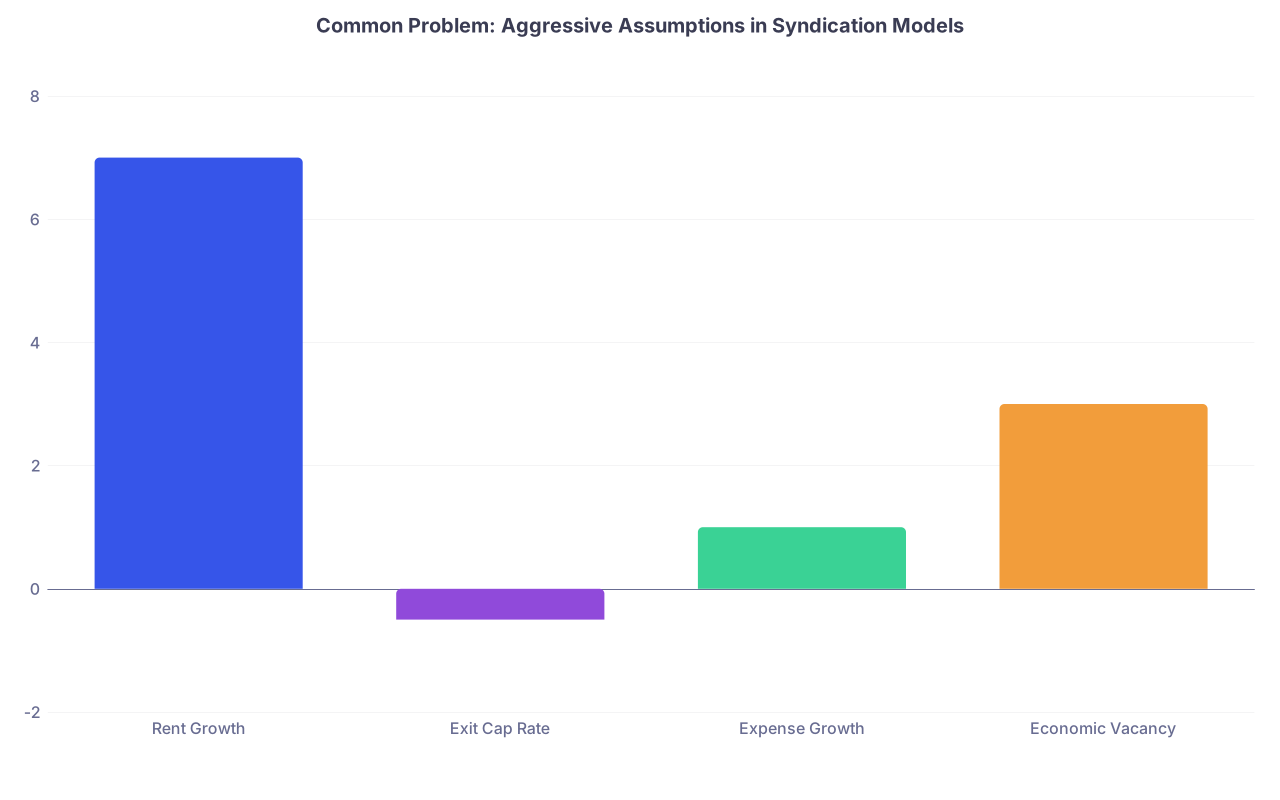
You would never accept a research paper that only shows the abstract and conclusion with no methods section. Yet many physicians commit six‑figure investments off a deck that is basically marketing copy with spreadsheets lightly glued on.
| Category | Value |
|---|---|
| Rent Growth | 7 |
| Exit Cap Rate | -0.5 |
| Expense Growth | 1 |
| Economic Vacancy | 3 |
The most abused assumptions
Aggressive rent growth
One of the classic sins:
- Pro forma assumes 4–7% rent growth every year for 5 years
- The property is already at the top of the local rent range
- The market is facing new supply or economic slowdown
Insist on:
- Actual trailing 12‑month rent roll
- Market rent comps with addresses
- A scenario showing flat or negative rent growth and what that does to returns
Cap rate compression fantasy
If the deck shows:
- Entry cap rate: 5.0%
- Exit cap rate in 5 years: 4.5%
Walk very carefully.
Reasonable underwriting usually:
- Assumes exit cap is equal or higher than entry (i.e., more conservative)
- At least adds 0.25–0.50% to entry cap for exit assumptions
If projected returns fall apart when you increase the exit cap by 0.5%, the deal is fragile.
Understated expenses
Common tricks:
- Using unrealistically low property taxes after a big value‑add plan (where taxes will get reassessed higher)
- Assuming payroll / repairs and maintenance much lower than comparable properties
- Ignoring insurance shocks (especially in Florida, Texas, coastal markets)
Ask them point‑blank:
- “What property tax rate and reassessment assumption did you use?”
- “What is your insurance quote, not your estimate?”
- “Show me your T‑12 vs pro forma operating expenses line by line.”
Ignoring recession scenarios
If there is no downside case in the deck, that is a red flag by itself.
You want to see:
- Stress tests:
- 10–20% rent drop
- Higher vacancy
- Higher interest rates at refinance
- Clear narrative: “If X happens, here is Plan B and C.”
Absence of this? You are looking at optimism, not analysis.
- Stress tests:
3. Opaque Fees and Misaligned Compensation
Physicians are used to coded billing, not capital stacks. Sponsors count on that confusion.
You must know exactly where incentives might push behavior in the wrong direction.
| Fee Type | Healthy Range (Often Reasonable) | Red Flag Range (Be Very Wary) |
|---|---|---|
| Acquisition Fee | 1–3% of purchase price | 4%+ or layered on sub‑fees |
| Asset Management | 1–2% of effective gross income | 2%+ with poor reporting |
| Disposition Fee | 0.5–1% of sale price | 1.5%+ plus other exit fees |
| Loan Guarantor | 0.5–1% of loan amount | Large % without risk sharing |
| Refinance Fee | 0–1% of new loan amount | 1%+ plus high asset fees |
Fee structures that should make you pause
High fees with weak preferred return
If you see:
- Acquisition fee 3–5%
- Asset management fee 2%
- Other “consulting” or “construction management” fees
- Preferred return only 6–7% (or none at all)
The deal may be designed to pay the sponsor well regardless of performance, and pay you well only if everything goes right.
Fees on fees
Common layering:
- The sponsor takes an acquisition fee, plus the property management company they own charges a management fee, plus they charge a “project management” fee for renovations.
- Or they get paid both at buy, during hold, and at sell, all out of your capital.
Fees are not inherently bad. Hidden or stacked fees are.
Promote structures that punish downside
Some structures:
- Give the sponsor 30–40% of upside profits after a relatively low IRR hurdle (say 8% or 10%)
- But do not have clawbacks if the deal returns are front‑loaded and then collapse
- Or allow the sponsor to get paid on capital events (like a refinance) even if the total project IRR later ends up poor
Ask directly:
- “Under what scenarios do you get paid your promote if the total project IRR is below X?”
- “Is there a true preferred return with catch‑up, or is it just a target?”
4. Legal Docs You Do Not Actually Read (and They Know It)
The most critical red flags are not in the slide deck. They are in the operating agreement, PPM (Private Placement Memorandum), and subscription docs. Where most physicians’ eyes glaze over.
This is where you get hurt.
Governance and control traps
Pay careful attention to:
Unilateral sponsor authority
Phrases like:
- “Manager may, in its sole discretion…”
- “Without prior consent of the members…”
- “Manager is not obligated to notify members before…”
On key issues:
- Major capital expenditures
- Refinancing terms
- Changing property managers
- Selling the asset earlier or later than projected
You do not want a structure where the sponsor can materially change the business plan without any investor approval threshold.
Weak removal provisions
Most operating agreements technically allow removal of the manager. The trick is in the thresholds and mechanics.
Red flags:
- Requires 75–90% of investor interests (nearly impossible to organize)
- Requires long notice and cure periods that favor the sponsor
- Ties your ability to sue or remove to heavy arbitration constraints in the sponsor’s home jurisdiction
Indemnification and liability language
Watch for overbroad clauses where:
- The manager is indemnified for almost everything
- Gross negligence, willful misconduct, or fraud carve‑outs are vague or missing
- Legal fees for disputes are always borne by the investor unless the sponsor is proven at fault in a very narrow way
This is where a real estate attorney earns their fee. Do not skip this.
Distribution and cash flow rules
Oversights here lead to nasty surprises:
- Waterfall distribution language that:
- Does not clearly describe the order:
- Return of capital
- Preferred return
- Catch‑up
- Promote
- Allows sponsor discretion to hold back cash “for reserves” without clear policies
- Does not clearly describe the order:
- No clarity on:
- How quickly you receive distributions after quarter‑end
- Treatment of tax distributions (if any)
- What happens in a capital call (if they have that right)
If you do not know what a capital call is and the legal consequences of refusing it in that specific deal, you are walking blind.
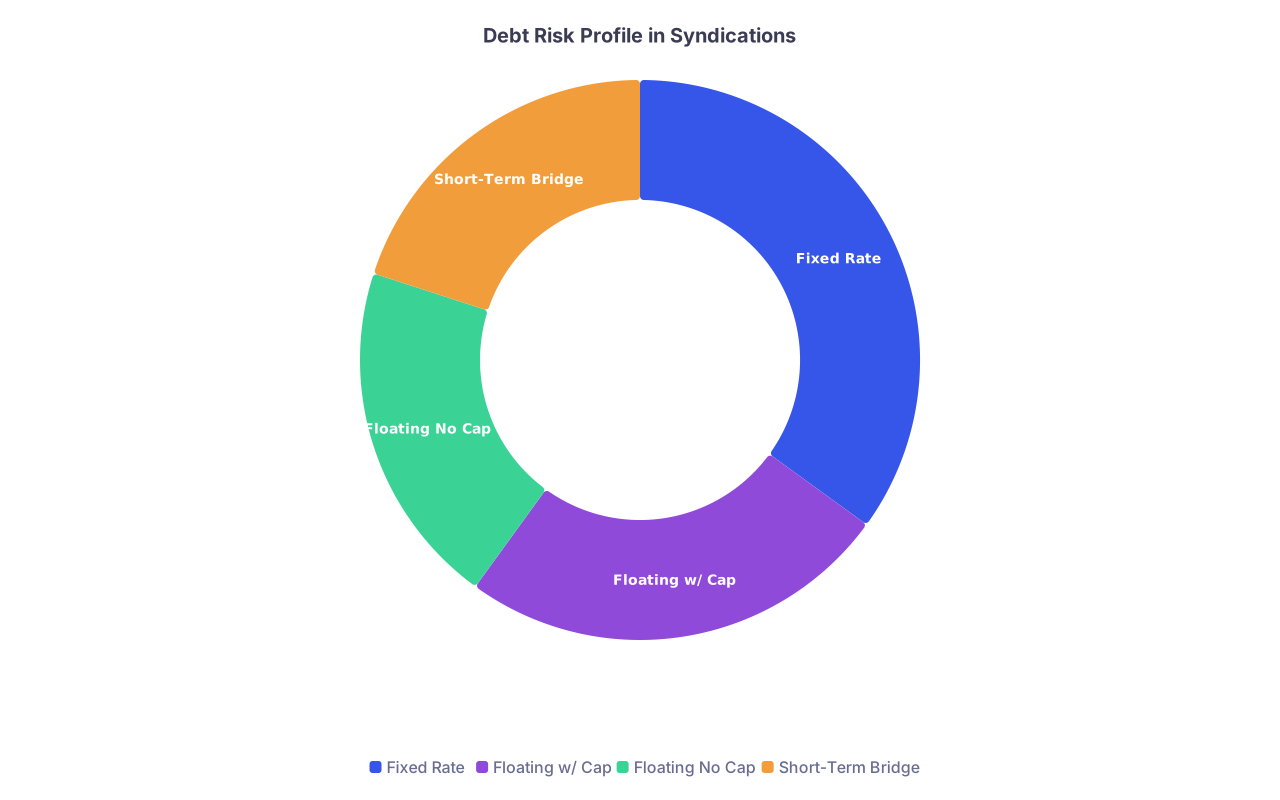
5. Debt Structures That Can Destroy an Otherwise Decent Deal
Many physicians look at:
- Projected cash‑on‑cash
- IRR
- Equity multiple
…and completely ignore the structure of the debt. That is like reviewing a surgical plan and ignoring the patient’s anticoagulation.
| Category | Value |
|---|---|
| Fixed Rate | 35 |
| Floating w/ Cap | 25 |
| Floating No Cap | 20 |
| Short-Term Bridge | 20 |
High‑risk debt red flags
Short‑term bridge loans with optimistic exit
Warning signs:
- 2–3 year term with one extension option
- Business plan requires:
- Heavy renovations
- Lease‑up
- Refinance or sale at much higher valuation
- Interest‑only payments during the term
If market freezes (like in 2022 with rate spikes), you are stuck:
- Refinancing at much worse terms
- Or forced to sell into a weak market
- Or facing a capital call to avoid default
Floating‑rate debt without proper rate caps
Ask three questions:
- Is the interest rate fixed or floating?
- If floating, is there a purchased interest rate cap? At what strike and for how long?
- What happens when that cap expires?
If they say:
- “We will probably buy a cap later.”
- Or they budget an unrealistically low cost for the cap (these got very expensive recently)
That is not risk management. That is wishful thinking.
High leverage with thin DSCR
Learn one ratio: Debt Service Coverage Ratio (DSCR)
- DSCR < 1.25 is thin
- DSCR < 1.10 is dangerous
If the pro forma DSCR is barely above 1.0 even with rosy assumptions, any small hiccup can push the deal into violation of loan covenants.
6. Reporting, Transparency, and Sponsor Behavior
A sponsor shows their real nature when things go wrong. The problem? You only find that out after wiring the money.
You can still spot early clues.
Behavioral red flags
Slow, vague communication pre‑investment
If it takes:
- Days to answer basic questions
- Or answers are hand‑wavy (“We will work that out later,” “Our attorney is revising that”)
- Or they seem annoyed by pointed questions
Expect worse after they have your funds.
No clear reporting cadence
At minimum you want:
- Quarterly financials:
- Income statement
- Rent roll
- Occupancy
- Major expenses and CapEx spend
- A written update that:
- States actual vs pro forma results
- Explains variances
If they promise only “regular updates” with no specifics, ask for example reports from existing deals.
- Quarterly financials:
Over‑polished, under‑detailed marketing
Watch out for:
- Slides full of stock photos, buzzwords, and testimonials
- No detailed operating budget
- No rent roll sample
- No loan term sheet
Style over substance is a big early‑stage red flag.
7. Physician‑Specific Psychological Traps
Your training actually makes you more vulnerable to certain investing mistakes.
Overconfidence in pattern recognition
You are used to:
- Seeing patterns on imaging
- Making fast decisions in the ED
- Trusting your gut
In syndications:
- The numbers do not care about your instincts
- The legal docs do not yield to charisma
- Your partner’s “good guy” status does not change a bad capital stack
Do not confuse clinical judgment with underwriting competence.
Herd behavior among colleagues
You know the hallway conversations:
- “Our whole group is in this deal, you should be too.”
- “Three cardiologists I trust have already wired money.”
- “The chief of staff is a GP in the sponsor’s last five deals.”
The red flag:
- No one did deep, boring work:
- Reading the operating agreement
- Stress‑testing assumptions
- Calling references who exited deals with that sponsor
Fifty physicians can be wrong together. And often are.
8. Simple Filters to Weed Out Most Bad Deals
You do not need to become a full‑time underwriter. But you must have a checklist that kills 80% of the junk before you spend real time.
Here is a blunt filter set:
Track record
- Fewer than 3 full‑cycle deals with real numbers and references? Pass.
- No down‑cycle experience (pre‑2020)? Extremely cautious.
Debt
- Floating rate with no purchased cap? Hard pass.
- Bridge loan with maturity < 3 years and aggressive value‑add? Usually pass unless sponsor has exceptional history.
Fees and structure
- Acquisition fee > 3% with no justification? Red flag.
- No true preferred return but big promote? Be wary.
- Complex, multi‑tier waterfall you cannot explain back in plain language? Pass.
Documents & legal
- Sponsor resists giving full docs before funding? Walk away.
- You cannot afford a real estate attorney review on a six‑figure investment? You cannot afford the investment.
Behavior
- Dismissive of downside scenarios? Skip.
- Selling lifestyle (“financial freedom,” “quit medicine early”) more than they discuss debt covenants and operating expenses? Big warning sign.
9. How to Protect Yourself Without Becoming a Full‑Time Analyst
You do not need a second fellowship in real estate. But you do need a deliberate process.
Build a small “deal triage” routine
For every syndication, before you even think of wiring:
- Ask for:
- Full PPM
- Operating agreement
- Loan term sheet
- Detailed underwriting model
- Skim for:
- Debt type, term, and rate cap
- Exit cap assumptions
- Fee structure table
- Removability of manager and voting rights
- Decide:
- Does anything feel hidden or rushed?
- Are they pushing you to close before you have time to review?
If yes, the answer is no.
Use professional help selectively
Spend money where it actually reduces risk:
- Have a real estate securities attorney review at least your first few deals’ docs
- Join a physician investing group that is not sponsored or paid by any syndicator
- Pay an unbiased analyst or consultant a flat fee to sanity‑check underwriting on larger commitments
Treat it like getting a second opinion on a major procedure. You would not cut corners on a surgery. Do not do it on $100,000 checks either.
Open the last investment deck or PPM you were sent and do this today:
Find the debt section and the exit cap rate assumption. If you cannot clearly explain, in your own words, how the loan works and why the exit cap is conservative, do not wire a single dollar to any syndication until you can.