It’s 11:45 p.m. You just finished a brutal call, your scrubs still smell like chlorhex, and instead of sleeping like a normal person you’re on Zillow, Redfin, and some random physician real estate Facebook group. Half the posts are “Real estate is the only way to build wealth as a doctor.” The other half are “Crash incoming. Sit on cash.”
You’re about to sign either:
- A huge primary home mortgage, or
- Your first “investment property” as a physician, because apparently everyone else in your residency class already bought one.
And in the back of your head is this sick feeling:
What if I buy at the top?
What if housing crashes 20–30%?
What if I trap myself in a financial mess and I’m already trapped in medicine?
Let’s walk through this like someone who is actually scared of downside, not a YouTube guru promising “real estate always goes up.” I’m going to be blunt about actual risks, but with a plan to not blow up your life.
Step 1: Admit What You’re Actually Afraid Of
Most physicians don’t fear “a housing crash” in the abstract. They fear the fallout.
You’re probably scared of at least some of this:
- Being underwater on your mortgage (owe more than the house is worth)
- Having to move for fellowship/attending job and not being able to sell
- Carrying two housing payments (new city + underwater property)
- Vacancy or non-paying tenants while you’re stuck in the OR / on nights
- A lawsuit or tenant injury eating your assets
- A 2008-style crash where values drop AND your income feels less secure
Let’s name the beast: your real fear is getting stuck. In a house. In a bad loan. In a property you can’t rent or sell without bleeding cash every month.
So the question isn’t “Will there be a crash?” — no one knows that with certainty. The question is:
If there is a crash, how bad can it hurt you?
You can’t control the market. You can control how much it can wreck your balance sheet and your sleep.
Step 2: Understand Which Risk You’re Actually Taking
There are two very different games here:
- Primary residence (where you live)
- Investment property (where someone else lives and pays you)
The downside and how you protect yourself are not the same.
| Aspect | Primary Home | Investment Property |
|---|---|---|
| Main risk | Being underwater, job move | Negative cash flow, vacancies |
| Income dependence | Your physician salary | Tenant rent |
| Tax treatment | Limited deductions | Depreciation and expense write-offs |
| Exit options | Sell, rent, or stay | Sell or hold as rental |
If you treat your primary like a short-term “investment,” you’re begging for regret in a downturn. If you treat actual investment properties like lottery tickets, same problem.
So first: decide what game you’re playing.
Step 3: How to Limit Downside on Your Primary Home
You’re probably thinking, “But I have to buy. Renting is throwing money away.”
No. Throwing money away is buying something with huge fixed costs that you have to fire-sale in 2 years because your program changed, your spouse matched elsewhere, or your group imploded.
Here’s how to protect yourself if you’re worried about a crash but still want (or need) to buy.
1. Time horizon: don’t buy if you can’t commit
If you can’t reasonably see yourself in that market for 5–7 years, renting is usually safer.
Because:
- Transaction costs alone (realtor, closing, moving) are roughly 8–10% of the home value.
- A 10% market drop + 8% selling costs = 18% swing. On a $600k house, that’s $108k of pain.
If there is a crash, longer time horizon gives prices some chance to recover. If you’re moving in 2–3 years for fellowship or job hunting, your downside risk is massive. I’ve watched residents buy PGY-2 and be forced to sell PGY-4 and cut checks to close.
2. Do not max out your “pre-approval” number
The lender’s “You’re approved up to $X” is not a favor. It’s a trap.
You want room if:
- Your income drops
- You have to carry the mortgage while it’s vacant or you move
- You need to rent it out for less than your ideal number
The safer range for a physician actually worried about downside:
- All-in monthly housing (mortgage, taxes, insurance, HOA) ≤ 20–25% of net take-home pay
- Keep a 3–6 month emergency fund that includes housing costs
That way, if values drop, at least you’re not strapped every month.
3. Fixed-rate, boring mortgage only
You’re a doctor, not a hedge fund. You don’t need fancy loan structures.
If you’re anxiety-prone and thinking “what if rates change / what if ARM resets right when prices tank?”—yeah, exactly.
- Use a 30-year fixed unless you are extremely certain you’ll be there short-term and can accept refinance risk.
- Avoid ARMs, balloons, or anything interest-only on your primary. They look cheaper. They turn nuclear in bad markets.
4. Margin of safety on purchase price
Don’t be the one in the bidding war writing an emotional “love letter to the seller” and waiving inspection.
Limit your downside by:
- Buying below the top-tier neighborhood if the schools and commute are still ok
- Prioritizing good rentability (layout, location, parking) in case you have to move and rent it out
- Not waiving inspection for a house that could hide $50k in issues
If prices drop 10–20%, a house with strong rental potential gives you another exit: Become an unintentional landlord who at least breaks even.
Step 4: How to Limit Downside on Investment Properties
Now we’re in “physician investor” territory. This is where a lot of people get hurt because they confuse “high income” with “I can absorb any mistake.”
You can’t. Not indefinitely. Not at current loan sizes and interest rates.
Rule #1: Cash flow matters
During a crash, two things can hit you at once:
- Property value drops
- Rent softens or vacancy rises
If your entire thesis is “I don’t care about cash flow, I just want appreciation,” you’re exposed. Hard.
You want a property that:
- Covers mortgage, taxes, insurance, and a realistic maintenance/CapEx reserve
- Still survives if rent has to drop 5–10%
If you can only make numbers work by assuming perfect occupancy and zero repairs, walk away.
Rule #2: Conservative leverage
Leverage is the thing everyone loves when prices rise and quietly ruins lives on the way down.
Safer ranges for a downside-averse physician:
- 25–30% down if this is not your first rodeo
- At minimum, 20% down plus a separate cash reserve dedicated to that property
- Never count HELOCs as “reserves” — they can be frozen when the market tanks
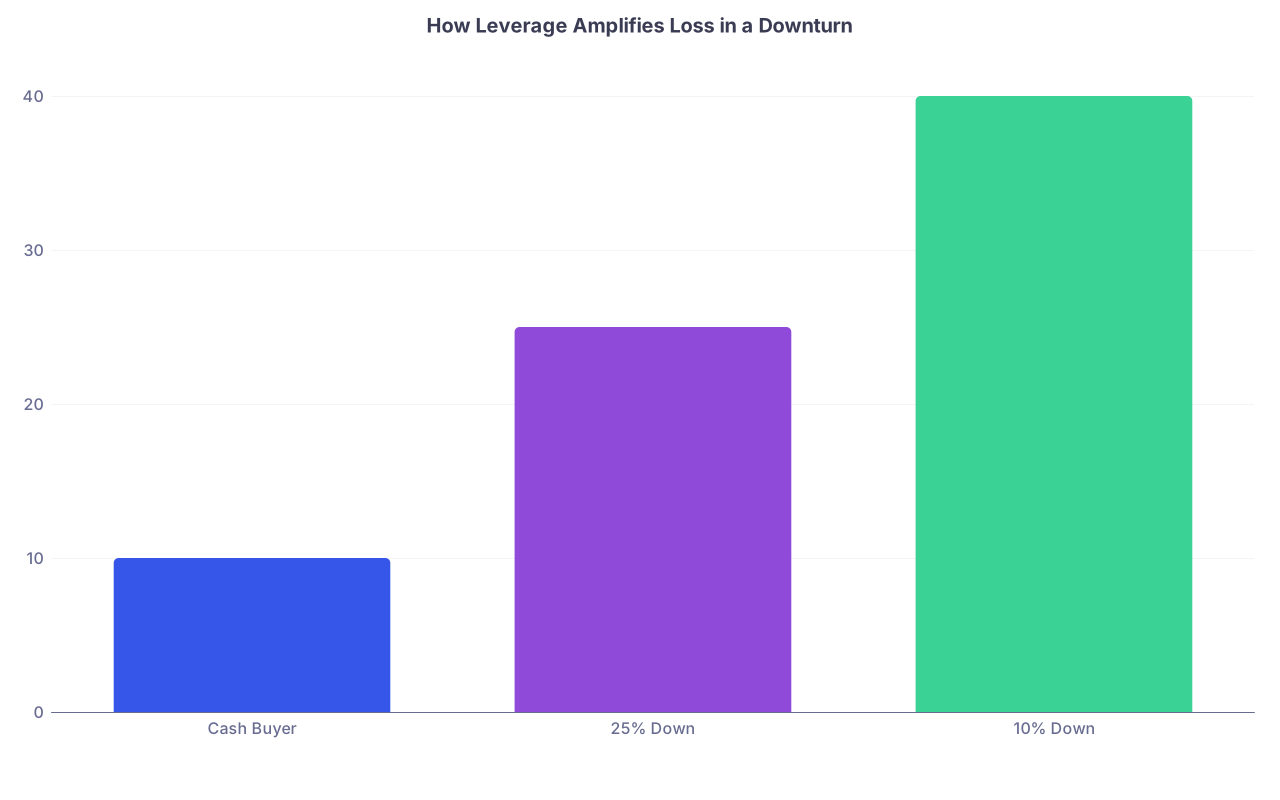
| Category | Value |
|---|---|
| Cash Buyer | 10 |
| 25% Down | 25 |
| 10% Down | 40 |
(Example concept: if value drops 20%, the owner equity loss is different depending on how much you borrowed. More leverage = bigger percentage hit to your actual money.)
Rule #3: Underwrite for stress, not perfection
Don’t plug in best-case numbers from the realtor’s pro forma. Stress test like a pessimistic intern.
When you run your numbers, ask:
- What if rents are 10% lower than projected?
- What if I have 2–3 months of vacancy per year?
- What if interest rates are still high when I need to refinance?
- What if property taxes go up 20–30% in the next reassessment?
If the deal breaks with any of those basic stressors, it’s not a deal. It’s a speculation.
Rule #4: Pick landlord-friendly markets
If you’re scared of a crash and difficult tenants and legal risk, buying in a highly tenant-favored jurisdiction is basically signing up for chronic chest tightness.
You want:
- Clear, reasonable eviction timelines
- Predictable property tax patterns
- Less regulatory risk around rent control
This is not about hating tenants. It’s about not stacking legal risk on top of market risk.
Step 5: Legal Shields That Keep a Crash from Becoming Catastrophic
Housing crash + lawsuit = the exact scenario that keeps anxious investors up at 2 a.m.
There are a few basic moves that turn a financial hit into something survivable instead of career-altering.
1. Adequate insurance (not the bare minimum)
For both your primary and rentals, this is non-negotiable:
- Homeowners / landlord policy at correct replacement cost
- Umbrella insurance (start with at least $1–2M)
- Confirm liability coverage lines up with your real net worth
Umbrella is cheap compared to losing your assets in a big claim. A lot of physicians skip it because no one pushed them hard enough.
2. Use LLCs for rentals, not for magic
LLCs aren’t a force field, but they’re better than nothing when used correctly.
Good use:
- Each rental (or small group of similar rentals) in its own LLC
- Proper operating agreement
- Separate bank account, separate bookkeeping
Terrible use:
- Spreading yourself across 5 LLCs with no actual separation in practice
- Thinking “LLC” means “I don’t need umbrella or good documentation”
Crash scenario: tenant sues because of an injury. You’d rather that claim be limited to the property LLC + insurance, not your personal accounts, house, or future earnings.
3. Keep personal and investment finances walled off
Do not:
- Co-mingle funds
- Treat rental income as a personal checking account
- Personally guarantee everything while also pretending you’re separated
As a physician, a lot of lenders will want your personal guarantee. Sometimes you can’t avoid it, especially early. So you counteract that by:
- Extra conservative leverage
- Strong reserves
- Insurance and legal entity structure

| Step | Description |
|---|---|
| Step 1 | Decide to Buy Property |
| Step 2 | Long Time Horizon 5 to 7 yr |
| Step 3 | Run Cash Flow Stress Test |
| Step 4 | Choose Fixed Rate Loan |
| Step 5 | Keep Emergency Fund |
| Step 6 | Use Conservative Leverage |
| Step 7 | Place in LLC |
| Step 8 | Add Umbrella Insurance |
| Step 9 | Limit Downside Risk |
| Step 10 | Primary Home or Investment |
Step 6: Emotional Risk Management (So You Don’t Lose Your Mind)
Here’s the part no one talks about on BiggerPockets or in those “Doctors and Real Estate” groups.
Some personalities should not be aggressively leveraged in real estate. Not because they’re dumb. Because they never sleep.
If your brain:
- Replays 2008 bubble stories on loop
- Checks home value estimates weekly
- Feels physically ill at the idea of being “stuck” in a property
…then your investing strategy has to match your nervous system, not just the spreadsheet.
That might mean:
- Fewer properties, more cash-heavy, boring ones
- Delaying buying until you hit certain net worth or cash reserve targets
- Sticking to your primary home + retirement accounts, and that’s it
You’re allowed to decide, “My downside risk tolerance is low; I’ll grow slower but sleep better.” That’s not weakness. That’s self-awareness.
Step 7: What If the Crash Actually Happens?
Let’s play out the nightmare scenario you’re secretly Googling.
Say:
- You bought a $700k house with 10% down
- Market drops 20%
- You now owe ~630k on a house worth ~560k
- You have to move for a job
If you followed none of the earlier safeguards, you’d be stuck.Selling at a loss big enough you’d have to bring cash to closing, or trying to rent at a number that might not cover everything.
But if you’d:
- Checked rentability upfront
- Chosen a boring fixed-rate loan
- Kept your payment reasonable
- Built a 3–6 month emergency fund
Then your playbook is:
- Move.
- Rent out the house, even if cash flow is slightly negative.
- Absorb a manageable monthly hit while you wait for markets to stabilize or loan principal to catch up.
Not fun. But survivable.
Same idea for investment properties. Crash hits:
- Don’t panic sell at the bottom.
- Focus on occupancy and cash flow, not “paper value.”
- Use reserves the way they were meant to be used — as shock absorbers, not wall art on a spreadsheet.
The people who get wiped are the ones who:
- Used max leverage
- Assumed appreciation
- Had no reserves
- Panicked and sold into the worst part of the downturn
You can absolutely avoid being in that group.
FAQs
1. I’m a resident. Is it insane to buy a house right now if I might move in 3–4 years?
Not insane. But high risk. If you buy as a resident, I’d only consider it if:
- You’re pretty sure you’ll stay in that city for fellowship or attending
- The house has very clear rental potential (near hospital, decent area)
- You’d be ok becoming a long-distance landlord or paying a manager
If any of that makes your stomach twist, renting during training is smarter. You’re not falling behind by renting for a few more years.
2. How much cash reserve should I have before buying an investment property?
Bare minimum I’d want to see for a risk-averse physician:
- Primary home: 3–6 months of total expenses
- Per rental property: 3–6 months of that property’s expenses (mortgage, taxes, insurance, average maintenance) in a separate bucket
If that sounds like too much cash “doing nothing,” remember: in a crash, that’s what keeps you from forced selling. It’s not doing nothing. It’s protecting everything.
3. Does it ever make sense to buy with almost no money down (physician loans, 5% down, etc.)?
For your primary home, maybe, if:
- You’re very early attending, with rapidly rising income
- You’re committed to staying put for a long time
But from a downside perspective, low-down-payment loans magnify your risk of being underwater in a crash. For investment properties, I’d avoid skinny down payments entirely if you’re already anxious. Leverage is gas on the fire in a downturn.
4. What if I already bought at what feels like the top and now I’m freaking out?
First, breathe. Don’t make a panicked move. Then:
- Stop checking home value estimates weekly. They’re noise.
- Lock in your job/income and build your emergency fund around your current payment.
- If it’s an investment property, focus on keeping it occupied and tightening expenses.
Your goal shifts from “timing the market” to “surviving any downturn without forced selling.” Most bad real estate stories become survivable if the owner can simply hold through the ugly years.
Today, do one concrete thing:
Open your current or planned housing budget and calculate your true all-in monthly cost and cash reserves.
If those numbers look tight enough that even a minor hiccup could wreck you, don’t buy yet. Or don’t buy that big. Adjust now—while it’s still hypothetical—instead of during a crash when it’s already too late.