
The idea that you should “always pay off debt before investing” is wrong for most physicians.
If you’re asking “Should I pay off student loans or buy a rental property first?”, the real answer is: it depends on your loan type, interest rate, job stability, and how serious you are about being a landlord. But we can turn this into a clear decision framework so you’re not guessing.
Let’s walk through it like a consult: history, data, assessment, plan.
Step 1: Know What Game You’re Actually Playing
You’re not choosing between “being responsible” and “taking a risk.” You’re choosing between:
- A guaranteed return equal to your student loan interest rate
vs. - A potentially higher but not guaranteed return from a rental, plus more complexity and risk
If you pay $50,000 toward a 6% loan, your “return” is 6% risk‑free, after tax. If you put that same $50,000 into a rental, you might get 8–15% total return annually (cash flow + principal paydown + appreciation + tax benefits)… or you might get 0% and headaches.
The right move depends on your specifics. So first, you categorize yourself.
Step 2: Quick Triage – Which Bucket Are You In?
Use this as a first pass. If any “Yes” hits hard, that’s your lane.

| Step | Description |
|---|---|
| Step 1 | Start |
| Step 2 | Pay loans first |
| Step 3 | Do not prepay loans |
| Step 4 | Fund basics first |
| Step 5 | Delay buying rental |
| Step 6 | Rental may come before extra loans |
| Step 7 | Private loans > 7 percent? |
| Step 8 | On PSLF or IDR? |
| Step 9 | Emergency fund and 401k match done? |
| Step 10 | Stable job and location? |
More detailed breakdown:
You should prioritize paying off student loans first if:
- You have private loans with interest ≥ 7%
- You’re not planning on forgiveness and loans stress you out daily
- You have unsteady income or you’re still moving frequently
- You haven’t yet built an emergency fund or gotten your retirement match
You should lean toward buying a rental first if:
- Your loans are federal, on PSLF or an income‑driven plan
- Your effective loan rate is low (5% or less, sometimes lower after tax deduction)
- You have strong savings, stable attending income, and time to manage real estate
- You want to build long‑term passive income and you’re willing to learn the business
Most physicians end up in a hybrid strategy:
- Pay the required amount (or slightly extra) on loans
- Invest simultaneously in retirement accounts
- Then add real estate once a basic foundation is in place
Step 3: Run the Numbers – What Are You Actually Comparing?
You can’t compare these decisions in the abstract. Let’s put some structure on it.
Assume you have $50,000 of extra cash to allocate this year.
Scenario A: Put all $50k toward loans at 6%
Scenario B: Keep paying minimum on loans, use $50k as down payment + closing + reserve for a rental
The math looks like this in principle:
| Option | Approximate Annual Effect |
|---|---|
| Pay $50k toward 6% loans | Saves ~$3,000/year interest (guaranteed) |
| Invest $50k in rental (10% total return) | Earns ~$5,000/year (not guaranteed, more variable) |
| Invest $50k in rental (5% total return) | Earns ~$2,500/year (lower than loan payoff) |
So if you can reasonably achieve a long‑term after‑expense return higher than your loan interest rate, the math favors the rental. If not, paying loans is financially better.
But “reasonably” is doing a ton of work here. You need to be brutally honest about your:
- Knowledge of your market
- Willingness to manage or pay a manager
- Time and stress tolerance alongside a physician job
Step 4: Key Factors That Should Decide This For You
Let’s go factor by factor. This is where the many “it depends” answers actually become clear.
1. Loan Type and Plan
This alone changes the entire game.
Federal loans on PSLF or IDR:
- If you’re going for PSLF (10 years of qualifying payments, tax‑free forgiveness), do not aggressively pay these down.
- Your goal is to pay as little as legally allowed and invest the difference elsewhere.
- Extra payments just reduce what would’ve been forgiven. That’s usually terrible math.
Federal loans on standard or refinance:
- If you’ve refinanced to 4–5% and are on a solid attending income, aggressive payoff becomes less urgent.
- A 4% guaranteed return is good, but over a 20+ year horizon, real estate + equities usually beat that.
- Many docs choose a 10‑year refi term, pay that scheduled amount, and invest surplus.
Private loans 7–9%+:
- These are the villains. There’s no forgiveness, high rates, and no upside.
- Paying these off is like a tax‑free 7–9% return. That’s hard to beat safely.
- In this situation, I’d usually say: kill these first, then look at real estate.
2. Interest Rate vs Expected Real Estate Return
Ballpark realistic long‑term expectations (not guru‑fantasy):
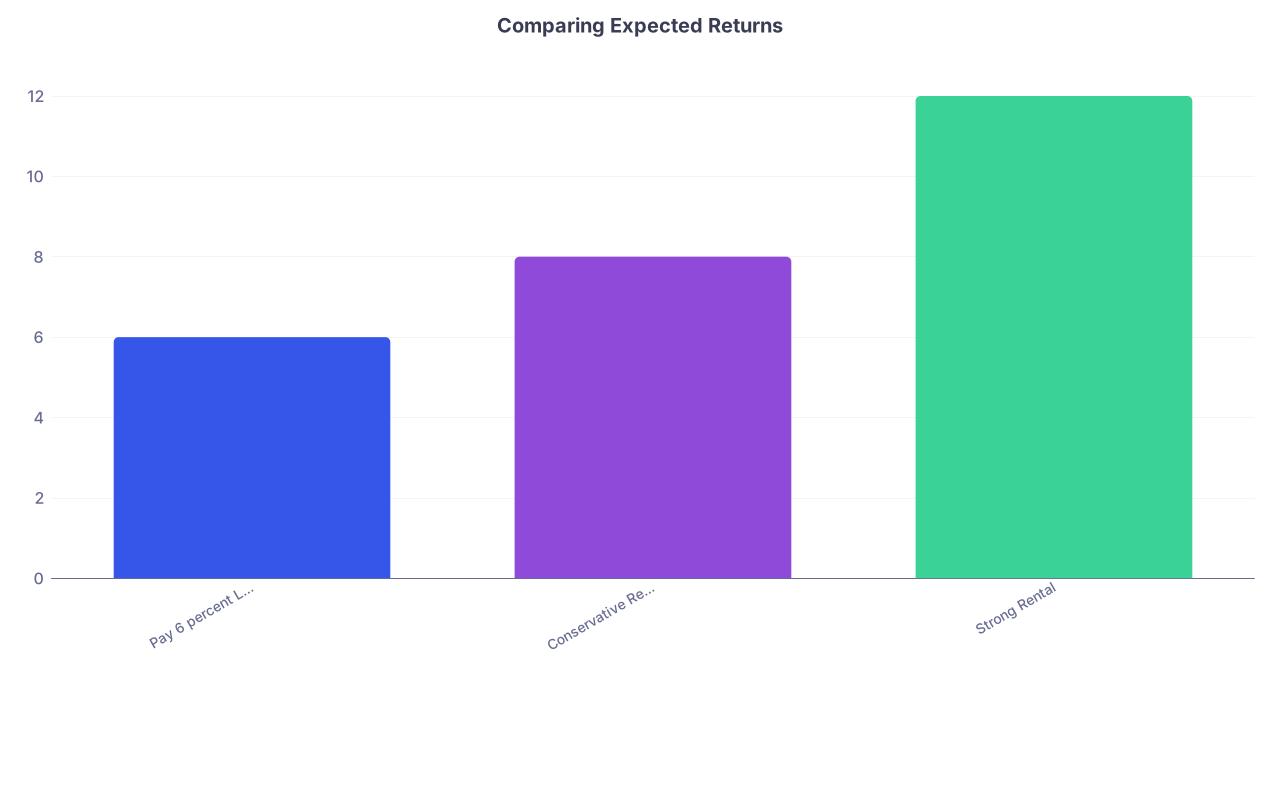
| Category | Value |
|---|---|
| Pay 6 percent Loan | 6 |
| Conservative Rental | 8 |
| Strong Rental | 12 |
- Paying a 6% loan: 6% guaranteed
- A decent long‑term rental: 8–12% total return (cash flow 3–6% + appreciation + principal paydown + tax benefits)
- A mediocre or mismanaged rental: 0–5% or negative
If your loan is:
- > 7%: paying it off is usually a better “investment” than an average rental
- 5–6%: gray zone – depends on your risk appetite and skill as an investor
- < 4–5%: I’d seriously consider investing first, especially if you already feel reasonably secure
3. Job and Location Stability
You shouldn’t buy a rental if you don’t know your next few years.
You’re not ready for a rental property if:
- You’re a resident/fellow who might move cities
- You’re an attending in year 1–2 and unhappy with your job or geography
- Your cash flow is still stabilizing, bonuses aren’t predictable yet
You’re in a safer spot to invest when:
- You have a 2–3+ year horizon in the same city
- You understand your after‑tax take‑home and lifestyle costs
- You’ve already built a 3–6 month emergency fund (separate from down payment)
Step 5: Don’t Skip the Boring Foundation
If you’re wrestling with this question, here’s the sequence I push most physicians toward.
Baseline Checklist (Before Rental OR Extra Loan Payoff)
You should do these first:
- Get a 3–6 month emergency fund in cash or high‑yield savings
- Contribute enough to get the full employer retirement match (401k/403b/457b)
- Be current on all minimum loan payments
- Carry no high‑interest consumer debt (credit cards, personal loans)
- Have disability insurance appropriate for your specialty, and basic term life if anyone depends on your income
Skipping this and buying a rental is how people end up with “three houses and no cash,” then a furnace dies and so does their sleep.
Once that base is done, then we talk about extra loan payoff vs rental.
Step 6: A Practical Framework You Can Actually Use
Let’s put this into a simple decision framework.
Step 1: Classify Your Loans
- All/mostly federal, going for PSLF/IDR → prioritize minimal required payments + investing
- Refinanced to 4–5% fixed → consider parallel track: pay on schedule + invest
- Private loans > 7% or ugly variable rates → attack these before real estate
Step 2: Assess Your Real Estate Readiness
You’re ready to consider a rental if:
- You can put 20–25% down AND still have 3–6 months of personal expenses + 3 months of property expenses in cash
- You’ve run actual pro forma numbers, not “my friend said he’s cash flowing $500/mo”
- You’re willing to:
- Answer calls or texts (or pay a manager 8–10% of rent)
- Learn basic landlord laws in your state
- Budget realistically for maintenance, vacancies, and CapEx
If that sounds awful? Don’t force it. There’s no moral prize for owning rentals. Use low‑cost index funds and/or extra loan payoff instead.
Step 3: Compare Your Realistic Options
Take your actual numbers. Example:
- Loans: $300k at 5.5%, refinanced, 10‑year term
- Extra cash: $60k
- Rental target: $300k property, 25% down, 7% interest investment loan
Option A – Extra loan payoff:
- Lump $60k into loans, reduce interest and shorten payoff, saving maybe $3–4k/year in interest over several years
- Simple, low risk, high psychological benefit
Option B – Buy rental:
- Use $60k for down payment + closing + small reserve
- Potential:
- Cash flow after all expenses: maybe $200–300/mo ($2.4–3.6k/year)
- Principal paydown: maybe $4–5k/year
- Long‑term appreciation + tax shelter: variable
Total “economic” return could be $7–10k/year on that $60k, but not guaranteed and not liquid.
Now it’s no longer abstract. You’re asking:
“Is it worth an extra $3–6k/year plus future equity and tax benefits to take on landlord risk and complexity rather than just nuking my loans faster?”
Some people say absolutely yes. Others say absolutely not. Both are fine if they’re making a conscious choice with eyes open.
Step 7: Common Physician Profiles – What I Actually Recommend
Let me be blunt for a few common scenarios I’ve seen over and over.
Early Attending, Massive Federal Loans, PSLF‑Eligible Job
Example: Hospitalist at academic center, $350k federal loans, 5 years PSLF credit remaining.
My take:
- Do not aggressively pay loans.
- Maximize retirement accounts, build emergency fund, consider modest investing (maybe including real estate) once stable.
- Rental property before extra loan payoff? Reasonable, if you meet the readiness criteria and want to be in real estate.
Private Practice Surgeon, High Private Loan Rates, No Forgiveness
Example: $300k loans at 7.5%, high income, planning long‑term in community.
My take:
- Prioritize refinancing if possible, then aggressive payoff of high‑rate debt.
- Delay rentals until loans are at least down to a manageable level or rate.
- Buy rental first? Usually no. Kill the 7.5% debt.
Mid‑Career, Loans at 4–5%, Already Investing
Example: 40‑year‑old anesthesiologist, loan balance $150k at 4.5%, maxing retirement accounts, solid savings.
My take:
- You’ve earned the right to optimize, not just survive.
- A well‑chosen rental before paying extra on low‑rate debt can make sense.
- I’d lean toward parallel: continue scheduled payoff, invest surplus in a mix of index funds and real estate if you like it.
Step 8: Psychological and Lifestyle Reality (Don’t Ignore This)
Money isn’t math only. For some of you, the right answer is whatever lets you sleep.
You should lean toward paying loans off first if:
- The balance makes you anxious every single day
- You grew up hating debt and you know it’ll always bother you
- You don’t want to think about tenants, roofs, or property managers
You should lean toward buying a rental first if:
- You’re genuinely interested in real estate as a skill and business
- You’re comfortable with some messiness for long‑term upside
- You like the idea of eventually replacing part of your clinical income
Both are valid. I’ve seen cardiologists more relaxed with $300k in low‑rate loans and three solid rentals than colleagues with zero debt and no investments. I’ve seen the reverse, too.
Pick the life you want, not the one Twitter thinks you should have.
FAQs
1. Is buying a rental property while I still have student loans irresponsible?
Not automatically. It’s irresponsible if:
- Your loans are high‑rate private loans and you’re ignoring them
- You don’t have an emergency fund
- You’re buying a property without understanding cash flow, vacancies, and maintenance
If your loans are manageable, your foundation is solid, and the deal is good, buying a rental can be completely reasonable.
2. Should I refinance my student loans before thinking about real estate?
If you’re not going for forgiveness and you have high‑rate private or federal loans, refinancing to a lower fixed rate can be a smart first move. Just be sure:
- You’re not giving up PSLF or federal protections you actually need
- You’ll still qualify for a future mortgage after the refi payment shows up on your credit report
Then revisit the payoff vs rental decision with the new interest rate.
3. Does a rental property help my taxes enough to beat loan payoff?
Rental real estate has great tax benefits (depreciation, expense write‑offs), but they’re not magic. Usually:
- The tax benefits sweeten a deal that already makes sense
- They don’t turn a bad property into a good one
- They rarely justify buying a rental that barely breaks even just for “tax write‑offs”
Loan payoff is effectively tax‑free “earnings” equal to your interest rate. Compare that to the after‑tax return on the rental.
4. How much cash should I have before I buy a rental if I still have loans?
I like this baseline:
- 3–6 months of personal expenses in cash
- 3 months of property expenses (mortgage, taxes, insurance, utilities) in cash after closing
- Down payment and closing costs not coming from your emergency fund
If you can’t do that while staying current on your loans, you’re too thin for real estate right now.
5. What if I want to house hack instead of a pure rental?
House hacking (buying a duplex/4‑plex, living in one unit, renting the others) can be a smart in‑between move. The math often works better because:
- You can use primary residence financing (lower rates, lower down)
- You reduce your own housing cost while building equity
In that case, I’m more willing to see you do it earlier, even with loans, as long as you’re not drowning in high‑interest debt.
6. What’s your simple rule of thumb for this decision?
Here it is:
- On PSLF/IDR with federal loans: Don’t prepay. Build wealth elsewhere (including rentals if you’re ready).
- Loans > 7%: Pay these off before buying rentals.
- Loans 4–6% and strong financial base: Parallel track – pay on schedule, invest in retirement accounts, then consider rentals with surplus cash.
Boiled down:
Kill toxic high‑rate debt.
Respect PSLF if you’re in it.
Only buy rentals when you have the cash, stability, and genuine interest to treat them like a business.