
The default advice that “busy doctors should always hire a property manager” is lazy and often wrong.
You should not pick a side until you run the numbers, look at your schedule, and decide what role you actually want real estate to play in your life. For some physicians, self-managing is a smart, high-yield side business. For others, it’s a distraction that quietly kills returns and adds stress on call nights.
Let’s walk through this like a real decision, not a slogan.
The Core Question: What Are You Actually Optimizing For?
Strip away the noise. You’re choosing between:
- Higher control and potentially higher net returns (self-managing)
vs. - Lower time burden and more systematized operations (property manager)
You’re not just choosing between 0% and 8–10% in fees. You’re choosing between:
- Late-night tenant calls vs. someone else handling it
- Learning landlord law vs. trusting someone who supposedly already knows it
- Building an operations skill set vs. staying closer to “pure capital investor”
If you only remember one thing: the “right” answer changes with:
- Your clinical schedule
- Number of units and distance from you
- Your tolerance for hassle and conflict
- How much you actually care about squeezing every dollar from each property
Let’s make it concrete.
The Money: How Much Does Management Really Cost You?
Here’s what most physicians miss. A property manager usually costs:
- 7–10% of collected rents
- Plus 25–100% of one month’s rent as a lease-up fee
- Plus possible markups on repairs, inspection fees, etc.
But that cost is not always a dealbreaker. On the flip side, self-managing has hidden costs: your time, mistakes, and delays.
| Scenario | Self-Manage | Hire Manager |
|---|---|---|
| Monthly Rent | $2,500 | $2,500 |
| Management Fee (8%) | $0 | $200 |
| Annual Fee | $0 | $2,400 |
| If you value your time at $200/hr and spend 2 hrs/mo | $4,800 time cost | $0 additional |
In that example, if you spend 2 hours/month dealing with one property, your “time cost” is actually higher than the manager’s fee—if you value your time like you value a clinical hour.
But here’s the catch: that assumes you’d actually convert that saved time into clinical income or valuable time with family or rest. Most people don’t. They doom-scroll or chart.
So be honest:
Is that extra income actually displacing your clinical or family time, or are you just trading Netflix hours for asset-building work?
Time, Lifestyle, and Burnout Risk
If you’re a full-time hospitalist working 7-on/7-off, self-managing three local single family homes might be perfectly reasonable. If you’re a busy surgeon, in-house call, with a young family – managing scattered rentals across town is self-sabotage.
Here’s how I’d frame it:
Self-manage makes more sense when:
- You have predictable or flexible hours (outpatient, part-time, telemed, academics with lighter clinic)
- You own 1–5 units in the same metro area
- Properties are relatively “boring” (B/B+ class, stable tenants, no major rehab)
- You enjoy systems, checklists, and a bit of ops work
Property management makes more sense when:
- You have heavy call or unpredictable schedules
- You’re scaling beyond 5–10 units or multiple cities
- You’re buying in another state
- You hate tenant conflict, scheduling repairs, or tracking details
Reality check: Even the best “hands-off” manager still requires you to:
- Approve bigger expenses
- Monitor monthly statements
- Review leases and renewals
- Decide on rent increases and capital projects
So there is no truly passive option. Just “less hands-on.”
Control, Quality, and Risk Management
This is the part that gets glossed over. There are bad property managers, and they can quietly burn more value than they cost.
Common problems I’ve seen with managers:
- Sloppy tenant screening to fill vacancies fast
- Accepting marginal tenants because “we can always evict” (you pay for that)
- Over-using their “favorite” vendors at inflated rates
- Letting small problems sit until they become big repairs
- Not raising rents appropriately because it’s more work and more tenant turnover
On the other side, self-managing physicians often make rookie mistakes:
- Violating fair housing rules with poorly worded listings or screening questions
- Mishandling security deposits (this gets landlords sued constantly)
- Failing to follow notice requirements before entry, rent increases, or non-renewal
- Trying to “be nice” and not following written policies, which backfires
So ask yourself: Do you want to become good at being a landlord, or do you want to outsource that learning curve?
Legal and Compliance: Where Physicians Get Burned
This is the phase you flagged: financial and legal. Good. Because this is where “winging it” is deadly.
Key legal responsibilities exist either way:
- Complying with federal laws (Fair Housing, lead paint disclosures in older homes)
- Following state and local landlord-tenant laws (these differ wildly)
- Properly handling security deposits (amount, holding, deadlines, itemized deductions)
- Keeping the property habitable (heat, hot water, safety, repairs)
- Following rules on notices, lease terms, and evictions
When you self-manage, you must:
- Use state-specific lease agreements (not some random template you found online years ago)
- Understand your local landlord-tenant rules at least at a basic level
- Have a process for documenting communication, payments, and damage
When you hire a property manager:
- They should bring compliant leases and processes
- But you’re still legally on the hook as the property owner
- If they screw up an eviction or deposit, guess whose name is on the lawsuit? Yours.
So no, hiring a manager does not eliminate legal risk. It changes who is doing the daily compliance work, but you’re still the owner.
You should at minimum:
- Have an attorney in the property’s state you can consult
- Review the PM company’s lease and addenda before they use it
- Verify they’re licensed (if required in that state) and insured
- Confirm how they handle trust accounts and deposits
Decision Framework: A Straightforward Way to Choose
Here’s the simple framework I’d use with a physician client.
Step 1: Score your situation
Rate 1–5:
- Clinical time intensity (1 = very light, 5 = brutal with call)
- Number of current/planned units in the next 2–3 years
- Distance from properties (1 = same neighborhood, 5 = different state)
- Interest in learning landlording (1 = hate it, 5 = genuinely interested)
- Tolerance for hassle and conflict (1 = avoider, 5 = comfortable)
If your total is:
- 8–12 → You’re probably a good candidate for self-management early on
- 13–18 → Mixed; consider hybrid (self-manage now, plan to delegate later)
- 19–25 → Stop pretending. You should likely hire management from day one
Step 2: Run the numbers honestly
For each property, estimate:
- Monthly rent
- 8–10% management fee
- Expected time you’ll spend if self-managing (be real – include tenant screening, showings, lease signing, bookkeeping, requests, renewals)
Then ask:
- What is my minimum hourly value for this time? Is it clinical rate? Half? A fraction?
- Do I actually want to do this work at that effective hourly rate?
Step 3: Decide your role
Pick one:
- “I want to learn operations and be an active landlord for a few units.”
- “I want to be an investor, not a landlord. I’ll pay for infrastructure.”
- “I’ll start active for 1–2 units local, then transition to PM once I scale or my job changes.”
Any of those is fine. What’s dumb is drifting into self-management because “how hard can it be” while you’re already drowning in clinical and family responsibilities.
When Self-Management is Actually Smart for Physicians
There are situations where I think it’s flat-out smart to self-manage, at least at the beginning.
Examples:
- You buy your first duplex 10 minutes from your house. You live in one unit, rent the other. Perfect training ground.
- You own 1–3 single family homes in your own city, low-drama tenants, good condition. Reasonable to manage yourself with systems.
- You’re aiming to build a small, local portfolio as a planned “semi-retirement” gig, maybe when you cut clinic time later.
Benefits you actually get:
- You see every expense and vendor quote yourself → forces discipline and sharpens your investor instincts
- You learn what really matters in tenant screening (credit, income, behavior patterns)
- You catch property issues earlier because you’re close to the ground
- You get an unfiltered view of how your asset performs, not a manager-filtered version
Many of the best long-term investors I’ve seen self-managed at least their first 1–3 rentals. Then, once they understood the game, they started delegating more surgically.
When Hiring a Property Manager is the Only Sane Choice
There are clear red flags where I’d strongly recommend you hire a PM:
- You’re doing out-of-state investing. Trying to manage rehab, leasing, and maintenance from 1,000 miles away while rounding on patients is asking for trouble.
- You’re buying in a heavily regulated, tenant-friendly city (e.g., specific parts of CA, NY, OR, etc.) where one legal mistake gets very expensive.
- You’re scaling beyond a handful of doors and your admin brain is maxed out from clinical work.
- You’re already experiencing burnout. You don’t need another inbox of problems.
In these situations, your main job is to:
- Choose the right market
- Choose the right manager
- Then manage the manager through metrics: vacancy rate, delinquency, turn time, maintenance spend, rent growth vs market
How to Choose a Property Manager (So You Don’t Regret It)
If you’re going to pay 8–10%, at least get your money’s worth. Ask specific questions:
- Who actually handles my property day to day? What is their portfolio size (door count per manager)?
- What is your average vacancy time between tenants in the last year?
- How do you screen tenants? Minimum income, credit, eviction history, references?
- Do you charge a lease-up fee? Renewal fee? Markup on maintenance?
- How do I approve repairs? Thresholds? Are there after-hours premiums?
- Can I see a sample owner statement?
Watch for:
- Vague answers, “it depends,” or resistance to clear metrics
- Door counts that are insane (one manager “handling” 250+ units) – quality will be poor
- Pressure to use their in-house maintenance at above-market rates without transparency
If they won’t talk in numbers, I wouldn’t hand them your asset.
Hybrid Approach: The Quietly Powerful Middle Ground
You don’t have to marry either extreme forever.
Common hybrid approaches I’ve seen physicians use successfully:
- Self-manage leasing and tenant selection (the most important part), then outsource ongoing maintenance coordination
- Self-manage local small properties, hire PM for out-of-state or larger complexes
- Use a PM for the first year to stabilize a rough property, then transition to self-management once things are cleaned up
Think in phases, not absolutes. “For the next 3 years, I’ll __. Then I’ll reassess once I reach X doors or my job shifts.”
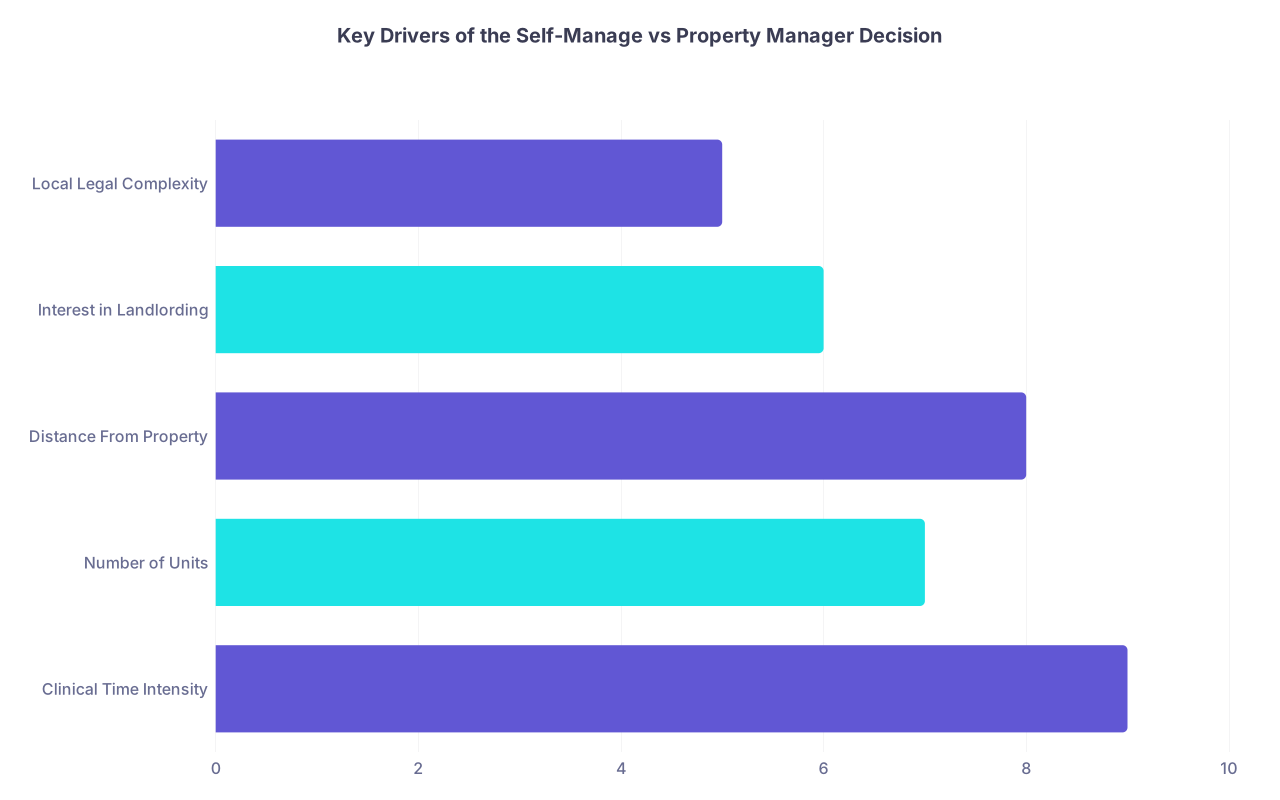
| Category | Value |
|---|---|
| Clinical Time Intensity | 9 |
| Number of Units | 7 |
| Distance From Property | 8 |
| Interest in Landlording | 6 |
| Local Legal Complexity | 5 |

| Step | Description |
|---|---|
| Step 1 | Buy Rental Property |
| Step 2 | Hire Property Manager |
| Step 3 | Start Self-Managing |
| Step 4 | Reassess at 3 to 5 units |
| Step 5 | Local and close by |
| Step 6 | Time and interest |
| Step 7 | Legal and city complexity |
Bottom Line: What Should Physicians Actually Do?
Here’s the answer you’re looking for.
If you’re a physician with:
- 1–3 local properties
- Reasonably predictable hours
- Some interest in understanding how your investments really work
You should strongly consider self-managing at least at the beginning. It will make you a better investor, even if you later hire management.
If you’re:
- In a brutal specialty or schedule
- Investing out of state
- Planning to scale quickly beyond a few doors
- Or already feeling stretched thin
Hire a competent property manager. Your brain and your family will thank you, and you’ll still get most of the benefits of real estate.
You’re not failing as an investor if you hire a manager. You’re failing if you choose by default, without running the numbers or being honest about your life.
FAQ: Physicians, Rentals, and Property Management
Is hiring a property manager tax-deductible for my rentals?
Yes. Management fees are an ordinary and necessary business expense for your rental activity and are fully deductible against rental income on Schedule E (or your entity’s return). Do not let “I’ll save taxes by self-managing” drive this decision; the fee is deductible either way.Can I self-manage rentals held in an LLC?
Absolutely. The ownership structure (LLC, LP, personal name) doesn’t dictate whether you can self-manage. What changes is how leases, insurance, and bank accounts are titled. You still need to keep clean records: rent to the LLC, expenses from the LLC account, and you as manager/owner performing services.Will self-managing help me qualify for real estate professional status (REPS)?
It can help, but most full-time physicians do not hit REPS hours legitimately. You’d need 750+ hours per year and more time in real estate than in your clinical work. Self-managing adds hours, but if you’re working full-time as a physician, you’re almost always over that on the medicine side already.What’s the biggest legal risk if I self-manage as a physician?
The most common traps: mishandling security deposits, violating fair housing with your ads or screening questions, and sloppy documentation around notices and evictions. All fixable with education and good templates, but you cannot just “wing it” or reuse random forms indefinitely.Can I switch from self-managing to using a property manager later (or vice versa)?
Yes. It’s very common. You’ll typically make the change at a natural break point: lease renewal, major life change, or when you add more units. Expect a 30–60 day transition period and some friction (new systems, new portal, tenant communication), but it’s completely doable and often a smart move as your portfolio or career evolves.
Key takeaways:
- Decide whether you want to be a landlord or an investor first—then pick self-managing or hiring a manager to match that role.
- Run the real numbers on time, fees, and legal risk, not just “8% sounds expensive.”
- You can change your mind later; the only bad move is choosing by accident instead of on purpose.