
What happens to your “great” rental property return when the IRS quietly claws back six figures over a few years—and you only notice when your CPA finally says, “We need to talk”?
If you’re a physician buying rentals, you’re walking into one of the most misunderstood corners of the tax code. The money you think you’re saving can vanish fast if you make the same mistakes I watch high‑income docs make every single year.
Let me be blunt: physician real estate horror stories almost never come from bad shingles or bad tenants. They come from bad tax setups.
Below are the traps that keep getting physicians—smart, accomplished people who somehow turn their brains off when they see “tax write‑off” in a listing presentation.
Mistake #1: Assuming “Losses” On Rentals Will Lower Your Big W‑2 Tax Bill
This is the number one fantasy I see:
“I make $550k as a hospitalist. I’ll buy a couple rentals, show $50k in losses, and lower my taxes. My friend’s realtor said real estate is how doctors pay no taxes.”
No. That’s not how the rules work for most of you.
Rental income is generally “passive.” Your clinical income is “non‑passive.” Under IRS rules, passive losses usually cannot offset non‑passive income.
So those “amazing” tax losses from:
- Depreciation
- Bonus depreciation / cost segregation
- Interest and expenses
…most likely do not reduce your W‑2 or 1099 clinical income if you’re a typical full‑time doc who doesn’t qualify as a real estate professional.
They either:
- Offset passive rental income (fine, but not magical), and
- Get suspended and carried forward to the future where they may or may not ever be used.
The mistake isn’t owning rentals. The mistake is buying them because someone promised you, “You’ll pay no taxes!” when you’re nowhere close to qualifying for that outcome.
If your business plan depends on tax losses reducing your doctor paycheck taxes, and you are not structured to qualify as a real estate professional (or using very specific short‑term rental rules), you’re building on sand.
Mistake #2: Ignoring Real Estate Professional Status (REPS) Rules—or Butchering Them
Here’s where the big money and the big audits are.
You’ve probably heard the cocktail party line: “Become a real estate professional and your rental losses offset your doctor income.”
That part is grounded in reality. But the requirements are brutal for physicians with full‑time clinical work. And faking it is how you paint a massive audit target on your back.
To meet Real Estate Professional Status (REPS) you must:
- Spend more than 750 hours per year in real property trades or businesses in which you materially participate, and
- Spend more time in those activities than in all other jobs combined.
So if you’re working 0.8 FTE in the ICU, call, admin meetings, notes—the IRS does not believe you also logged more hours in your rentals than in medicine. And they’re usually right.
I’ve seen docs do this wrong in three common ways:
- They claim REPS while still working full‑time clinically, with no time logs. The IRS is not stupid.
- They count investor‑type time (reading BiggerPockets, studying markets, passive syndication webinars) as “hours.” That doesn’t count.
- They don’t make the correct election to treat all rental activities as a single activity, or fail material participation tests on each property.
If you do legitimately want REPS:
– Your clinical time usually needs to be minimal or zero, or
– Your spouse needs to qualify (and actually do the work) if filing jointly.
And if your CPA “just checks the box” for REPS because you asked? That’s not a partner, that’s a liability.
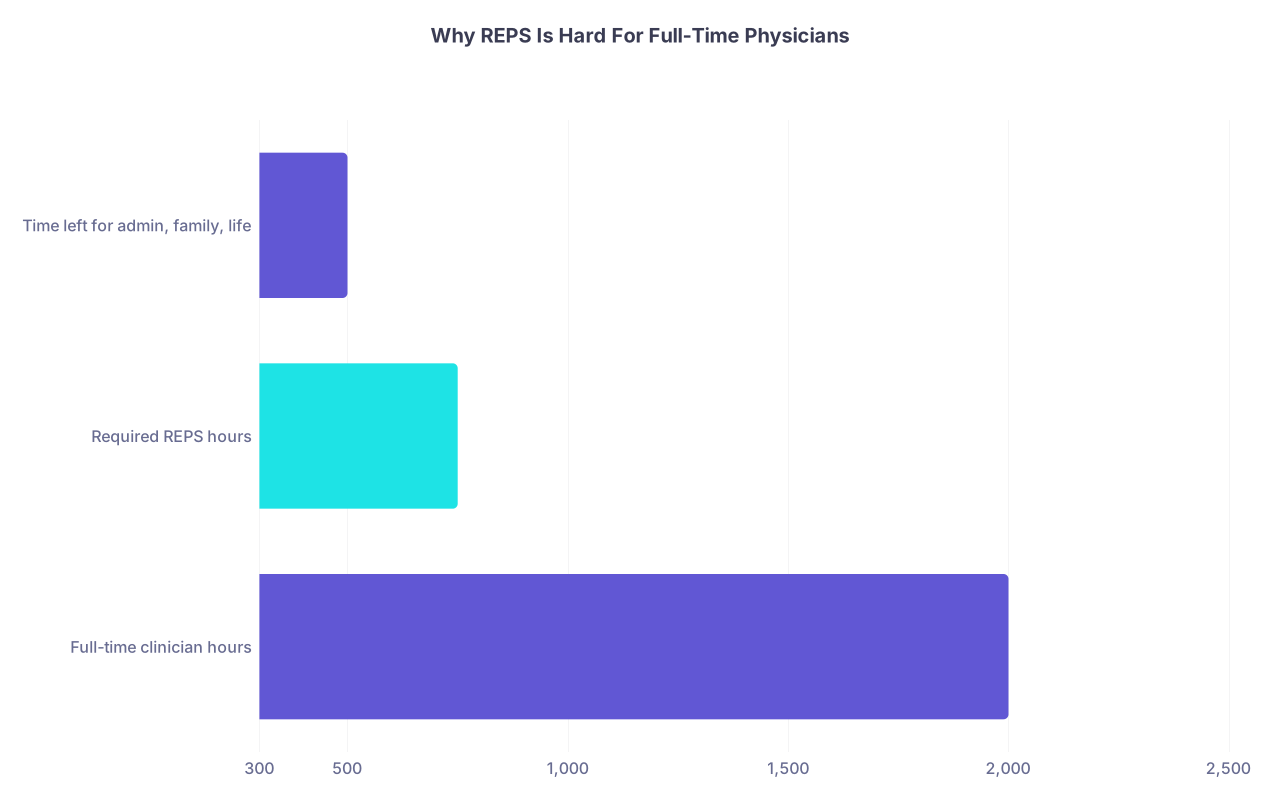
| Category | Value |
|---|---|
| Full-time clinician hours | 2000 |
| Required REPS hours | 750 |
| Time left for admin, family, life | 500 |
The takeaway: do not casually claim REPS because a guru told you it’s the secret. Either commit to actually meeting the standard (and documenting it) or don’t go near it.
Mistake #3: Forgetting That Short‑Term Rentals Have Different (and Tempting) Rules
Another seductive pitch:
“Don’t worry about REPS. Just buy Airbnbs. Those can create losses that offset your W‑2 without REPS.”
There is some truth here. Short‑term rentals with an average stay of 7 days or less are not automatically grouped as passive in the same way as traditional long‑term rentals. If you also materially participate, their losses can be non‑passive and potentially offset your clinical income.
But the mistakes physicians make here are nasty:
- They don’t actually track average stay length to prove it’s under 7 days.
- They offload management to a property manager, then still claim material participation.
- They confuse short‑term rental rules with REPS and mush it all together in a mess an IRS agent could tear to pieces in one afternoon.
You need to understand the tests for material participation:
- 500 hours
- Or 100 hours and more than anyone else
- Or substantially all participation by you
…and you need documentation that would convince someone who doesn’t like you.
If your “participation” is mostly clicking “accept booking” in an app while your management company does the actual work, do not tell yourself a story that you’re materially participating.
The IRS doesn’t care how many YouTube videos said you were fine.
Mistake #4: Messing Up Depreciation and Cost Segregation
Depreciation is powerful. Cost segregation plus bonus depreciation is explosive.
Which is exactly why sloppy handling here is so dangerous.
A few recurring blunders:
Not depreciating at all
I’ve reviewed physician tax returns where rentals sat on Schedule E with zero depreciation because “the previous CPA never brought it up.” Years of lost deductions that can’t all be magically recovered.Depreciating the wrong number
You don’t depreciate land. Only the building (and some improvements). If you or your tax preparer just plug the whole purchase price in and ignore the land value, you’re overstating depreciation. That can bite you hard at sale.Doing cost segregation on the wrong kind of deal
People are told, “Always do cost seg and bonus depreciation, get huge write‑offs!” So they pay thousands for a study on a small or marginal property where:- They don’t have REPS or short‑term rental status.
- The losses just get suspended.
- Then they sell early and suffer massive depreciation recapture at high ordinary rates.
Not planning for recapture
Depreciation is not free money. When you sell, you often pay depreciation recapture tax—frequently at rates up to 25% (plus possible state tax). If your plan is to “depreciate like crazy then sell in 3 years,” you’d better understand that math.
Here’s the usual ugly version:
You “save” $40k a year with depreciation for four years, feeling very clever. Then you sell and hand a big chunk of it back—except this time the tax bill hits all at once.
Depreciation is a timing tool. It can be strategically great, especially if:
- You expect to be in a lower bracket later.
- You plan to hold long term, refinance, and potentially 1031 exchange.
- You actually use the losses now due to REPS or short‑term rules.
But blindly chasing the biggest write‑off this year without a plan for the next 10–20 years? That’s how you end up turning “tax strategy” into “tax boomerang.”
Mistake #5: Commingling Personal and Rental Finances Like It’s a Hobby
You’d be shocked how often I see this from physicians who are otherwise meticulous:
- No separate bank account for rentals.
- Security deposits mixed with personal spending.
- Venmo from tenants going into a random checking account.
- Repairs paid on a personal credit card with no records.
Then at tax time, they text their CPA: “I spent about $8–10k on upkeep, just put $9k?”
This is how you:
- Lose legitimate deductions because you can’t prove them.
- Raise red flags if you are ever audited.
- End up paying more tax than necessary every single year.
Even worse: they’re sometimes using an LLC “for asset protection” but not treating it like a business. No corporate formalities. No separation. That undercuts both the legal protection and the tax defensibility.
You should have, bare minimum:
- Separate bank account for your rental activity.
- Separate credit card used only for rental expenses.
- Basic bookkeeping (even a simple spreadsheet if you insist, though actual software is better).
If you ever want to scale beyond one or two doors, getting this wrong early is like building a house on crooked footings. Every new property multiplies the mess.
Mistake #6: Randomly Putting Everything In an LLC and Assuming That Changes the Tax
I hear this line all the time:
“I formed an LLC so now I can write off more.”
No. An LLC is a legal wrapper, not a magic tax credit machine.
For most small landlords:
- A single‑member LLC is disregarded for federal tax purposes. It’s still reported on your personal return, Schedule E.
- A multi‑member LLC is taxed as a partnership unless you elect otherwise. It creates a partnership return (Form 1065) and K‑1s, not new types of deductions out of thin air.
The mistakes physicians make:
- Spending thousands on fancy LLC setups before they understand if they even need them.
- Creating complicated multi‑LLC structures pushed by “asset protection” lawyers, then never maintaining them properly.
- Thinking just having an LLC lets them “take more write‑offs.” The allowable deductions are based on the activity, not the letters after the name.
LLCs can be useful for liability and sometimes for estate planning or partnership structure. But from a tax perspective, if your primary motivation is “my colleague said I need an LLC to write off trips to Hawaii,” you’re already off the rails.
Mistake #7: Treating Personal Trips and Toys as Obvious “Business Write‑Offs”
This is where I see docs get a little…greedy.
Some greatest hits:
- “I’ll buy a beach house, ‘check on it’ a few times, and deduct all our family vacations.”
- “We’ll tour properties in Europe—tax write‑off, right?”
- “My truck is for the rental. I also happen to tow my boat with it.”
Will there be legitimate mixed‑use situations? Sure. But physicians often cross the line from smart tax planning into obvious abuse.
The IRS is not naive about:
- “Board meetings” that are just family dinners.
- “Due diligence trips” that are mostly snorkeling.
- Vehicles that mysteriously rack up 90% “business miles” with no mileage log.
If you can’t explain, calmly and with documentation, why an expense was ordinary and necessary for your rental business, don’t write it off. Or at least don’t be shocked if it gets disallowed.
And no, your scrub pants don’t become deductible “uniforms” because you walked through a rental once in them.
Mistake #8: Relying On the Wrong Professionals—or None At All
Let me be direct: your average tax preparer who cranks out 1,200 basic returns between January and April is not set up to design a real estate strategy for a high‑income physician.
Common patterns:
- The CPA is fine with W‑2, some itemized deductions, maybe a small Schedule C. Rentals? Cost seg? REPS? They’re Googling on the side.
- Or the opposite: the aggressive “real estate CPA” who thinks every client should claim REPS, do cost seg on everything, and push every deduction to the edge.
Both extremes are dangerous.
You need someone who:
- Understands high‑income W‑2/1099 physician realities.
- Works with multiple real estate investors at your scale or beyond.
- Is willing to say “no” when you want to be aggressive without support.
- Talks to you in February–September, not just three days before the filing deadline.
Here’s a simple red flag: if your CPA has never once asked about your hours, your spouse’s hours, or average stay lengths for short‑term rentals, and yet you’re claiming big non‑passive losses…that relationship is a risk.
| Red Flag | Why It’s Dangerous |
|---|---|
| Never asks about your time/hours | Weak basis for REPS or STR treatment |
| Only talks to you in March/April | No proactive planning |
| Says “everyone does it” as defense | No legal/tax reasoning, high audit risk |
| Doesn’t see many physicians | Misses specialty‑specific issues |
| Hates questions or documentation | You’ll miss legal strategies or overreach |
Mistake #9: No Exit Plan—Then Getting Crushed at Sale
Everyone loves talking about “cash flow” and “tax savings” on the way in. Almost no one wants to think about:
- Depreciation recapture
- Capital gains
- State taxes
- Exit timing
- 1031 exchange rules
So what happens? A few years in, your group changes compensation, your kids’ private school tuition jumps, you want out. You sell two rentals you’ve “tax sheltered” for years.
Then your CPA tells you: “You’ve got $300k in gain, plus recapture.”
Shock. Anger. “What do you mean? I thought we wrote it off.”
No, you deferred some tax and reduced others, but the bill shows up when you recognize gains and recapture.
If you’re doing:
- Heavy cost segregation + bonus depreciation
- Short holding periods
- Rapid scaling then rapid unwinding
…without planning for the exit, don’t be surprised when the IRS shows up to collect down the line.
A thoughtful plan might include:
- Long‑term hold strategy with refinancing instead of selling.
- 1031 exchanges where appropriate (with realistic timelines).
- Roth conversions or income‑shifting in lower‑income years coordinated with sales.
- Timing disposals across multiple tax years.
But none of that happens if you buy first and ask tax questions later.
Mistake #10: Copy‑Pasting Someone Else’s Strategy Onto Your Life
Your situation is not the same as:
- The anesthesiologist who stopped clinical work and is now full‑time REI.
- The surgeon whose spouse legitimately spends 1,500 hours a year managing 15 doors.
- The blogger who lives off syndication fees and course sales.
Yet I watch physicians try to graft these people’s tax strategies onto their own lives without checking if the underlying assumptions match.
“Doctor X doesn’t pay any taxes, and they said just buy enough properties and you won’t either.”
Sometimes that doctor:
- Has very different income composition (partnership, K‑1, business losses).
- Lives in a low‑tax state.
- Has a spouse fully dedicated to real estate.
- Took a massive but legitimate one‑time hit (practice buy‑in, business write‑down) that made a specific strategy look amazing on Twitter.
If you don’t understand why a strategy works in someone else’s world, you have no business importing it into yours.

| Step | Description |
|---|---|
| Step 1 | High income physician |
| Step 2 | Get tax education and advisor |
| Step 3 | Assess hours, spouse, logs |
| Step 4 | Check average stay and participation |
| Step 5 | Do not claim large non passive losses |
| Step 6 | Document and plan long term |
| Step 7 | Use losses vs passive income only |
| Step 8 | Own or buying rentals |
| Step 9 | Understand passive vs non passive? |
| Step 10 | Trying to offset W2 income? |
| Step 11 | REPS or STR path? |
| Step 12 | Legit qualify? |
How To Stop Making These Expensive Mistakes
You don’t need to become a tax attorney. But you absolutely cannot be the physician who:
- Buys real estate because “it’s a great write‑off.”
- Delegates everything to a random CPA and a glossy‑brochure syndicator.
- Signs a return you do not understand.
Here’s a saner path:
Get a basic working knowledge of:
- Passive vs non‑passive income
- REPS requirements
- Short‑term rental rules
- Depreciation and recapture
Assemble a team that actually matches your ambitions:
- A CPA who likes both physicians and real estate.
- An attorney who doesn’t sell you 8 LLCs before your first property closes.
Decide up front whether your rentals are:
- Long‑term wealth and diversification, with modest tax benefits, or
- A central pillar of an aggressive tax strategy with REPS/STR and high documentation burden.
If you try to play in the second category while acting like you’re in the first, you’re begging for trouble.
Your Move Today
Open last year’s tax return—right now—and do three things:
- Find Schedule E. List your properties and note: are you depreciating them? How much?
- Look at whether your rental losses are being suspended or actually reducing your overall tax.
- Write down, in one sentence, how you think your rentals are helping you tax‑wise. Then ask your CPA, in writing, if that belief matches reality.
If your written belief and your CPA’s written explanation don’t match, that gap—the one between story and law—is exactly where physicians lose the most money. Fix that before you buy your next property.