
The idea that you must be a hands‑on landlord to benefit from real estate is dead. Or at least it should be—especially if you are already drowning in call, charts, and OR days.
You do not need to chase tenants, fix toilets, or argue over pet deposits to get real estate working for you. But you do need a clear playbook, tight legal/financial structures, and a hard line against “passive” investments that are anything but.
This is that playbook.
1. Ground Rule: You Are Not Allowed to Take a Second Job
Let me be blunt: if you are a practicing physician, your “job” is already two jobs.
What you cannot afford:
- A second W‑2 (or W‑2‑equivalent) in the form of active property management
- Late‑night tenant calls between cases
- Becoming the default problem solver for a building you barely have time to think about
What you can afford, if you are smart about it:
- Passive income streams structured so your only jobs are:
- Vet deals
- Wire money
- Read quarterly reports
- File tax forms your CPA prepares
Your litmus test for any real estate idea:
“If I keep my current clinical schedule exactly as is, will this investment still function without me?”
If the honest answer is no, it is the wrong strategy for you.
So we are not talking about:
- House hacking your spare bedroom
- Self‑managing a 4‑plex
- Flipping houses on your “days off”
We are talking about true physician‑appropriate options:
- REITs
- Private real estate funds
- Syndications
- Professionally managed turnkey properties (with rules attached)
2. The Four Main Paths That Do Not Turn You Into a Landlord
Here is the menu. Each has a different blend of control, liquidity, tax benefit, and complexity.
| Strategy | Liquidity | Minimums | Involvement Level | K‑1 Tax Form |
|---|---|---|---|---|
| Public REITs/REIT ETFs | High (daily) | Low ($100+) | Very low | No (1099) |
| Private REITs/Funds | Low–Medium | Moderate ($5–25k) | Very low | Often Yes |
| Syndications | Low | Higher ($25–100k) | Low (front‑loaded) | Yes |
| Turnkey w/ PM | Low–Medium | Higher ($20–50k+) | Low–Medium | Yes |
Let us walk through each like a triage protocol.
3. Path 1: Public REITs – The Cleanest, Easiest Entry
If you want “real estate flavor” with minimal complexity and maximum liquidity, this is your first stop.
What it is
- REIT = Real Estate Investment Trust
- A company that owns and operates income‑producing real estate: apartments, storage, medical office, industrial, data centers, etc.
- Public REITs trade like stocks (VNQ, SCHH, individual names like O, PLD, etc.)
Why physicians like this path
- Buy in your existing brokerage/retirement accounts
- No K‑1s, mostly 1099‑DIV and 1099‑B
- Daily liquidity if you need cash
- No calls, emails, or tenants. Ever.
Basic setup protocol
Define your allocation
- Decide what percent of your portfolio you want in real estate beyond your primary home.
- For most physicians: 5–20% of investable assets is a reasonable band.
Choose your vehicle
- Easiest: broad REIT ETF (e.g., VNQ, SCHH, IYR)
- Slightly more hands‑on: mix sectors (residential, industrial, healthcare)
- I would not waste time day‑trading individual REIT stocks. You are not a hedge fund.
Tax location
- REIT dividends are often not very tax‑efficient.
- Prefer:
- 401(k)/403(b)
- Traditional/ROTH IRAs
- HSA if you are already maxing everything else
Execution rule
- Automate contributions monthly or quarterly.
- Ignore short‑term price noise. You are a physician, not a day trader.
Downside:
You lose the big depreciation and K‑1 tax magic you get from private deals. But if your goal is “simple, liquid, not another headache,” public REITs are the benchmark.
4. Path 2: Private REITs & Real Estate Funds – More Tax Flavor, Less Liquidity
This is where it starts to feel closer to “direct” real estate without you owning doors.
What it is
- Pooled investment vehicle run by a sponsor/manager
- Buys multiple properties: apartments, storage, industrial, etc.
- You own units or shares in the fund, not a specific building
Think of:
- “Evergreen” funds you can enter quarterly
- 5–10 year closed‑end funds with defined exit timelines
Why physicians use them
- Professional management and underwriting
- Diversification across many properties and markets
- Often passes through depreciation to you on a K‑1
- You are utterly hands‑off after wiring funds
Non‑negotiable legal/financial checks
Before you invest a dollar:
Read the Private Placement Memorandum (PPM)
Not skim. Read. Or have your attorney read and explain:- Strategy (value‑add, core, opportunistic)
- Target hold period
- Leverage policy
- Fee structure (acquisition, asset management, disposition, promotes)
Accredited investor status
- Many funds are 506(c) or 506(b) offerings
- You will likely need to be accredited:
- $200k+ individual income or $300k+ joint for last 2 years or
- $1M+ net worth excluding primary residence
Legal entity decision
- Invest in your personal name or through your:
- Revocable living trust
- Single‑member LLC
- Self‑directed IRA/solo 401(k) (if allowed and appropriate)
- Ownership form will drive:
- Creditor protection
- Estate planning
- Tax reporting
- Invest in your personal name or through your:
Red flag list
- No track record or vague numbers
- High leverage with thin reserves
- Overly rosy projections with no sensitivity analysis
- “Guaranteed” returns (run)
- Sloppy or amateurish documents
Workflow for a busy physician
- Have a standing relationship with:
- A real estate focused CPA
- An attorney accustomed to private placements
- Create a standard checklist you reuse for every offering:
- Sponsor background verified
- Fee structure compared to industry norms
- Stress scenarios discussed
- Exit assumptions challenged
If you treat each deal like a mini‑credentialing process, you reduce the odds of getting burned.
5. Path 3: Syndications – Direct Ownership Without Direct Headaches
This is where the real estate crowd tries to seduce physicians. “You’ll be a partner in a 300‑unit complex! Tax benefits! Cash flow!”
Sometimes that is true. Sometimes it is a slow‑motion mess.
What a syndication actually is
- A group investment into a specific property (or small portfolio)
- Structure is usually:
- LLC owns the property
- You own membership units in the LLC
- The sponsor/general partner (GP) finds, manages, and eventually sells the property
- You are a limited partner (LP) with limited liability and limited control
Why it works for overworked docs
- One memorandum, one wire, one K‑1 per syndication
- No operational decisions, no contractor calls
- Potentially:
- Cash flow distributions
- Depreciation flowing through to offset passive income
- Profit share at sale/refinance
The fee and structure trap
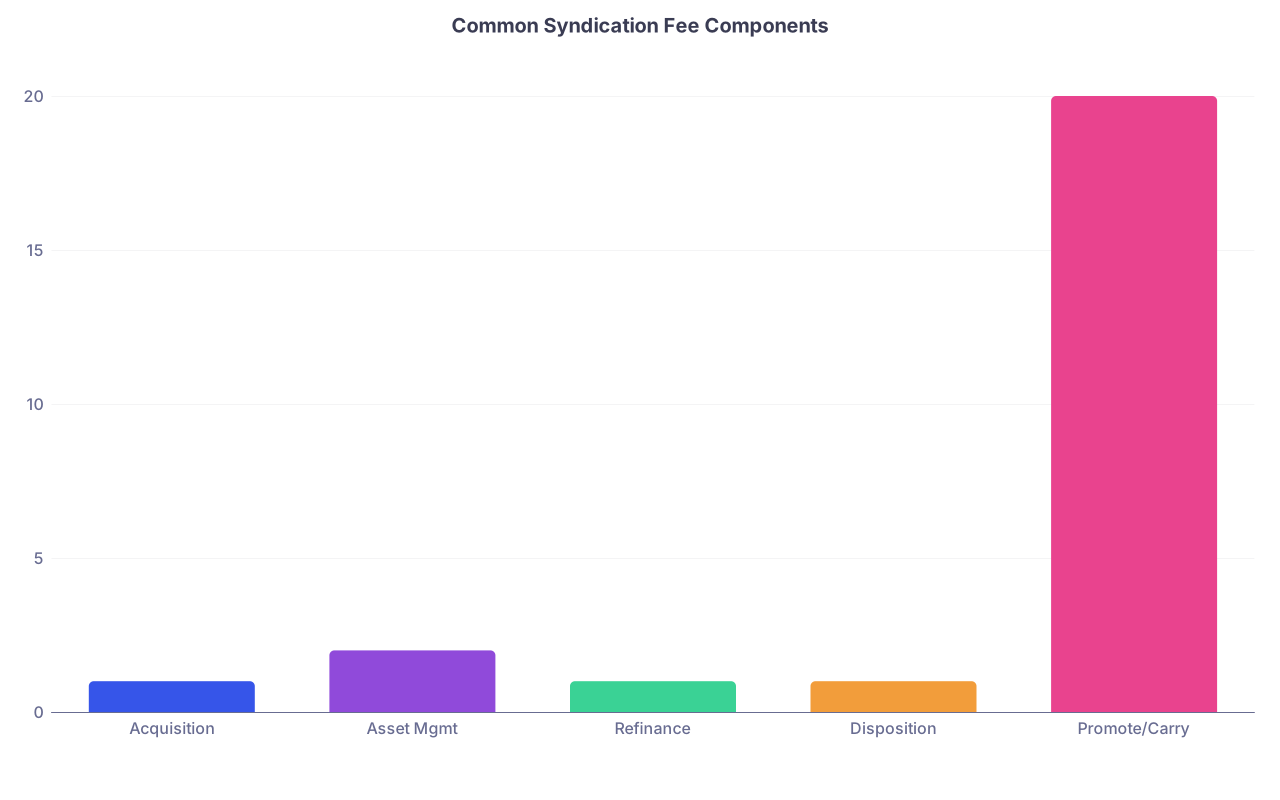
You must understand the GP/LP split, or you will donate returns you did not need to.
| Category | Value |
|---|---|
| Acquisition | 1 |
| Asset Mgmt | 2 |
| Refinance | 1 |
| Disposition | 1 |
| Promote/Carry | 20 |
Typical structure (example, not gospel):
- Preferred return: 6–8% to LPs before GPs share profits
- Split after pref: 70/30 or 80/20 (LP/GP) on additional profits
- Fees:
- Acquisition fee: 1–3% of purchase price
- Asset management: 1–2% of effective gross income
- Refinance / disposition fees
None of these are inherently bad. Abuse comes from:
- High fees plus weak underwriting
- Sponsors paying themselves handsomely regardless of investor outcome
Syndication vetting checklist
You are busy. Use a repeatable filter. For every deal:
Sponsor due diligence
- Number of full‑cycle deals (bought–operated–sold)
- Specific track record in the same asset type and market
- Background checks (yes, literally)
- Talk to prior investors. Ask what went wrong.
Deal specifics
- Purchase price vs recent comps
- In‑place cash flow vs pro forma fairy tales
- Sensitivity analysis: What if rents grow slower? Cap rates expand?
Legal docs
- Operating agreement (who controls what, voting rights)
- Waterfall structure (how returns are split at each level)
- Capital call provisions (can they demand more money?)
- Exit strategy and right of first refusal terms
Tax reality
- Confirm you are getting a K‑1
- Ask your CPA:
- How will depreciation work in my situation?
- How do passive loss rules apply to me as a physician?
- What happens if I have big suspended passive losses when the property sells?
Your rule as an overworked physician
You should be able to answer, in one paragraph:
What is the business plan, what could reasonably go wrong, and why does this team have an edge?
If you cannot articulate that, you do not understand the deal. Pass.
6. Path 4: Turnkey Properties with Professional Management – “Own Doors, Not Problems”
Now we are closer to traditional ownership, but with strict guardrails.
This can work if you obey one rule: you are not allowed to be the property manager. Ever.
What this approach looks like
- You buy a rental property (often in a more affordable market)
- From day one you have:
- Professional property management
- Clear management agreement
- Written financial reporting schedule
You are the capital. Not the workforce.
Key legal and structural steps
Form an LLC per property or per market cluster
- Example:
- “Smith Capital Realty LLC” holds 2–4 properties in one city
- Work with an attorney and CPA:
- Some states add significant franchise tax / complexity
- Too many LLCs becomes an administrative zoo
- Example:
Operating agreement
- Even if you are the only member:
- Spell out decision‑making powers
- Banking authority
- How profits are distributed
- Critical for:
- Asset protection
- Estate planning
- Clarifying roles if you later bring in a partner or spouse
- Even if you are the only member:
Property management agreement Non‑negotiables:
- Fee structure (usually 7–10% of rents, plus leasing fees)
- Who approves repairs over a threshold amount (e.g., >$300)
- Response standards for:
- Emergency repairs
- Routine maintenance
- Frequency and format of owner reports
- Termination clause if they underperform
Insurance
- Landlord policy (not standard homeowner’s)
- Strong umbrella policy over your whole portfolio
- Entity and personal coverages aligned with your attorney’s asset protection plan
Financial reality check
- Turnkey with property management is still semi‑passive
- You must:
- Review monthly reports
- Approve large capital expenditures
- Track cash flow for your CPA
If you cannot commit at least 1–2 hours a month per property to oversight, you should default to REITs/funds/syndications instead.
7. How to Decide: A Simple Flow Framework
Here is a blunt decision tree for physicians who do not want a second job.

| Step | Description |
|---|---|
| Step 1 | Start |
| Step 2 | Public REITs or REIT ETFs |
| Step 3 | Private REITs or Real Estate Funds |
| Step 4 | Syndications as LP |
| Step 5 | Stay with Public/Private REITs |
| Step 6 | Turnkey with professional management |
| Step 7 | Increase exposure via funds/syndications |
| Step 8 | Need liquidity within 3 years? |
| Step 9 | Want zero operational responsibility? |
| Step 10 | Comfortable reading PPMs and vetting sponsors? |
| Step 11 | Want to own physical property? |
Match your personality and time constraints first. Not your FOMO.
8. Tax, Asset Protection, and Legal Reality: Adult Answers Only
This is the part most “passive income” gurus gloss over, usually because they do not actually file complex physician tax returns or defend physicians in court.
You cannot outsource this thinking, even if you hire pros.
Core tax concepts you must understand at a high level
Passive vs active income
- Your clinical income = active
- Most real estate income (as an LP or hands‑off owner) = passive
- Passive losses cannot offset your W‑2 clinical income (exceptions exist, e.g., real estate professional status, but most full‑time doctors will not qualify legitimately).
-
- Syndications and private funds pass through:
- Income
- Expenses
- Depreciation
- In early years, depreciation can create paper losses even while you receive cash distributions.
- These losses generally:
- Offset other passive income
- Carry forward if not used
- Syndications and private funds pass through:
Capital gains and recapture
- When properties sell:
- Long‑term capital gains on appreciation
- Depreciation recapture at higher tax rates
- Big lump‑sum events. Plan for them.
- When properties sell:
Retirement accounts
- You can invest in some real estate deals via:
- Self‑directed IRA
- Solo 401(k)
- Watch for UBIT/UBTI if there is leverage. Your CPA must model this.
- You can invest in some real estate deals via:
Asset protection basics for physicians
You are a lawsuit target. You must separate:
- Clinical risk
- Personal wealth
- Business risk (including real estate)
Practical steps:
- Do not hold rentals in your personal name if you can avoid it
- Use LLCs, possibly series LLCs where appropriate
- Keep strong personal liability and umbrella coverage
- Coordinate:
- Your state’s homestead protections
- Retirement account protections
- LLC structure
One attorney. One CPA. Talking to each other. Not working in silos.
9. Avoiding the Three Classic Physician Real Estate Mistakes
I have watched these happen repeatedly. In hospital lounges. On call. At med staff dinners.
Mistake 1: Confusing “Busy” with “Passive”
You tell yourself you will “just do a couple of flips” or “self‑manage for a year to learn.” That is not passive. That is a third job.
If your diary already includes:
- 10+ clinic sessions per week
- Call
- Admin meetings
You are not allowed to add another operationally demanding activity and label it “an investment.” That is self‑deception.
Mistake 2: Chasing yield without understanding risk
High projected IRR on a pretty slide deck does not equal safety.
You must be able to answer:
- What happens if interest rates stay higher for longer?
- What if rent growth stalls?
- What if cap rates expand by 1–2%?
Any sponsor who gets defensive when you push on downside scenarios does not deserve your money.
Mistake 3: Treating each investment like a one‑off science experiment
You need a system. Not random deals.
10. Build a Simple, Physician‑Friendly Real Estate Plan
Here is a practical, step‑by‑step framework that fits into a real life that already includes rounding, OR time, and soccer practice.
Step 1: Define your real estate “job description”
Write this out in one paragraph. My recommendation:
“I will act as a capital allocator only. I will not personally manage tenants, contractors, or properties. My work will be limited to vetting opportunities, selecting managers/sponsors, and reviewing reports.”
Keep it visible. If a deal violates this, you decline it.
Step 2: Set your total real estate allocation
Decide:
- Target percentage of net worth in real estate (excluding primary home)
- Target split between:
- Liquid (public REITs, cash)
- Illiquid (funds, syndications, direct)
Example:
- Real estate target: 20% of net worth
- 10% via public REIT index funds
- 10% via diversified private funds / syndications
Adjust numbers to your risk tolerance and stage of career.
Step 3: Choose 1–2 primary vehicles
Do not try to do everything at once.
Common physician templates:
Ultra‑simple:
- Only public REIT ETFs inside retirement accounts
Moderate:
- 60–70% of real estate allocation in public REIT ETFs
- 30–40% in 1–2 private funds or carefully vetted syndications
More advanced (but still not a second job):
- A foundation of public REIT ETFs
- A “ladder” of syndications with staggered exits
- 1–3 turnkey properties under professional management
Start simple. Earn the right to add complexity after you have tax, legal, and reporting systems humming.
Step 4: Build your advisory bench
Minimum professional team:
- Real estate‑savvy CPA
- Familiar with K‑1s, depreciation, passive losses, UBIT
- Asset protection/real estate attorney
- Designs entity structure, reviews private placement docs
- Fee‑only financial planner (optional but valuable)
- Ensures your real estate fits your overall plan, not just your FOMO
You want people who have actually seen messy deals, not just read about them.
Step 5: Implement a deal review process
Before you say yes to anything:
- Use a 1‑page scorecard for:
- Sponsor track record
- Deal leverage
- Market quality
- Fee reasonableness
- Alignment of interests
If a deal fails 2 or more categories, you pass. Discipline beats excitement.
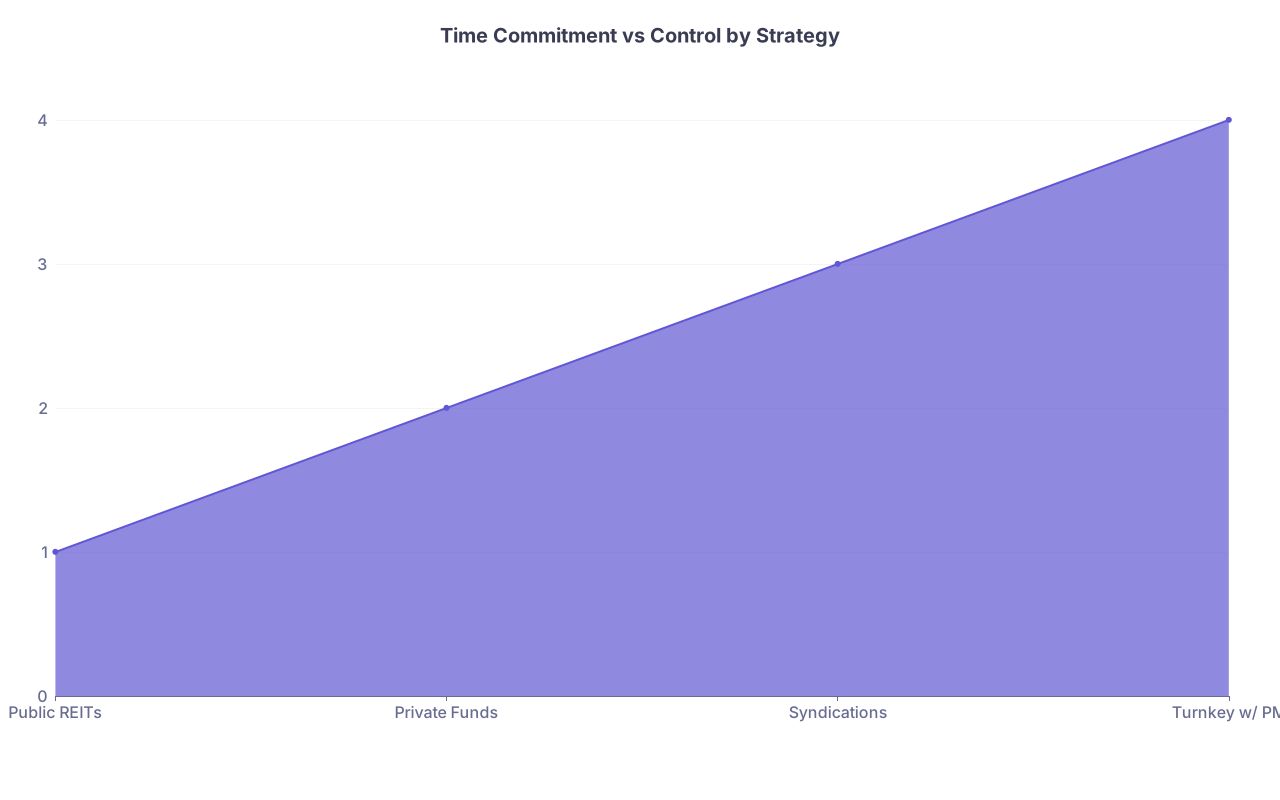
11. A Quick Look at Time vs Control vs Complexity
| Category | Value |
|---|---|
| Public REITs | 1 |
| Private Funds | 2 |
| Syndications | 3 |
| Turnkey w/ PM | 4 |
Lower number = less time and less control, higher = more.
If you are already overworked, your starting point should be on the left side of that chart. You can always move right later if you really want more control.
12. Concrete 30‑Day Action Plan
You want something you can actually do between cases. Here is a tight, realistic 30‑day protocol.
Week 1: Get organized
- List all investable accounts and current holdings
- Calculate current real estate exposure (probably just your home + maybe some REIT in a target date fund)
- Decide on a target % of your net worth for real estate
Week 2: Choose your main strategy
- If you want maximum simplicity:
- Open or adjust a brokerage/retirement account to buy a REIT index fund
- Set an automatic monthly investment
- If you want some private exposure:
- Identify 2–3 reputable real estate fund or syndication sponsors
- Start due diligence, not wiring money
Week 3: Build your support team
- Schedule a 30–60 minute call with:
- A real estate‑savvy CPA
- An asset protection attorney
- Ask them:
- “If I want to build a passive real estate portfolio without running properties, what is the cleanest structure for me?”
Week 4: Execute one small, reversible step
- Buy a modest amount of a diversified REIT ETF in a retirement account
- Or, if you are already set there:
- Select one private deal or fund that passed your due diligence filters
- Invest an amount that will not keep you up at night
Track how much time that step took. It should be measured in hours per month, not hours per week.
FAQ (Exactly 4 Questions)
1. What is the most truly passive real estate investment for a busy physician?
Public REIT index funds (like VNQ or SCHH) are the closest thing to “set and forget.” You buy them in your existing brokerage or retirement accounts, they require no landlord duties, and you can sell anytime the market is open. You lose the deeper tax advantages of private deals, but you gain simplicity, liquidity, and zero operational headaches.
2. How much of my portfolio should I put into real estate if I am just starting?
A reasonable starting band for most physicians is 5–15% of investable assets, excluding your primary home. Begin at the lower end with public REITs. As you gain comfort, stable income, and a competent CPA/attorney team, you could move toward 15–20% if it fits your broader financial plan. There is no magic number; the mistake is going from 0% to 40% overnight because of FOMO.
3. Are real estate syndications safe for physicians, or are they too risky?
Syndications are not inherently unsafe, but the risk is highly sponsor‑dependent. Good sponsor, conservative leverage, fair fees, and transparent communication – reasonable risk. Aggressive sponsor, heavy leverage, slick marketing, and vague downside planning – unnecessary risk. As a physician, your advantage is stable income, not insider knowledge of real estate. Use that income cautiously, and only invest in deals you can explain in plain language.
4. Do I really need an LLC to invest in real estate if I am not a landlord?
For public REITs and most private real estate funds, you can invest directly in your own name or through retirement accounts; an LLC is usually unnecessary and adds paperwork. For direct property ownership and some syndications, an LLC can improve asset protection and estate planning. The right answer depends on your state, net worth, and risk profile. Have an asset protection attorney map out a simple structure rather than copy what a colleague did in a different state.
Open your account list right now and write down your current real estate exposure as a percentage of your net worth. Once you see that number, choose one path from this article and take the smallest possible step toward it this week.