
The way most physicians set up LLCs for rentals is backward—and it quietly exposes them to risk they think they have “protected” against.
You do not fix this by downloading a random online template and hoping your white coat is some kind of legal force field. You fix it with a deliberate, stepwise setup that actually separates you from the property—legally, financially, and on paper.
Here is the clean, practical, step‑by‑step protocol for setting up an LLC for your first rental as a physician, without burning time or money on fluff.
Step 1: Decide If You Even Need an LLC For This First Rental
Start here or you risk solving the wrong problem.
You form an LLC for three main reasons:
- Liability segregation – if a tenant sues, they go after the LLC’s assets, not your personal accounts (assuming you did not personally screw something up as the doctor-landlord).
- Clean separation of finances – easier bookkeeping, tax prep, and eventual scaling to more rentals.
- Estate and asset planning – you can restructure ownership, gift interests, or move the LLC into a trust more easily.
But an LLC is not magically required for:
- Getting landlord insurance
- Writing off legitimate rental expenses
- Managing one small, low‑risk property in a very landlord‑friendly state
You should strongly consider an LLC if:
- You are a high-income physician with significant personal assets.
- The property will have multiple tenants (duplex, triplex, student housing).
- You want to scale to more rentals in the next 3–5 years.
- You practice in a specialty where you are already lawsuit‑sensitive and want another layer between personal and rental risk.
| Situation | LLC Recommended? |
|---|---|
| Single family in quiet suburb | Maybe |
| Duplex / small multifamily | Yes |
| Student housing near campus | Yes |
| High-crime area or older building | Yes |
| Short-term rental (Airbnb style) | Yes |
Here is the blunt truth: as a physician, you are a bigger lawsuit target. That alone usually tips the scale toward using an LLC for the rental, even when a non‑physician investor might skip it for the first property.
Still, if you have:
- Minimal assets
- Strong umbrella insurance
- A cheap single‑family home in a low‑risk area
…you could reasonably delay the LLC for now. But you asked how to set it up correctly, so I will assume you are going forward.
Step 2: Choose the Right State and LLC Structure
Most physicians overcomplicate this. They read about Delaware, Wyoming, Nevada and start fantasizing about “anonymous” structures before they even buy a water heater.
For your first rental, do this:
Form the LLC in the state where the property is located.
- If you form the LLC in a different state (e.g., Wyoming) but the property is in Texas, you still must register as a foreign LLC in Texas. That means:
- Two states worth of fees
- Two annual reports (in many cases)
- Twice the administrative noise
- You gain little that cannot be achieved more simply via good insurance and solid contracts.
- If you form the LLC in a different state (e.g., Wyoming) but the property is in Texas, you still must register as a foreign LLC in Texas. That means:
Default to a single-member LLC (SMLLC) if:
- You own the property alone.
- You are married but live in a non–community property state and want to keep the ownership simple (you can still handle estate planning later).
Consider a multi‑member LLC if:
- You and your spouse are equal co‑investors and live in a community property state.
- You are buying with another physician or partner.
- You may want some valuation discounts later for estate planning (this is more advanced, but your estate attorney will care).
For tax purposes, your options:
- Single‑member LLC → treated as a disregarded entity by default. Rental goes on Schedule E of your personal return.
- Multi‑member LLC → taxed by default as a partnership (Form 1065 + K‑1s).
- Elect S‑corp? For long‑term buy‑and‑hold residential rentals: almost always no. S‑corps complicate depreciation, ownership changes, and distributions. Keep rentals out of S‑corps unless you are doing active flipping or a tax pro with real estate experience tells you otherwise, with actual numbers.
Step 3: Name Your LLC Like an Adult, Not a Brand New Guru
You do not need to be cute. You need:
- Distinctiveness
- Availability
- Something you will not hate in 10 years
Skip “Dr. Smith Luxury Holdings” and similar ego-driven names. Use something boring and functional, like:
- “Maple Ridge Holdings LLC”
- “Southview Property Group LLC”
- “West Elm Rentals LLC”
Check:
- State corporation database – look up existing entity names for conflicts.
- Domain availability (optional but smart if you will scale).
Step 4: Actually Form the LLC (Properly, Not Halfway)
You have three options:
- Do it yourself via the state website – cheapest, and in many states very easy.
- Use a formation service (e.g., LegalZoom, Incfile, Northwest) – fine, but they will try to upsell registered agent services and useless add‑ons.
- Use an attorney – best if:
- You are in a heavily litigious state (CA, NY, FL).
- You plan to grow to multiple properties and want the structure right from day 1.
- You already have a CPA and estate attorney and want everything coordinated.
Core steps (these are almost universal):
File Articles of Organization (or Certificate of Formation)
You provide:- LLC name
- Business address (use a real address; avoid your home if possible)
- Registered agent name and address
- Management structure (member-managed vs manager-managed — for now, member-managed is usually fine)
- Organizer information
Designate a Registered Agent
- Could be you, but that makes your home address public in many states and ties you personally to service of process.
- Better: use a professional registered agent ($100–$150/year). Privacy and clean separation.
Pay the filing fee
- Ranges widely. For example:
- Delaware: ~$90
- Texas: $300
- California: $70 to file + $800 annual franchise tax
Do not cheap out to save $100 in the wrong state and create a mess.
- Ranges widely. For example:
Wait for approval
- Often immediate or a few days with online filing.
- You receive stamped Articles / Certificate. Save them as if they are your board certification documents.
Step 5: Draft a Real Operating Agreement (Even for One Member)
This is where most physicians screw up. They think “single member” means “no agreement needed.” Wrong.
You need an operating agreement for:
- Proving separation between you and the LLC.
- Lender and bank requirements (many will ask for it).
- Future partners, estate planning, and possible sale of interests.
What goes into it (at minimum):
- LLC name, purpose (“owning and managing real property” – keep it broad).
- Members and ownership percentages.
- Capital contributions (how much you put in).
- Rules on distributions.
- How decisions are made and who can sign what.
- What happens if you die, become disabled, or want to sell your interest.
If you are solo and want something quick:
- Use your state bar’s sample or a reputable legal template, then have a local attorney do a light review. Costs a few hundred. Worth it.
Step 6: Get an EIN and Open a Separate Bank Account
If you use your personal checking for rental income/expenses, you have already started blurring the liability wall you just paid to build.
Do this:
Get an EIN from the IRS
- Completely free.
- Do it online on the IRS website. Choose “Limited Liability Company” and follow prompts.
- Use your SSN as the responsible party, but the EIN will be for the LLC.
Open a dedicated LLC bank account
- Use a bank that does business checking without stupid fees.
- Bring:
- Articles of Organization
- EIN letter
- Operating Agreement
- Your ID
- Name on the account: “Maple Ridge Holdings LLC” (not your personal name).
From now on:
- All rent goes into this account.
- All expenses (repairs, insurance, property tax, etc.) come out of this account.
- If you need to put in money: capital contribution from you personally to the LLC.
- If you want to take money out: distribution from the LLC to you.
This separation is what lawyers look at when trying to pierce the corporate veil. Do not give them ammunition.
Step 7: Decide How the Property Will Be Titled and Financed
Here is where physician-investors often get frustrated: lenders.
There are two main paths:
Path A: Buy in Your Own Name, Then Transfer to LLC
- You close on the property personally.
- After closing, you execute a deed transfer (often a warranty deed or special warranty deed) from you → your LLC.
- This is common and many conventional lenders tolerate it as long as:
- You keep making payments.
- The LLC is still effectively “you.”
Risks / headaches:
- Your mortgage note might have a due-on-sale clause. Technically, transferring to the LLC violates this.
- In practice, as long as payments are on time and the LLC is just you, lenders often ignore it. But no guarantees.
Path B: Buy Directly in the LLC
- You use a commercial or portfolio loan.
- Lender underwrites based on:
- Property income
- Your global debt picture
- Sometimes your personal guarantee
- Usually:
- Higher rates than best conventional.
- Shorter terms (e.g., 20–25 years, balloons).
- But cleaner title: the LLC owns the property from day one.
For your first rental, most physicians go with Path A, then cleanly transfer to the LLC once the dust settles.
Critical: Use a local real estate attorney for the deed transfer. They will:
- Prepare and record the deed correctly.
- Ensure transfer tax / documentary stamp issues are handled.
- Avoid accidentally breaking title insurance coverage.
Step 8: Coordinate Insurance, Umbrella Policies, and Liability
LLC ≠ invincibility.
You need three layers:
Property (landlord) insurance
- Make sure the named insured is the LLC, not just you.
- If purchased in your name and later transferred, call your agent and add the LLC as insured or additional insured.
- Do not leave this half-finished; claims adjusters love technicalities.
Umbrella policy
- Your personal umbrella will often not automatically cover LLC activities.
- Ask your carrier explicitly:
- “I own a rental in an LLC. Will my umbrella cover liability claims from that property?”
- If not, get either:
- A separate umbrella that extends over the LLC, or
- A commercial umbrella that sits on top of the landlord policy.
Professional vs landlord liability
- Tenant sues you for a broken stair → that is landlord liability (LLC + insurance).
- Patient sues you in the hospital → that is malpractice. Separate world.
The idea is to make sure these two worlds never overlap financially.

| Category | Value |
|---|---|
| No LLC, No Umbrella | 1 |
| LLC Only | 2 |
| LLC + Landlord Insurance | 3 |
| LLC + Insurance + Umbrella | 4 |
Step 9: Understand How the LLC Affects Your Taxes (Without Getting Lost in Jargon)
Here is the basic reality for a single rental in an LLC:
- Tax benefits do not come from the LLC itself.
- They come from:
- Depreciation
- Expense deductions
- Interest deductions
- Possibly cost segregation once you scale
For a single‑member LLC:
- The IRS ignores the LLC entity by default.
- You report:
- Rental income and expenses on Schedule E.
- No self‑employment tax on long‑term rental income.
- Losses are often passive and may be limited if your physician W‑2 income is high. They may carry forward.
For a multi‑member LLC:
- File Form 1065 (partnership).
- Issue K‑1s to each member.
- Same passive/active logic applies.
Where the LLC helps:
- Clean documentation.
- Easier for your accountant.
- Smoother expansion once you have 2, 3, 5 properties.
Get a CPA who actually handles physician + real estate regularly. The combo matters because of:
- Passive activity loss rules
- Potential real estate professional status later if a spouse manages the portfolio.
- Coordination with 401(k), backdoor Roth, defined benefit plans, etc.
Step 10: Set Up a Minimal But Real Bookkeeping System
If you are building a serious side portfolio, you do not track expenses in a random Excel file plus a handful of crumpled Home Depot receipts.
Standard approach that works:
- One dedicated business checking account for the LLC.
- One credit card used only for LLC expenses (could be a business card or a dedicated personal card).
- Simple software:
- For 1–3 rentals: something like Wave, QuickBooks Simple Start, or even a disciplined spreadsheet.
- For more: QuickBooks or a real estate specific tool (e.g., Stessa, Buildium when you scale).
Track:
- Rent received
- Mortgage interest and principal (interest is deductible, principal is not).
- Property tax
- Insurance
- Repairs and maintenance
- Utilities (if you pay them)
- Property management fees (if any)
- Travel to and from the property (mileage log)
You want to be able to hand your CPA:
- A clean P&L (profit and loss) by property.
- A clear list of capital improvements for depreciation schedules.
Step 11: Avoid the Big Legal and Structural Mistakes I See Physicians Make
Here is the landmine list.
Using one LLC for everything
- Rental, consult LLC, speaking income, random side gig = all in one entity.
- That is how you cross-contaminate liability.
- Your rental LLC should hold rental activities only.
Putting your home in the same LLC as the rental
- No. Just no.
- You are literally inviting a plaintiff to consider your primary home part of the pot.
Ignoring state‑specific rules
- Example: California’s $800 franchise tax surprises out‑of‑state owners who buy there.
- Some states require annual reports; skip them and your LLC can be administratively dissolved.
No operating agreement, no minutes, no paper trail
- When courts pierce the corporate veil, they look for signs the LLC was just your alter ego:
- Commingled funds
- No documentation
- No formal agreements
- You do not need to hold fake “board meetings,” but at least:
- Keep a digital folder with major decisions.
- Document capital contributions and loans.
- When courts pierce the corporate veil, they look for signs the LLC was just your alter ego:
Buying with friends with no written rules
- “We are both attendings, we trust each other.”
- Then:
- One gets divorced.
- One wants out in three years.
- One wants to cash‑out refi while the other is risk‑averse.
- Your operating agreement must spell this out from the start.
Step 12: Plan for Scaling Without Rebuilding the Structure Every Time
You are setting up an LLC for your first rental. But if you do this right, it will not be your last.
Here is a scalable approach:
- Start with one LLC for the first property, learn the process and bookkeeping.
- Once you pass 3–4 doors or ~$500k equity, consider:
- Separate LLCs by property or by small clusters.
- A holding company LLC that owns the property LLCs (sometimes called a “parent‑child” or “series” structure).
This is where a real estate attorney plus CPA can map a 5–10 year vision.

| Step | Description |
|---|---|
| Step 1 | You |
| Step 2 | Holding LLC |
| Step 3 | Property LLC 1 |
| Step 4 | Property LLC 2 |
| Step 5 | Rental Property 1 |
| Step 6 | Rental Property 2 |
For your first property, do not overbuild a holding company unless:
- You have the cash and certainty to buy multiple doors in 12–24 months.
- Your attorney advises it specifically for your state and situation.
Step 13: Put It All Together – A Simple Checklist You Can Actually Follow
Think of this as your surgical checklist for setting up the LLC.
- Decide:
- Yes, I want an LLC for this rental (given my income, risk profile, and goals).
- Choose state:
- Use the property’s state, not where you practice, unless same.
- Structure:
- Single‑member or multi‑member?
- Member‑managed to start.
- Name the LLC:
- Boring, professional, and unique.
- Form the LLC:
- File Articles / Certificate with the state.
- Choose a professional registered agent.
- Pay the filing fee.
- Draft and sign the Operating Agreement.
- Get an EIN from the IRS (online).
- Open a dedicated bank account and, ideally, a dedicated card.
- Coordinate with lender:
- Decide whether to buy in your name or LLC.
- If in your name, plan a post‑closing deed transfer with a real estate attorney.
- Align insurance:
- Landlord policy listing the LLC properly.
- Umbrella coverage that actually extends to the rental.
- Set up bookkeeping:
- Decide on software.
- Use only the LLC account for rental transactions.
- Engage pros early:
- CPA who understands physicians with rentals.
- Real estate attorney for deed and initial documents.
- Keep records:
- Digital folder: Articles, EIN, Operating Agreement, deed, insurance, loan docs, major decisions.

What This Looks Like In Real Life For a Typical Physician
Quick scenario to ground this:
- 38‑year‑old hospitalist in Texas.
- Buys a $350k single‑family rental.
- Forms “Maple Ridge Holdings LLC” in Texas.
- Files Articles online, uses a registered agent, cost ~$350 total.
- Drafts a simple operating agreement; attorney reviews for $400.
- Closes on the property in her personal name with a conventional mortgage.
- Post‑closing: attorney files a Warranty Deed transferring property to the LLC.
- She gets an EIN, opens a business checking account at a local bank.
- Rent goes into LLC account; repairs paid from same.
- Landlord policy updated to list Maple Ridge Holdings LLC as named insured.
- Personal umbrella extended (for extra premium) to cover the LLC’s liability.
- CPA does taxes: rental appears on Schedule E, same as if she owned it personally, but documentation is clean and segregated.
That is what “done correctly” actually looks like. No offshore trusts, no 9‑entity stacks. Just a solid, defensible structure.
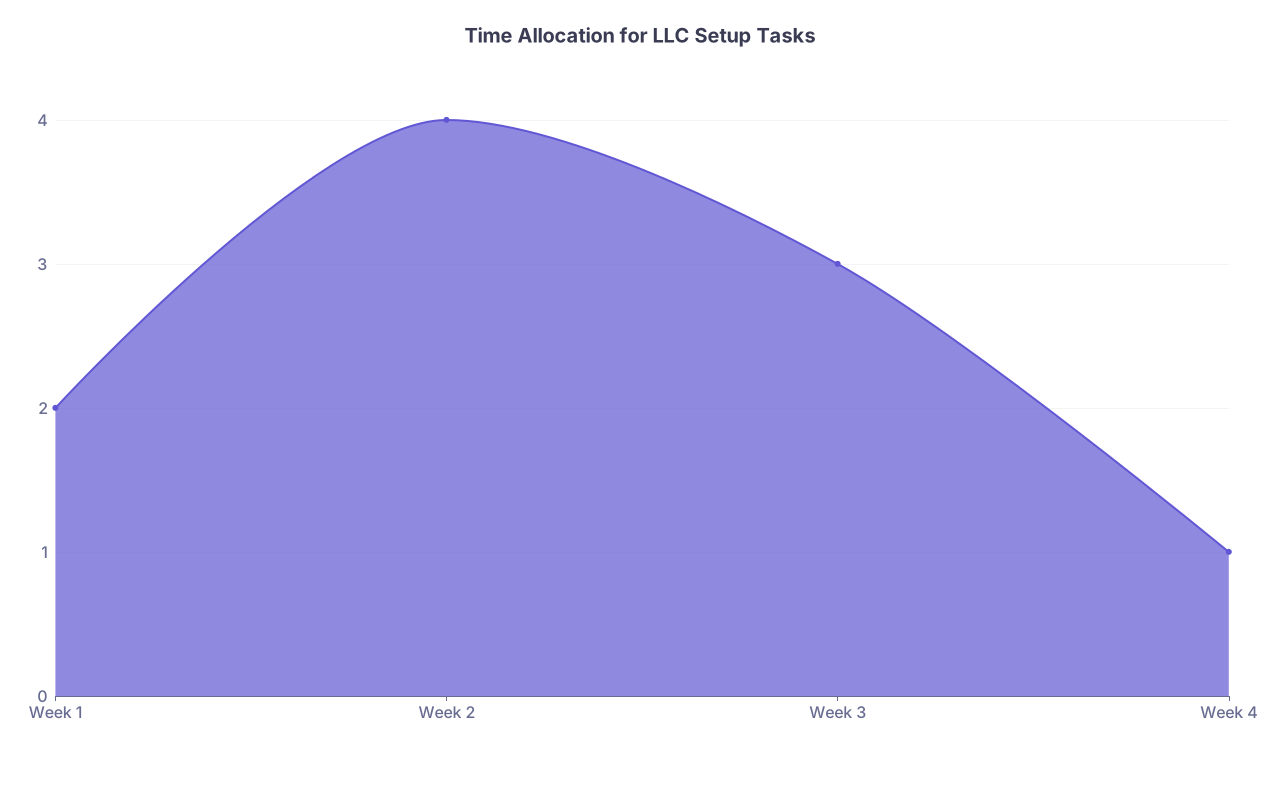
| Category | Value |
|---|---|
| Week 1 | 2 |
| Week 2 | 4 |
| Week 3 | 3 |
| Week 4 | 1 |
Final Takeaways
- The LLC is not about being clever. It is about clean separation: ownership, banking, risk, and records.
- For your first rental, keep the structure simple but real: one property, one LLC, proper documents, proper bank account.
- Do the boring parts—operating agreement, deed transfer, insurance alignment—and you will have a foundation you can actually scale, instead of a fragile shell that cracks the first time someone slips on the stairs.