
Your mortgage denial is not a verdict on your future. It is a data point. And you can fix it.
Most physicians get blindsided the first time a bank says “no” to an investment property loan. You assume: high income, MD after your name, decent credit = automatic approval. Lenders do not care about your credentials as much as you think. They care about risk, documentation, and math.
Let us build a plan that turns “declined” into “approved” for your next investment mortgage.
Step 1: Decode the Denial (Stop Guessing)
The worst response after a denial is to shotgun more applications without understanding why you were rejected. That just racks up hard inquiries and makes you look desperate.
You need to extract the underwriting story behind the “no.”
1. Get the Exact Reason in Writing
Call the loan officer. Be direct:
- “Walk me through exactly why this file was declined.”
- “What were the underwriting guidelines I failed to meet?”
- “What numbers or documents specifically triggered the denial?”
Then get the formal adverse action notice (they are required to provide one). It usually cites:
- Debt-to-income ratio (DTI) too high
- Insufficient reserves
- Insufficient or unstable income
- Credit score below minimum
- Recent negative credit events
- Property does not qualify (DSCR too low, appraisal issues, condition, etc.)
You want specifics, not generic language.
2. Ask for the Internal Numbers
Push a little further. Ask:
- “What DTI did you calculate?”
- “What income figure did underwriting actually use?”
- “What credit score did your system pull?”
- “What loan-to-value and reserve amounts were you looking at?”
You would be surprised how often:
- Your moonlighting or 1099 income was not counted
- Student loans were counted at 1% of the balance even if on income-driven repayment
- Future rental income was not included because there is no history or lease
- Your attending contract was ignored because you had not started yet
Once you see their numbers, you can target the weak point instead of flailing.
Step 2: Identify Which Barrier You Actually Have
Most physician investment loan denials fall into one (or more) of these categories:
- DTI / overall leverage problem
- Documentation / income type problem
- Credit quality problem
- Property-specific problem
- Wrong lender / wrong loan product
You fix each of these differently. Let us triage.
| Denial Reason | Primary Fix Focus |
|---|---|
| High DTI | Restructure debt / DSCR loan |
| Insufficient reserves | Build cash / reduce purchase |
| Unstable / 1099 income | Documentation / alt lender |
| Low credit score | Targeted repair / paydowns |
| Property cash flow weak | Different property / DSCR |
| Too many mortgages | Portfolio or DSCR lender |
If you do not know which bucket you are in, you are not ready to apply again.
Step 3: Fix High DTI Like a Professional, Not a Consumer
Physicians often get crushed by DTI despite high income. Big student loans, car payments, already owning a primary home, maybe a prior rental. Underwriting sees leverage, not your potential.
Here is how you attack that.
1. Know the Two Worlds: Agency vs DSCR
You probably got denied on a conventional (Fannie/Freddie) investment loan. Those care heavily about your personal DTI.
Alternative: DSCR (Debt Service Coverage Ratio) and portfolio loans.
Conventional investment loan
- Looks at you – DTI, income, tax returns, W2, etc.
- Uses 75% of rental income, often needs leases or history.
-
- Primarily looks at the property’s income vs its payment.
- Minimal or no personal income documentation.
- Higher rates/fees, but far less DTI pressure.
If your DTI is high due to student loans, multiple mortgages, or other physician lifestyle choices, you may simply be in the wrong loan universe.
2. Recalculate Your Own DTI (Properly)
Do this before any new application.
DTI = total monthly debt payments / gross monthly income.
Include:
- Student loans (underwriter may use: actual payment, 0.5% of balance, or 1% of balance depending on guidelines)
- Mortgage(s), HELOCs
- Car loans, personal loans
- Credit card minimums, not balances
- Alimony/child support, if applicable
Then compare to common thresholds:
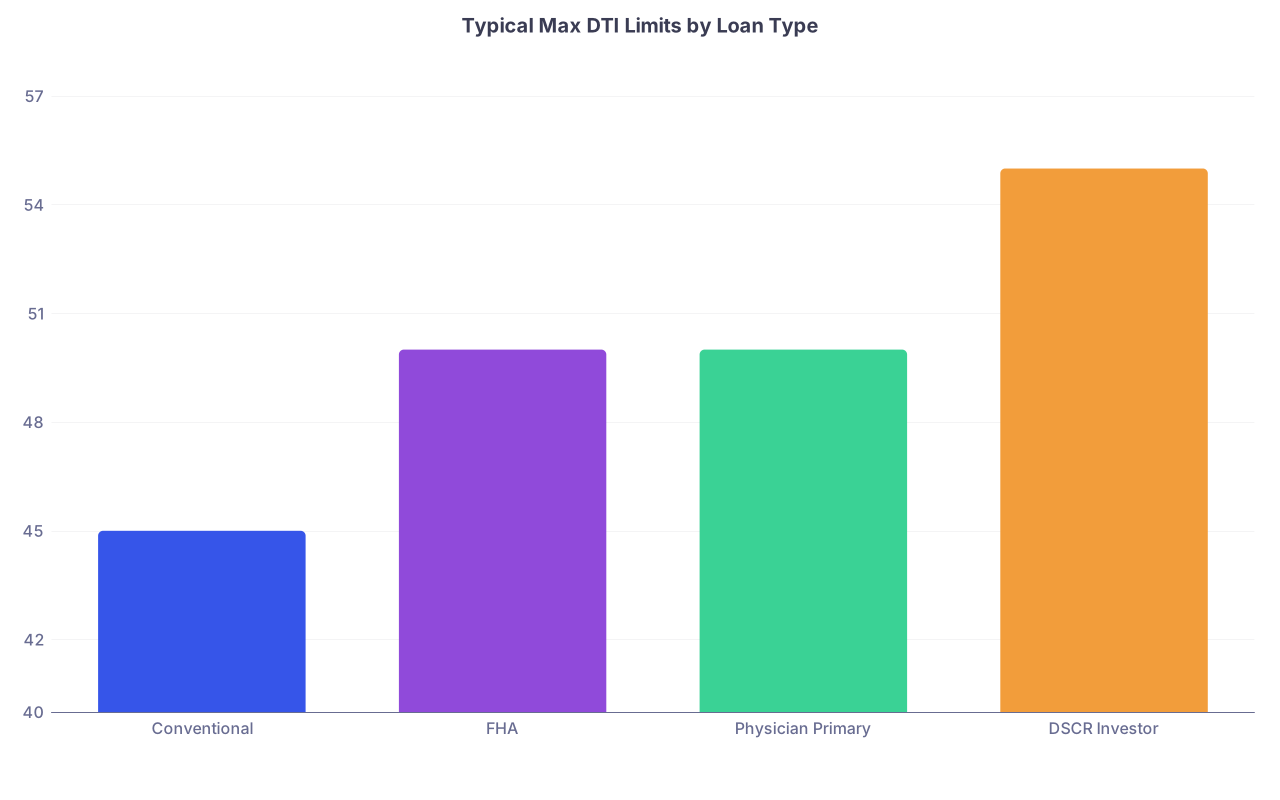
| Category | Value |
|---|---|
| Conventional | 45 |
| FHA | 50 |
| Physician Primary | 50 |
| DSCR Investor | 55 |
If you are:
- Under 40%: you usually have room, something else blocked you
- 40–50%: borderline, depends on lender and file strength
- 50%+: you will need either:
- A different loan type (DSCR), or
- A deliberate debt clean-up plan before reapplying
3. Strategic Debt Moves That Actually Help Approval
Here is what actually moves the needle (not the advice your broke coworker gives you):
Pay off or refinance car loans
- A $700/month Tesla payment kills more approvals than any latte ever will.
- Drop that, and your DTI instantly improves, permanently.
Consolidate high-interest personal loans
- One lower payment is better than three separate high payments.
Avoid new consumer debt for 6–12 months
- No new cars, furniture financing, or random installment loans.
For student loans:
- Ask the lender which calculation they use.
- If they accept IDR payments, make sure your payment is updated and documented.
- If they default to 1% of the balance and your balance is huge, you either need a different lender or a loan type that does not hammer your student loans as hard.
You are not trying to be “debt free.” You are trying to be “underwriting friendly.”
Step 4: Make Your Income Count (Even If It Is 1099 or New)
Many physicians get denied because the lender does not recognize half their income. Why? It is not W2, it is new, or it is not seasoned.
Fixable.
1. W2 Attending with New Job or Contract
If you just finished residency or moved to a new group:
- Use lenders who understand physician contracts.
- They can often qualify you with:
- Signed employment contract with start date
- Proof of licensing and credentials
- Sometimes even before you have 30 days of paystubs
If your lender treated you as “unstable new income” and refused to count it, you probably picked a generic retail bank instead of a physician-friendly lender.
2. 1099 / Locums / Side Gigs
This is where most denials happen for investors:
Underwriters often want:
- Two years of 1099 income on tax returns
- Stable or increasing trend
- Add-backs understood (depreciation, some business expenses, etc.)
If you:
- Just started 1099 work this year
- Or your 1099 income is very up-and-down
- Or you “tax-optimized” your return so aggressively it looks like you made nothing
…then that income may not be usable.
Two routes:
Plan ahead
- Accept that you may need 12–24 months of 1099 history before conventional lenders use it.
- File clean, comprehensible returns. Do not try to zero out your income with every deduction imaginable, then expect a bank to say “looks great.”
Use a loan product that does not rely on your tax returns
- DSCR loans for investment properties
- Bank statement loans (some portfolio lenders)
- Asset-based loans where they focus on your liquid assets and net worth
3. Fixing an “Insufficient Income Documentation” Denial
Concrete actions:
Gather complete documentation:
- Last 2 years of tax returns
- W2s, 1099s
- Year-to-date paystubs
- Employment contract
- Explanation letters for job changes
Sit with a mortgage broker who works with physicians and investors. Not just the loan officer at your checking account bank.
Ask them explicitly:
- “Which loan types will ignore or minimize my student loans?”
- “Which products use DSCR or bank statements instead of tax returns?”
- “Given my situation, what can we realistically do in 3 months vs 12 months?”
Step 5: Repair Credit the Smart Way (No Myths, Just Math)
Physicians sometimes coast on “good enough” credit from med school days and then discover that a 680 will not cut it for the best investor loans.
You want to target 720+ if possible. Above 740, pricing improves further.
1. Order All Three Credit Reports
Not just your score from one app. You want:
- TransUnion
- Equifax
- Experian
Check for:
- Late payments (especially in last 24 months)
- High utilization on credit cards
- Collections, charge-offs
- Errors: accounts that are not yours, wrong limits, misreported lates
2. Immediate Levers (30–60 Days)
If utilization is the problem:
- Get every revolving account under 30% of its limit
- Get at least 1–2 key cards under 10%
- Do not close old cards
- Ask for credit line increases (without hard pulls if possible)
These moves can raise scores significantly in a couple of months.
If there are errors:
- Dispute directly with the bureaus
- Provide documentation
- Focus on items that clearly do not belong to you or are inaccurately reported
3. Medium-Term Levers (3–12 Months)
If you have:
- Recent late payments
- Medical collections
- Charge-offs
You might not erase them, but you can mitigate:
- Goodwill letters to creditors if it was a genuine one-off mistake
- Negotiate pay-for-delete on some collections (especially medical)
- Keep every single payment current going forward
For a physician with strong income, the biggest self-inflicted wound is usually high utilization and sloppy payment history during residency/fellowship. Fixable with discipline and a clear timeline.
Step 6: Deal with Property or DSCR Problems Head-On
Sometimes you are not the issue. The property is.
I have seen:
- Residents try to buy a “rental” that would lose $600/month even at 20% down
- Attendings try to force a DSCR loan on a condo with insane HOA fees
- Investors banking on Airbnb income in a market where regulations are tightening
If your denial cited:
- Appraisal issues
- DSCR too low
- Cash flow not supporting the loan
You need to fix your acquisition criteria, not your life.
1. Understand DSCR and Lender Thresholds
DSCR = (Gross rental income) / (Total monthly PITIA)
Where:
- P = principal
- I = interest
- T = taxes
- I = insurance
- A = association dues (if any)
Many DSCR lenders want:
- DSCR ≥ 1.0 (breakeven) minimum
- DSCR 1.15–1.25 for better pricing
If your property underwrites at 0.85, the lender is not being mean. The deal is weak.
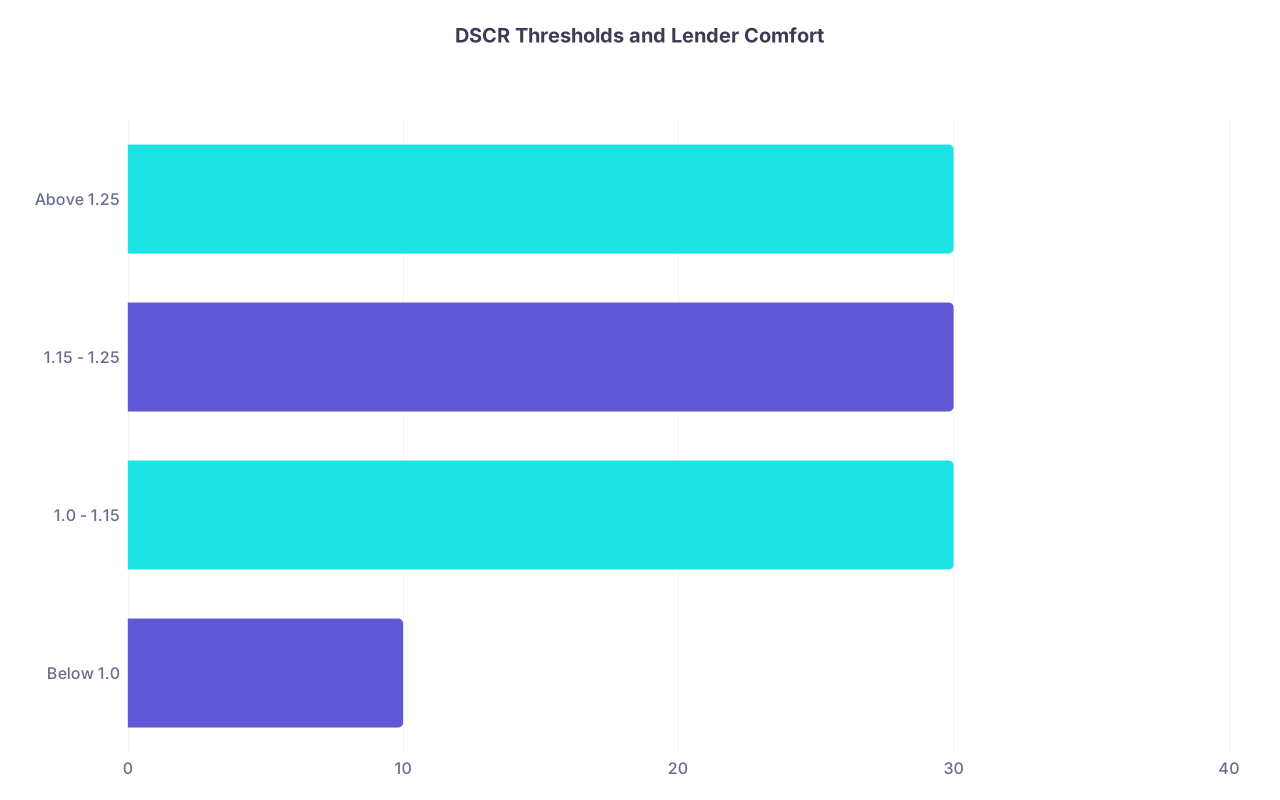
| Category | Value |
|---|---|
| Below 1.0 | 10 |
| 1.0 - 1.15 | 30 |
| 1.15 - 1.25 | 30 |
| Above 1.25 | 30 |
Rough interpretation:
- Below 1.0: Negative cash flow. Many DSCR lenders will decline or price it brutally.
- 1.0–1.15: Thin margin. Some lenders approve; pricing not great.
- 1.15–1.25: Acceptable; many investors operate here.
- Above 1.25: Strong. Lenders comfortable; better rates.
2. Fix the Property Side
You have options:
- Increase down payment to improve DSCR
- Buy in a better-yielding market (Midwest, Southeast, secondary cities)
- Avoid HOAs that crush cash flow
- Target small multi-units rather than shiny urban condos
If a lender declined your investment mortgage because “property does not cash flow / DSCR too low,” take that as a favor. You almost bought a headache.
Step 7: Choose the Right Lender for Physicians and Investors
Going back to the same retail bank that just rejected you is not a plan. You need matching between:
- Your profile (W2 vs 1099, DTI, credit, existing mortgages)
- The property (1–4 unit, short-term rental, small multifamily)
- The loan product (conventional, DSCR, portfolio, physician-specific)
Here is how to think about it.
| Loan Type | Best For |
|---|---|
| Conventional | First 1–4 rentals, strong DTI |
| Physician mortgage | Primary home, sometimes 2nd home |
| DSCR investor loan | High DTI, multiple properties |
| Portfolio lender | >10 properties, complex situations |
| Bank statement loan | Heavy 1099, messy tax returns |
Practical moves:
Work with a mortgage broker who does:
- Investor loans
- DSCR products
- Physician mortgage programs
Be transparent up front:
- “I have high student debt, multiple mortgages, and mixed W2/1099 income. I am a physician looking to scale rentals. Which products actually fit me?”
Stop emotionally attaching to one bank:
- The bank that refinanced your med school loans is not necessarily the one that should fund your 4-unit rental. Different game.
Step 8: Build a 6–12 Month “Approval Plan”
If you got denied today, you need a timeline. Not vague “I’ll try again later.” A specific, staged plan.
Here is a sample 6–12 month action plan for a typical young attending:
Months 0–1: Diagnosis
- Get denial reasons and underwriting numbers
- Pull full credit, calculate true DTI
- Meet with an investor-focused mortgage broker
Months 1–3: Quick Wins
- Pay down/kill 1–2 high-payment debts (car, personal loan)
- Bring all revolving utilization under 30%, one major card under 10%
- Clean up any obvious credit report errors
- Gather and organize all income docs
Months 3–6: Structural Fixes
- Adjust tax strategy so your income does not vanish on paper
- If heavy 1099, build a consistent billing/invoicing pattern and maintain a business checking account
- Increase cash reserves:
- Aim for 6 months of personal expenses + 3–6 months of proposed rental expenses in liquid or near-liquid form
Months 6–12: Targeted Re-Entry
- Run a pre-underwrite with the broker using updated numbers
- If DTI still tight → pivot to DSCR/portfolio lender and adjust buy box to hit DSCR ≥ 1.15
- Submit a new application only when:
- Credit score hit your target band (e.g., 720+)
- DTI and reserves meet the product’s rules
- The property truly cash flows on paper
You are not at the mercy of a random “yes” or “no.” You are engineering an approval.
Step 9: Protect Yourself Legally and Financially While You Scale
As you move from “denied” to “approved” and start actually acquiring, you still need to protect your downside.
Basic but non-negotiable for physician investors:
Do not commingle business and personal funds
- Open dedicated accounts for rentals. Clean records matter for both taxes and future lending.
Consider using LLCs or entities strategically
- Talk to a real estate attorney and CPA who understand your state and your specialty.
- Some DSCR and portfolio lenders will lend directly to your LLC, which can be cleaner for liability.
Understand recourse vs non-recourse
- Most 1–4 unit loans are recourse (they can come after you personally).
- Some DSCR/portfolio options are non-recourse or limited recourse but read the fine print.
Do not blindly sign personal guarantees for random side deals
- Your balance sheet is your weapon. Protect it.
This is not about fear. It is about staying in the game long-term.
Final Tight Summary
- A loan denial is a data problem, not a life sentence. Get the exact reasons, numbers, and guidelines that blocked you, then target those directly.
- Match your strategy to your reality: if DTI and complex income are your issue, conventional loans may be wrong. DSCR, portfolio, and physician-aware lenders exist for a reason—use them.
- Build an approval plan, not a hope. Over 6–12 months, deliberately fix DTI, clean up credit, stabilize/document income, and choose cash-flowing properties that underwrite well. Then apply once, with a file that deserves a “yes.”