
The way hospital executives evaluate medical office investments is far more brutal and mechanical than most physicians realize.
You’re thinking about yield, appreciation, maybe some tax benefits. They’re thinking about strategic control, downstream revenue capture, bond covenants, and how your building affects their negotiating leverage with payors and competing systems. And they’ll kill a deal you think is “great” in five minutes if it dings one of those levers.
Let me walk you through how it actually works behind the curtain, from the C‑suite and strategy meetings you’ll never be invited to.
The Real Hierarchy: Who Actually Decides on Medical Office Investments
First secret: it’s almost never just the “CEO.” There’s a machinery behind every “yes” or “no.”
Here’s the typical cast:
- CFO – The real gatekeeper. If the numbers do not work in their model, nothing happens.
- Chief Strategy Officer (or VP Strategy) – The person asking, “Does this move our chess pieces or weaken them?”
- Real Estate / Facilities VP – Handles the dirt and the buildings, but follows strategy and finance.
- Legal & Compliance – The professional deal-killers if Stark/AKS/compliance looks shaky.
- Sometimes: Chief Medical Officer – If physician alignment, service line strategy, or clinical ops are heavily involved.
You pitch some medical office concept—new MOB across from campus, joint venture with physicians, converting an existing strip center into a multispecialty clinic. Here’s what really happens after you leave the room:
There’s an internal meeting you never see. Someone from planning throws up a map of their service area. Someone from finance throws up a 10‑year pro forma. Strategy talks about competitor plans. Legal brings up risk and regulatory landmines. And then they ask one question:
“Does this help or hurt the hospital’s long-term position?”
If the answer is anything less than “clearly helps,” they stall you with “we’ll need to study this more.”
The Hidden Framework: How Hospital Execs Actually Score an MOB Deal
Executives don’t say this out loud, but internally they’re scoring your project on a small set of ruthless criteria. Not the fluffy “community benefit” language you see in press releases.
Here’s the real short list:
- Strategic control of geography and referrals
- Impact on hospital financials (not yours; theirs)
- Political effect on key physician groups
- Payor and competitor implications
- Regulatory / compliance risk
- Capital constraints and opportunity cost
I’ve seen deals with a 9% projected yield die because they weakened strategic control. I’ve seen weak-yield deals sail through because they locked up a key service line and strangled a competitor.
Let’s unpack the big ones.
Strategic Control: The Part Physicians Underestimate Constantly
You care about: “Is there demand here? Will patients come?”
They care about: “If we put doctors here, will they still send cases to our ORs, imaging, and procedural units—or does this move referrals out of our orbit?”
Executives start with a map. Literally.
They’ll overlay:
- Their primary and secondary service areas
- Current referral patterns by ZIP code
- Competitor facilities
- Existing and planned payor contracts (narrow networks, tiered products)
Then they ask:
- Does this MOB cement our hold on this micro-market?
- Does it neutralize or provoke a competitor?
- Are we cannibalizing our own higher-margin services by decentralizing too much?
You might think, “This outpatient surgery center 15 minutes away will be great for patients.”
CFO hears: “We’re moving profitable surgical volume from our hospital ORs (where we collect facility fees + ancillaries) to a lower-revenue site we don’t fully control.”
Unless that outpatient center is part of a deliberate system-wide shift with a clear financial and strategic rationale, they’ll try to block it or at least avoid supporting it.
They like MOBs that:
- Tie high-referring physicians closer to the system
- Create “stickiness” (imaging, labs, primary care hubs that feed into their specialty services)
- Block competitor encroachment into high-value zip codes
They hate MOBs that:
- Make independent physicians stronger without increasing the hospital’s capture of downstream revenue
- Improve convenience in a way that leaks referrals to another system
- Create “orphan” sites with no strategic connections to their core campuses
If your investment strengthens independent physician bargaining power more than it strengthens the hospital’s ecosystem, expect resistance.
The Money Model: How They Really Look at Returns
Here’s where physicians usually misread the room.
You look at:
- Cap rate
- Cash-on-cash return
- Debt coverage
- Appreciation potential
They look, instead, at:
- Net revenue per square foot (including downstream revenue, not just rent)
- Impact on their operating margin
- Effect on bond ratings and debt capacity
- 10–15 year NPV of the overall service line, not just the building
So an 8% yield MOB sounds fantastic to you.
To them, it might actually be a drag if:
- To hit that yield, lease rates are high, which then squeeze physician practice margins
- That squeeze risks physicians jumping ship to a competing system with subsidized space
- The capital used for that building could have funded a higher-return project (like an ASC with clear volume and payor commitments)
They live in a world of capital planning committees and bond covenants. You’re thinking “this is a great stand-alone building.” They’re thinking “if we sink $25M here, that’s $25M we can’t use for the new cath lab, ASC, or EMR upgrade that hits multiple service lines and keeps the rating agencies happy.”
Here’s how a typical internal comparison looks behind the scenes:
| Project Type | Typical Internal Lens |
|---|---|
| On-campus MOB | Strategic control + MD alignment |
| Off-campus clinic | Market expansion + competitor response |
| ASC (joint venture) | Margin replacement + physician loyalty |
| Imaging center | High-margin volume capture |
| Parking/infra | Necessary evil, supports other projects |
If your medical office investment request is competing against a planned ASC or imaging expansion, you’re already losing unless your project clearly preserves or increases their high-margin downstream revenue.
Payor and Competitor Dynamics: The Layer Most Docs Never See
Hospital executives are obsessed—rightly—with how every physical asset affects negotiating power with payors and competitors.
Your MOB proposal gets run through these silent questions:
- If we put this building here, does it strengthen our hand in payor negotiations in this micro-market?
- Does it help us achieve critical mass for a value-based or narrow network product?
- Will a payor use this site as leverage to push down our hospital rates by steering outpatient cases away from inpatient/OR bundles?
They’re tracking things like:
- Where Blue Cross is building narrow networks
- Which zip codes are flipping from one dominant hospital to another
- Where large employers are concentrated and what steerage programs they’re adopting
That “great location next to a large employer park” that excites you? They’re asking:
- Are we already the dominant system for those employees? Then the MOB may be defensive but useful.
- Are we weak there and a competitor already has embedded clinics? Then we’re late—and the building might not swing the market enough to justify the cost.
And here’s a brutal truth: sometimes they’ll support or oppose your MOB primarily because it harms or helps a competitor, even if the standalone real estate economics are mediocre.
Physician Politics: Why Some Deals Fly and Others Stall Forever
Do not underestimate physician politics. Ever.
Executives ask quietly:
- Which physician groups win or lose with this building?
- Does this align with our employed group or with independents who negotiate hard?
- Are we risking a split among key high-volume specialists?
Here’s a scenario I’ve watched play out:
- Independent ortho group wants to develop an MOB with an ASC off-campus. High yield. Good projections.
- Hospital’s own employed ortho service line is struggling, losing market share.
- Hospital leadership smiles politely in the meeting with the independent group, then internally says: “Approving this basically cements our employed ortho failure and strengthens the group that beats us up in contracting.”
- Result: Slow-walk, vague “concerns,” “need more data,” and the deal eventually dies on “strategic alignment” grounds.
You thought it was about rent and construction costs.
They thought it was about who controls orthopedic volume in the region for the next 10–15 years.
If your MOB investment plan pits favored employed groups against independents, you can expect all kinds of obstacles: denied hospital support, refusal to sign long-term leases, non-cooperation on co-locating services.
Legal & Compliance: Stark, AKS, and the Quiet Kill Shot
Legal departments don’t care about your yield. Their job is to keep the organization out of headlines and DOJ settlements.
Every MOB scenario that involves physician ownership or referral patterns triggers:
- Stark Law analysis (financial relationship + referrals for DHS)
- Anti-Kickback Statute review (any perceived “remuneration” for referrals)
- Fair market value (FMV) review of rent and ownership terms
- Commercial reasonableness opinions
Here’s where execs get especially nervous:
- Below-market leases for referring physicians (classic red flag)
- Ownership structures where physician ROI is clearly juiced by their own referrals to the building or ancillary services
- Complex JV setups that look, frankly, like disguised kickbacks
So while you’re celebrating “We negotiated a great lease rate with the hospital!” the legal team might be writing a memo that says, “This looks like inducement for referrals. High risk. Recommend no.”
And executives listen to that. They’re not risking an eight-figure settlement so you can get a few percentage points more on a real estate deal.
How They Actually Underwrite a Medical Office Building
Let me walk you through how a real underwriting discussion sounds in a capital allocation meeting.
Planning/Strategy presents:
- Market demand analysis
- Population growth, aging demographics
- Projected visit volume by specialty
- Impact on strategic service lines (cardiology, ortho, oncology, etc.)
Finance presents:
- Project cost, timing of cash flows
- Lease-up assumptions (which physicians, what specialties, what rent)
- Operating expenses and net operating income (NOI)
- NPV and IRR under conservative assumptions
Then the tough questions start:
- “Are we assuming physicians will move here just because we build it, or do we have signed LOIs?”
- “If we house independents, are they committing any volume guarantees to our hospital/ASC, even informally?”
- “What happens to inpatient volume if we move this much ambulatory care off-campus?”
- “Show me the sensitivity: what if rent is 10% below pro forma and occupancy is 85% instead of 95%?”
- “Does this help us renegotiate with United or Anthem in this region, or is it just nice-to-have space?”
They will build downside scenarios you never considered. And if the downside looks ugly, even if the base case is nice, their default is “no.”
To visualize the spread of what gets approved vs. shelved, picture something like this:
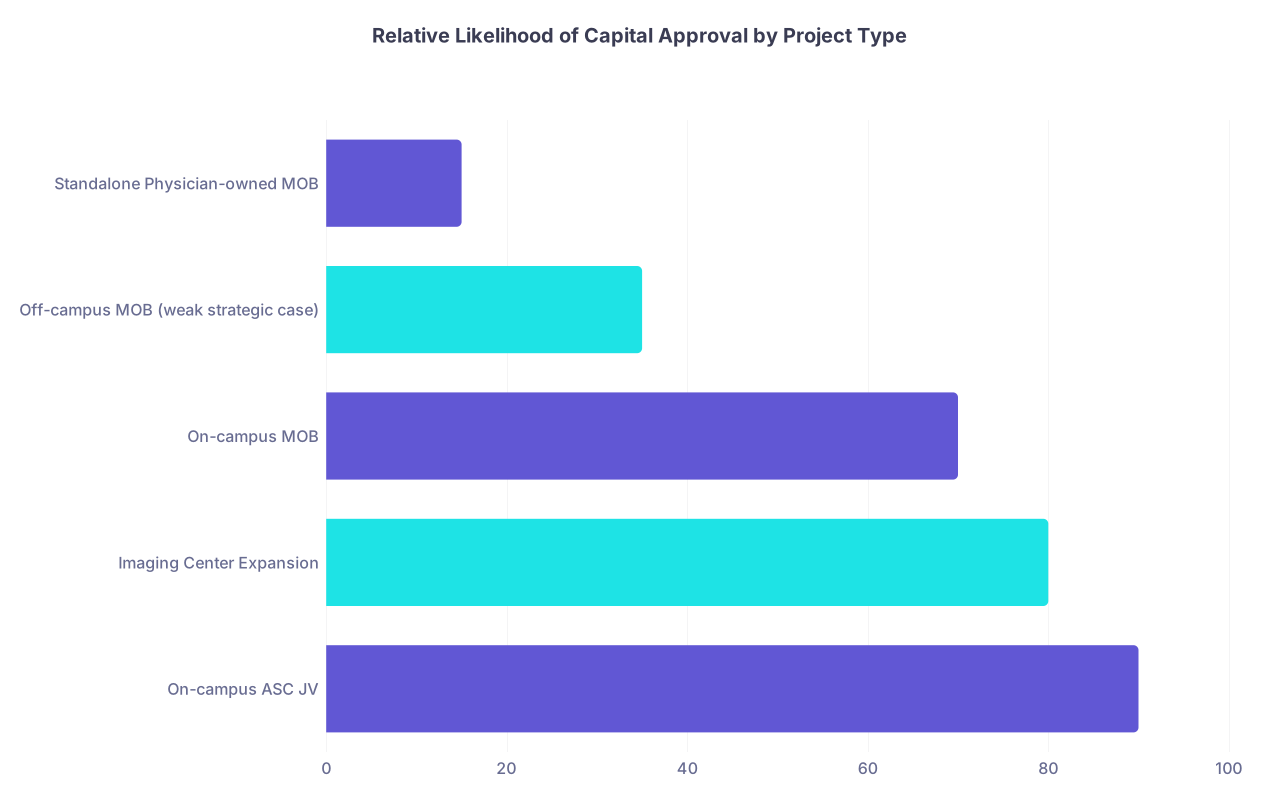
| Category | Value |
|---|---|
| On-campus ASC JV | 90 |
| Imaging Center Expansion | 80 |
| On-campus MOB | 70 |
| Off-campus MOB (weak strategic case) | 35 |
| Standalone Physician-owned MOB | 15 |
That’s the hierarchy in practice. Your independent, physician-owned MOB is usually at the bottom of the priority pile unless it aligns with a very specific system strategy.
Capital Constraints and the Harsh Reality of “We Like It, But No”
You will sometimes hear executives say, “Strategically this is strong, but we just do not have the capital this cycle.”
Translation:
- “We’d rather spend limited capital on assets that hit our margin faster.”
- “Our debt ratios are tight and the rating agencies are watching.”
- “We can’t justify this building versus the ASC/cath lab/ED expansion that’s ahead of you.”
Many hospitals are operating with razor-thin margins. Some are violating covenants quietly and praying volumes bounce back. MOBs—especially if they don’t drive immediate high-margin volume—get cut from the list even when leadership likes them conceptually.
That’s why you’ll see so many hospital-affiliated MOB projects involving third-party developers and REITs. Off-balance sheet. Less capital strain. Still strategic control through master leases, ROFRs, or long-term ground leases.
If you’re a physician investor, and you want hospital support, offering a capital-light structure for the hospital (with them as master tenant or key anchor tenant but not owner) is much more attractive than asking them to commit major equity.
Where Physician Investors Go Wrong – And How To Play the Game Smarter
Here’s where most physician real estate investors blow it:
They walk in talking about rent, yield, and design. Executives are listening for strategy, leverage, and risk.
If you want your medical office investment to be something hospital execs will support (or at least not oppose), you have to frame it in their language.
You should walk into that meeting prepared to answer, crisply:
- How does this MOB increase the hospital’s control or influence in this specific micro-market?
- What downstream revenue does this building help preserve or grow—imaging, procedures, admissions?
- How does this help them in negotiations with at least one major payor? Be concrete.
- Which physician groups benefit, and how does that align with the hospital’s employed vs. independent strategy?
- How are you avoiding Stark/AKS landmines—FMV lease rates, clean ownership structure, commercially reasonable justification?
And then you need to be honest with yourself: if the building fundamentally strengthens physician independence more than hospital system power, expect friction. You might still do the deal. But don’t kid yourself about how the C‑suite sees it.
To help you think like them, here’s the mental checklist I’ve seen actually used in exec sessions:
| Question | If Answer is Yes… |
|---|---|
| Does it lock in a key geographic hub? | Strong strategic points |
| Does it anchor high-volume referrers? | High priority to support |
| Does it boost payor contracting leverage? | Big plus |
| Is capital light for hospital? | More likely to advance |
| Is compliance risk clearly mitigated? | Less likely to get legal pushback |
A Simple Visual: How Your Idea Moves Through the Machine
Here’s what really happens from “great idea” to “approved project.”

| Step | Description |
|---|---|
| Step 1 | Physician or Developer Idea |
| Step 2 | Initial Meeting with Strategy or Real Estate |
| Step 3 | Polite Rejection or Endless Delay |
| Step 4 | Preliminary Financial Model |
| Step 5 | Legal and Compliance Review |
| Step 6 | Capital Planning Committee |
| Step 7 | Board or Executive Approval |
| Step 8 | Design Lease LOIs Construction |
| Step 9 | Strategic Fit? |
| Step 10 | Meets Return and Volume Thresholds? |
| Step 11 | Stark AKS and FMV Clean? |
| Step 12 | Beats Other Projects Competing for Capital? |
Your job, as a physician investor, is to make every “Yes” on that path as easy and low-risk as possible for them.
FAQ: Behind-the-Scenes Answers You Won’t Hear in Public
1. Why does the hospital say our physician-owned MOB is “not aligned” even when it’s near their campus?
Because “aligned” is code for “increases our control and margin.” If your structure favors independent physicians, doesn’t give them leverage in payor talks, and risks moving volume to lower-margin settings they don’t own, they’ll call it “misaligned” no matter how close it is to campus.
2. Do hospital executives actually care about the physician investment returns in these projects?
Not really. They care about physician behavior. If good returns make key groups loyal and cement referrals to their facilities, they like it. If good returns empower physicians to act independently, negotiate harder, or partner with competitors, your IRR is a problem, not a feature.
3. How can we structure a MOB so the hospital is more likely to participate or at least not block it?
Make it capital-light for them (3rd-party developer, long-term lease rather than heavy equity), ensure lease terms are FMV and clean from a Stark/AKS perspective, and explicitly tie the building to growth of specific downstream services they care about—ASC cases, imaging, infusion, etc.
4. Why does legal sometimes “torpedo” deals the business team likes?
Because every system now has scars from enforcement actions, settlements, or scary OIG letters. Legal will not bless anything that smells like inducement for referrals: below-market rent, sweetheart equity, or ROI clearly linked to referral volume. Once legal flags it as high-risk, executives almost always walk away, even if they love the strategic or financial angle.
5. As a physician, should I still pursue medical office investments if the hospital might see them as threatening?
Yes, but do it with open eyes. If your investment is fundamentally about physician independence or partnering across systems, plan for friction and don’t build your pro forma around hospital support. If you want them as a partner or anchor tenant, design the project to serve their strategic, financial, and compliance priorities first—and your yield second.
In the end, remember three things:
Hospital executives are playing a long, system-level game, not a building-level game.
They care more about control, margin, and leverage than about your cap rate.
If you want your medical office investments to succeed near or with a hospital, you need to think—and talk—the way they do, not the way most physicians are used to.