
You just stepped out of the OR. Anesthesia is reversing, the next case is in pre-op, and you have 18 minutes before you scrub again. You sit down, open your email, and there it is:
“Time-sensitive opportunity, 18% IRR, 2x equity multiple, 5-year hold, 300-unit value-add in Dallas. Soft commit by tonight.”
You click the deck. 50+ pages. Pro formas, maps, pretty pictures, waterfall diagrams, lender quotes. You have exactly enough time to either skim and guess… or have a tight, repeatable 15‑minute system that tells you:
- Yes – this is worth a deeper look later tonight
- No – delete and move on
- Maybe – but only if XYZ checks out
I am going to give you that 15‑minute system.
This is not a full underwriting course. This is a battlefield triage protocol for busy physicians so you can stop “investing by vibes” and start filtering deals like someone whose time is actually worth $400–800/hour.
The 15-Minute Framework: What You’re Trying to Decide
Between cases, you are not trying to:
- Rebuild their pro forma
- Re‑underwrite the entire deal
- Read every line of the legal docs
Your only goal in 15 minutes:
Decide: PASS fast or SHORTLIST for deep-dive later.
To do that, you run through five checkpoints:
- Sponsor sanity check – Who is driving this bus?
- Deal fit check – Does this match your personal strategy and risk level?
- Quick numbers check – Do the returns and structure pass basic smell tests?
- Risk landmines – Are there obvious ways this can blow up?
- Legal & alignment snapshot – Are incentives aligned or predatory?
Give each checkpoint ~2–3 minutes. Skip any step where the deal obviously fails. Hard pass. Next.
Let me walk you through exactly what to look for, in order, with real‑world shortcuts.
Step 1 (2–3 minutes): Sponsor Sanity Check
If the sponsor is wrong, nothing else matters. Strong deal + weak sponsor = eventual headache.
Here is your rapid sponsor triage:
1.1 Who are they really?
Look for:
- Company name and key principals (usually on the first 3–5 slides or on the website).
- Track record summary: “X deals, Y units, Z exits, average realized returns.”
Minimum bar to stay in your “maybe” pile:
- Prior experience with this asset type (e.g., multifamily, self‑storage, medical office).
- At least one full cycle (bought, operated, sold) that they can show.
- Not some brand‑new “doctor group” doing their first big deal as co‑GP without an institutional partner.
If you cannot find:
- Names
- Prior deals
- Real bios
In 2 minutes… that is a no. Credible sponsors show off their track record.
1.2 Quick reputation and alignment
You cannot deep‑diligence reputation between cases, but you can do three fast things:
- Google: “SponsorName reviews,” “SponsorName SEC,” “SponsorName lawsuit.”
- Check if they or the fund are 506(b) or 506(c) – not a quality guarantee, but at least indicates some regulatory structure.
- See whether they co‑invest real money: “Sponsor is investing $X of their own capital.”
Red flags that should make you hit delete:
- Zero mention of sponsor co‑investment.
- All of their “experience” is as limited partners, not operators, but they’re now leading a $50M deal.
- Over‑hyped language: “once in a lifetime,” “no risk,” “guaranteed,” “slam dunk.”
Pass those tests? Move on. Still under 3 minutes.
Step 2 (2–3 minutes): Deal Fit – Is This Even Your Game?
Most physicians waste time analyzing deals they would never actually buy if they were honest.
You need a simple personal mandate. Example:
- Asset class: Multifamily and self‑storage only
- Market: Sunbelt and Midwest, population growing, job growth positive
- Risk: Core‑plus / light value‑add, no ground‑up development
- Hold time: 3–7 years
- Target: 13–17% net IRR, strong cash flow, tax efficiency
- Liquidity: Accepts being illiquid for the full hold
If the deal does not match your mandate, it is an automatic pass, even if the pro forma looks pretty.
Here is your rapid deal-fit checklist:
2.1 Asset, market, and business plan
Find in the deck (usually in the first 10 slides):
- What is it? (200‑unit Class B multifamily, 80k SF medical office, etc.)
- Where is it? City, submarket, any basic context.
- What is the plan? Light renovation? Heavy repositioning? Ground‑up? Short‑term rental arbitrage?
Your rules of thumb as a physician with a real job:
- If you are new: Avoid development and heavy value‑add as a first few deals. Too many ways to miss – construction, zoning, timeline, cost overruns.
- If the strategy sounds like wizardry (“buy at 2% cap, convert to crypto storage, exit at 5x”), it’s a no.
- If you do not believe the story instantly (“we will gentrify this war zone in 2 years”), also no.
2.2 Market sanity
Spend 60–90 seconds on this:
- Google the city’s population trend: “[City] population growth rate.”
- Quick check for employer diversity – is this a one‑horse town with a single major employer?
- Look at the submarket comment in the deck: Are they hand‑waving or giving real data (rents, occupancy, comps)?
You want:
- Growing or stable population
- Multiple employment sectors
- Rents that are not already absurd relative to local incomes
If the business plan is “raise rents 40% in a flat‑income market,” that is not value‑add; that is fantasy.

Step 3 (4–5 minutes): Quick Numbers Check – Are the Returns Actually Reasonable?
Now the meat. In 5 minutes you can get a solid first impression of whether the numbers are nonsense or within a realistic band.
Look for the “Projected Returns” summary slide or page. Usually includes IRR, equity multiple, average cash‑on‑cash, and hold period.
3.1 Return band sanity
You want to see:
- Projected net IRR to LPs
- Projected equity multiple
- Projected average annual cash‑on‑cash over the hold
- Hold period (3, 5, 7 years)
Use this basic filter:
| Risk Level | Net IRR Range | Equity Multiple | Avg Cash-on-Cash |
|---|---|---|---|
| Core / Core-Plus | 8–12% | 1.4–1.7x | 4–7% |
| Value-Add | 13–17% | 1.8–2.2x | 6–9% |
| Opportunistic | 17–22%+ | 2.2x+ | Low early years |
If a garden‑variety Class B multifamily “light value‑add” in a mature submarket is promising:
- 22–25% net IRR
- 2.7–3.0x equity multiple
- High cash flow from year 1
…with modest leverage and conservative assumptions?
No. That is not conservative. That is either:
- Over‑optimistic rent growth
- Aggressive exit cap rates
- Underestimated expenses
- Or they are lying.
On the other hand, if every deal you see is projecting 9–10% IRR, ask why you are bothering with illiquid real estate instead of a simple index fund plus tax‑loss harvesting.
You want credible upside, not fairy tales and not T‑bills.
3.2 Rent growth and exit cap quick sniff test
Three numbers tell you a lot, very fast:
- Annual rent growth assumptions – If they are underwriting 3–4%+ annual rent growth, especially after Year 2, that is rich in many markets now. 2–3% is more defensible.
- Exit cap rate vs. entry cap rate – You want exit cap the same or higher than entry, not lower. They should assume the market is at least as competitive, if not less, when they sell.
- Expense growth – Are expenses growing at least as fast as rents? If not, they are faking the margin expansion.
If they:
- Underwrite rents growing faster than expenses
- Drop the exit cap below the entry cap (“we’ll sell into an even hotter market”)
…those returns are fragile. That is not what you want when you scrub back in and forget about your money for 6 hours at a time.
3.3 Debt structure at a glance
Scroll to the debt slide. In 60–90 seconds, identify:
- Loan type: fixed vs. floating
- Interest rate and any rate caps
- Leverage: loan‑to‑value (LTV) and loan‑to‑cost (LTC)
- Interest‑only period
Rules of thumb for 2024+ reality:
- Floating rate without a purchased rate cap – auto pass. That is how investors got blown up in 2022–2023.
- High leverage (75–80%+) combined with aggressive rent growth – very fragile. You want ≤70% in many deals.
- Interest‑only (IO) is not bad by itself, but IO + aggressive exit timeline + high leverage = riskier.
You want loans structured to withstand:
- Interest rate volatility
- Short‑term occupancy dips
- A slower sale market than hoped
If the entire deal only works if they refinance in year 3 at 150 bps lower, that is not a plan. That is a wish.
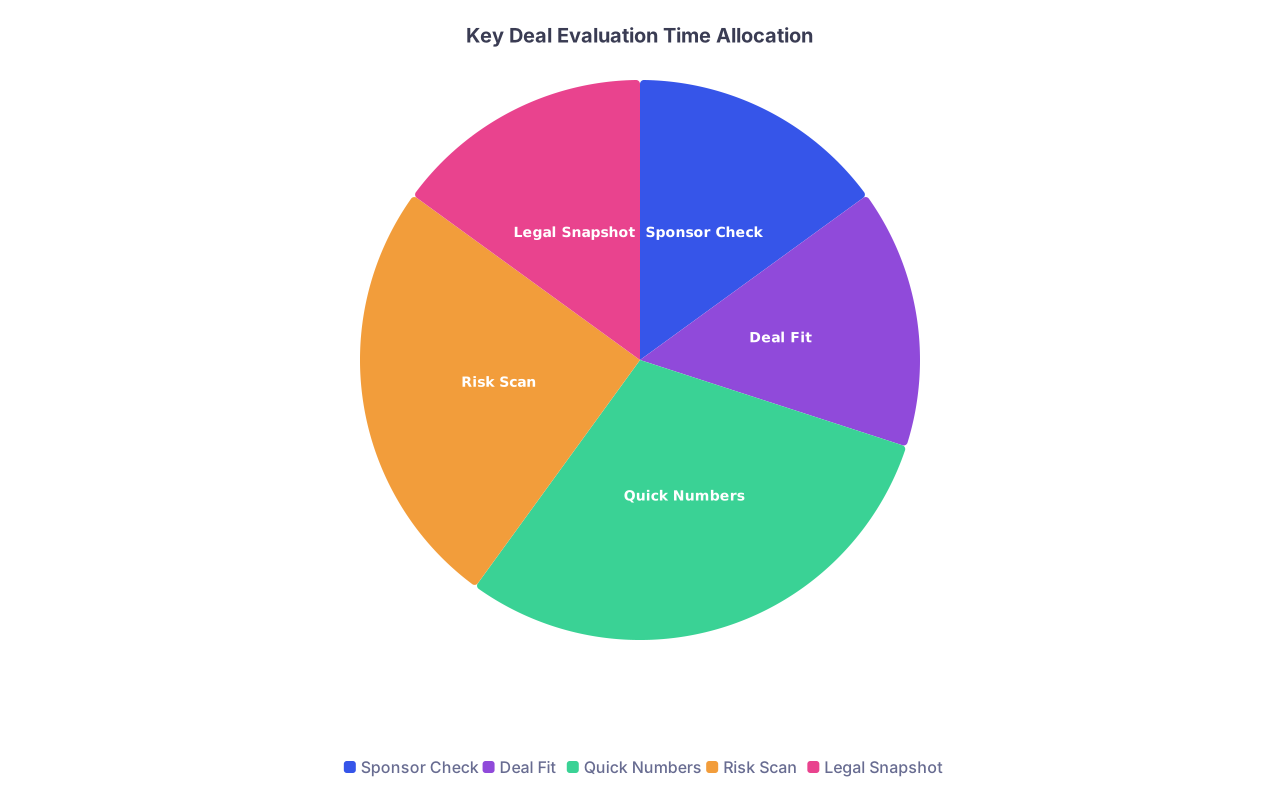
| Category | Value |
|---|---|
| Sponsor Check | 15 |
| Deal Fit | 15 |
| Quick Numbers | 30 |
| Risk Scan | 25 |
| Legal Snapshot | 15 |
Step 4 (3–4 minutes): Risk Landmines – Where Can This Blow Up?
You have maybe 5 minutes left. Use them to look specifically for how you lose money, not just how you make it.
Here is the condensed version of what I look for when a deck hits my inbox.
4.1 Operational risk
Scan for:
- Occupancy assumptions – Starting vs. stabilized.
- Renovation plan – Pace per month, cost per unit, projected rent bumps.
- Management – In‑house vs. third‑party, any track record.
Red flags:
- They are taking a property from 70% to 95% occupancy in 6–9 months with no incentives, heavy renovation, and minimal lease‑up risk acknowledged.
- Renovation budgets that are “$5k per unit” to add washer/dryers, upgrade interiors, redo amenities, and fix deferred maintenance. Not in this economy.
- No mention of who will manage the property day‑to‑day. That silence is loud.
You do not need to know if $9,500 vs. $10,000 per unit is correct. You need to know if the whole story is even vaguely believable.
4.2 Concentration and timing risk
Ask yourself, quickly:
- How big is your minimum check vs. your net worth and investable assets?
- Are you already heavily exposed to this market or this sponsor?
- Does this deal rely heavily on short‑term market timing (e.g., “sell in year 3 when cap rates compress”)?
Physicians get burned by:
- Over‑concentrating in 1–2 syndicators because “they’re friends of friends.”
- Piling into multiple deals at the top of the cycle with similar structures.
- Ignoring correlation – four value‑add deals in the same metro are not diversification.
If you already have exposure to:
- Same sponsor
- Same market
- Similar project type
You need a very good reason to add more.
4.3 Recession and bad‑case awareness
Look for a “sensitivity analysis” or “stress test” slide:
- What happens if rents grow slower?
- What if exit cap is 50–100 bps higher?
- What if occupancy is 5% lower than pro forma?
Competent sponsors show you at least one stress scenario.
If every slide is sunshine and “base case” is basically a bull case, they are selling you a dream, not building a plan.
Step 5 (2–3 minutes): Legal & Alignment Snapshot – Are They On Your Side?
You cannot read the full 150‑page PPM between cases. But you can spot alignment in 2–3 minutes from the summary or term sheet.
5.1 Fee structure
Look for, at minimum:
- Acquisition fee
- Asset management fee
- Disposition (sale) fee
- Refinance fees (if any)
- Construction/ development fees (if development)
Reasonable, in most standard syndications:
- Acquisition fee: 1–3% of purchase.
- Asset management fee: 1–2% of effective gross income or a small % of equity.
- Disposition fee: 0–1%.
What I do not like:
- Stacked, opaque fees in every line item.
- “Project management,” “construction management,” “consulting” fees all payable to the sponsor’s related entities – without clear justification.
- High fees even if the deal underperforms.
You are not trying to nickel‑and‑dime. You just need to avoid “you take the risk; they harvest the fees.”
5.2 Preferred return and promote
Look for:
- Preferred return (often 6–8%) – is it cumulative? Is it paid current or accrues?
- Promote (carried interest) – usually something like 70/30 or 80/20 splits, possibly with hurdles.
Basic, LP‑friendly structure:
- 6–8% cumulative preferred return.
- After pref, cash flows split 70/30 or 80/20 (LP/GP).
- Sometimes tiered so sponsor gets higher promote above a higher IRR hurdle.
Beware:
- No pref at all, but rich promote.
- Waterfall so complex you cannot explain it in one sentence. Complexity usually hides sponsor‑favorable terms.
- “Catch up” clauses that give the GP a huge back‑end even if returns are mediocre.
5.3 Liquidity, control, and worst‑case clauses
In a minute or two, find:
- Is there any redemption option or secondary market? Often no, and that is okay, but you should know.
- What happens if the sponsor dies / is disabled / dissolves? Successor management?
- Can they force capital calls? And what happens if you cannot contribute?
Here is the harsh reality:
- Many syndications are non‑voting for LPs. You have essentially zero say.
- Capital calls can dilute non‑participating investors into oblivion.
- Most PPMs protect the sponsor aggressively – which is fine, if returns are fair and risk is truly understood.
You do not have to read every clause in 15 minutes. You just have to know whether:
- You are okay with complete illiquidity for the hold
- There are surprise capital call provisions
- Sponsor has all the levers and little downside
If you do not like what you see in the summary, move on. There will be another deal.
Your 15‑Minute Checklist (Use This Between Cases)
Here is how I would run the actual 15‑minute block, clock in hand.
Minutes 1–3: Sponsor
- Find sponsor bio and track record.
- Confirm asset‑type and market experience.
- Quick Google search for lawsuits / big red flags.
- Verify they co‑invest meaningful capital.
Decision: Does this team deserve any of your attention? Yes/No.
Minutes 3–6: Deal Fit
- Asset type, market, business plan.
- Check against your written personal mandate.
- Quick city growth and employer diversity sanity check.
Decision: Is this the type of deal you even want? Yes/No.
Minutes 6–11: Numbers
- IRR, equity multiple, cash‑on‑cash vs. the risk band table.
- Scan rent growth, expense growth, exit cap assumptions.
- Check debt: leverage, fixed vs. floating, rate cap, IO period.
Decision: Are these projections within believable, not‑insulting range? Yes/No.
Minutes 11–14: Risk
- Occupancy and lease‑up assumptions.
- Renovation scope vs. budget per unit.
- Quick concentration check vs. your portfolio.
- Look for at least one stress test scenario.
Decision: Is there a clear way this can implode that they are ignoring? Yes/No.
Minutes 14–15: Alignment Snapshot
- Scan fee table for egregious fees.
- Pref and promote structure – simple and LP‑fair or lopsided?
- Any obvious capital call or liquidity surprises in the summary.
Final decision for now:
- Hard Pass – delete, unsubscribe if needed.
- Shortlist – add to “Deep Dive Tonight” list and set a reminder.
- Borderline – ask 1–2 pointed questions by email; sponsor response quality becomes part of the data.
What This System Does For You (That Most Physicians Miss)
Most physician investors either:
- Spray and pray – invest based on friend emails and FOMO, or
- Freeze – never invest because the detail feels overwhelming
This 15‑minute protocol forces you to:
- Respect your time as much as your capital
- Ruthlessly filter 80–90% of deals without guilt
- Only spend evenings and weekends going deep on the top 10–20% that clear the first bar
Over time, you also build a personal “pattern recognition” bank. You will see:
- Which sponsors send consistently sane deals
- Which markets produce reasonable, stable returns
- Which terms show up right before cycles turn ugly
You are not trying to become a full‑time underwriter. You are trying to be a disciplined allocator of time and capital, while still actually practicing medicine.
One Thing To Do Today
Pull up the last real estate deal email sitting in your inbox.
Set a 15‑minute timer.
Run it through the exact five‑step triage:
- Sponsor
- Deal fit
- Numbers
- Risk
- Alignment
Force yourself to make a call at minute 15: pass, shortlist, or ask 1–2 specific questions.
Do it once. Feel how different it is to have a system instead of guessing between cases.
Then save this as a template, or print a one‑page version and stick it in your white coat. Next time you are staring at a glossy OM in the call room, you will know exactly what to do.