
The most experienced physician investors do not read syndication PPMs the way you do. They hunt them.
They’re not skimming for “projected 18% IRR” and “preferred return 8%.” They already know those numbers are marketing. What they’re really looking for is where you get screwed when things go sideways, and who gets paid before you when a deal underperforms.
Let me walk you through what actually happens when a seasoned doc-investor opens a PPM. Not the fluffy stuff sponsors talk about on podcasts. The pages that make or break whether we wire six figures or quietly pass.
First Reality Check: What a PPM Really Is (and Is Not)
A PPM is not written to protect you.
It’s written to protect the sponsor and their lawyers. That’s the starting point you need burned into your brain.
The glossy pitch deck sells the dream. The PPM is where the sponsor legally documents all the ways:
- They can change the plan
- They can pay themselves
- You might lose everything
And still have almost no recourse.
Experienced physician investors know this. So they use the PPM as a hunting ground for three things:
- How aligned the sponsor actually is with investors
- How much discretion and power they have to change the deal
- How painful your downside looks when things go wrong
If you read a PPM and feel “reassured,” you probably missed the point. When I like a deal, I feel slightly annoyed reading the PPM. Because it reminds me that legally speaking, the sponsor holds most of the cards.
I invest anyway when I see that—even with those cards—they’ve chosen to be fair.
The First Pages We Scan: Terms, Fees, and Control
The sophisticated crowd never starts with the 20-page risk section. Those risks are boilerplate. Copy–paste from a thousand other deals.
We start where the conflicts live.
1. The Capital Structure: Who Really Sits in Front of You
If you remember nothing else, remember this: capital stack is destiny.
In the PPM (often in the “Summary of the Offering” or “Securities Offered” section), experienced investors look for:
- Is this equity truly common equity, or is there mezzanine debt, preferred equity, or “co-GP” structures sitting in front of you?
- Are there multiple classes of units with different rights?
- Are you in Class A (fixed pref, no upside) vs Class B (pref + upside)? Or is there some Frankenstein structure?
What we’re silently asking: in a bad year, who gets paid first, second, third—and are we last in line pretending we’re “partners”?
You’ll often see language like:
“The Company may, in its sole discretion, incur additional indebtedness, including secured, unsecured, preferred equity, or mezzanine financing that may be senior to the Interests being offered herein.”
That single sentence should slow you down. It tells you they can bring in new capital ahead of you later if they get in trouble. Experienced investors mentally translate: “If this goes sideways, they might dilute my position or put someone in front of me.”
2. Fee Structure: Where the Real Money Is Made
Sponsors make money off fees. That’s not evil. That’s the business.
But there’s a difference between “fairly compensated” and “bleeding the deal dry.”
The PPM and/or operating agreement will spell out fees. This is where the pros get very picky.
We look for:
- Acquisition fee: Is it 1–2% or creeping up to 3–4%+? Is it based on purchase price or total capitalization?
- Asset management fee: Flat or percentage of equity or revenue (2% of effective gross income vs. 2% of equity is a big difference)?
- Disposition fee: Are they charging to sell the property on top of brokerage commissions?
- Construction / development / project management fees: Are they double-dipping as GC or construction manager?
- Refinancing fees: Are they taking a cut just to organize a refi?
Then we ask: How much are they guaranteed to make even if the investment underperforms?
I’ve passed on deals where the sponsor took:
- 3% acquisition
- 2% asset management
- 1% disposition
- Construction oversight fees
- And a hefty promote (70/30 split)
All while projecting mid-teens returns. That math only works beautifully—for them.
Sophisticated doc-investors run a sanity check: if the deal only breaks even, do investors get anything while the sponsor still walks away with hundreds of thousands in fees? If yes, that’s a problem.
| Fee Type | Reasonable Range | Red Flag Range |
|---|---|---|
| Acquisition Fee | 1–2% | 3%+ |
| Asset Mgmt Fee | 1–2% of revenue | >2.5% |
| Disposition Fee | 0–1% | >1% plus broker |
| Refi / Financing | 0–1% | >1% recurring |
| Construction Mgmt | 4–7% of hard cost | Hidden / stacked |
You won’t see that table in the PPM obviously. That’s the mental table people are using behind closed doors.
3. Control Rights: “Sole and Absolute Discretion”
This phrase shows up over and over. It’s the sponsor’s favorite.
We look for every place the manager or GP is given:
“sole and absolute discretion”
over things like:
- When to sell
- When to refinance
- When to do capital calls
- Whether to accept lowball offers
- Whether to admit new classes of investors
You’re not going to negotiate this language. But if it’s completely one-sided, without any guardrails or investor consent thresholds, seasoned investors make a note. One bad actor with “sole discretion” is how investors get dragged through 10-year zombie deals they can’t exit.
The Waterfall and Pref: Where Reality Diverges from the Marketing
The marketing deck simplifies the waterfall. “8% pref, 70/30 split, projected 17% IRR.”
The PPM is where the truth lives. Experienced investors go line by line here, because this is literally your paycheck formula.
4. How the Preferred Return Actually Works
Most sponsors throw “preferred return” around like it’s a guarantee. The PPM usually clarifies two things we care about:
- Is the pref cumulative?
- Is it compounding or non-compounding?
Here’s the difference in plain English:
- Non-cumulative, non-compounding: If they do not hit 8% one year, it doesn’t carry over and doesn’t grow. That’s weak.
- Cumulative, non-compounding: Missed pref accumulates like a bucket but doesn’t earn “interest on missed interest.” Standard.
- Cumulative, compounding: The gold standard. Missed pref grows over time until paid.
The PPM will spell out something like:
“The Preferred Return shall be non-cumulative and shall not compound.”
Experienced investors barely need the rest of the document after that. A non-cumulative pref is basically a marketing slogan. In a rough two-year period, you bear the risk and they don’t owe you for the shortfall.
We also look at when pref starts. At funding? At stabilization? After the sponsor decides the property is “cash flowing”? That’s another small line buried deep that changes actual returns.
5. The Waterfall Details: Promote Games
The waterfall is where sponsors can play tricks that 90% of physicians never catch.
Some of the things we look for:
- Is the sponsor getting a promote before or after returning all contributed capital?
- Are IRR hurdles calculated with or without fees?
- Is there a catch-up provision where the sponsor gets a big chunk after you receive your pref?
The PPM might say:
“After payment of the Preferred Return, the Manager shall be entitled to a 50% catch-up distribution until it has received 20% of total distributions…”
That “catch-up” can shift a huge amount of upside to them once minimum targets are met.
A clean, investor-aligned structure usually looks like:
- Return of all investor capital
- Unpaid accumulated pref
- Then split of profits (e.g., 70/30)
Once we see fancy catch-ups and multi-tier gimmicks that always seem to favor the sponsor, the experienced crowd starts backing away.
Management, Governance, and Your Ability to Say “No”
Physicians are used to committees and bylaws. Syndications? Not so much.
In most syndications, you are not a partner. You are a passenger in coach. On a plane with a locked cockpit.
6. Voting Rights and Removal of Manager
In the PPM/operating agreement, here’s what we hunt:
- What percentage of ownership is required to remove the manager “for cause”?
- What exactly counts as “cause”? Only fraud and felony? Or repeated failure to meet reporting obligations, mismanagement, etc.?
- Do you have any say over big decisions (sale, major refinancing, material deviation from the business plan)?
Typical language I see:
“The Manager may be removed for cause upon the affirmative vote of Members holding at least 75% of the outstanding Interests.”
On paper that sounds like “you have power.” In reality, coordinating 75% of fragmented LPs, scattered across the country, many of whom are busy physicians who don’t even read the emails—good luck.
Experienced investors look for more realistic thresholds (50–60%) and a broader definition of “cause,” plus technical default triggers if they blatantly ignore reporting or misuse funds.
7. Capital Calls: The Hidden Landmine
Capital call language is where naïve investors get blind-sided.
We look for:
- Is there a right—but not obligation—to participate in capital calls?
- What happens if you don’t contribute? Dilution? Penalty interest? Forced sale of your interest at a discount?
- Can they require additional contributions beyond your initial investment?
Language to watch:
“The Manager may, in its discretion, require additional capital contributions from the Members…”
That single sentence can turn your “$100k max exposure” into an open-ended commitment. Experienced investors do not touch mandatory capital call structures unless heavily compensated and very confident in the sponsor.
The preferred language is:
- Capital calls optional
- If you don’t participate, your ownership may be diluted but you’re not forced to sell at a 50% haircut
- No personal liability beyond your initial commitment
If the PPM is vague or aggressive here, the seasoned folks either size way down or walk.
Debt, Guarantees, and How Much Risk You’re Really Taking
Another rookie mistake: focusing only on the equity, ignoring the debt structure. That’s like reading only the H&P and skipping the CT scan.
8. Loan Terms and Maturity Risk
In the “Risk Factors” and “Description of the Business” sections, we look hard for:
- Is the loan fixed-rate or floating? If floating, is there an interest rate cap? Is it already purchased or just “intended”?
- What’s the loan term vs. the projected hold period? A 3-year bridge loan with a 7-year hold plan is a contradiction.
- Are there extension options? What do they cost? Are they automatic or conditional on debt yield / DSCR covenants?
The most experienced investors got burned or watched others get burned on short-term bridge debt when rates jumped. They now want concrete language, not hand-waving.
If the PPM says:
“The Company expects to obtain a floating rate bridge loan and may, but is not obligated to, purchase an interest rate cap…”
That “may, but is not obligated” is doing a lot of work. That’s a no from many of us now.
9. Recourse vs Non-Recourse and Carve-Outs
You as an LP are almost always non-recourse, but we still read the language on guarantees.
- Who is signing the carve-out guarantees?
- Are there any “bad boy” triggers that could actually be tripped by aggressive behavior?
- Could mismanagement cause a full recourse event that blows up the sponsor personally?
Sophisticated investors like when sponsors have real skin in the game here—personal guarantees, net worth, liquidity. But we also don’t want cowboys who might cut corners and trigger recourse.
Sponsor Track Record: What the PPM Quietly Confesses
The marketing materials will gush about “combined 50 years of experience” and “$500M of real estate transacted.” The PPM is where they have to be more honest.
10. Prior Performance Disclosures
There’s often a “Prior Performance” or “Background” section. Experienced investors look for:
- Have they actually gone full cycle (bought, operated, sold) on similar deals in similar markets?
- Any prior deals that underperformed or lost money? How do they describe those?
- Any litigations, bankruptcies, foreclosures, or regulatory issues?
Very common trick: talking about “deals we participated in” instead of “deals we directly sponsored and signed for.” If the PPM language is vague, that’s on purpose.
You might see:
“Members of the Manager’s team have been involved in over $300M of real estate transactions.”
Involved how? As brokers? Junior analysts? Passive investors? That’s not track record as a sponsor.
The experienced crowd cross-references these claims with what’s on the sponsor’s website and what they’ll say when pressed on a call: “Tell me about a deal that didn’t go to plan. What happened and what did you learn?” If that story and the PPM disclosures don’t match, we’re done.
11. Sponsor Co-Investment: Real or Cosmetic
Everyone now knows to ask: “How much are you putting in?”
The PPM is where the truth shows up—or doesn’t.
We look for:
- Are they actually writing a check into the same equity class as LPs?
- Or are they just rolling acquisition fees as “skin in the game”?
- What percentage of total equity is true sponsor capital? 1% is very different from 10%.
If the PPM is strangely quiet about sponsor co-investment, or buries it in vague language, that’s a red flag. Experienced physician investors want real dollars at risk, not “sweat equity” dressed up as alignment.
Risk Factors: What We Actually Read vs. Ignore
That 20–40 page “Risk Factors” section looks like mind-numbing filler. A lot of it is.
But there are three categories seasoned investors pay attention to:
12. Deal-Specific vs Boilerplate Risk
We skim boilerplate: “Real estate investing involves risk,” “Illiquidity,” “Loss of principal,” etc.
We slow down for deal-specific risks:
- “The property is highly dependent on a single tenant representing 60% of rental income.”
- “The property requires substantial capital improvements to address deferred maintenance.”
- “Our projections assume rent growth exceeding historical market averages.”
These are the quiet admissions the marketing deck glossed over.
13. Exit Risk and Market Assumptions
Many risk sections now bury an admission like:
“The assumptions regarding rent growth, occupancy, and exit cap rates used in the financial projections may not be achieved.”
That’s fine; it’s true. But if elsewhere in the PPM they explicitly state they’re assuming, say, 3–4% annual rent growth in a flat or declining market, the pros take that very seriously.
We don’t need 10 pages of possible disasters. We want to know: are their underwriting assumptions conservative or rosy relative to these risk disclosures?
Tax Structure and K-1 Reality
Physicians care about taxes. But most barely understand what the PPM says about them.
14. Tax Status and Depreciation
Experienced investors check:
- Is this a standard 506(b) or 506(c) partnership issuing K-1s?
- Any special tax elections (e.g., using cost segregation, bonus depreciation)?
- How likely are paper losses in early years, and what happens as bonus depreciation phases out?
We’re also reading for:
- Will there be state filing requirements in multiple states?
- Any mention of UBTI or debt-financed income issues if investing through certain entities or retirement accounts?
If the PPM is silent or vague, we assume complexity and ask follow-up questions.
How We Actually Use the PPM Before Wiring Money
Let me be honest: nobody reads every word of every PPM, line by line, for every deal. Even the most experienced people don’t.
But they do have a disciplined pattern:
- They read enough PPMs over time to recognize standard language vs. aggressive language.
- They know exactly where the landmines usually sit: fees, waterfall, capital calls, manager powers, debt terms, removal rights.
- They cross-check the PPM against the pitch deck and what the sponsor said on calls. Inconsistencies kill deals.
The sophisticated physician investor’s workflow usually looks like this:
- Screen sponsor and deal at the “trust and numbers” level first.
- If it passes, hit the PPM with a targeted review focusing on: economics, control, debt, downside.
- Flag questions or inconsistencies, push them back to the sponsor, and judge how transparent and precise the answers are.
- Decide position size based on how clean the PPM and answers are, not just how pretty the IRR looks.
You’re not trying to turn yourself into a securities attorney. You’re trying to stop being the easiest money in the room.

| Step | Description |
|---|---|
| Step 1 | Initial Deal Review |
| Step 2 | Pass on Deal |
| Step 3 | Targeted PPM Review |
| Step 4 | Check Fees and Waterfall |
| Step 5 | Check Control and Capital Calls |
| Step 6 | Check Debt and Exit Risk |
| Step 7 | Clarify Questions with Sponsor |
| Step 8 | Size Investment and Commit |
| Step 9 | Sponsor Trustworthy |
| Step 10 | Major Red Flags |
| Step 11 | Clear, Honest Answers |
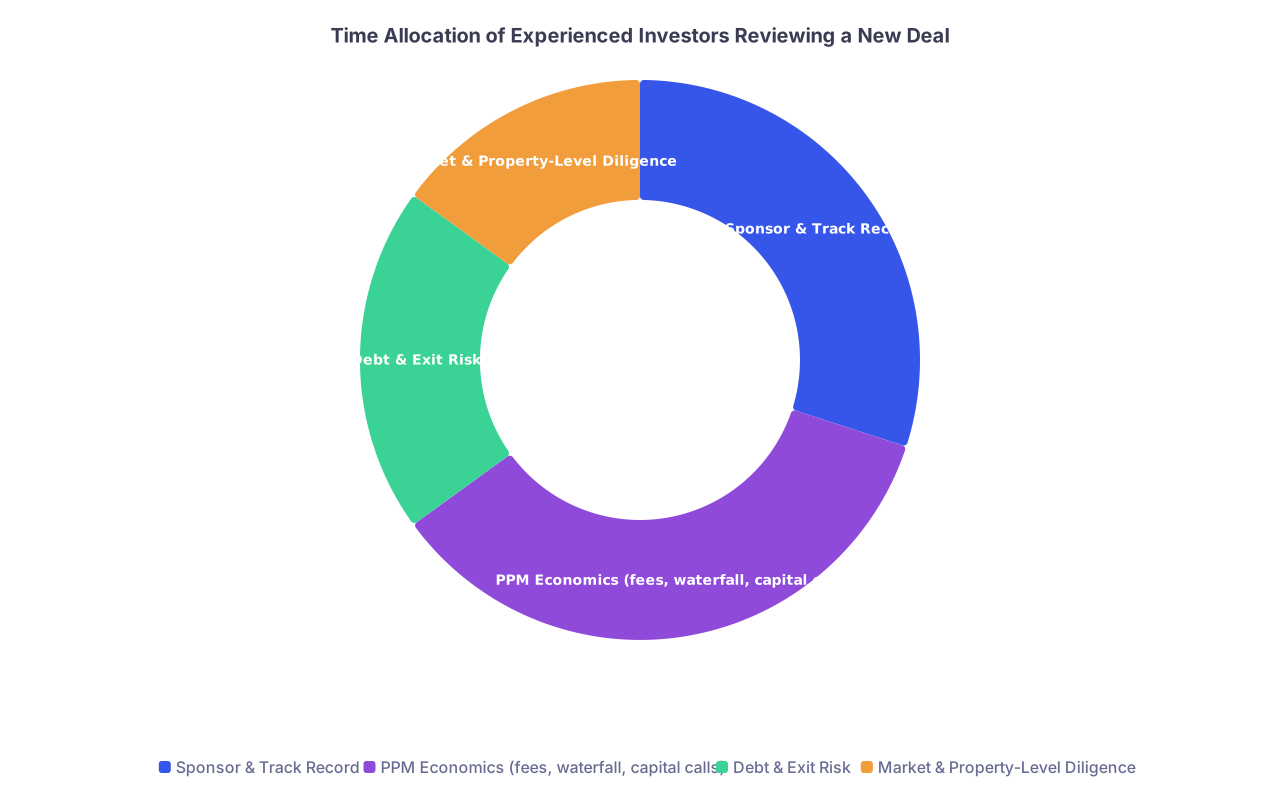
| Category | Value |
|---|---|
| Sponsor & Track Record | 30 |
| PPM Economics (fees, waterfall, capital calls) | 35 |
| Debt & Exit Risk | 20 |
| Market & Property-Level Diligence | 15 |
FAQ: Physician Investors and PPMs
1. Do experienced investors actually read the entire PPM word for word?
Rarely. They read enough full PPMs early in their journey to recognize patterns, then they become very targeted. They go straight to economics, control provisions, capital calls, debt terms, and risk sections that look deal-specific. They also cross-check the PPM with the pitch deck and what was said verbally. Consistency matters more than reading every boilerplate line.
2. If almost every PPM is one-sided, how do you ever feel comfortable investing?
You accept that the legal docs will always favor the sponsor. The goal isn’t to find a “perfectly fair” PPM. It’s to avoid abusive, lopsided structures and sponsors who quietly sneak in self-serving clauses. You look for reasonable fees, clean waterfalls, limited and optional capital calls, realistic debt structures, and sponsors who are candid when you ask them about the ugly parts of the deal.
3. Is a high preferred return (e.g., 10–12%) always a good sign?
No. Sometimes a high pref is just lipstick. If the pref isn’t cumulative or is structured so that it almost never actually gets paid in full, it’s marketing fluff. A well-structured 7–8% cumulative pref with a fair waterfall and conservative underwriting is far better than a 12% “non-cumulative pref” in a highly leveraged, risky deal.
4. What’s the biggest red flag in a PPM that makes experienced physicians walk away immediately?
Mandatory capital calls with harsh penalties are near the top. Also: excessive, layered fees; vague or misleading track record language; ability to unilaterally issue new senior capital; aggressive short-term floating-rate debt without a clear cap strategy; and any sign that the sponsor’s economics look great even if investor returns are mediocre.
5. Do I need to hire a securities attorney to review every PPM?
For your first few deals, having a knowledgeable attorney walk you through one or two PPMs is money well spent—less for “finding gotchas” and more for teaching you what to look for. After that, most experienced physician investors don’t hire an attorney every time; they use a repeatable framework and reserve lawyers for very large checks or unusually complex structures.
Key points. First, PPMs are sponsor-protection documents; your job is to see how fair they chose to be within that power. Second, experienced physician investors stop obsessing over IRR slides and start dissecting fees, waterfalls, capital calls, and debt—because that’s where your real risk and return live.