
The “max leverage at all times” mantra is wrong for most physicians. Not a little wrong. Backwards.
You’ve probably heard the script: “Use as much other people’s money as possible, lock in cheap debt, scale faster, real estate always goes up, the bank takes the risk.” That story gets repeated at physician conferences, in real estate masterminds, and in those Saturday Zoom calls where someone with 30 doors and a ring light teaches you to “think like a bank.”
Let me be blunt: banks don’t “take the risk” when you max out leverage. You do. With your license, your sleep, and sometimes your marriage.
This isn’t an anti-debt rant. Leverage is a powerful tool. It’s also a lever that amplifies everything—including your mistakes and your timing.
Let’s walk through what the data actually shows when high-earning but time-poor physicians try to “leverage to the max” in real estate.
What Leverage Really Does (Not What Gurus Claim)
Leverage doesn’t create value. It redistributes risk and reward.
At a boring, math level, leverage does three main things:
- Amplifies returns on equity when things go well.
- Amplifies losses on equity when things go poorly.
- Increases the probability of a cash-flow crunch even if the property is “profitable on paper.”
That third one is the killer for docs.
Let’s use simple numbers. No “infinite banking,” no exotic waterfalls. Just a basic deal.
You buy a $1,000,000 small apartment building.
Scenario A: Conservative leverage
- 60% loan-to-value (LTV) → $600,000 loan
- 40% down → $400,000 equity
Scenario B: “Max leverage”
- 80% LTV → $800,000 loan
- 20% down → $200,000 equity
Assume the property produces $60,000 of net operating income (NOI) after all expenses but before debt service.
Now look at what interest rates and leverage actually do.
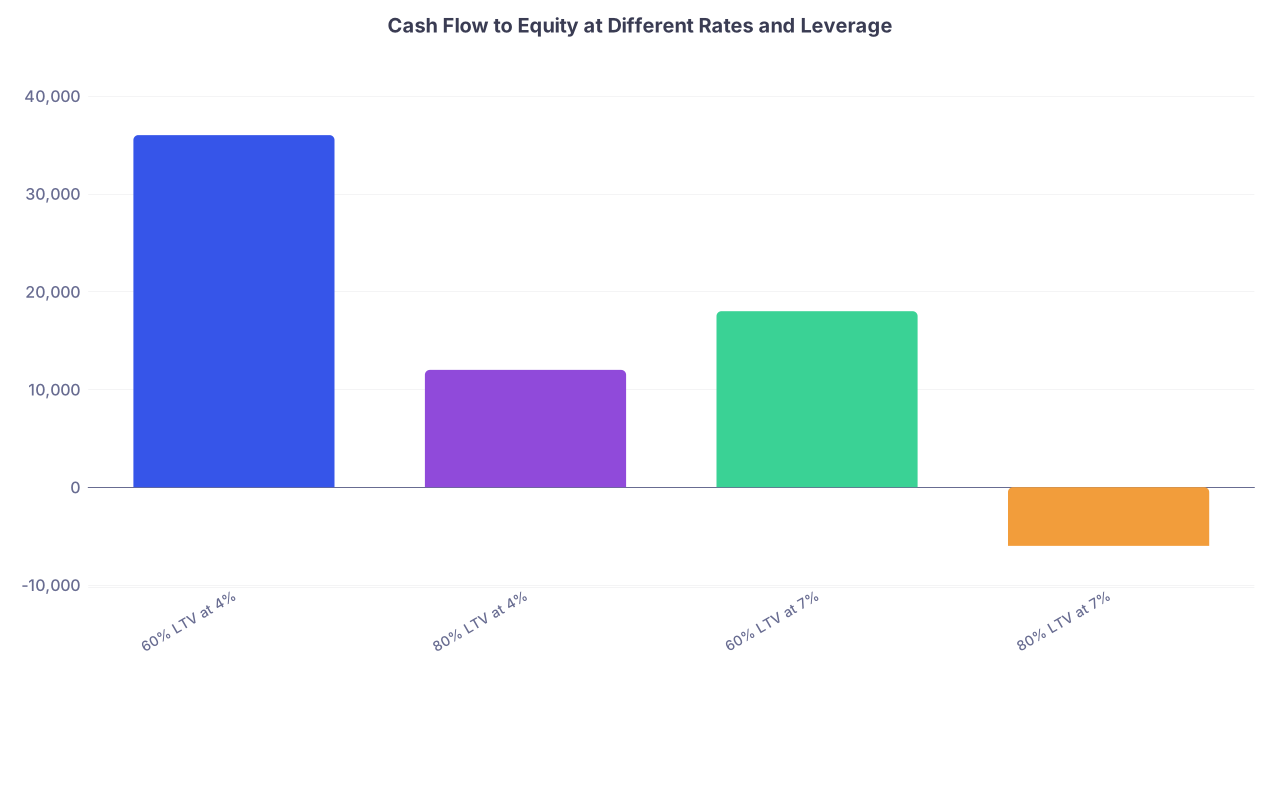
| Category | Value |
|---|---|
| 60% LTV at 4% | 36000 |
| 80% LTV at 4% | 12000 |
| 60% LTV at 7% | 18000 |
| 80% LTV at 7% | -6000 |
Here’s the translation:
At 4% interest, 25-year amortization:
- 60% LTV: annual debt ≈ $24k → cash flow ≈ $36k
- 80% LTV: annual debt ≈ $48k → cash flow ≈ $12k
At 7% interest, 25-year amortization:
- 60% LTV: annual debt ≈ $42k → cash flow ≈ $18k
- 80% LTV: annual debt ≈ $66k → cash flow ≈ negative $6k
Same property. Same operations. Two things changed: your leverage and the interest rate.
So who is actually taking the risk? Not the bank. The bank still gets paid first.
This is why experienced operators talk about debt service coverage ratio (DSCR) and interest-rate sensitivity, not “maxing leverage.”
Myth: “As a Physician, You Can Always Support the Property With Your Income”
This one gets said out loud in real estate masterminds: “If the property dips negative, you’re a doc, you can float it. You’re the ultimate backstop.”
That’s exactly why many physicians end up accepting more risk than professional investors would ever tolerate.
Professional operators usually have:
- Strict DSCR minimums (1.20–1.35+).
- Stress-testing at higher interest rates and lower rents.
- Real cash reserves at the property and portfolio level.
Most individual physicians I’ve seen doing “max leverage” have:
- A pro forma spreadsheet from a broker using best-case rent and vacancy.
- 80–85% leverage because “that’s how you juice returns.”
- Little to no reserve policy beyond “I can cover it if I have to.”
On rounds, I’ve heard real conversations like:
“I’m losing 3k a month on that building now that rates reset. It’s fine; I just pick up an extra call shift.”
That works. Until it doesn’t.
Burnout, reduced hours, hospital consolidation, divorce, illness, or just changing priorities—tying your time and mental bandwidth to propping up highly leveraged real estate is not the flex people think it is.
What the Data Says About Leverage and Risk
Let’s pull this out of anecdote and into evidence.
Real estate return and risk characteristics have been studied to death. Key patterns:
Higher leverage increases default probability.
Every serious study on commercial real estate defaults says the same thing: higher LTV → higher chance of distress or foreclosure when something goes wrong. Not a little higher. Multiples higher once you push above ~75–80% LTV, especially on short-term or floating-rate debt.Cap rate expansion destroys thin equity.
If cap rates move from 5% to 6% (which we just watched happen in many markets when rates spiked), that’s a 20% drop in value even if NOI stays the same.- At 60% LTV, your equity falls but usually survives.
- At 80–85% LTV, your equity can be nearly wiped. Your net worth swings like a meme stock.
Refinance risk is real.
Everyone loves BRRRR until they meet a lender who says: “We value this at 10% less than you expected, rates are 2.5% higher, and we now want DSCR 1.25.”
High leverage magnifies refinance risk—the risk that when your loan matures or resets, new terms make the deal ugly or unsustainable.
Physicians are particularly vulnerable because their investing often relies on:
- Short or medium-term value-add business plans (2–5 years).
- Floating or short-term fixed debt with aggressive assumptions.
- Limited tolerance for active management when medicine is already crushing them.
If you insist on 80–85% leverage, you are effectively betting on stable or falling rates and benign lending conditions when you need to refinance. That’s not “risk managed.” That’s naked exposure you don’t control.
Risk-Adjusted Return: The Part Gurus Skip
The gurus show you pro formas with 20–25% “IRR” using high leverage and then smile like they discovered fire.
What they don’t show you is the risk-adjusted return. Ironically, that’s what most docs should care about. You’re already earning a high, relatively stable income from your day job. You don’t need lottery-ticket upside. You need asymmetric downside protection.
Consider two versions of the same property:
- Property X: 60% LTV, fixed-rate for 10 years, DSCR stress-tested to 1.25 at higher rates, healthy reserves.
- Property Y: 80% LTV, floating or short 3-year fixed, DSCR 1.05–1.10 today, minimal reserves.
Does Y show a higher pro forma IRR? Absolutely. But that “return” is just the equity being stretched thinner. It’s not magic.
Let’s compare qualitatively:
| Feature | Conservative (60–65% LTV) | Maxed-Out (80–85% LTV) |
|---|---|---|
| Cash flow stability | Higher | Fragile |
| Refinance risk | Moderate | High |
| Default/distress risk | Low to moderate | High |
| Sensitivity to rates | Lower | Very high |
| Emotional load | Manageable | Significant |
If your goal is to escape the treadmill of medicine, building a portfolio that might demand extra call shifts to keep it alive is insane.
When High Leverage Can Make Sense (And When It’s Flat-Out Dumb)
Let me be fair: max leverage isn’t always stupid. There are narrow cases where it can be rational—even for a physician.
Reasonable scenarios for higher leverage:
- You’re early in your earning years, but your clinical income is locked in and rising, and you have a long runway.
- The deal has strong, documented in-place cash flow with genuine margin above debt service, not just “pro forma after renovations.”
- You have substantial liquid net worth and can treat the equity at risk almost like an “angel investment,” not your foundation.
- You’re working with conservative, experienced partners who actually survived a full real estate cycle, not just 2015–2021.
Still, even then, 75–80% is typically the ceiling where professionals start to get nervous without some other mitigants (like interest rate caps, long-term fixed rate, or personal reserves dedicated to the asset).
Where it’s just stupid for most physicians:
- You’re using highly leveraged short-term bridge debt to buy your first or second property.
- Your only stress test is “If it goes bad, I’ll work more shifts.”
- You’re chasing forced appreciation in a hot market with thin cap rates and zero margin for error.
- The GP group you’re investing with markets “90%+ total project leverage” as a selling point rather than a red flag.
I’ve seen surgeons with seven-figure incomes lose sleep over a $3–5M highly leveraged deal because a rate reset blew up their cash flow. It doesn’t matter how rich you are if you wake up at 3 a.m. checking rent rolls.
Legal Reality: Your “Limited Liability” Isn’t As Limited As You Think
Another myth: “Just put it in an LLC. The bank can only take the property.”
That’s not how physician debt typically looks once lenders see “MD,” “DO,” or a Schedule C with large clinical income.
Banks often require:
- Personal guarantees (PGs) on smaller commercial loans, especially for first-time or small operators.
- Cross-collateralization between properties or business entities.
- Covenants that trigger default if DSCR, occupancy, or net worth fall below thresholds.
If you’ve signed a personal guarantee—and most docs do early on—“max leverage” is not capped downside. It’s personal balance sheet exposure.
Lose a tenant. Hit a rate spike. Miss a covenant. Suddenly the real estate loan you thought was ring-fenced to an LLC can touch your assets.
So no, the bank is not your risk partner. They are your senior creditor with contractual rights that are usually better than yours.
Psychological Load: The Part No Spreadsheet Captures
The spreadsheet always looks neat. The actual lived experience rarely does.
Here’s what highly leveraged investing looks like in the wild, especially when the cycle turns:
- Watching central bank meetings like you used to watch Step score releases.
- Checking rent collections mid-month because one hiccup puts you negative.
- Fighting with partners about capital calls because not everyone has the same appetite to “keep feeding” a bleeding property.
- Negotiating with lenders who suddenly care a lot about your updated PFS, tax returns, and DSCR.
None of that shows up in the IRR column. It shows up in your cortisol levels.
Physicians are already in a high-stress profession. Designing an investment strategy that introduces ongoing operational stress is just bad portfolio design.
So What Actually Makes Sense for Most Physicians?
If your primary income is medicine and you want real estate as a wealth builder, the boring answer is this:
Stop optimizing for maximum leverage. Optimize for survivability and simplicity.
That usually means:
- Moderate leverage (60–70% LTV) with strong DSCR.
- Longer fixed-rate or capped-rate debt structures, even if the rate is slightly higher today.
- Deals that cash flow even if rents soften and expenses rise.
- True reserves at the asset level and personally—months of mortgage payments in cash, not “I could borrow from my 401(k) if I had to.”
And crucially: stop treating “equity in the deal” like a sin. Putting more equity down:
- Lowers your risk of capital loss.
- Reduces variability of outcomes.
- Increases your ability to sleep at night, which, last I checked, has value.
I’ve seen many physicians with $5–10M net worths deliberately choose 50–60% LTV on large properties. They can absolutely qualify for more debt. They just no longer confuse clever capital structure with actual wealth.
How to Check If You’re Drunk on Leverage
Quick self-audit. If any of these ring true, you’re probably overdoing it:
- Your first question about a deal is, “How little can I put down?” instead of “What’s the downside scenario?”
- Your pro forma assumes rent growth above inflation but flat expenses.
- You don’t know your portfolio-wide weighted average LTV or DSCR.
- You can’t answer, in one sentence, “What happens if rates are 3% higher at refi time and values drop 15%?”
If you’re signing documents with seven-figure liabilities and can’t answer those, you’re not investing. You’re gambling in a white coat.
Key Takeaways
- Max leverage doesn’t magically boost “safe” returns; it magnifies both upside and downside, and it sharply increases your exposure to interest-rate and refinance risk.
- For most physicians, the smarter play is moderate, boring leverage that prioritizes cash flow durability, long-term fixed or capped debt, and true liability protection—not cute IRR numbers on a pitch deck.
- If your real estate strategy depends on “I’ll just work more shifts if it goes bad,” you’re not escaping the treadmill. You’re chaining your investments to it.