
Most residents are wasting their biggest financial advantage: cheap, reliable debt wrapped in a doctor loan they never use strategically.
You can change that. And multifamily house hacking during residency is one of the few plays that is both aggressive and defensible—if you do the legal and financial homework up front instead of “figuring it out later” like too many colleagues.
Let me break this down specifically.
1. What “Doctor House Hacking” Really Means (Not the Instagram Version)
House hacking is simple on paper: you buy a place, live in one unit/room, rent out the others, and let your tenants subsidize your housing and mortgage.
“Doctor” house hacking during residency just adds three realities:
- Your income is low now, but your future income is high and very predictable.
- Your time and cognitive bandwidth are limited. Nights + weekends are not infinite.
- Lenders and landlords see you as low default risk, even if your current salary looks mediocre.
For multifamily, the classic version:
- You buy a 2–4 unit property (duplex, triplex, quad).
- You live in one unit (to qualify as “owner-occupied” for loan purposes).
- You rent the other unit(s) to co-residents, nurses, or regular tenants.
- The rents cover some or all of: mortgage, taxes, insurance, utilities, and maybe even leave you cash flow.
Anything >4 units is commercial. As a resident, 99% of the time you want 2–4 units. The financing is easier, cheaper, and built for individuals, not LLCs with tax returns you do not yet have.
2. The Financial Spine: How the Numbers Actually Work
If the numbers do not work, nothing else matters. Let’s structure this like a lender and an investor would, not like a “dream of passive income” blog post.
2.1 The Core Equation
At its most basic:
Net Cash Flow =
Gross Rents + Other Income
− (Mortgage P&I + Taxes + Insurance + Utilities you pay + Maintenance + Vacancy + HOA if any + Management if used)
On top of that, your effective benefit includes:
- What portion of your own housing cost is covered.
- Principal paydown each month.
- Long-term appreciation (speculative, but real over 10–20 years).
- Tax benefits (depreciation, interest deduction, etc.).
If during residency the raw “cash flow” is close to zero but you live for far cheaper than the guy in the $2,100 luxury apartment halfway across town, you are winning.
2.2 Resident-Friendly Financing: Physician Loans vs Conventional
Here is where being a physician actually matters.
| Feature | Physician Loan | Conventional 5% Down | FHA 3.5% Down |
|---|---|---|---|
| Max units (owner-occupied) | Usually 2–4 units | 2–4 units | 2–4 units |
| Required down payment | 0–5% | 5–15%+ | 3.5% |
| PMI | Often waived | Usually required | Required |
| Student loan treatment | Very favorable | Standard (can hurt) | Standard |
| Rate | Slightly higher | Often lowest | Middle |
Key points:
Physician loan:
Great if your debt-to-income is ugly because of student loans. They often ignore IBR payments or even fully defer loans. They may allow 0–3% down with no PMI. Rates can be 0.25–0.5% higher than the best conventional, but the leverage and approval flexibility are huge during residency.Conventional:
Best when you have some down payment, your student loans are not insane, and you can qualify on conventional ratios. Often has the best interest rate.FHA:
Good for low down payment and flexible credit. But: has upfront and ongoing mortgage insurance that will not go away easily. That can kill cash flow on small multifamily.
If you think you will only own this building 3–5 years, a bit of extra rate on a physician loan is often worth the easier underwriting and lower capital out-of-pocket.
3. Underwriting the Deal Like an Adult (Not a YouTuber)
Do not buy based on “my friend’s rent” or what a random listing claims is “projected rent.” Underwriting poorly is how you become the resident with a $600/month surprise shortfall, trying to pick up extra moonlighting just to keep the lights on.
3.1 Use Conservative Assumptions
Pull actual data:
- Rent: Use Rentometer, Craigslist/Facebook/HotPads, and ask local property managers. Take the lower of what you find.
- Vacancy: 5–8% is reasonable in most cities. High-turn neighborhoods can be worse.
- Maintenance/CapEx: For small multifamily, 8–12% of rent is reasonable. Old building? Use 12–15%.
- Management: Even if you self-manage during residency, model 8–10%. You might move for fellowship and need a manager.
- Taxes: Look at current tax bill and check how often reassessed. Some counties jump heavily when a property changes hands.
- Insurance: Get a quote before offering, especially in high-risk states (Texas, Florida, coastal areas).
3.2 Go Through a Real Example
Simplified duplex in a mid-tier city, purchase price $450,000.
Units:
• Your unit: market rent would be $1,600, but you live here.
• Rented unit: $1,700/month.Financing: Physician loan, 5% down, 6.5% interest, 30-year fixed.
5% of $450k = $22,500 down.
Loan = $427,500 → P&I ≈ $2,702/month.Other monthly expenses (estimates):
Taxes: $550
Insurance: $180
Water/Trash (you pay): $120
Maintenance/CapEx: 10% of gross rent.
Gross rent here is $1,700 (only the other unit), so $170.
Vacancy: 5% of rent = $85.
Management: 8% of $1,700 = $136 (even if you self-manage, model this).
Total monthly “all-in” cost:
- P&I: 2,702
- Taxes: 550
- Insurance: 180
- Utilities: 120
- Maintenance/CapEx: 170
- Vacancy: 85
- Management: 136
Total ≈ $3,943
Income:
- Rent from other unit: $1,700
- Effective benefit of you living there: you would otherwise pay, say, $1,600 for similar housing.
Pure cash P&L: 1,700 − 3,943 = −$2,243/month
Sounds terrible. But that is because we are counting your housing cost as if it should be zero.
Compare this to renting:
- If you rented a similar 2-bed apartment: $1,600/month out of pocket.
- In this setup, your total cash out-of-pocket is:
Total costs − rent received = 3,943 − 1,700 = $2,243.
So you are effectively paying $2,243/month to live there vs $1,600 as a renter: $643 more per month. That is the “premium” for ownership, principal paydown, appreciation potential, and tax benefits.
Once you add:
- Monthly principal paydown: around $550–600 of your P&I in year 1.
- Depreciation and tax savings.
- Rent growth over time while your mortgage is fixed.
It gets more favorable.
Now, if this same duplex was priced at $380k with the same rents, the picture flips and you may effectively live free or very cheap. That is the kind of deal you look for.
4. Legal Structure: Title, LLCs, and Protecting Yourself
This is where physicians overcomplicate things because they heard at a dinner: “You should never own anything in your own name, always use an LLC.”
For an owner-occupied 2–4 unit with less than, say, $750k total equity and appropriate insurance, a complex LLC structure is usually unnecessary during residency. I know that will annoy the internet lawyers. It is also reality.
4.1 Title and Financing Reality
- Most lenders for owner-occupied multifamily require that you hold title in your personal name and sign personally.
- Transferring to an LLC after closing can technically trigger the due-on-sale clause in your mortgage, because you changed ownership.
Most banks do not care as long as payments are current, but you need to know the risk.
So, options:
Buy and hold in your personal name during residency. Focus on:
- Strong landlord insurance.
- An umbrella liability policy (often $1–2 million is cheap).
- Good lease forms and tenant screening.
Post-residency, when:
- You have higher income.
- You might have more than one property.
You can discuss with a real estate attorney whether to deed the property to an LLC or trust and accept the small due-on-sale risk, or simply continue as-is given your coverage.
If you plan to run a short-term rental operation (Airbnb) in a quadplex, that is a different risk profile and an LLC becomes more justifiable.
4.2 Landlord-Tenant Law: Non-Negotiables
Even as a resident, you are not “just” a doctor. You are a landlord. That means:
- Use state-specific lease agreements, ideally from a reputable landlord association or a real estate attorney, not a random free download.
- Know your state’s rules on:
- Security deposit limits and handling (escrow, interest).
- Notice requirements for entry.
- Notice and procedure for nonpayment and eviction.
- Late fee caps.
- Local inspection or registration requirements for rental units.
If your attending pulled you aside and said, “There is a malpractice landmine here,” you would listen. Landlord-tenant law is exactly that for real estate.
Do not rent to friends or co-residents on a handshake because “we know each other.” That is how holiday call schedules and rent payments both blow up.
5. How Your Student Loans and Income Actually Affect Approval
Residents almost always underestimate how much their student loans can complicate conventional underwriting.
5.1 Debt-to-Income (DTI) Reality
Lenders care about your DTI:
DTI = Total monthly debt payments ÷ Gross monthly income
Debts include:
- Student loans (even if in deferment or IBR).
- Minimum payments on credit cards.
- Car loans.
- New mortgage PITI (Principal, Interest, Taxes, Insurance) and sometimes HOA.
Most conventional underwriting wants total DTI ≤ 45%. Some stretch to 50%. Physician loans can be more flexible, especially on student loans.
Example:
- PGY-2 making $68,000/year → ~$5,667/month gross.
- Student loans: $350,000, IBR payment ~$450/month now.
- New PITI on duplex: $3,400/month.
DTI ≈ (450 + 3,400) / 5,667 ≈ 68% → dead on arrival for many conventional lenders.
But a physician loan might:
- Ignore the student loans entirely if proof of deferment for >12 months.
- Or count 0.5% of the loan balance (0.5% × 350k = 1,750) → still high, but some programs use the actual payment or ignore if in residency with a future contract.
The trick: shop lenders. Do not just walk into Wells Fargo because there is a branch across from the hospital.
6. Residency-Specific Risks and How to Contain Them
You do not get a pass on risk just because you are a physician.
6.1 Program Moves and Fellowship
Question: What if you match in another city for fellowship?
Answer: That is why I told you to underwrite as if you will eventually use a property manager.
If the property:
- Cash flows or at least breaks even with 8–10% management fee.
- Is in a fundamentally healthy rental market (hospital adjacency helps).
Then moving for fellowship simply shifts you from “live-in house hacker” to “remote landlord with a manager.” Annoying, yes. Fatal, no.
What you cannot afford is a property that:
- Only “works” because you are underpricing your unit to yourself.
- Turns negative $500–1,000/month the minute you move out and layer in a manager.
6.2 Lifestyle Creep and Being “House Poor”
Big red flag: buying the cute 4-unit in the trendy neighborhood with a kitchen you do not need instead of the ugly-but-functional duplex 10 minutes from the hospital.
As a resident, you are not optimizing for Instagram aesthetics. You are optimizing for:
- Safety and reasonable distance from the hospital.
- Stable tenant base.
- Numbers that do not blow up if the furnace dies the same month you fail your boards and have to pay for a retake.
I have watched PGY-1s stretch to their absolute limit because “this is an investment.” Then six months later they are moonlighting for Uber during their golden weekend because they misjudged maintenance and their savings buffer.
House hacking should lower your financial stress. If it raises your baseline anxiety, you did it wrong.
7. Multifamily Strategies That Actually Work During Residency
Let us get specific. Three archetypes tend to work for residents, depending on market and tolerance.
7.1 The Classic Resident Duplex
- You live in one 1–2 BR unit.
- You rent the other 1–2 BR to:
- Another resident or fellow.
- A nurse or allied health worker.
- Regular tenant.
Advantages:
- Lower tenant count, fewer headaches.
- Easier to manage while working 60–80 hours/week.
- Rent from one unit covers large chunk of the mortgage.
- Still qualifies as owner-occupied financing.
Execution tips:
- Try to get separate utilities for gas/electric if possible. You can then have tenants pay their own.
- If water/sewer are shared, build a flat water fee into the lease.
- Keep your unit slightly nicer (finishes, appliances) to make moving in/out easier if you eventually switch.
7.2 The Triplex/Quad with “Doctor Stack”
Here, you get more aggressive:
- Fourplex walking distance to the hospital.
- You live in one unit.
- You rent the other three to residents/fellows.
Pros:
- Higher rent roll.
- Strong demand from rotating trainees.
- Easy marketing through program listservs or word of mouth.
Cons:
- Higher management burden. You are now the “landlord friend” of three colleagues. That can get messy.
- Vacancy risk from synchronized moving cycles (everyone graduates at once).
Mitigation:
- Use professional distance. Signed leases, clear late fee structure, no “just pay me next month” nonsense.
- Stagger lease start dates if possible so you do not have 3 units turning over on June 30.
- Have a handyman and cleaning crew on speed dial to reduce weekend chaos.
7.3 “Live in One, Rent by the Room” Hybrid
A variation: buy a duplex and rent your side by the room to co-residents.
Example:
- Side A (yours): 3-bed/2-bath. You take the master, rent 2 bedrooms to other PGY-1s.
- Side B: rented as a full unit to a family.
This is more management intensive but can maximize cash flow. Legal consideration: check local occupancy limits and whether room renting triggers any boarding house rules.
8. Tax Structure and Depreciation Without Pretend Sophistication
You do not have to become a tax attorney. But if you ignore tax planning completely, you are leaving thousands per year on the table.
8.1 The Basic Tax Picture
For a 2–4 unit where you live in one unit and rent the rest, you effectively have:
- Personal residence portion (your unit).
- Rental business portion (other unit(s) + sometimes a proportional share of common expenses).
Your CPA will usually:
- Allocate a percentage of the property (by square footage or units) to rental vs personal.
- Depreciate the rental portion over 27.5 years.
- Deduct rental expenses: mortgage interest (rental portion), taxes (rental portion), insurance, repairs for tenant units, etc.
- Your own unit still gets the usual homeowner goodies (e.g., mortgage interest deduction, property tax deduction, subject to current IRS rules and SALT caps).
You end up filing Schedule E for the rental portion. During residency your taxable income is low, so some benefits are muted, but carrying forward passive losses can help later when your attending income spikes.
8.2 Do You Need Cost Segregation? No, You Do Not.
Ignore anyone trying to sell you cost segregation on a single duplex during residency. Too much complexity for too little gain at this stage. Focus on:
- Accurate expense tracking.
- Proper allocation between personal and rental.
- Defensible documentation.
A straightforward CPA with real estate experience is enough.
9. Risk Management: Insurance, Umbrella, and Staying Suable but Not Destroyable
Physicians fixate on LLCs and forget the simpler tools.
9.1 Insurance Stack That Makes Sense
Baseline:
- Landlord policy (dwelling policy) for the building, not just homeowners.
- Liability coverage: at least $500k, often $1 million is cheap.
- Umbrella policy: $1–2 million over your auto + home + rentals.
Umbrella coverage for a resident physician is comically cheap relative to your risk. And yes, it can typically extend over personally owned rentals.
Make sure you disclose to your insurance agent that:
- This is an owner-occupied 2–4 unit.
- You have rental units.
- You might add a property manager later.
9.2 Simple Behavior That Prevents Lawsuits
You already know risk management from medicine:
- Document key tenant interactions: serious complaints, notices, payment plans, etc.
- Fix safety issues quickly: handrails, broken steps, smoke/CO detectors, loose carpets.
- Do not discriminate illegally in tenant selection. Follow fair housing laws.
- Do annual safety checks even if it costs you half a Saturday.
You would not ignore an abnormal lab. Treat tenant safety complaints with the same seriousness.
10. When Doctor House Hacking During Residency Makes Sense (And When It Does Not)
Let me be blunt.
It makes sense if:
- You are in a relatively stable city with reasonable prices and solid rental demand near the hospital (think: Pittsburgh, St. Louis, Indianapolis, not always San Francisco/Boston).
- You can put some money down and still maintain a cash reserve of at least 3–6 months of PITI + living expenses.
- You are willing to spend a few evenings learning landlord basics and screening tenants like an adult.
- The numbers work even if you leave after 3–4 years and hire a property manager.
It does not make sense if:
- You are in a super-high-cost market where owner-occupied duplexes are $1.5M and rent for $3,000/unit. You are not going to “cash flow that” as a PGY-1.
- You are deeply burned out and barely keeping up with life. You cannot tack on landlord duties without something breaking.
- Your projected program/fellowship path almost guarantees multiple cross-country moves in 3–5 years, and rental demand around your current program is weak.
- You are doing it purely for the ego hit of “I own real estate” and not because the numbers and lifestyle trade-offs make sense.
Owning property is not a personality trait. It is a tool. Use it when it gives you leverage, not when it drags you under.
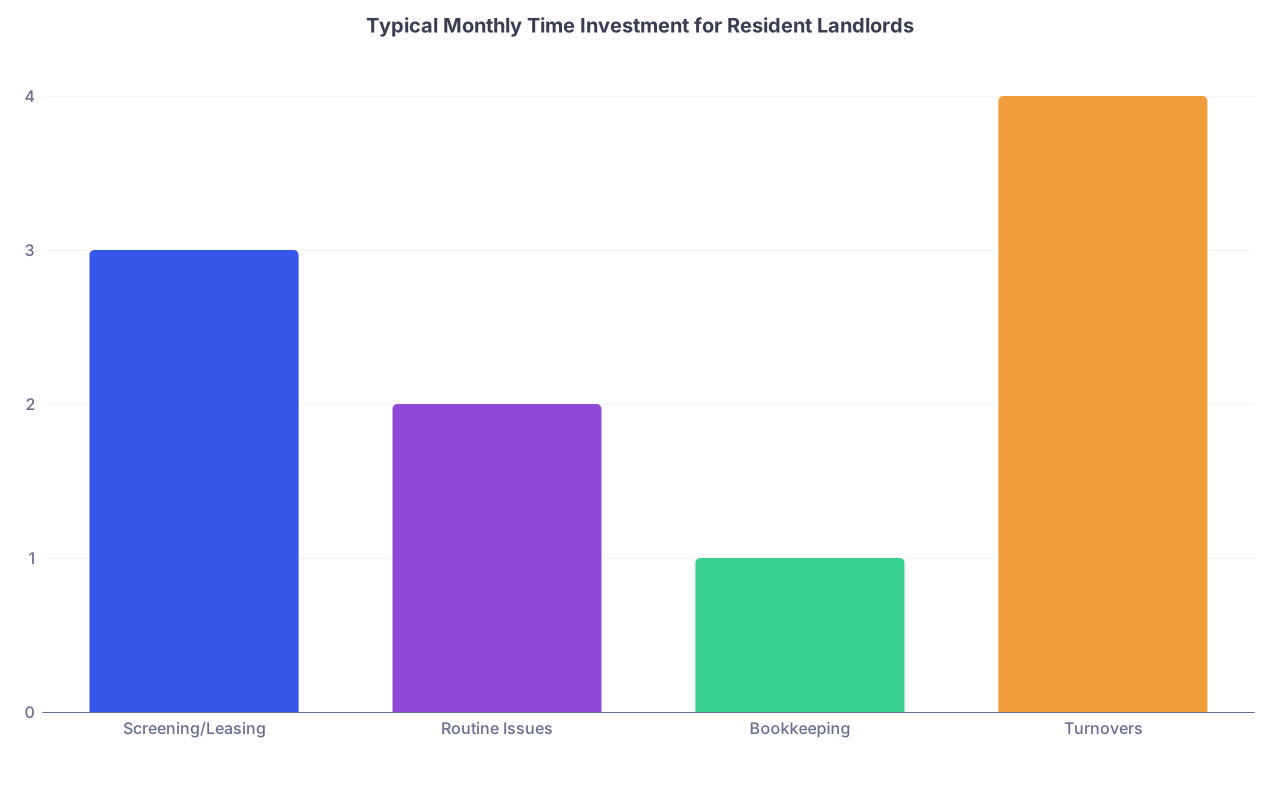
| Category | Value |
|---|---|
| Screening/Leasing | 3 |
| Routine Issues | 2 |
| Bookkeeping | 1 |
| Turnovers | 4 |

| Step | Description |
|---|---|
| Step 1 | Interested in house hack |
| Step 2 | Rent and invest passively |
| Step 3 | Pursue 2 to 4 unit purchase |
| Step 4 | Market prices reasonable |
| Step 5 | Can keep 3 to 6 months reserves |
| Step 6 | Property cash flows with manager |

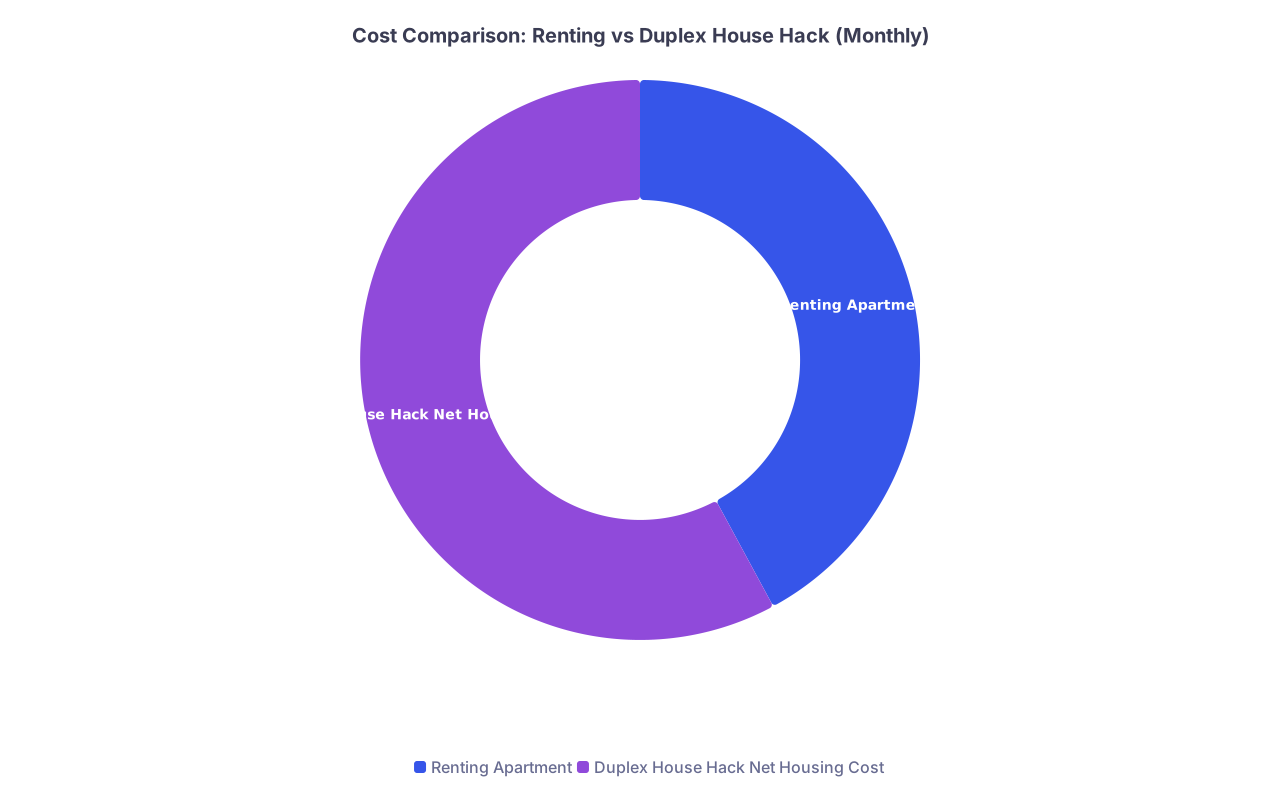
| Category | Value |
|---|---|
| Renting Apartment | 1600 |
| Duplex House Hack Net Housing Cost | 2200 |

FAQ (Exactly 6 Questions)
1. Should I buy my first multifamily in an LLC during residency?
For an owner-occupied 2–4 unit, usually no. Most lenders will not allow an LLC borrower for primary residence financing, and transferring after closing can technically trigger the due-on-sale clause. During residency, holding title in your own name with strong insurance and an umbrella policy is usually the cleanest solution. Once you are attending-level and own multiple properties, you can revisit entity structuring with a real estate attorney.
2. How much cash should I have before I house hack as a resident?
Bare minimum: your down payment + closing costs plus 3–6 months of total housing expenses (PITI, utilities, typical maintenance) and personal living expenses. So if your all-in monthly cost is $3,500 and you spend $2,000/month personally, you want $16–33k in true reserves after closing. If that number feels impossible, you are too early for a house hack.
3. Can I use projected rental income from the other unit(s) to qualify for the mortgage?
Often yes, but with conditions. Many lenders will allow a percentage (typically 75%) of documented market rent or lease rent from the other units as income for DTI calculations, especially for 2–4 unit properties. You may need an appraiser’s rent schedule or existing leases. Physician loan programs vary, so you need to ask this directly when shopping lenders.
4. What if my co-resident tenant stops paying and we are friends?
You are a landlord first. That means you follow your written lease. Step one is a frank, private conversation. Step two, if unpaid rent persists, is to follow your state’s legal process for nonpayment (notice to pay or quit, etc.). Mixing friendship and tenancy is exactly why you need clear expectations and a professional lease from day one. If enforcing a lease against a friend sounds impossible, do not rent to friends.
5. Is it better to pay extra on the mortgage or save for the next property?
During residency, liquidity is king. Once you have a comfortable emergency fund and are maxing (or at least strongly funding) retirement vehicles like your 403(b)/401(k) and Roth IRA, extra cash is usually better aimed at reserves or the next down payment rather than aggressively paying down low-to-moderate rate fixed debt. The equity you build with principal payments is locked; your life is unpredictable over the next 5–7 years. Stay liquid.
6. How do I find a good CPA and attorney who understand physician real estate?
Ask specific questions. For a CPA: “How many clients do you have with small multifamily properties?” and “How do you usually handle owner-occupied 2–4 units for tax purposes?” For an attorney: “How many landlord-tenant cases or small investor transactions have you handled this year?” Avoid professionals who only know W-2 employees with single-family homes. Your ideal team sees physician landlords often enough that your situation is not exotic to them.
Key takeaways:
- House hacking a 2–4 unit during residency only works if the numbers are conservative, the property can stand on its own with a manager, and you keep adequate cash reserves.
- Skip premature LLC gymnastics; focus on solid financing, competent leases, and serious insurance and umbrella coverage.
- Treat yourself like both a physician and a small business owner—because if you do this, that is exactly what you are.