
The most profitable asset class for physicians right now is not chosen by hype; it is chosen by cap rate math and risk-adjusted return data.
If you treat physician office, retail, and multifamily as three “patients” in your portfolio, the numbers are very clear about who is stable, who is volatile, and who is overpriced. Let’s walk through it like a workup, using cap rates as the primary vital sign.
1. Cap Rate Basics (In Physician Language)
Cap rate is not magic. It is just a speedometer for income relative to purchase price.
Cap rate = Net Operating Income (NOI) ÷ Purchase Price
- NOI = rent collected − operating expenses (taxes, insurance, maintenance, management, etc.)
- It ignores financing. Cap rate is an unlevered return.
- You use it to compare income yield across deals and asset types.
If a building generates $300,000 in NOI and sells for $4,000,000:
- Cap rate = 300,000 ÷ 4,000,000 = 7.5%
So every $1 million you put into that building produces $75,000 per year in pre-debt income.
Where physicians get misled is treating cap rate like a single score that decides everything. It does not. It tells you what the market is paying for a given stream of income, but you still need to ask:
- How durable is that income? (lease term, tenant quality)
- How much can NOI grow? (rent growth, expense control)
- How volatile is the asset class? (tenant demand, regulatory risk, new supply)
- How likely is cap rate compression or expansion when you sell?
The data shows very different answers across physician office, retail, and multifamily.
2. Typical Cap Rates by Asset Type (2024 Snapshot)
Let us start with current market ranges. These numbers vary by market, credit quality, and building type, but the spread is real and persistent.
| Asset Type | Core / Prime Markets | Secondary Markets | Tertiary / Smaller Markets |
|---|---|---|---|
| Physician / Medical Office | 5.50% – 6.25% | 6.25% – 7.25% | 7.25% – 8.25% |
| General Retail (unanchored) | 6.25% – 7.50% | 7.00% – 8.50% | 8.00% – 9.50% |
| Necessity Retail (grocery) | 5.25% – 6.00% | 5.75% – 6.75% | 6.50% – 7.50% |
| Multifamily (Class A) | 4.50% – 5.25% | 5.00% – 5.75% | 5.75% – 6.50% |
| Multifamily (Class B/C) | 5.25% – 6.25% | 5.75% – 7.00% | 6.50% – 8.00% |
The pattern:
- Multifamily trades at the lowest cap rates (investors pay more per dollar of NOI).
- Physician / medical office sits in the middle.
- General retail often shows the highest cap rates (on paper, the highest initial yields).
Let’s visualize an average:
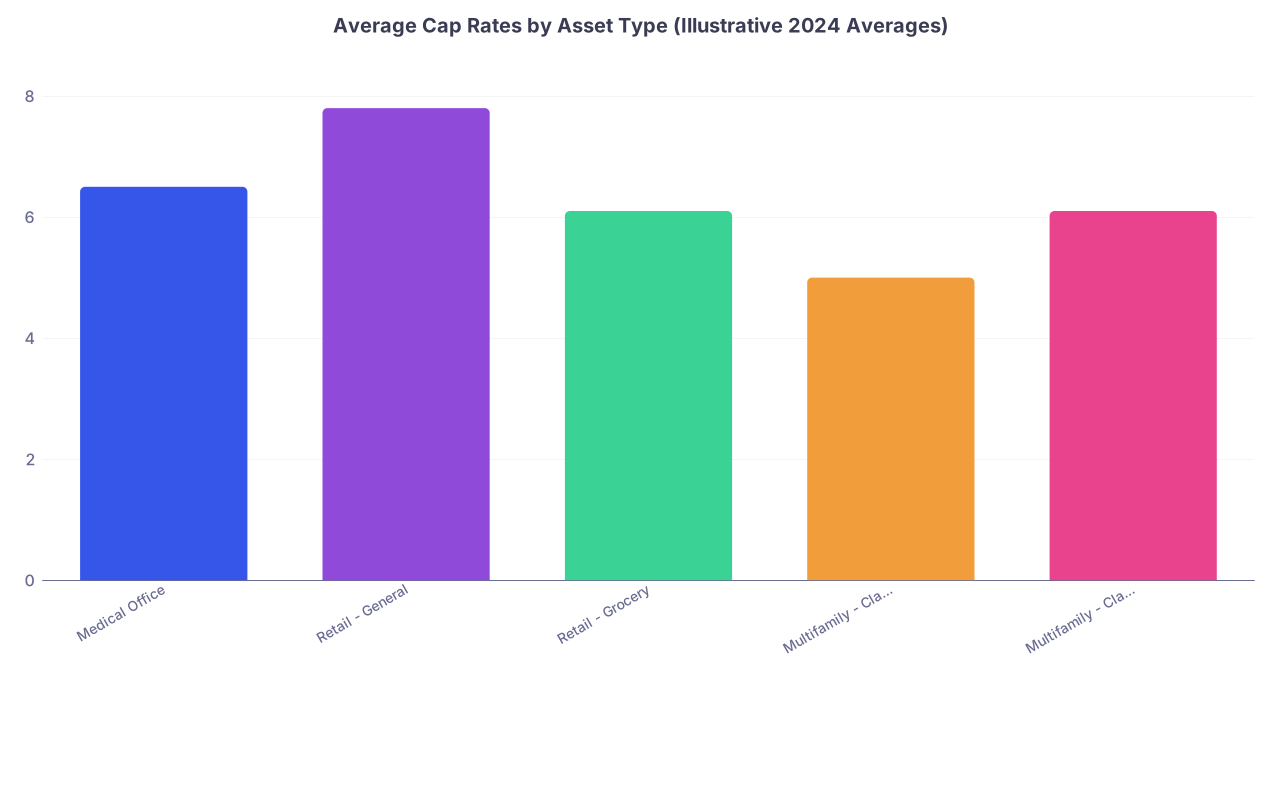
| Category | Value |
|---|---|
| Medical Office | 6.5 |
| Retail - General | 7.8 |
| Retail - Grocery | 6.1 |
| Multifamily - Class A | 5 |
| Multifamily - Class B/C | 6.1 |
So why not just chase the highest cap rate every time? Because high cap rate often equals higher risk, weaker tenant quality, or poorer growth prospects. Yield is rarely free.
3. Physician Office: Income Stability With Mid-Range Cap Rates
Medical office behaves differently from most commercial assets. The data on tenant stickiness and rent collection is brutally lopsided in its favor.
What the numbers say
Across several industry datasets (REIT filings, CBRE, JLL, Revista):
- Tenancy length: Medical office average tenancy often runs 7–15 years, especially for practices with specialized buildouts (surgery centers, imaging, dialysis).
- Tenant retention: Renewal rates commonly exceed 80%, especially when physicians own the practice.
- Build-out cost: $80–$200/sf for true medical (plumbing, shielding, procedure rooms), making moves painful and expensive.
- Rent collection: During COVID, medical office rent collection remained north of 95–98% in most institutional portfolios, versus significantly weaker collections in casual dining, gyms, and some retail.
So a 6.5% cap rate in medical office is not the same risk as a 6.5% cap in an older strip retail center with month‑to‑month tenants.
Concrete example
Physician-owned outpatient clinic:
- Purchase price: $5,000,000
- NOI: $325,000
- Cap rate: 6.5%
- Lease: 10-year NNN, 2.5% annual rent bumps
- Tenant: Strong multi-physician group with ancillary revenue
Year 1 yield: 6.5%
By year 10, with 2.5% bumps, NOI ≈ $325,000 × (1.025^9) ≈ $409,000
If cap rates are flat at 6.5% when you sell:
- Exit price ≈ $409,000 ÷ 0.065 ≈ $6.29M
Unlevered IRR is driven by:
- 6.5% starting yield
- 2.5% annual income growth
- Modest value appreciation if cap rates hold
You get bond-like stability with slower but reliable growth.
For a physician who is also the tenant (owner-occupier), the equation is even stronger:
- You control lease terms.
- You can adjust distributions between practice income and property income for tax efficiency.
- Vacancy risk is essentially your own business risk, which you understand better than a random multifamily tenant base.
4. Retail: Higher Cap Rates, Higher Range of Outcomes
Retail is where investors chase yield and sometimes get burned.
The spread problem
Retail is all about tenant mix and relevance:
- Grocery-anchored / necessity retail often behaves almost like infrastructure: people still buy food, prescriptions, basic services.
- Unanchored strip centers, older big-box, and discretionary retail (salons, boutiques, gyms) carry much higher volatility.
The cap rate premium exists because:
- Tenant failure risk is higher.
- Re-leasing downtime can blow up your actual yield.
- Rents can be flat or even negative if you must cut to attract tenants in weaker locations.
Let’s compare two retail deals with identical headline cap rates.
Example A: Necessity retail
- Price: $6,000,000
- NOI: $390,000 → 6.5% cap
- Tenants: National grocery, pharmacy, quick-service restaurant
- Leases: 10–15 years, 1–2% annual bumps, mostly NNN
- Probability of full occupancy staying high: strong
Example B: Unanchored strip
- Price: $6,000,000
- NOI: $390,000 → 6.5% cap
- Tenants: Local nail salon, vape shop, insurance office, small restaurant
- Leases: 3–5 years, flat rent, weak guarantees
- One vacancy every other year is realistic
On paper, same cap rate. In reality:
- Effective cap rate over a 10-year hold might average 6.0–6.2% or less in Example B after downtime and leasing commissions.
- In Example A, you are more likely to realize close to your underwritten 6.5% with modest bumps.
The market partially prices this, which is why quality necessity retail actually trades closer to medical office cap rates than to generic retail.
COVID showed the stratification
- Grocery and pharmacy rents largely continued.
- Many small retail tenants requested abatements, deferrals, or simply defaulted.
- Medical office and necessity retail were near the top of the collection hierarchy; gyms and nonessential retail were at the bottom.
The lesson: A 7.5–8.5% cap in general retail may not out-earn a 6.5% cap medical office over a cycle once you factor in downtime and TI (tenant improvement) costs.
5. Multifamily: Lowest Cap Rates, Best Liquidity
Multifamily is the darling of institutions, syndicators, and frankly every “passive income” influencer on the internet. The result: compressed cap rates.
Why multifamily trades rich
The data explains the pricing:
- Diversified income: 100–300 leases instead of 3–10 tenants.
- Basic need: People must live somewhere; demand floor is durable.
- Deep debt market: Agencies (Fannie, Freddie) aggressively lend on multifamily.
- Exit liquidity: Tons of buyers, from small investors to giant REITs and funds.
But low risk and high demand = lower cap rates.
The growth argument
Multifamily investors justify 4.5–5.0% caps by pointing to:
- Rental growth in supply-constrained markets (e.g., urban infill).
- Value-add: renovate units, increase rents 15–30%, push NOI.
Here is the problem for a physician who is not living and breathing real estate operations:
- Value-add is operationally heavy: construction, tenant management, lease-up risk.
- Many markets have seen double-digit rent growth from 2020–2022, which is already baked into current rents. Forward growth may normalize or even reverse in oversupplied markets.
- Cap rates can expand 50–100 bps in a rising rate environment, which can cut exit values sharply.
Let’s quantify:
Class A multifamily, strong market:
- Purchase price: $20,000,000
- NOI: $1,000,000
- Cap rate: 5.0%
- Projected rent growth: 3%/year
- Projected expense growth: 2%/year
- NOI growth ≈ 3%/year (simplifying)
Year 10 NOI ≈ $1,000,000 × (1.03^9) ≈ $1,305,000
Scenario 1: Cap rate stays at 5.0%
- Exit price ≈ $1,305,000 ÷ 0.05 ≈ $26.1M
Scenario 2: Cap rate expands to 6.0%
- Exit price ≈ $1,305,000 ÷ 0.06 ≈ $21.75M
That 1.0% cap rate movement erased about $4.35M in value, ~21% of the exit price, even though NOI grew steadily. This is how some multifamily investors look smart in falling-rate environments and get crushed when rates rise or markets cool.
6. Cap Rate vs Risk: A Side-by-Side for Physicians
Let’s put the major attributes side by side from a physician investor’s perspective.
| Factor | Medical Office | Retail (General) | Multifamily |
|---|---|---|---|
| Typical Cap Rate (2024 avg) | ~6.5% | ~7.5–8.0% (general), 6.0% (grocery) | ~5.0–6.0% |
| Income Stability | High | Moderate to Low (tenant dependent) | Moderate to High |
| Tenant Stickiness | Very high (build-out heavy) | Highly variable | Moderate (12-month leases) |
| Growth Potential (Rents) | Moderate | Moderate (location-driven) | High in value-add; moderate stabilized |
| Operational Complexity | Low–Moderate | Moderate–High | High |
| Pandemic / Recession Resilience | Strong | Mixed | Strong–Moderate (market-specific) |
| Exit Liquidity | Moderate | Variable | Very high |
From a numbers-and-risk standpoint:
- Medical office: Core income asset.
- Retail: Yield + risk spread, with big dispersion.
- Multifamily: Growth + liquidity, but thin going-in yield.
7. How Cap Rate Differences Translate into Actual Cash
A lot of physicians look at a 1–2% cap rate difference and shrug. That is a mistake.
Consider three $5M acquisitions, each at a different cap rate:
- Deal A: Medical office at 6.5%
- Deal B: General retail at 7.8%
- Deal C: Multifamily at 5.0%
Year 1 NOI:
- A: 5,000,000 × 0.065 = $325,000
- B: 5,000,000 × 0.078 = $390,000
- C: 5,000,000 × 0.050 = $250,000
Spread vs medical office:
- Retail pays $65,000 more per year than medical office.
- Multifamily pays $75,000 less per year than medical office.
Over 10 years, ignoring growth and financing, that is:
- Retail: +$650,000 vs medical office
- Multifamily: −$750,000 vs medical office
Now inject realistic growth and risk:
- Medical office: 2.5% rent growth, 2% vacancy/loss
- Retail: 1.5% rent growth, 8–10% effective vacancy over time (churn, downtime)
- Multifamily: 3% rent growth, 5% vacancy, higher capex (turns, roofs, systems)
The data from long-term NCREIF / REIT sector performance shows:
- Office and medical office often deliver lower volatility but slightly lower total returns than aggressive multifamily in boom times.
- Retail is polarizing. Top quartile performs extremely well; bottom quartile is ugly.
- Multifamily total returns are strong, but a large portion comes from appreciation, not income yield.
If you are a high-income physician, you often care more about stable cash yield and tax strategy than about swinging for high IRR with operational headaches.
8. Physician-Specific Angle: Owning Your Office vs Chasing Apartments
For practicing physicians, medical office is not just “another asset class.” It is the one where you have:
- Natural edge in understanding tenant risk (your own specialty, referral base, payor mix).
- Built-in tenant (your practice).
- Alignment: you improve both practice value and real estate value with the same operational excellence.
Here is a typical owner-occupier structure I see:
- Physician group forms an LLC that owns the building.
- The practice entity signs a 10–15 year NNN lease with that LLC.
- Rent is set at fair market, often with 2–3% annual bumps.
- Physicians own LLC shares roughly proportional to their equity stake in the group.
From a cap rate standpoint:
- Appraisers will value the building based on market medical office cap rates (say 6.25–7.0% depending on market and lease).
- You control whether the income stream is solid because you control the practice.
That is a far more “underwritable” risk than betting on 200 apartment tenants you have never met in a market you barely know.
9. Risk-Adjusted View: Which Asset “Wins”?
If you strip away the narrative and look at risk-adjusted economics for a typical physician investor:
- Pure yield: Retail (especially non-prime) often shows the highest cap rates.
- Risk-adjusted yield: Medical office frequently wins because its cap rate premium over multifamily is not fully explained by risk.
- Total return with leverage and growth: Multifamily can win, but requires excellent operator selection and timing.
For a physician not interested in being a full-time operator:
- A physician office property with a strong lease to your own group or a creditworthy medical tenant is often the most rational first step. Good cap rate, high stability, understandable risk.
- Multifamily makes sense via strong sponsors or funds if your goal is long-term appreciation and you accept lower immediate yield.
- Retail can be attractive if:
- It is necessity-based (grocery, pharmacy, medical, daily needs).
- You are disciplined about tenant mix and willing to underwrite downside (vacancies, TI).
Here is how the tradeoffs look visually:
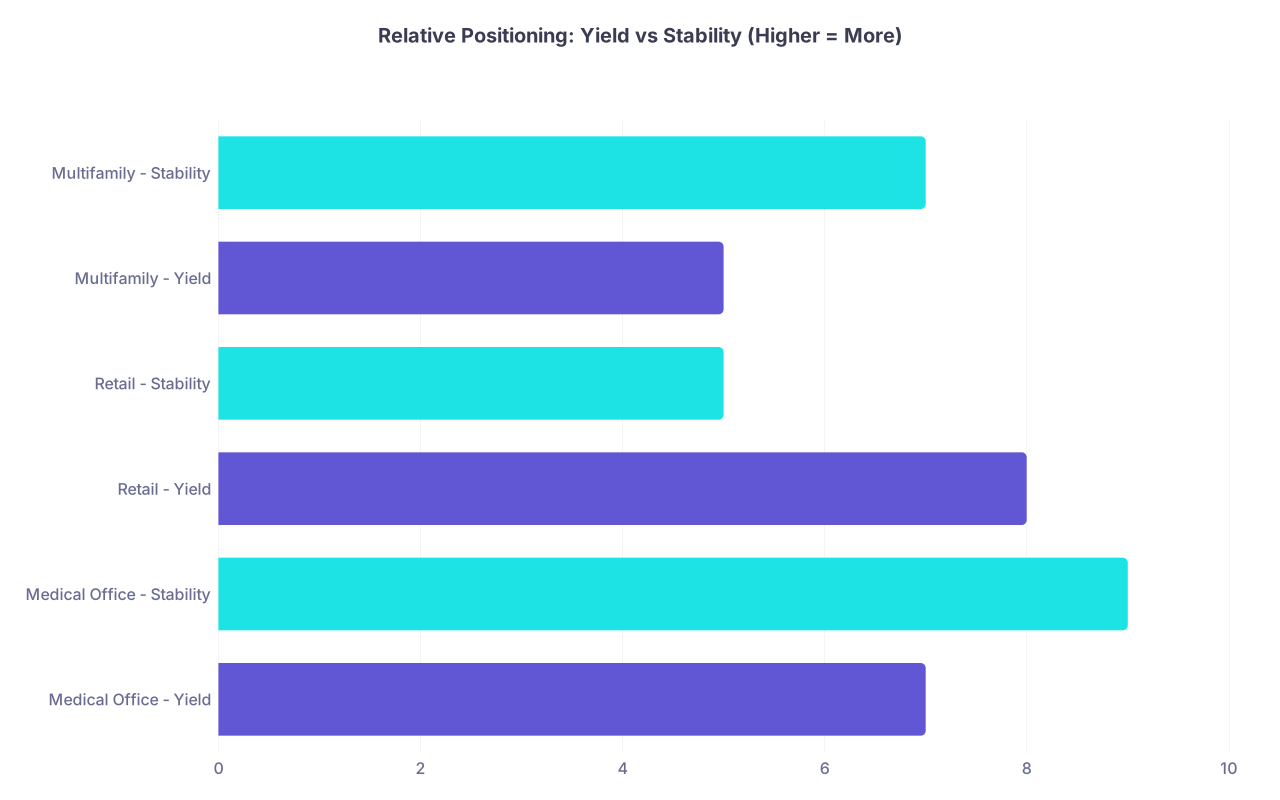
| Category | Value |
|---|---|
| Medical Office - Yield | 7 |
| Medical Office - Stability | 9 |
| Retail - Yield | 8 |
| Retail - Stability | 5 |
| Multifamily - Yield | 5 |
| Multifamily - Stability | 7 |
Scale 1–10, illustrative only. The point is the shape, not the exact numbers.
10. Practical Takeaways For Physicians
You do not need to become a full-time analyst to make good decisions. But you do need to stop treating all 6–7% cap rates as equivalent.
Concrete recommendations:
Start where you have edge. If you operate a practice, your office building is the cleanest risk you will ever underwrite. You know the payer mix, competition, and demand.
Use cap rates as a filter, not a verdict. A 7.5% retail cap is not automatically “better” than a 6.5% medical office cap. Adjust for:
- Probable downtime over 10–15 years.
- Tenant failure risk and re-leasing costs.
- Rent growth vs flat or declining markets.
Respect low cap risk. A 4.75% multifamily cap in an overheated market makes you highly sensitive to:
- Rent growth underperformance.
- Even small cap rate expansion at exit.
- Interest rate shocks.
Quantify the downside. Always run a stress case:
- Cap rates +75–100 bps at exit.
- NOI 10–15% lower than base case.
- 6–12 months extra downtime in retail.
Match the asset to your income needs.
- If you want current cash flow with moderate growth: medical office or necessity retail.
- If you want long-term appreciation and can tolerate lower yield: institutional-quality multifamily with a solid sponsor.




FAQs
1. Are cap rates for medical office really more stable than for retail and multifamily?
Yes. Historical transaction data shows that medical office cap rates move, but they tend to be less volatile than discretionary retail and more anchored than “hot” multifamily markets. Tenant stickiness, high build-out costs, and long lease terms smooth out the bumps. You do not see the same boom-bust repricing seen in trendy retail or overbuilt apartment submarkets.
2. Should I prioritize the highest cap rate I can find as a physician investor?
No. Chasing the highest cap rate is how investors end up owning half-empty C‑class strip centers in dying corridors. You need to adjust the headline cap for realistic long‑term vacancy, re‑tenanting costs, and rent growth. A 6.5% cap medical office building with 2.5% annual rent bumps and 90–95% true occupancy can easily outperform an 8% cap retail deal that sits 20% vacant and requires major TI to backfill space.
3. Is multifamily still a good investment for physicians given low cap rates?
It can be, but only with discipline. Multifamily at a 4.5–5.0% cap demands either strong rent growth or value-add execution to justify the pricing. If you invest passively with a seasoned sponsor who has a real track record in that specific market and asset type, it can provide diversification and long-term upside. But as a first or only investment, buying low-cap multifamily on your own is usually a poor risk-reward move for busy physicians.
4. If I am planning to build or buy my own office, what cap rate should I target?
For an owner-occupied medical office in a decent metro, targeting a 6–7% stabilized cap rate on cost is reasonable. That means your Year 1 NOI (after a ramp-up period if needed) should be roughly 6–7% of your all-in project cost. If your pro forma shows only a 4–5% yield at stabilization, you are probably overpaying or overbuilding relative to the market. Use prevailing market medical office cap rates as your sanity check and underwrite a conservative lease rate your practice can truly support.
Key points to keep in mind:
- Cap rates are not just yield; they are market consensus on risk—medical office usually offers the best risk-adjusted middle ground for physicians.
- Retail’s higher cap rates come with meaningful tenant and downtime risk; multifamily’s low cap rates demand real operational skill and growth to work.