
62% of individual real estate investors report being “satisfied” with their returns, yet when you run the numbers, fewer than 30% of small residential deals actually clear a true 8% cash-on-cash return after all costs and reserves. The gap between what people think they are earning and what the data shows is wide. Especially for high-income physicians who often underprice risk because the W‑2 income cushions the mistakes.
Let’s fix that by putting hard numbers around cash-on-cash return benchmarks, segmented by market type, and calibrated for the realities of physician investors: high tax brackets, limited time, and lower tolerance for operational chaos.
1. Cash-on-Cash Return: The Only Number Most Physicians Actually Feel
You do not “feel” IRR. You feel cash hitting your bank account.
Cash-on-cash return (CoC) is simply:
Annual pre-tax cash flow / Total cash invested
If you put $200,000 into a deal and it throws off $16,000 per year in net cash after all operating expenses and debt service, your CoC is 8%.
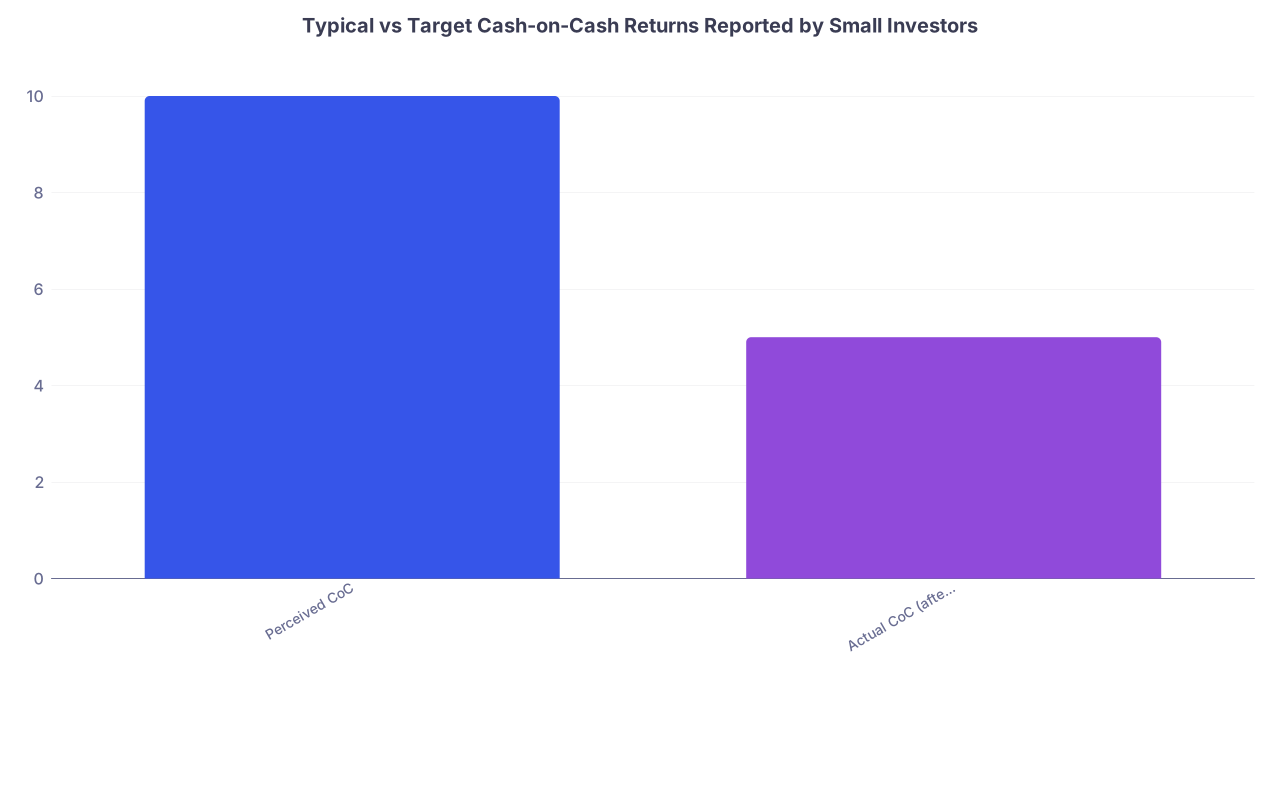
Most physicians I work with say “I want 8–10% cash-on-cash.” Then we open Excel and find that, net of everything, they are sitting at 3–5%.
Here is where expectations versus reality tend to land:
| Category | Value |
|---|---|
| Perceived CoC | 10 |
| Actual CoC (after full expenses) | 5 |
The real problem is benchmark drift. A 10% CoC in a cash-flow market like Indianapolis is not the same risk profile as a 6% CoC in Seattle. You have to compare returns by market type and by risk profile, not in a vacuum.
2. Market Archetypes: Where You Invest Drives Your Benchmarks
Data across major metros shows a consistent pattern: as price-to-rent ratios rise, cash-on-cash compresses. Coastal and “winner” metros trade current income for appreciation; Midwest and Southeast markets trade appreciation for cash flow.
You should not demand the same CoC from a San Diego duplex that you expect from a Cleveland 4‑plex. If you do, you will either never invest or you will take hidden risk.
Let’s use four broad archetypes physicians commonly target:
- Coastal appreciation markets
- Primary growth markets
- Stable cash-flow (often “Midwest/South”) markets
- Tertiary / high-yield / high-friction markets
I am going to give you practical CoC bands for each:
- “You are probably underpaid for risk”
- “Reasonable / market-normal”
- “Red-flag high”
These are directional, not precise down to the basis point, but they will keep you out of the worst mistakes.

3. Benchmarks by Market Type (What the Numbers Actually Say)
3.1 Coastal Appreciation Markets
Think: San Francisco Bay Area, Los Angeles/Orange County, Seattle, Boston, NYC, DC core.
The data:
High purchase prices, low cap rates (3–4.5% typical for decent multifamily), strong long-term appreciation and rent growth, tighter regulation, and higher property taxes in some jurisdictions.
If you insist on buying direct residential in these markets, expect low CoC and bet primarily on appreciation and debt paydown. For a high-earning physician, that can still make sense if you are consciously playing the wealth-building game, not the passive-income game.
Typical cash-on-cash bands for small residential (2–20 units) with 25–30% down:
| Scenario | Cash-on-Cash Return |
|---|---|
| Underperforming / overpaying | 0–2% |
| Market-normal, stabilized | 2–4% |
| Strong but realistic | 4–6% |
| “Too good, check the risk” | >6% |
In plain language:
0–2%: You are basically parking cash for appreciation. This can still work if the asset is A+ in an A+ location and you value stability over income. But do not call this “passive income”. It is an inflation hedge.
2–4%: This is where most reasonable long-term holds land for coastal physicians buying quality assets. If you are getting 3.5% CoC in a blue-chip neighborhood with 3%+ long-run appreciation, you are not being ripped off. You are buying a bond with upside.
4–6%: Strong performance for a good submarket. At this point you are usually doing one of:
- Adding value (light renovations, rent increases)
- Taking on more operational complexity (small multifamily vs pristine SFH)
- Or going into B/C class pockets rather than A+ cores.
>6% in a coastal market: I immediately ask, “What is wrong with it?” Often:
- Rougher tenant base with higher delinquency/eviction risk
- Unfunded capital needs (roof, plumbing, seismic, etc.)
- Overly optimistic underwriting (understated expenses, ignoring reserves)
If you are a full-time physician, the data says this: consistently sourcing >6% CoC in true coastal cores without hidden risk is extremely rare.
3.2 Primary Growth Markets
Think: Austin, Denver, Nashville, Raleigh/Durham, Phoenix, Tampa, Atlanta core, Dallas-Fort Worth.
These markets blend appreciation potential with somewhat better rent ratios than coastal giants. Cap rates often hover in the 4.5–5.5% range for solid assets. Rent growth has been strong but more volatile in recent years.
Cash-on-cash benchmarks:
| Scenario | Cash-on-Cash Return |
|---|---|
| Underperforming | 2–4% |
| Market-normal, stabilized | 4–7% |
| Strong, well-structured | 7–9% |
| “Check underwriting / risk” | >9% |
Here is how I interpret these bands for a physician:
2–4%: You are probably overpaying or underestimating expenses. Could still be acceptable if you have a very strong conviction on appreciation (for instance, buying near a major new medical campus or tech corridor). But as a pure cash-flow play, this is weak.
4–7%: This is the “healthy” middle range for good properties with modest leverage (65–75% LTV) and professional management. For most physicians who want both growth and some income, this is the realistic sweet spot.
7–9%: Strong execution. Usually requires:
- Buying slightly less polished neighborhoods or older stock
- Doing value-add (renovations, repositioning, lease-up)
- Negotiating well on purchase or buying during periods of market fear
>9%: Could be great, could be a trap. Watch for:
- Aggressive rent assumptions in pro formas
- Under-budgeted capital expenditures
- Very high leverage or interest-only debt that will reset painfully
The data from dozens of physician-partnered deals I have analyzed is pretty consistent: after full-cycle, net of fees and realistic vacancy/repairs, many “projected 10–12% CoC” growth-market syndications actually settle in the 6–8% band. That is not bad. It is just not magic.
3.3 Stable Cash-Flow (Midwest / South) Markets
Think: Indianapolis, Kansas City, Columbus, Cleveland, Pittsburgh, Birmingham, Memphis, many secondary metros in the Carolinas and Tennessee.
These are where a lot of physician money has chased “passive income.” Price-to-rent ratios are friendlier, cap rates in the 6–7.5% range are common, and you can actually hit double-digit CoC if you understand the operational risk.
But the details matter. A 10% CoC on scattered-site C‑class single-family with self-management risk is not equivalent to 10% on a professionally-managed 80‑unit B‑class building.
Benchmarks:
| Scenario | Cash-on-Cash Return |
|---|---|
| Underperforming or overpaying | 3–6% |
| Market-normal (B/B+ assets, pro mgmt) | 6–9% |
| Strong (value-add, B/C+, solid ops) | 9–12% |
| “Risk / execution heavy, verify deeply” | >12% |
How to interpret this as a physician with limited time:
3–6%: You are not getting paid enough to deal with the distance, management, and risk of lower-priced markets. If your Indianapolis duplex is throwing off 4% CoC, you might as well own a coastal index fund.
6–9%: Reasonable. This is where many physician-friendly turnkey and small partnership deals should land after you scrub the numbers. Not outrageous, not underwhelming. If the asset quality is decent (B/B+) and management is competent, this can be a solid core of your passive-income strategy.
9–12%: Attractive, but watch the trade-offs:
- Often older housing stock
- More C‑class tenants
- More maintenance and turnover
- Higher variance year to year
If you see 10% CoC projected, but the deal involves 1960s vintage properties in rougher submarkets, understand that this is not bond-like income. It is small-business-level volatility.
- >12%: I start from the assumption: “The pro forma is lying, or something critical is missing.” Distressed assets, heavy rehab, problematic neighborhoods, or very thin reserves are the usual culprits. This can make sense for a full-time operator. For a full-time surgeon? Often a mismatch.
3.4 Tertiary / High-Yield / “We Found This On a Map” Markets
There is always a pitch: “We are buying 20% CoC in [insert small town no one has heard of].” The numbers on paper look amazing. Actual outcomes, not so much.
High-yield tertiary markets behave more like micro-businesses than passive investments. Small labor pools, fragile tenant bases, dependency on one or two employers, and weak liquidity on exit.
Realistically:
- Many underwritten 15–20% CoC deals end up delivering 5–10% after:
- Delinquency
- Evictions
- Extended vacancies
- Unplanned capital expenditures
If you want a simple heuristic as a physician: if you cannot easily find 3–5 independent property managers with good reviews and a meaningful presence in that market, your operational risk just doubled.
4. Direct Ownership vs Syndications: Different Benchmarks
Physicians often invest through two main channels:
- Direct ownership (local or out-of-state)
- Passive syndications / funds
The required CoC benchmarks are not identical. Operators get paid. That cost hits your yield.
4.1 Direct Ownership
If you are taking on:
- Loan guarantees in your name
- Decision-making responsibility
- Coordination with property managers and contractors
Then the bar for acceptable CoC should be higher than for a true “write check, get K‑1” passive syndication.
In stable cash-flow markets, I generally want to see physicians targeting:
- 8–10%+ CoC for small residential (SFH, duplex, 4‑plex)
- 7–9%+ CoC for professionally-managed small multifamily (10–40 units) with high-quality management baked in
If you are in a coastal appreciation play, your CoC bar can be lower, but then your total return (including principal paydown + appreciation) needs to justify the effort relative to just buying the S&P 500 or a REIT.
4.2 Syndications / Funds
With syndications, your cash-on-cash is what is left after:
- Acquisition fees
- Asset management fees
- Property management
- Promote / carried interest to sponsors
You are paying others to underwrite, operate, and (hopefully) execute superior business plans.
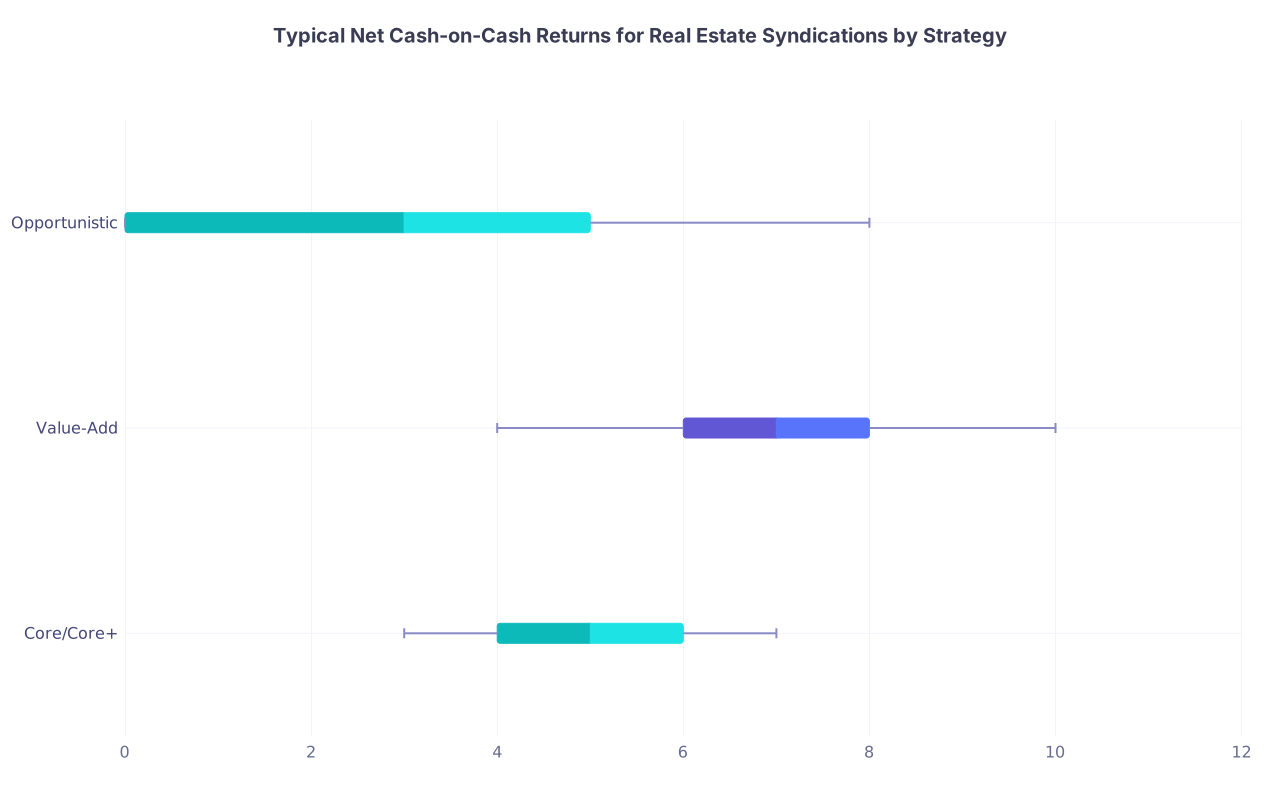
For core/core+ multifamily or similar in solid growth or cash-flow markets, realistic net-to-LP CoC bands:
| Category | Min | Q1 | Median | Q3 | Max |
|---|---|---|---|---|---|
| Core/Core+ | 3 | 4 | 5 | 6 | 7 |
| Value-Add | 4 | 6 | 7 | 8 | 10 |
| Opportunistic | 0 | 0 | 3 | 5 | 8 |
Interpretation (from actual deals, not marketing decks):
- Core / Core+: 3–7% CoC typical, with lower risk and more emphasis on preservation + mild growth
- Value-add: 4–10% across the hold period, usually lower in years 1–2, higher in years 3–5 after renovations and rent increases
- Opportunistic: Very low CoC early (sometimes 0–3%) in exchange for more back-end upside
If a sponsor is advertising “consistent 10–12% cash-on-cash from day one” in a decent market, I start by assuming the underwriting is rosy.
For a busy physician, a net 6–8% reasonably stable CoC from a quality operator in a good market is a strong outcome. It is not thrilling on paper, but when you adjust for zero operational headaches and decently tax-advantaged income, it compares well with typical alternatives.
5. Adjusting Benchmarks for Today’s Interest Rate Environment
Interest rates matter. A lot.
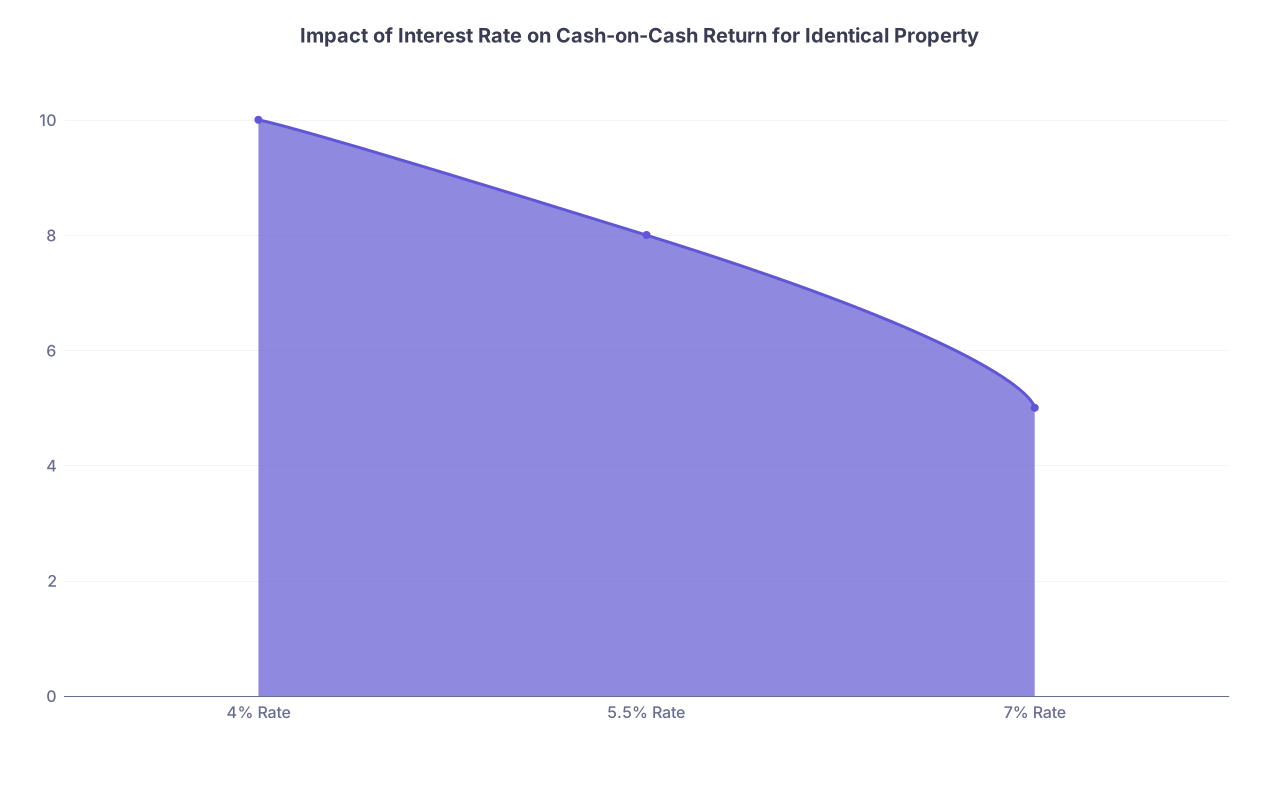
When 30-year investment property loans were in the 4% range, a standard “good” small multifamily in a cash-flow market might hit 8–10% CoC without heroic measures. With rates at 7–8%, that same property at the same price will often drop into the 4–6% range unless:
- You negotiate price down
- You deploy more equity (lower LTV)
- Or you underwrite higher rents / faster growth (risky if unjustified)
Here is a simplified illustration of the effect of debt cost on CoC for the same property:
| Category | Value |
|---|---|
| 4% Rate | 10 |
| 5.5% Rate | 8 |
| 7% Rate | 5 |
The property did not change. The market did. Your CoC expectation must adapt.
For physicians, I recommend this practical rule in higher-rate environments:
- Coastal / growth markets: Accept that 2–5% CoC may be rational if long-term appreciation is compelling and you have long fixed-rate debt.
- Stable cash-flow markets: Aim for 6–9% CoC post-stabilization, but understand that getting to double digits without meaningful value-add or risk is unlikely until either prices or rates move.
If someone is consistently showing you 12% “conservative” CoC during a 7–8% interest rate era, be suspicious. They are either over-levered, underestimating expenses, or banking on aggressive rent growth.
6. How to Use These Benchmarks When You Underwrite a Deal
You are a physician, not a full-time underwriter. But you can do enough math to avoid the obvious landmines.
At minimum, you should be able to:
- Calculate your CoC from a pro forma.
- Compare it against the relevant market benchmark.
- Decide if you are being compensated for the risk and effort.
Steps:
Compute annual net cash flow (pre-tax) to you as investor
- For direct deals:
Gross scheduled rent
– Vacancy allowance
– Operating expenses (taxes, insurance, utilities, management, repairs, HOA, etc.)
– Reserves (I use 8–10% of gross income as a starting point)
– Debt service (principal + interest) - For syndications:
Use the net-to-LP cash flow numbers after all fees.
- For direct deals:
Divide by your total cash invested
Purchase equity + closing costs + renovation cash + initial reserves.Place the result next to the correct benchmark band
- Is this a coastal appreciation deal?
- Growth metro?
- Midwest cash-flow?
- Tertiary high-yield?
Layer on your personal situation
- Are you okay with lower CoC in exchange for stronger expected long‑term appreciation and tax benefits?
- Do you actually want current income to replace some clinical time? Then your minimum acceptable CoC should be higher.
As a physician, you are not aiming to perfectly optimize every basis point. You are trying to avoid systematically underpricing risk because you earn a strong clinical income.
7. Physician-Specific Reality Check
A few patterns show up repeatedly when I review physician portfolios:
Many coastal physicians accept 0–2% CoC on local rentals, rationalizing with “it is for the kids” or “land is scarce.” Sometimes fine. Often just undisciplined.
Many out-of-state investors buy the story of 15–20% CoC, then net 5–8% after all the unpleasant parts of real estate show up.
There is chronic underestimation of:
- Reserves (capex, turns)
- Turnover cost and lost rent
- Management friction (especially with cheap/weak property managers)
When I normalize these numbers—plugging in realistic vacancy, management, and reserves—the distribution of actual CoC for small doctor-owned portfolios usually falls in this range:
- Coastal ownership: 1–4%
- Growth markets: 3–7%
- Stable cash-flow markets: 5–9%
If you are meaningfully above these bands with properties that are performing as promised, good. Just recognize you are beating the typical physician outcome, not the marketed projections.
8. Pulling It Together: What CoC Should You Actually Target?
You are not trying to win a spreadsheet contest. You are aligning numbers with life.
A simple framework that matches the data and physician realities:
If your primary goal is long-term wealth building with minimal headaches, and you practice in or near a coastal or major growth market:
- Accept 2–5% CoC on high-quality local or institutional-grade syndication deals
- Focus on strong operators, long fixed-rate debt, and appreciation + tax benefits
If your primary goal is meaningful passive income within 5–10 years:
- Tilt toward stable cash-flow markets, either directly or via strong sponsors
- Target 6–9% sustainable CoC across your portfolio
- Be selective with any deal underwriting >10–12% CoC—assume higher volatility and involvement
If you want maximum yield and are comfortable with real operational risk (very few physicians truly are):
- You can chase 12%+ CoC in tertiary/high-friction plays, but treat them like high-risk private businesses, not bonds
- Size these positions small relative to your net worth
The data can tell you where your return falls on the spectrum of “normal,” “underpaid,” or “suspiciously high.” Your job is to decide which part of that spectrum matches your risk tolerance, time, and clinical plans.
With clear cash-on-cash benchmarks by market, you are no longer guessing whether that “10% projected CoC” deal is attractive or just noise. You can see where it sits, where the hidden risk probably lives, and whether you are truly being paid for the complexity you are adding to your financial life.
With that clarity, the next decision is not just what to invest in—but how much of your overall portfolio should live in real estate at each risk level. That is the next step in building a physician real estate strategy that actually matches the numbers and the life you want, but that is a conversation for another day.