
The myth that “high income automatically impresses lenders” is wrong. For real estate, the data shows lenders care far more about your Debt Service Coverage Ratio (DSCR) than your W-2 as a physician.
If you want to be taken seriously as a physician real estate investor, you must speak the language of coverage ratios. Not anecdotes. Not vibes. Numbers.
What DSCR Actually Measures (And Why Lenders Obsess Over It)
Debt Service Coverage Ratio is brutally simple:
DSCR = Net Operating Income (NOI) ÷ Annual Debt Service
Where:
- NOI = Rental income minus operating expenses (before debt service, before taxes, before depreciation)
- Annual Debt Service = Total yearly principal + interest payments on the loan
Lenders use DSCR to answer one cold question:
“Does this property, by itself, reliably generate enough income to pay its own mortgage with a margin of safety?”
They are not underwriting your lifestyle goals. They are underwriting cash flow vs obligation.
If a property produces:
- $120,000 NOI per year
- $80,000 annual debt service
Then:
DSCR = 120,000 ÷ 80,000 = 1.50
That tells the lender:
“For every $1.00 of debt payments, the property generates $1.50 of income.”
Good cushion. They sleep well at night.
Now flip it:
- $95,000 NOI
- $80,000 debt service
DSCR = 95,000 ÷ 80,000 = 1.19
Suddenly the margin is thin. One vacancy, one roof leak, one bad tenant—and coverage falls below 1.0. That is the risk lenders price. Or reject.
The DSCR Benchmarks Lenders Actually Use For Physicians
Put bluntly: your MD buys you almost nothing on DSCR requirements. You might get slightly better interest rates or loan terms, but coverage thresholds barely move.
Across banks and debt funds I have seen, the expectations cluster tightly.
| Property Type | Common Min DSCR | Tighter / Conservative DSCR |
|---|---|---|
| Single-tenant medical office | 1.25x–1.30x | 1.35x–1.40x |
| Multi-tenant medical office | 1.20x–1.25x | 1.30x–1.35x |
| Small multifamily (2–4 units) | 1.20x | 1.25x–1.30x |
| Commercial multifamily (5+ units) | 1.25x | 1.30x–1.40x |
| Retail / mixed-use | 1.25x–1.30x | 1.35x–1.40x |
Notice what is missing: “Physician discount”. Lenders do not meaningfully lower DSCR just because you are a cardiologist or orthopedic surgeon.
The most common minimum DSCR I see for stabilized deals: 1.25x. Some community banks will close at 1.20x on strong, low-LTV situations. Institutional lenders routinely demand 1.35x–1.40x for riskier markets or weaker tenants.
Here is the basic rule:
- ≥ 1.40x – Lender-favorite. Often qualifies for better rates, faster approval.
- 1.25x–1.39x – Standard, acceptable. Not special, not weak.
- 1.20x–1.24x – Borderline. Needs compensating strengths (low LTV, strong guarantor, prime location).
- < 1.20x – Usually a problem for conventional commercial loans. Bridge or private debt maybe, but you will pay for it.
The Four Variables That Quietly Control Your DSCR
Every physician asks, “What DSCR do lenders want?” Wrong question. The better question is:
“Which levers can I adjust to hit the DSCR lenders want?”
There are four main ones.
- Net Operating Income (NOI)
- Loan amount / Interest rate / Amortization (how big and how expensive your debt is)
- Loan term and structure
- How the lender underwrites income and expenses (their version of reality vs yours)
Let’s walk through each with numbers.
1. NOI: Why Your “Pro Forma” Is Almost Always Too Optimistic
Physicians love pro forma spreadsheets. They usually love them a bit too much.
NOI is:
Gross Scheduled Rent
– Vacancy / credit loss
– Operating expenses (taxes, insurance, repairs, management, utilities if landlord-paid, etc.)
= NOI
You can inflate this on paper easily. Lenders know that. So they trim.
Say you find a small medical office condo:
- Current rent: $8,000 per month = $96,000 per year
- Tenant pays NNN (taxes, insurance, CAM). Your landlord expenses are minimal: $6,000 per year.
- You project 0% vacancy because “this dermatologist has been here 10 years.”
Your pro forma NOI:
96,000 – 6,000 = $90,000
The lender’s version will be harsher:
- They assume 5% vacancy / credit loss: 0.05 × 96,000 = 4,800
- They may normalize some “owner-paid” overhead if they think you underreported expenses
So their underwritten NOI might be:
96,000 – 4,800 – 6,000 = $85,200
Right there, you just lost $4,800 of NOI in their model. That lowers DSCR and hence max loan.
2. How Lenders Back Into Your Maximum Loan Amount From DSCR
Here is the part most physicians miss: lenders do not start with “loan amount” and then compute DSCR. They often start with required DSCR and work backward to the maximum loan they will give you.
The equation rearranges like this:
Max Annual Debt Service = NOI ÷ Minimum DSCR
Then they solve for loan size that produces that debt service, given an interest rate and amortization.
Let’s quantify this.
Assume:
- Underwritten NOI: $120,000
- Required DSCR: 1.25x
- Max annual debt service: 120,000 ÷ 1.25 = $96,000
Now assume:
- Interest rate: 6.50%
- Amortization: 25 years
At 6.50% and 25-year amortization, annual payment per $1,000 of loan is about $81.04.
So with $96,000 annual debt service:
Max loan ≈ 96,000 ÷ 81.04 × 1,000 ≈ $1,185,000
If the purchase price is $1,700,000:
- Your maximum loan from DSCR = ~$1.185M
- Required equity = ~$515,000
- That is roughly 70% LTV. Fine.
Now watch what happens if rate jumps to 7.50% with everything else constant:
At 7.50% and 25 years, annual payment per $1,000 ≈ $89.29.
Max loan ≈ 96,000 ÷ 89.29 × 1,000 ≈ $1,075,000
Your loan capacity just fell by ~$110,000 purely from the rate increase. Same NOI. Same property. Same physician.
That is DSCR at work.
3. DSCR vs Interest Rate: How “Doctor Loans” Can Backfire On Investments
Many physicians chase special “physician loans” or high-LTV products. They sound attractive: lower down payment, flexible underwriting. For personal residences, fine. But for investment properties, the story is different.
Higher leverage and slightly higher rates destroy DSCR.
Take a small multifamily:
- Underwritten NOI: $60,000
- Lender minimum DSCR: 1.25x
- Max annual debt service = 60,000 ÷ 1.25 = $48,000
Scenario A – Lower rate conventional:
- Rate: 6.25%, 25-year amortization → annual per $1,000 ≈ $79.20
- Max loan: 48,000 ÷ 79.20 × 1,000 ≈ $606,000
Scenario B – “Promotional” program:
- Rate: 7.25%, same amortization → annual per $1,000 ≈ $87.46
- Max loan: 48,000 ÷ 87.46 × 1,000 ≈ $549,000
Even if Program B says “up to 80% LTV,” DSCR caps you first. You never reach the advertised LTV because cash flow cannot support it.
The data is consistent: in stabilized income-producing real estate, rate and amortization usually matter more than maximum LTV marketing language.
4. Special Case for Physicians: Owner-Occupied Medical Space
When you are buying space for your own practice (e.g., a 3,000–10,000 sq ft medical condo or small office), underwriting shifts in an important way:
- The lender cares about the business cash flow and your personal credit as much as the property.
- They may accept lower DSCR in early years if your practice has strong historical financials.
- SBA 504/7(a) loans sometimes tolerate apparent DSCR < 1.20x in year 1 if projections + guarantor support are solid.
But there is a catch: the “rent” your practice pays to your real estate entity is not whatever you want it to be. Sophisticated lenders will:
- Normalize rent to market rates for similar medical space in your area.
- Normalize expenses, vacancy, and reserves just like any other commercial deal.
Many physicians try this trick:
“I will just set my practice rent high enough to hit DSCR.”
Lender response: “We will cap that at market. Show us third-party rent comps.”
The underwriting math still wins.
What DSCR Ranges Mean For You In Practice
Let me translate DSCR into plain English consequences.
DSCR ≥ 1.50x – “Over-Qualified” But Powerful
- Lender sees strong cushion.
- You often get:
- Better pricing (rate discounts of 25–75 basis points).
- More flexibility on covenants.
- Potentially longer amortization.
For physicians scaling a portfolio, consistently hitting 1.40x–1.50x+ tells banks: you are not playing amateur-hour leverage games.
Yes, your cash-on-cash returns might look lower on paper. But your risk of capital loss is dramatically reduced. The data from the last few cycles is clear: overleveraged deals fail more than under-optimized ones.
DSCR 1.25x–1.40x – “Normal, Bankable”
This is where most performing commercial loans live. You will:
- Qualify with standard terms.
- Rarely wow a loan committee but rarely scare them.
Most first medical office building purchases wind up here if priced reasonably.
DSCR 1.20x–1.24x – “Thin Ice Zone”
You might still close in these ranges if:
- LTV is low (≤ 60–65%).
- Tenant quality is excellent (e.g., large health system, national chain).
- You as guarantor have strong liquidity and net worth.
But understand: a 5–10% drop in NOI can push DSCR below 1.0. That is exactly how people get in trouble when reimbursements shrink, or a tenant leaves, and re-lease takes longer than expected.
DSCR < 1.0 – “The Property Does Not Pay Its Own Debt”
Mathematically, this means:
NOI < Annual debt service.
You must subsidize the property from your personal income or other sources. Some physicians do this intentionally for a year or two (e.g., heavy value-add, renovation, lease-up). But those are business plans, not mistakes.
Lenders will either:
- Refuse permanent financing until stabilization, or
- Treat it as a bridge / construction / transitional loan with higher rates, lower leverage, and tighter oversight.
Visualizing How DSCR Caps Loan Size
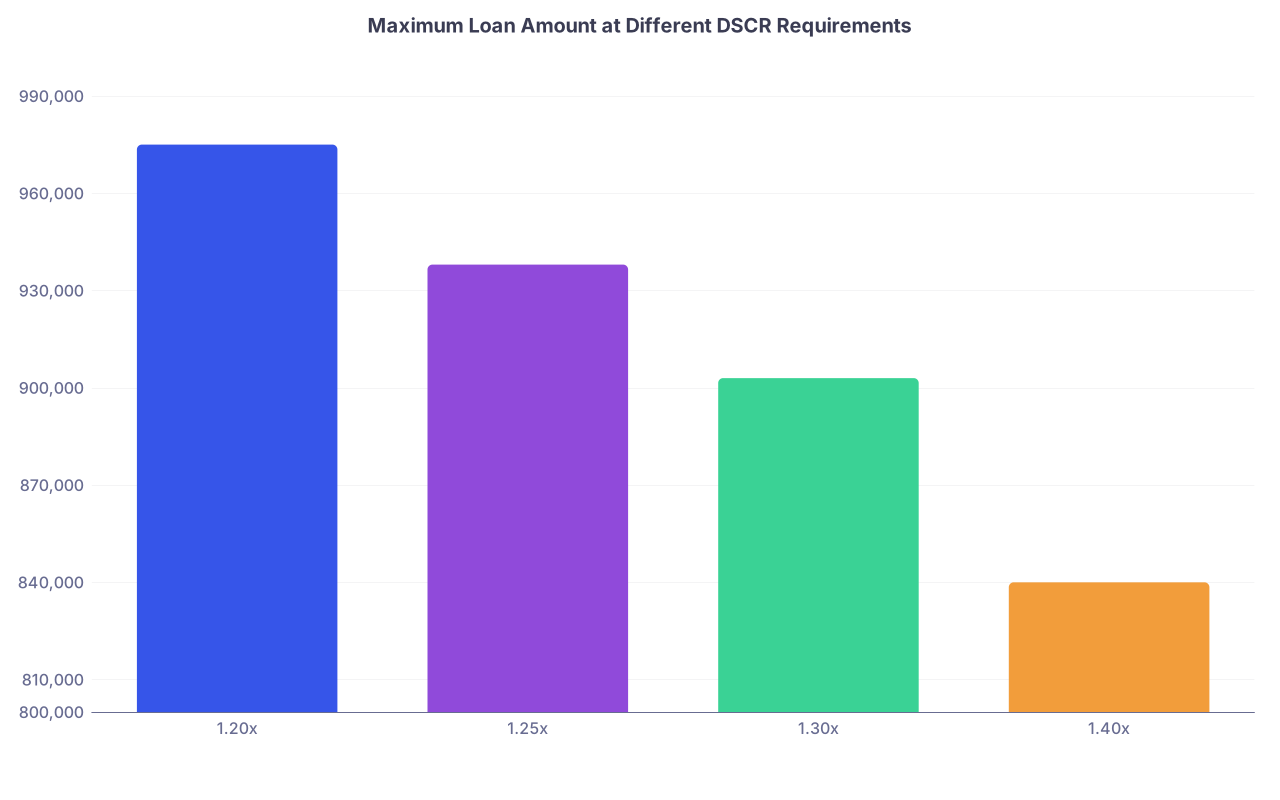
Here is a simple visualization of how DSCR thresholds limit loan amounts on a hypothetical property.
Assumptions:
- Underwritten NOI: $100,000
- Interest rate: 7.0%
- 25-year amortization
- Annual payment per $1,000 ≈ $85.39
| Category | Value |
|---|---|
| 1.20x | 975000 |
| 1.25x | 938000 |
| 1.30x | 903000 |
| 1.40x | 840000 |
Those values are approximations:
- 1.20x → 100,000 ÷ 1.20 ≈ 83,333 annual debt service → ≈ $975k loan
- 1.25x → ≈ $938k
- 1.30x → ≈ $903k
- 1.40x → ≈ $840k
Same property, same NOI. Just stricter DSCR, and suddenly you need to bring an extra $135,000 of equity between 1.20x and 1.40x.
How To Reverse-Engineer DSCR Before You Ever Call a Lender
You should not be surprised by a DSCR denial. If you have a spreadsheet, you can forecast this yourself.
Here is the process I use with physician investors.

| Step | Description |
|---|---|
| Step 1 | Estimate Market Rent |
| Step 2 | Apply Vacancy Factor |
| Step 3 | Estimate Operating Expenses |
| Step 4 | Calculate NOI |
| Step 5 | Choose Target DSCR |
| Step 6 | Compute Max Debt Service |
| Step 7 | Solve for Max Loan |
| Step 8 | Compare to Purchase Price |
| Step 9 | Adjust Price or Equity |
| Step 10 | Proceed to Term Sheet |
| Step 11 | Gap? |
Step-by-step, with real numbers:
Estimate realistic gross rent
Use actual leases, then adjust to current market if renewals are near.Apply vacancy / credit loss
- 5% minimum for most stable markets
- 7–10% for riskier, tertiary markets
Estimate operating expenses
Include:- Property taxes
- Insurance
- Repairs / maintenance
- Management (even if you self-manage, lenders will impute a fee, often 3–8% of EGI)
- Utilities (if landlord-paid)
- Reserves (sometimes)
Calculate NOI = Effective Gross Income – Operating Expenses.
Pick a DSCR target
- Use 1.25x as your floor.
- If you want bank enthusiasm, underwrite to 1.35x–1.40x.
Max Debt Service = NOI ÷ DSCR Target.
Solve for Max Loan using a mortgage calculator with rate + amortization.
Compare to purchase price. Decide:
- Is the deal over-priced?
- Do you need more equity?
- Does your business plan rely on speculative future rent growth just to clear DSCR?
If the only way the deal works is with aggressive rent increases or fantasy-level expense cuts, the data already told you what you need to hear.
Physician-Specific Pitfalls With DSCR
I see the same errors over and over with high-income professionals:
Ignoring DSCR stress tests.
They underwrite to a static NOI and never ask, “What if NOI drops 10%?”Overestimating rent for owner-occupied space.
They set internal rent at an unrealistic level to hit coverage, assuming lender will accept it.Under-budgeting for capital expenditures.
Medical space is not cheap to build out or maintain. TI, imaging equipment, specialized HVAC—all those costs eventually hit actual cash flow.Missing the refinance risk.
A loan originated at 1.25x DSCR and 4.5% may become non-refinanceable at 7.0% if NOI has not grown. DSCR compresses and caps your refi loan amount.Confusing personal cash flow with property performance.
Yes, you can write a check from your surgical income to save a weak property. That does not mean a lender wants to fund that situation long-term.
A Quick Numeric Stress Test You Should Run On Every Deal
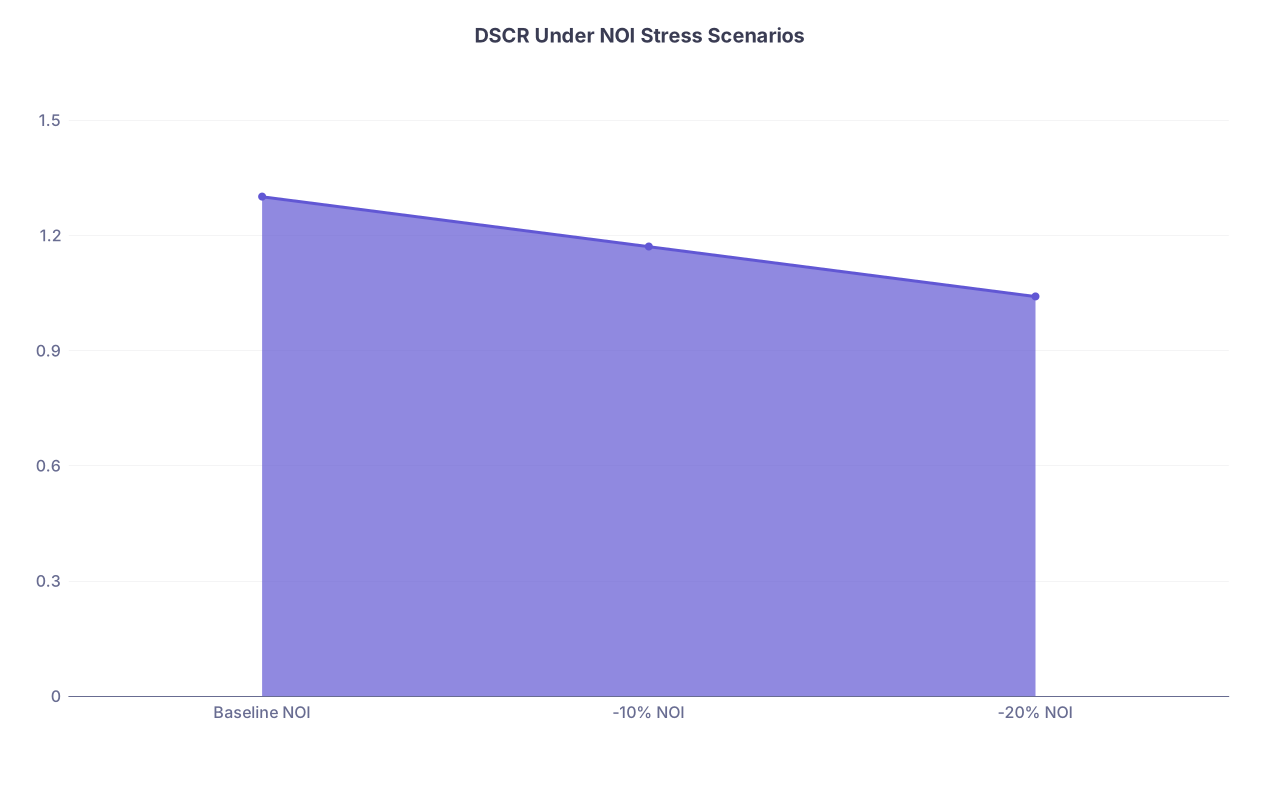
Here is a simple sensitivity test that has saved a lot of pain:
- Baseline NOI: $100,000
- Baseline DSCR: 1.30x
- Annual debt service: 100,000 ÷ 1.30 ≈ $76,923
Now:
- If NOI drops 10% to $90,000
- New DSCR = 90,000 ÷ 76,923 ≈ 1.17x
- If NOI drops 20% to $80,000
- New DSCR = 80,000 ÷ 76,923 ≈ 1.04x
So a 20% hit to NOI brings you right to the edge of not covering your debt. That is before you pay yourself, before capital expenditures, before taxes.
You can visualize this:
| Category | Value |
|---|---|
| Baseline NOI | 1.3 |
| -10% NOI | 1.17 |
| -20% NOI | 1.04 |
If looking at that line makes you uncomfortable, you are finally thinking like a lender.
How To Use Your Physician Profile Without Ignoring DSCR
Your income and profession are not irrelevant. They just matter differently:
- They can help you secure recourse loans at better rates.
- They can make lenders comfortable with temporary DSCR shortfalls during construction or lease-up.
- They often reduce friction at the credit committee stage.
But the property still has to stand on its own, especially for:
- Long-term, non-recourse, or agency debt.
- Portfolio-level financing as you scale beyond 2–3 assets.
Smart physician investors embrace this. They treat DSCR not as an obstacle, but as a discipline filter. Deals that cannot produce 1.25x–1.35x coverage at realistic assumptions are simply not worth the time.
With this DSCR lens in place, you are ready for the more nuanced questions: recourse vs non-recourse, loan covenants, and what happens if coverage slips mid-loan. Those are the next layers of the game—and they matter a lot more once you stop assuming your MD will pay the mortgage for you.
FAQ (Exactly 5 Questions)
1. Is there a “typical” DSCR lenders expect specifically from physicians?
No. For investment properties, physicians are underwritten almost identically to other borrowers. The property DSCR thresholds—usually 1.25x or higher—do not change much based on your profession. You might get a slightly better rate or more flexibility on recourse, but coverage minimums barely move.
2. Can my high W-2 income compensate for a low DSCR property?
In the short term, yes—you can subsidize a weak property with personal income. But most commercial lenders will not underwrite long-term permanent debt on a property with chronic DSCR below their minimum. They will view it as business risk, not an income hiccup, regardless of your salary.
3. How does DSCR interact with loan-to-value (LTV)?
In practice, DSCR usually caps your loan size before LTV does on stabilized deals. You might see marketing that says “up to 75–80% LTV,” but if your NOI is modest or rates are high, your DSCR limit can hold you to 60–70% LTV instead. Always calculate both and use the lower loan amount.
4. Are DSCR loans (like DSCR-based investor loans for rentals) good tools for physicians?
They can be, especially for small residential portfolios, but the same math applies. Those lenders still require minimum DSCR (often 1.15x–1.25x). They may underwrite more aggressively on income assumptions, and rates tend to be higher than bank financing. You trade some cost and flexibility for speed and reduced income documentation.
5. What DSCR should I personally target as a physician real estate investor?
I tell conservative physicians to underwrite to at least 1.30x–1.35x at realistic NOI and current market interest rates. If a deal barely squeaks to 1.20x on your own rosy spreadsheet, it will likely fall short under lender underwriting. Aiming higher protects you against rate shocks, vacancies, and reimbursement pressure while keeping lenders firmly on your side.