
The real estate contract you sign at midnight after call can cost you more than a malpractice suit.
Physicians get eaten alive by real estate clauses they barely read. Not because you are unintelligent. Because you are tired, busy, and you assume the “standard contract” is fair. It is not. It is written to protect the broker, the seller, the developer, or the syndicator. Not you.
Let me walk you through seven contract clauses that routinely trap doctors – and how to avoid becoming an easy target.
1. Personal Guarantees That Quietly Put Your Future Earnings on the Hook
This is the clause that has wrecked more high‑income professionals than any cap rate miscalculation.
In commercial loans, partnership agreements, triple‑net lease deals, and some “doctor‑friendly” developments, lenders and sponsors love personal guarantees. The language looks sterile:
“Borrower hereby unconditionally and irrevocably guarantees the full and prompt payment and performance of all obligations…”
Translation: If the deal fails, they can come after your personal assets and future wages. You thought you were investing $100K. The contract quietly made your entire career collateral.
Common physician mistakes:
- Signing joint and several personal guarantees with other investors
- Assuming personal guarantees are “just boilerplate” and not negotiable
- Letting an LLC give a guarantee that is then tied back to you individually
Here is how this typically plays out. A group of eight physicians invests in a small surgical center building. Bank requires joint and several guarantees. The project underperforms, the loan is called. Three physicians are already out of the group and broke. The bank sues all eight but actually chases the two highest earners. Congratulations: you are paying more than your “share” because you have the most to lose.
Red flags in the contract:
- “Joint and several liability”
- “Unconditional and irrevocable” guarantee
- Any language where you, by name, or your revocable trust, guarantees the loan
Safer alternatives:
- Non‑recourse loans (with only standard “bad boy” carve‑outs)
- Limited guarantees capped at your investment amount or a fixed dollar amount
- Pro rata guarantees – explicitly limiting liability to your ownership percentage
If the sponsor or lender refuses to discuss anything but a full personal guarantee, ask yourself why this deal needs your medical income as a backstop. Busy physicians overestimate the safety of the underlying asset and underestimate the risk of the guarantee. That is backwards.
2. “As‑Is” and Inspection Clauses That Turn Due Diligence into a Fantasy
The most expensive words in real estate for physicians: “as‑is, where‑is, with all faults.”
You see those words, skim past them, and rely on a brief inspection summary that fits into one PDF your broker emailed you. Then a year later you are dealing with:
- Foundation issues that were “visually obstructed”
- Environmental contamination you did not test for
- Roof, HVAC, or structural problems that exceed your total cash flow for years
The trap is not only the as‑is language. It is the combo punch:
- As‑is clause
- Cramped inspection window (7–10 days)
- Clauses that make it hard or expensive to back out
Busy physicians do the predictable thing: they outsource everything to a general home inspector or a cursory property condition report and assume that is “standard diligence.” It is not, especially for:
- Old buildings
- Former industrial properties
- Any property with medical, dental, or lab use (biohazards, imaging, gases, etc.)
Watch specifically for clauses like:
- “Buyer acknowledges that Buyer has had sufficient opportunity to inspect…”
- “Buyer relies solely on Buyer’s own investigation…”
- “Seller makes no representations or warranties whatsoever…”
If your schedule means you cannot personally walk the property thoroughly, then you need more protection, not less.
Avoid these mistakes:
- Accepting a 7‑day inspection window because the agent says “this market is competitive”
- Not ordering: sewer scope, roof inspection, environmental report (Phase I at minimum for commercial)
- Failing to tie inspection findings to automatic price reduction or termination rights
You want clear contract text that lets you walk away for any reason within the inspection period and recover your entire earnest money. If the clause limits you to “material structural defects only” or similar vague language, you will end up arguing in court about what “material” means. From a hospital workroom. On your post‑call day. Do not do this to yourself.
3. One‑Sided Assignment and Exit Restrictions That Lock You In
Physicians love the idea of “optionality” and “passive” exits. The contracts often do not.
Buried midway down the agreement you will see:
“Buyer shall not assign this Agreement without Seller’s prior written consent, which may be withheld in Seller’s sole and absolute discretion.”
or in syndications:
“No Member may transfer or assign any interest without the prior written consent of the Manager…”
That sounds harmless. Until:
- You need to move quickly for a new attending job across the country
- Your practice merges and no longer needs the building
- You want to move your ownership interest into a different entity or trust
The assignment and transfer clauses can block:
- Moving the property into a new LLC
- Selling your share to a partner or another physician
- 1031 exchanges when the timing is tight and the counterparties are picky
Here is the part many doctors miss: The sponsor or seller usually retains broad assignment rights. Meaning:
- They can assign the contract to another entity they control
- They can sell the whole package to another fund
- They can change who you are really in bed with, without your consent
So you are locked in. They are not.
Red flags:
- Consent to assign can be “withheld in sole and absolute discretion”
- Any transfer triggers forced buyback at a discount or automatic forfeiture
- No carve‑outs for transfers to family trusts, disregarded entities, or estate planning
If a contract prevents you from reorganizing your affairs for asset protection and estate planning, it is not physician‑friendly. It is lazy, sponsor‑friendly lawyering, and you are the one who pays for it.
Ask for at least:
- Automatic approval for transfers to entities you control and your estate planning structures
- Reasonable consent standards: consent “not to be unreasonably withheld, conditioned, or delayed”
- For partnership interests, clear procedures for voluntary exit, valuation, and timelines
Never assume you can “just get out later” if things go sideways. If it is not written, it does not exist.
4. Capital Call and Dilution Clauses That Quietly Punish Your Busy Schedule
You think you are writing a one‑time check. The contract quietly says otherwise.
In many physician‑targeted syndications, development deals, and medical office buildings, you will see language like:
“Members agree to fund additional capital contributions as may be required by the Manager from time to time…”
And then, a few paragraphs later:
“In the event any Member fails to contribute its share of any Capital Call, the Manager may, at its option, (a) treat such failure as a loan bearing interest at [high rate], or (b) dilute the defaulting Member’s interest…”
This is how physicians end up:
- Having their equity cut in half because they missed an email during a brutal ICU month
- Owing “default interest” to other investors because they did not wire funds within 5 business days
- Effectively forced to throw good money after bad to avoid ugly dilution
Busy schedules make you the easiest target in these structures. The manager knows very few investors will truly track:
- Every capital call email
- Every 10‑day funding deadline
- Every amendment that quietly increases required contributions
Look carefully for:
- No hard cap on total possible capital calls
- Rights for the manager to “unilaterally determine” amount and timing
- Penalty clauses that are wildly disproportionate to the missed contribution
If you are still in training, early attending years, or building a family, unlimited capital call risk is irresponsible. You do not control hospital closures, payer mix changes, or construction delays. Yet the contract might treat your inability to fund a surprise $50K call as a moral failure instead of a rational decision.
Protect yourself by:
- Only joining deals where capital calls are capped, or where your maximum additional contribution is clearly defined in writing
- Requiring reasonable notice periods (30 days, not 5–7 business days)
- Ensuring dilution formulas are clearly spelled out and not punitive
If the sponsor insists on unlimited capital call powers “for flexibility,” what they are really saying is they want to be able to use your balance sheet as an emergency ATM. Decline the honor.
5. Management and Fee Clauses That Turn “Passive” Into Expensive and Powerless
Physicians are magnets for “turnkey” and “hands‑off” language. That is exactly why so many predatory deals are stuffed with opaque management and fee clauses.
Here is the usual pattern:
- Asset management fee: 1–2% of assets annually
- Property management fee: another cut of gross income
- Acquisition fee: 1–3% upfront
- Disposition fee: when they sell
- Construction management fees, refinance fees, sponsor promotes, and more
Then they wrap it all in a structure where:
- The manager has broad discretion to spend project funds
- Reporting is minimal or optional
- Your voting rights are essentially ceremonial
You end up bearing the risk, they skim the fees, and the contract gives them cover.
Common language to watch:
- “Manager shall have sole and absolute discretion…” over key decisions
- “Fees may be adjusted from time to time without Member consent…”
- “Members acknowledge that conflicts of interest may exist…” with no real mitigation
Put bluntly: if you see a stack of fees and near‑zero investor control, you are not investing. You are subsidizing someone else’s lifestyle.
Take an extra two minutes and do this:
- List every explicit fee in the contract.
- Ask the sponsor: “What fees can you earn that are not listed here?”
- Ask: “Under what exact conditions can you be removed as manager?”
If the answer to #3 is “basically never unless we commit overt fraud,” you are handing over control of your capital with no real recourse.
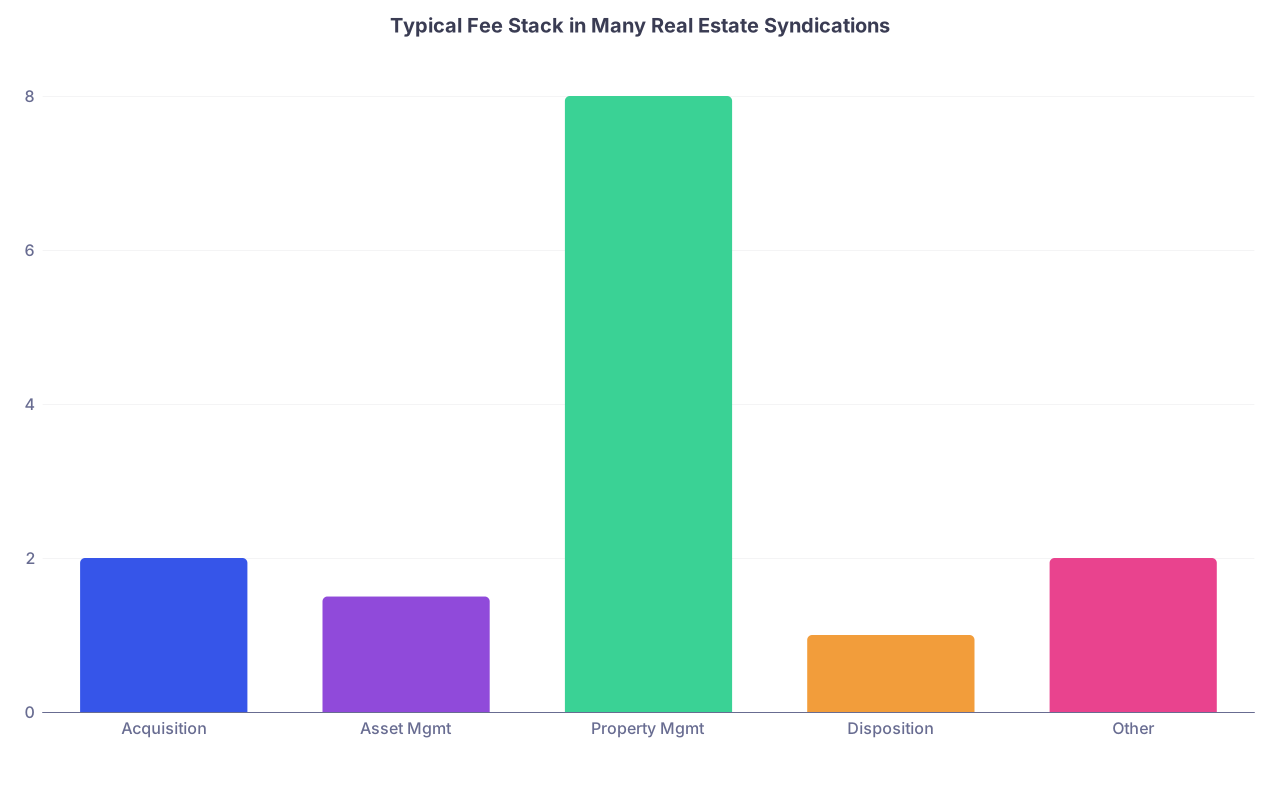
| Category | Value |
|---|---|
| Acquisition | 2 |
| Asset Mgmt | 1.5 |
| Property Mgmt | 8 |
| Disposition | 1 |
| Other | 2 |
In that example, 10–15% of gross income can be drained before you see anything meaningful. I have seen physicians shocked that “cash flow is low” while every other party has been paid handsomely and on time. The contract allowed it. Your signature endorsed it.
You do not need zero fees. You do need transparency and alignment:
- Performance‑based compensation rather than stacked fixed fees
- Clear removal rights for persistent underperformance or misconduct
- Hard limits on related‑party transactions (e.g., manager hiring their own company at inflated rates)
If you cannot explain to a co‑resident or partner how the manager gets paid in under 60 seconds, you do not understand the deal. And if you do not understand the deal, the person who wrote the contract has home‑field advantage.
6. Dispute Resolution, Venue, and Indemnity Clauses That Make You Powerless When Things Go Wrong
Real estate contracts are written by people who assume conflict will eventually happen. Smart sponsors and sellers prepare for that. Less ethical ones weaponize it.
Three areas physicians routinely ignore:
- Mandatory arbitration clauses
- Venue and governing law clauses
- Indemnity provisions
Let’s take them one by one.
Mandatory Arbitration
You will see lines like:
“Any dispute arising out of or related to this Agreement shall be resolved by binding arbitration administered by [provider]…”
Sounds efficient. Faster, cheaper, right? Not necessarily.
Problems:
- You lose the right to a jury, formal discovery, and public record
- Many arbitration organizations historically skew toward repeat players (guess who that is – not you)
- Appeal options are almost nonexistent
If the sponsor chooses the arbitration body and location, and you live two time zones away, you just agreed to fight on their turf, under their rules, with limited tools.
Venue and Governing Law
Buried near the end:
“This Agreement shall be governed by the laws of the State of [far‑away state] and any action shall be brought exclusively in the courts located in [their city].”
That means if something truly ugly happens, you are hiring an out‑of‑state attorney, taking time off clinic, and spending money just to gain minimal leverage. Many physicians simply will not bother. That is the point.
Indemnity
The nuclear bomb:
“Investor agrees to indemnify and hold harmless the Manager from any and all claims, losses, damages, and expenses arising out of the investment…”
Sloppy or aggressive drafts try to make you indemnify them even for their own negligence or misconduct. That is insane. Yet physicians sign it every week.
You should never indemnify a manager or sponsor for:
- Their fraud
- Their gross negligence
- Their willful misconduct
And the contract should say so explicitly.
At minimum, push for:
- Mutual indemnities (you each stand behind your own actions)
- Venue that is not entirely one‑sided
- The right to seek injunctive relief in court even if arbitration is required for money damages
If the sponsor’s entire business model collapses when terms are fair, they are not running a serious operation.

| Step | Description |
|---|---|
| Step 1 | Problem Noticed |
| Step 2 | Send Written Notice |
| Step 3 | Consult Attorney |
| Step 4 | Prepare for Arbitration |
| Step 5 | Consider Court Filing |
| Step 6 | Evaluate Cost vs Claim |
| Step 7 | Decide - Pursue or Settle |
| Step 8 | Review Contract |
| Step 9 | Contract Says Arbitration? |
You do not want to discover your rights at this stage. You want to know them before you sign.
7. Buy‑Sell, Valuation, and Waterfall Clauses That Rig the Payouts Against You
Everyone obsesses over purchase price. Far fewer physicians study the exit math.
In partnerships, operating agreements, and syndications, the nastiest surprises live in:
- Buy‑sell provisions
- Valuation formulas
- Waterfall (distribution) clauses
This is where sponsors quietly move the goalposts.
Buy‑Sell and Forced Buyouts
Sample trap language:
“In the event of a Member default, the Manager may purchase the defaulting Member’s interest at the lesser of (a) capital account balance, or (b) appraised value less 30% discount…”
Imagine being forced out during a down year, when temporary market conditions slash value. The manager scoops your interest at a discount, then holds until recovery. You just funded their future upside and got pennies.
Valuation Tricks
Watch for:
- Single‑appraiser valuations chosen by the manager
- Discounts that are automatic and large (20–30%)
- Use of book value instead of market value
You did not work nights and weekends to sell your position at accounting value.
Waterfall Clauses
Physicians love seeing “preferred return 8%” in the glossy pitch deck. Then they never read the actual waterfall:
- Is it cumulative? Non‑cumulative?
- Does it accrue if unpaid?
- Do fees get paid before or after preferred return?
- When does the sponsor promote (their profit share) actually kick in?
I have seen deals where, in practice:
- Preferred return sounds good but is non‑cumulative and easily missed
- Sponsor collects their promote while investors are still negative if you factor in risk and time
- Exit waterfall prioritizes repayment of internal loans and fee reimbursement before meaningful investor gains
Here is a simple reality: if you cannot trace, with a pen, who gets what dollar at each stage of performance (poor / base case / upside), you are not qualified to judge that investment. That is not an insult. That is just how stacked these agreements can become.

Where Physicians Need to Tighten Their Process
The consistent problem is not intelligence. It is process.
Physicians rush, trust, and delegate too early, then sign documents that would make a securities attorney wince. You cannot out‑earn a aggressively one‑sided contract.
Use a simple discipline before you sign any real estate contract, whether it is a single‑family rental, a clinic condo, or a private syndication:

| Step | Description |
|---|---|
| Step 1 | Receive Contract |
| Step 2 | Wait 24 Hours |
| Step 3 | Skim for 7 Trap Categories |
| Step 4 | Mark Clauses to Question |
| Step 5 | Send to Real Estate Attorney |
| Step 6 | Still Consider Attorney |
| Step 7 | Negotiate Changes |
| Step 8 | Decide - Sign or Walk Away |
| Step 9 | Deal Size > 20k? |
The 7 categories you now know to flag immediately:
- Personal guarantees
- As‑is and inspection language
- Assignment / transfer restrictions
- Capital call and dilution terms
- Management control and fees
- Dispute resolution, venue, indemnity
- Buy‑sell, valuation, waterfall mechanics
Do not outsource reading the contract. Outsource interpreting and negotiating it. Those are different things.
For deals larger than what you would tolerate losing completely, pay a real estate attorney who works with investors regularly. Not your friend who does estate planning. Not a random litigator. Someone who has actually seen these investment structures in the wild and knows where the bodies are buried.
| Clause Type | Risk Level | Who It Usually Favors |
|---|---|---|
| Personal Guarantees | Very High | Lender / Sponsor |
| As-Is Language | High | Seller |
| Capital Calls | High | Manager / Other Investors |
| Assignment Limits | Medium | Seller / Sponsor |
| Fee Structures | Medium | Manager / Broker |
| Arbitration & Venue | Medium | Repeat Player (not you) |
| Waterfall Terms | High | Sponsor / GP |

The Bottom Line: 3 Things to Remember
- Contracts are where you actually make or lose money. Not the webinar. Not the pro forma. The clauses.
- Your medical income makes you a prime target for guarantees, capital calls, and lopsided control. Do not co‑sign your future to someone else’s spreadsheet.
- If you are too busy to read and question the contract, you are too busy for that deal. Miss the investment rather than lock yourself into a bad one.