
The way senior partners protect their rental properties with LLCs is not what your CPA’s brochure says. It’s more layered, more strategic, and a lot less “one LLC per property” than the internet gurus keep preaching.
Let me walk you through how the people signing seven-figure K-1s actually do this—what they say in partner meetings and off-the-record calls with their asset protection attorneys.
The first lie: “Just put it in an LLC and you’re protected”
Here’s the part no one tells you: an LLC is a container, not a force field.
I’ve sat in rooms where physicians said, “It’s fine, it’s in an LLC,” and the senior partner across the table quietly raised an eyebrow. Because the attendings who’ve been sued know:
- If your personal name is on the loan, the bank still has you.
- If you commingle funds, your “LLC” is paper only.
- If you manage everything like a hobby, a decent plaintiff attorney will walk right through it.
Most junior physicians think the decision is: “Should I use an LLC or not?” That’s the wrong question. The real questions the senior partners ask are:
- Where do I want liability to stop?
- What assets do I absolutely not want exposed?
- How much administrative pain am I realistically going to manage every year?
Their LLC structure is built around those three, not around Instagram advice.
How the first rental is actually structured
Let’s start with one or two properties. This is where most physicians overcomplicate things or, worse, do nothing.
Here’s the real behind-the-scenes pattern I see among senior partners with 1–3 rentals:
- Property is purchased in personal name to get the best residential loan terms.
- Immediately after closing, title is transferred to an LLC that they own.
- The lender either doesn’t care, looks the other way, or has a “no due-on-sale trigger if you keep making payments” culture. (Yes, banks say one thing on paper and another in practice.)
They do not waste time forming some Delaware series structure for a single $400k rental. They do a simple, well-run, single-member LLC—but they run it like a real business.

Here’s what that usually looks like:
- A state-level LLC (often in their home state, not Nevada/Wyoming) holds title.
- Separate bank account in the LLC name.
- Leases are in the LLC’s name, not the physician’s.
- Landlord insurance is written for the LLC as named insured.
- They keep a clean paper trail: minutes once a year, updated operating agreement if ownership changes, formal documentation of capital contributions and distributions.
The secret is less about the logo on the top of the document and more about the behavior that makes the entity defensible in court.
You’d be shocked how many physicians I’ve watched lose the benefit of an LLC because rent went into a joint personal account “just this one time” for two years straight.
When they stop using just one LLC
The question you’re really asking is, “When do senior people stop putting everything in one bucket?”
I’ll tell you how they talk about it behind closed doors.
In a partner meeting I sat through, one of the senior radiologists laid it out like this: “I’m comfortable with about $1–1.5M in equity per LLC. Above that, we split.”
They don’t care about number of doors. They care about:
- Total property value under one LLC
- Equity exposed under one LLC
- Risk profile of the properties (class C versus class A, student rentals versus long-term families)
So a typical inflection point looks like:
- 1 rental: 1 LLC
- 2–4 rentals: maybe still 1 LLC (if modest equity, low-risk tenants, all in same state)
$1–2M equity or higher-risk tenants: they start segregating into more LLCs
It’s not a strict formula, but there’s a pattern: legal risk divided by admin headache.
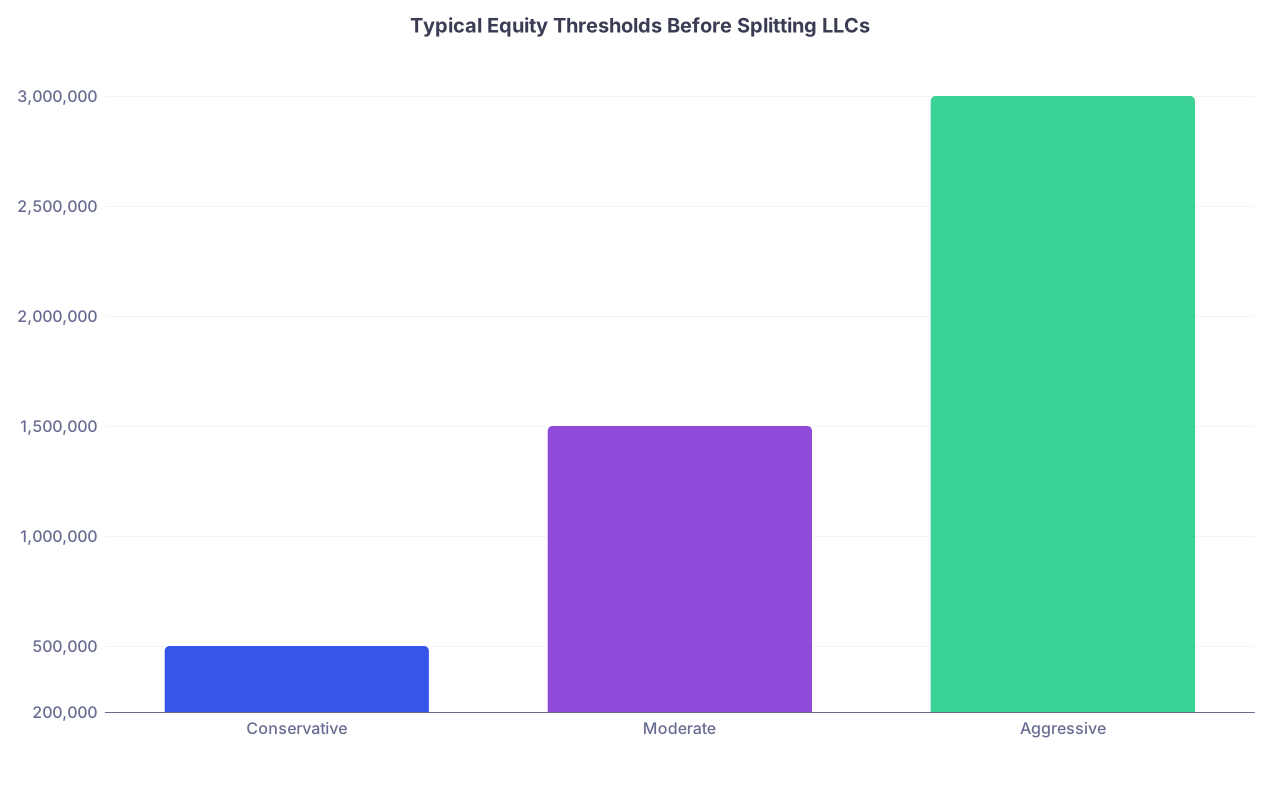
| Category | Value |
|---|---|
| Conservative | 500000 |
| Moderate | 1500000 |
| Aggressive | 3000000 |
The rookie move is creating an LLC for each $250k condo, then drowning in fees, annual reports, and tax prep. The senior move is clustering smartly, not obsessively.
Holding company vs property LLCs: how they really stack entities
You’ve probably seen the pretty diagrams: holding company at the top, multiple LLCs under it. Here’s how that actually plays out for physicians with real assets.
Most of the senior partners end up with two layers:
- A holding company LLC (often in their home state or a “privacy” state like Wyoming, if their attorney actually knows what they’re doing)
- One or more property LLCs that directly own the real estate
The key thing: the holding company doesn’t own the properties. It owns the membership interests in the property LLCs.
So functionally:
- Property LLC A: owns 3 single-family homes in State X
- Property LLC B: owns a small 8-unit in State Y
- Holding LLC: owns 100% of LLC A and B
- You (and maybe spouse): own the holding LLC, sometimes via a trust
| Layer | What It Owns | Purpose |
|---|---|---|
| Personal/Trust | Holding LLC membership | Estate + privacy |
| Holding LLC | Membership in property LLCs | Central control, anonymity |
| Property LLC(s) | Actual rental properties | Liability containment |
Why do they bother with the holding company?
Because once you’re at 5–10 properties, changing ownership or gifting interests is much easier at the holding level than redoing deeds for each property. And if they want partners or kids involved, they just carve out membership units at the holding company, not at the property deed level.
Also, it gives them a clean separation:
- They manage, bank, and record everything at the property LLC level.
- They plan, allocate ownership, and do estate maneuvers at the holding level.
“One LLC per property” – why senior people roll their eyes
This is the part the attorneys in fancy suits won’t put on their websites, but they’ll admit over lunch.
The “one LLC per property” religion is often overkill unless you’re:
- Doing high-risk use properties (student housing, halfway houses, short-term rentals with constant turnover)
- Operating in very plaintiff-friendly jurisdictions
- Sitting on huge equity in each asset
I’ve watched real conversations like this:
Younger doc: “I set up eight LLCs for my eight doors.”
Senior partner: “So you’re paying eight annual fees, eight returns, and you still have your name plastered on every loan?”
That’s the reality. Every entity has:
- State filing fees (some states are nasty—California, I’m looking at you)
- Annual reports / franchise taxes
- Separate bookkeeping
- Possible separate tax returns (even disregarded entities still create complexity)
The senior partners tend to cluster properties by:
- State (you don’t mix Florida and Ohio in one LLC)
- Type (long-term rentals separate from short-term/Airbnb)
- Risk profile (student housing in one bucket, stable residential in another)
So you might see something like:
- “Sunbelt Residential LLC” – holds 4 long-term rentals in Texas
- “Midwest Value-Add LLC” – holds 6 units in Ohio
- “Short-Term Rentals LLC” – holds 3 Airbnbs in one market
Not 13 tiny LLCs. Three well-run ones.
The malpractice shadow: why physicians structure differently
Let me be blunt: your biggest threat is not the slip-and-fall at your rental. It’s the plaintiff attorney coming after you for a bad outcome in clinic.
Senior physicians understand this. That’s why they don’t hold rentals in their personal name once they’re beyond their first or second property. They know how discovery works.
In a malpractice case, opposing counsel is going to look at:
- Personal assets
- Real estate holdings
- Anything suggesting you’re “rich” and a juicy target
This is why the smart seniors:
- Keep their personal name off recorded property ownership where possible
- Use entities that don’t scream “high net worth physician”
- Avoid titling everything as “Dr. John Smith Family Holdings LLC”
They’ll quietly use something neutral: “Red Oak Properties LLC.” You’d never know a cardiologist owns it.
Some go further:
- They have a living trust own the holding LLC.
- The trust is named in a boring, non-identifiable way.
- Public records show a trust or generic LLC, but not “Dr. So-and-So.”
Is it bulletproof? No. But it changes the optics and the initial asset search. And in the real world, optics affect aggression.
The insurance + LLC combo senior partners insist on
Here’s the dirty secret: if your structure isn’t backed by serious insurance, program directors, partners, and attorneys who’ve lived through lawsuits will quietly judge you as naive.
Senior physician investors always layer:
Property-level coverage
Each property LLC has robust landlord insurance naming the LLC as insured.Umbrella policy
$2–5M umbrella on top, sometimes tied to personal, sometimes a separate commercial umbrella.Legal structure
The LLC is the last line of defense, not the first.
They think in layers:
- First, the tenant sues → insurance responds.
- If the judgment exceeds coverage, plaintiff goes after the LLC.
- If they manage the LLC correctly, it stops there. It doesn’t reach your personal house and retirement accounts.
Don’t skip insurance because you “have an LLC.” That’s how amateurs talk. Professionals think, “My first job is to make the person whole with insurance. My second job is to firewall the damage with entities.”
Multi-state holdings: where it gets messy
Once a physician has rentals in multiple states, the structure conversation changes. You can’t just “use one Delaware LLC for everything” and pretend state law doesn’t exist. Senior people know this. They’ve had the calls with lawyers after some poor soul tried that shortcut.
For a property in State A, you have two real options:
- Form the LLC in State A where the property physically sits.
- Or form it elsewhere, then register it as a foreign LLC doing business in State A.
Either way, State A is going to get jurisdiction and their pound of flesh in fees.
So what do senior partners do?
- They usually form property LLCs in the property’s state; it simplifies everything with local banks, title companies, and courts.
- Then, if they use a holding company in a different state (Wyoming, Nevada), that holding company just owns the membership interests. It’s not “doing business” where the property sits.
You’ll see setups like:
- Wyoming holding LLC
- Texas property LLC – owns TX rentals
- Georgia property LLC – owns GA rentals
That’s not theory—that’s exactly what some of your senior colleagues are quietly following.
How they integrate LLCs with estate planning
Here’s where young physicians are usually completely in the dark. The LLC structure isn’t just about lawsuits. It’s about who ends up with the assets when you’re not here.
Senior partners who’ve done their estate planning use LLCs as units of transfer, not just buckets of liability.
Example of what I’ve actually seen:
- Revocable living trust owns the holding LLC.
- The holding LLC owns all the property LLC interests.
- They create “units” or “shares” of the holding LLC, like 10,000 membership units.
- Over years, they gift or assign some units to children or family trusts, sometimes using valuation discounts.
The benefit?
- No need to change property deeds every time they adjust who owns what.
- Rental operations stay exactly the same at the property LLC level.
- All the estate maneuvering happens at the holding-company-ownership level.
Attorneys who work with serious real estate physicians all steer them here once their portfolio crosses a few million in value. It’s not about being fancy. It’s about being flexible.
What they do not bother with (that you’ve probably heard about)
Let me cut through some popular nonsense I’ve seen pitched hard to physicians:
- Offshore entities for standard US rentals – almost never used by serious, practical physician landlords. Massive complexity, ugly optics in litigation, and overkill for $2–5M portfolios.
- Complex series LLCs across multiple states – they’re occasionally useful, but most states don’t treat them cleanly, and your average CPA doesn’t understand them. Senior partners avoid being beta testers for untested structures.
- Shell games they do not maintain – if the entity structure is too complex to actually respect (separate accounts, records, meetings), it’s worse than useless. It gives false confidence and cracks easily.
The senior move is boring, repeatable, and maintainable. That’s the part people don’t like to hear.
A simple “starter to seasoned” progression
Here’s a realistic arc I’ve seen repeatedly among physician partners over 10–15 years.

| Step | Description |
|---|---|
| Step 1 | First Rental in Personal Name |
| Step 2 | Single Member LLC for That Property |
| Step 3 | Add 2-4 Rentals in Same State to Same LLC |
| Step 4 | Create Second LLC for Different State or Higher Risk |
| Step 5 | Form Holding LLC to Own Property LLCs |
| Step 6 | Integrate Holding LLC with Living Trust |
You do not need to start at step E. The ones who last build up gradually, revisiting the structure at meaningful portfolio milestones:
- After first property
- Around 3–5 doors
- When crossing $1–2M equity
- Before any major partnership or syndication involvement
- Before serious estate planning adjustments
If your structure hasn’t changed since your first duplex but your net worth has tripled, you’re behind.
FAQs
1. Do I really need an LLC for my very first rental?
If you’re a physician, I’d say yes more often than not. You already have elevated lawsuit exposure from your day job. Even with one rental, I’d strongly prefer you use a simple single-member LLC, run properly, plus good insurance. Will some people hold the first in their name? Sure. Are they intentionally accepting risk most senior partners will not accept? Also yes.
2. Is it safer to put my spouse as the owner of the LLC and keep my name off?
People do this all the time, but it’s not magic. In community property states, that “separation” can be more illusion than reality. Plaintiffs can still argue that the rental income supports your household. That said, some senior physicians do use non-physician spouses as the visible member or manager, especially for optics. Just do it with a real attorney, not based on bar talk.
3. Does a Wyoming or Nevada holding company make sense for a small portfolio?
Not at the beginning. For one or two properties, a fancy out-of-state holding company is usually hobby cosplay. Once you’ve got multiple property LLCs and a few million in value, then maybe a Wyoming holding company comes into play for privacy and charging order protection. Until then, your time and money are better spent on clean books, proper insurance, and a solid operating agreement.
4. What’s the biggest mistake physicians make with LLCs and rentals?
They form the LLC, then ignore it. They mix personal and rental money, sign leases in their own name, let the insurance sit in their personal name, never do minutes or update documents, and think the three letters alone will save them. Plaintiffs love that. A sloppily run LLC is almost worse than none, because you’ll be blindsided when it doesn’t hold up.
5. When should I involve a real estate attorney versus just using an online LLC service?
If you’re a physician with malpractice exposure, I’d involve a real estate/asset-protection attorney from the first property if you can afford it. At absolute minimum, once you hit 3–4 doors or cross $1M in total value, you should stop DIY-ing this. Senior partners are not using $99 boilerplate for seven-figure structures. They pay for tailored work once the numbers get real.
Two things to remember: first, the LLC is just one layer; the real protection comes from the combination of structure, behavior, and insurance. Second, mimic what the quiet richest physician in your group is doing, not what the loudest “investor” in the residents’ lounge is bragging about. Senior partners build structures they can actually run for 20 years. You should too.