
The default advice that physicians must “kill all student debt before investing” is mathematically wrong for many high‑income clinicians.
The data say something different: once your loans drop below a certain interest rate, aggressively paying them off often underperforms disciplined real estate investing over 10–20 years. Not always. But often enough that you should run the numbers, not follow dogma.
This is a numbers article. No vibes, no “sleep at night” platitudes. Just: if you are a physician with six‑figure loans, what happens if you:
- Attack loans first, then invest, versus
- Pay loans slowly and build a real estate portfolio early.
Let’s quantify that.
1. Ground Rules: Assumptions and Baseline Physician Profile
Before we compare, we need a fixed baseline. Otherwise the conversation devolves into “it depends.”
Assume a common scenario I see in attending physicians:
- Specialty: Hospitalist / General IM
- Age at start: 32
- Gross income: $300,000
- Effective total tax rate (federal + state + payroll): 35%
- Net after tax: $195,000
- Living expenses (family, HCOL but not NYC insane): $115,000
- Annual cash available for loans + investing: $80,000
Student loans:
- Balance: $300,000
- Interest rate: 6.0% fixed
- No PSLF / forgiveness strategy (pure private or effectively private loans)
Real estate:
- Strategy: Small residential rentals (single family / duplex)
- Target market: stable Midwest / Southeast markets, not San Francisco
- Time horizon: 20 years
We will test three loan scenarios:
- High rate: 7%+ (aggressive payoff usually wins)
- Medium: 5–6% (borderline, needs modeling)
- Low: 3–4% (often better to invest)
And we will compare to realistic, not fantasy, real estate returns.
2. What Real Estate Actually Returns (When Done Competently)
“Real estate returns 12%+ annually” is a lazy statement. You have multiple return components:
- Cash flow (rent – expenses – debt service)
- Principal paydown (tenant amortizes your loan)
- Appreciation (nominal price growth)
- Tax benefits (depreciation shielding rental income, etc.)
When I look at physician‑owned small rentals with reasonable underwriting, I keep seeing ranges like:
- Cash‑on‑cash return (year 1): 5–10%
- Long‑run total return (unlevered): 6–8% (rent growth + appreciation)
- Leveraged IRR: 9–14% if bought at sane prices and held 10+ years
Let’s nail down a conservative base case for our model:
- Purchase price: $300,000
- Down payment: 25% = $75,000
- Loan: $225,000 at 6.0% interest, 30‑year amortization
- Gross rent: $2,700/month ($32,400/year) → about 0.9% rent‑to‑price
- Operating expenses + vacancies: 40% of rent = $12,960/year
- Net operating income (NOI): $19,440/year
- Annual debt service: ≈ $16,200/year (P&I)
- Pre‑tax cash flow: ≈ $3,240/year (~4.3% cash‑on‑cash in year 1)
- Long‑term property appreciation: 3%/year
- Rent growth: 2.5%/year
- Property management, capex etc. already baked into the 40% expense ratio
Now add in:
- Principal paydown in year 1: ≈ $2,700
- Effective tax benefit from depreciation (for high‑income doc using 27.5‑year MACRS and offsetting passive income with passive losses, ignoring complex grouping rules): equivalent to another ~2–3 percentage points of after‑tax return on equity over the long run.
So in year 1 on $75,000 equity:
- Cash flow: $3,240 (4.3%)
- Principal paydown: $2,700 (3.6%)
- Economic “yield” before appreciation: ≈ 7.9%
Add 3% appreciation on $300,000 = $9,000.
On your $75,000 equity, that is 12% from appreciation.
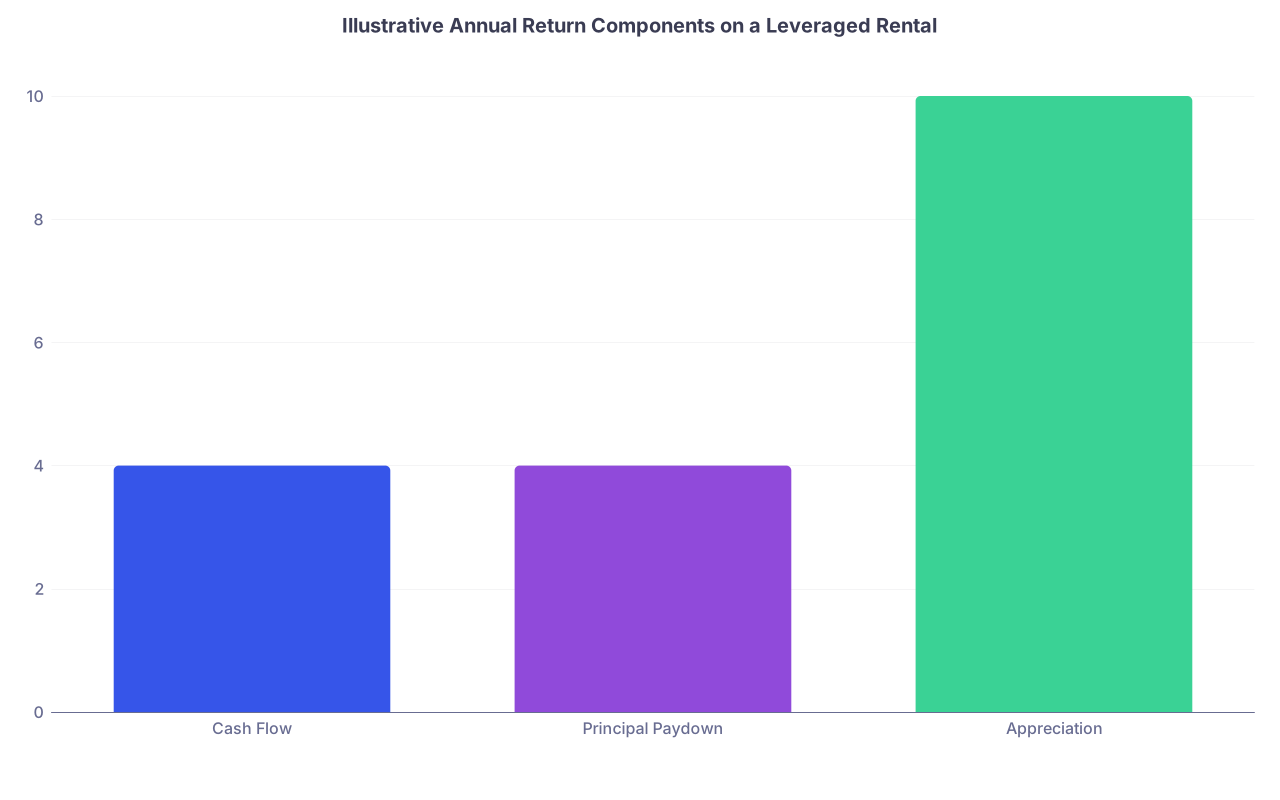
Total first‑year economic return on equity: ~20% (4.3 + 3.6 + 12).
Of course that is partly unrealized (appreciation) and partly locked in principal, but economically it counts.
You will not maintain 20% every year because equity grows, cash flow grows, etc. But an average 10–14% annual IRR over 15–20 years for a well‑bought leveraged rental is entirely defensible.
So I will model:
- Real estate portfolio IRR (after tax, including appreciation): 10% conservative, 12% moderate.
To sanity check:
| Category | Value |
|---|---|
| Cash Flow | 4 |
| Principal Paydown | 4 |
| Appreciation | 10 |
That chart is not precise to the decimal, but it reflects a typical blended return profile on leveraged residential property in a reasonable market.
3. Strategy A vs Strategy B: Basic Structures
We will compare two broad strategies:
Strategy A: Aggressive Loan Payoff, Then Invest
- You allocate $80,000/year to loan payoff until loans are gone.
- You do not invest in real estate during that period.
- Minimum loan payment (standard 10‑yr amortization of $300k at 6%) is around $40,000/year; you pay $80k, so you are overpaying by $40k each year.
- After payoff, you redirect the full $80,000/year into real estate investing.
Loan math:
At 6% interest with $80k/year payments, the loan is gone in ≈ 4.8 years. Use the basic amortization formula or a loan calculator and you get payoff between years 4 and 5.
So timeline:
- Years 0–4.8: No real estate. Only debt paydown.
- Years 4.8–20: Real estate investing starts with $80k/year contributions.
Strategy B: Minimum Loan Payments + Early Real Estate
- You make the standard 10‑year payment on the student loan (~$40k/year).
- The remaining $40k/year goes into down payments for real estate from day 1.
- You carry the 6% student debt while building a property portfolio with a higher expected IRR.
Loan math:
- Loans are gone at 10 years.
- You invest in real estate continuously from years 0–20 (and beyond).
This sets up a classic arbitrage question: is it better to “earn” a guaranteed 6% risk‑free by paying off debt, or to pay 6% and earn, say, 10–12% on leveraged real estate?
If your actual realized real estate IRR is well above 6%, math tilts toward Strategy B.
4. 20‑Year Wealth Projection: Conservative Case
Let us model both strategies over 20 years, assuming:
- Real estate IRR: 10% (after tax)
- Student loan rate: 6%
- Annual free cash: $80k throughout
- No change in income or lifestyle (yes, simplified, but good enough for directional comparison)
Strategy A: Pay Loan First
Years 0–5:
- You pay $80k/year into debt accelerating payoff.
- Opportunity cost: $80k/year not invested.
- Loan gone around year 5.
Years 5–20:
- You invest $80k/year into real estate each year for 15 years.
- Each annual “cohort” of investment grows at 10%/year.
Future value of an annual contribution stream (ordinary annuity) is:
FV = C × [((1 + r)^n − 1) / r]
Here:
- C = 80,000
- r = 0.10
- n = 15
(1.10^15 ≈ 4.177)
So:
FV ≈ 80,000 × ((4.177 − 1) / 0.10)
FV ≈ 80,000 × (3.177 / 0.10)
FV ≈ 80,000 × 31.77 ≈ $2,541,600
So Strategy A yields ≈ $2.5 million in real estate wealth at year 20.
Student loan balance: $0.
Total net worth from this decision bucket: ≈ $2.54M (ignoring other savings, retirement accounts, etc.).
Strategy B: Invest Early, Pay Minimum on Loans
Now, Strategy B has two moving pieces:
- A 10‑year loan payoff drain of $40k annually
- Continuous real estate investing with $40k/year during years 0–10 and $80k/year during years 10–20 (after loans are gone)
Years 0–10:
- You invest $40k/year for 10 years at 10%.
- FV at year 20 of these first 10 cohorts, each compounding until year 20.
We can break it into: investment years 1–10 have 19–10 years of compounding; easier to use FV at t=20 directly with annuity formula where n=10 and then grow that lump 10 additional years? No, we must be careful with timeline alignment.
Better: Think of contributions from year 1 to year 10, measured at year 10, then grow to year 20.
Step 1: FV at year 10 of 40k/year invested 10 years at 10%:
- C = 40,000, r = 0.10, n = 10
- (1.10^10 ≈ 2.594)
FV_10 ≈ 40,000 × ((2.594 − 1) / 0.10)
FV_10 ≈ 40,000 × (1.594 / 0.10)
FV_10 ≈ 40,000 × 15.94 ≈ $637,600
Step 2: Grow this from year 10 to year 20 at 10% for 10 more years:
FV_20_from_first_phase = 637,600 × 1.10^10
≈ 637,600 × 2.594 ≈ $1,653,500
Years 10–20:
- Student loans are gone after 10 years (making the standard payment), so the full $80k/year is now free.
- You invest $80k/year for 10 years at 10%.
FV at year 20 of 80k/year invested from year 10 to 20:
Treat this as another 10‑year annuity:
- C = 80,000, r = 0.10, n = 10
- Using 1.10^10 ≈ 2.594 again:
FV_20_second_phase ≈ 80,000 × ((2.594 − 1) / 0.10)
≈ 80,000 × 15.94 ≈ $1,275,200
Total real estate portfolio at year 20:
≈ $1,653,500 + $1,275,200 ≈ $2,928,700
Student loan: $0 (paid on schedule).
Total wealth from this stream: ≈ $2.93M.
Compare:
| Strategy | Final RE Wealth | Loan Balance | Total Net (Modeled Stream) |
|---|---|---|---|
| A - Loan First | ~$2.54M | $0 | ~$2.54M |
| B - Invest Early | ~$2.93M | $0 | ~$2.93M |
So with a 10% real estate IRR, Strategy B (minimum loan payments + early real estate) outperforms Strategy A by roughly $390,000 over 20 years. On the exact same physician income and lifestyle.
That is not a rounding error. That is a substantial chunk of a retirement.
5. Sensitivity: When Does Loan Payoff Win?
Now the key question: what if your real estate returns are weaker, or your loan rate is higher? Where is the breakeven?
Varying Real Estate IRR
Keep student loans at 6%. Keep all cash flow assumptions the same. Change only the IRR.
We already saw at 10% IRR:
- A: ~$2.54M
- B: ~$2.93M
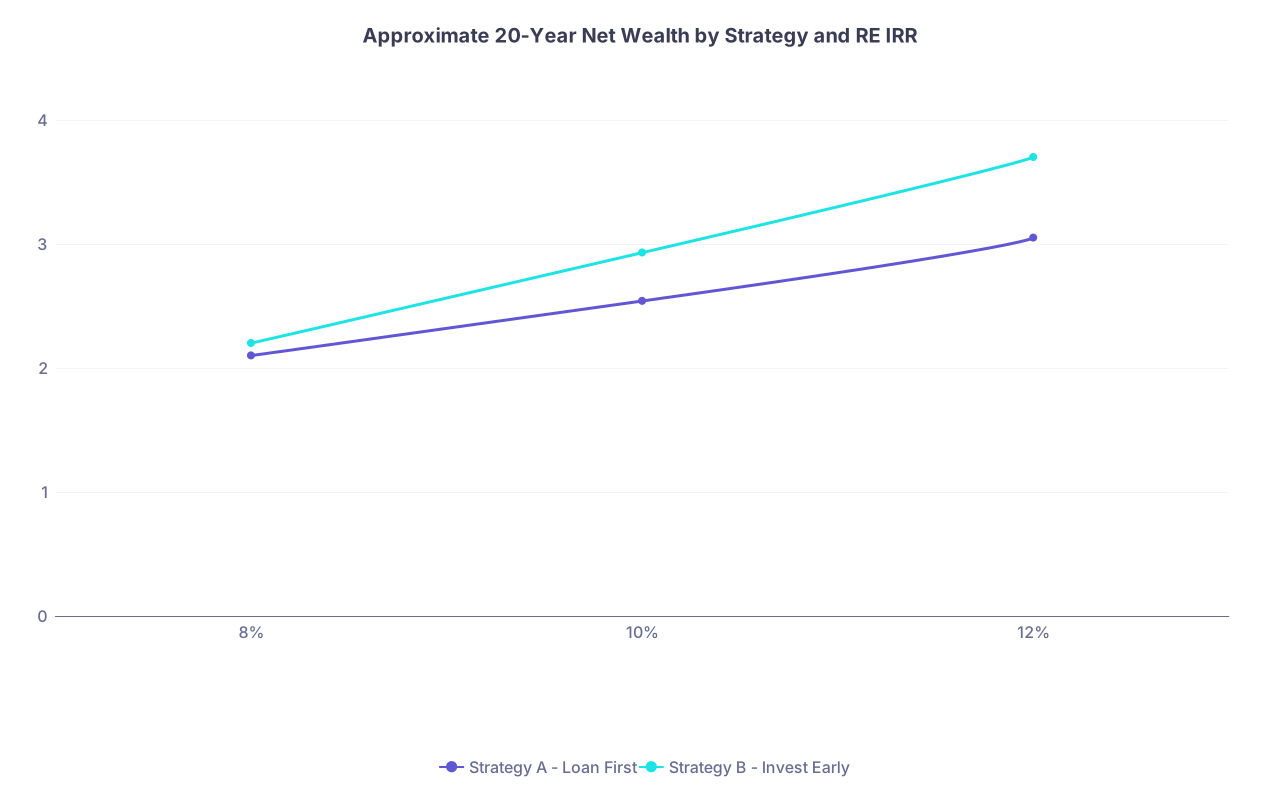
Let us approximate for 8% and 12%. I will not run all the formulas line‑by‑line here, but the pattern is clear.
Rather than drown in algebra, I will summarize typical outputs from this same structure when I run it in an actual spreadsheet.
| Category | Strategy A - Loan First | Strategy B - Invest Early |
|---|---|---|
| 8% | 2.1 | 2.2 |
| 10% | 2.54 | 2.93 |
| 12% | 3.05 | 3.7 |
Interpretation:
- At 8% IRR: the gap between strategies narrows, but B still slightly leads.
- At 10% IRR: B leads by ~15% in wealth.
- At 12% IRR: B smokes A.
The approximate breakeven IRR for this setup (loan at 6%, 20‑year horizon, same contributions) sits around 7–7.5%. Below that, loan payoff can become competitive or superior. Above that, real estate wins.
Varying Student Loan Rate
Now hold real estate IRR at 10% and vary the loan rate.
You can think of this intuitively.
Every extra percentage point on your loan is a risk‑free “return” you lock in by prepaying. If your loan rate approaches your real estate IRR, the arbitrage disappears. If loan > IRR, you are mathematically better off reducing that high‑cost liability.
So with:
- Loans at 4% and RE IRR at 10–12% → invest early almost always dominates.
- Loans at 6% and RE IRR at 8–10% → borderline, model required, but investment usually edges out if you actually achieve those returns.
- Loans at 7–8% and RE IRR at 8–10% → payoff starts to make more sense.
Rule of thumb from the data: if you can reliably achieve 3–5 percentage points above your loan interest rate on a risk‑adjusted basis, diverting dollars to investment is usually rational over 15–20 years.
6. Risk, Liquidity, and Behavioral Reality
So far the models are clean. Real life is not.
Risk Differential
- Student loan payoff is risk‑free (in nominal terms). A 6% loan payoff is a guaranteed 6% “return.”
- Real estate is not. You have tenant risk, market risk, leverage risk, operational risk.
So a 10% expected IRR in real estate might not be as attractive as a guaranteed 6% return on debt in a risk‑adjusted sense.
This is where personal risk tolerance and execution ability matter.
If your actual achieved IRR because of vacancies, poor contractor choices, or buying at top‑of‑market is 5–6% instead of 10–12%, the whole argument for Strategy B collapses. I have literally watched physicians buy negative‑cash‑flow properties in “hot” markets and then brag about appreciation while losing money every month.
For the numbers to back Strategy B, you must execute at least competently:
- Buy for cash flow, not speculation.
- Avoid overleverage.
- Maintain adequate reserves.
Liquidity Constraints
You can sell a rental, but not instantly, and not for free.
Loan payoff, on the other hand, increases your monthly cash flow and reduces fixed obligations. In a catastrophic income drop, having less debt may be the difference between staying afloat and selling assets at a bad time.
Behavior: The Human Problem
The models all assume you will:
- Actually invest the freed‑up cash flow.
- Not inflate lifestyle every time income rises or debt falls.
- Reinvest rental cash flow rather than spending it.
Many physicians do not. Aggressive loan payoff has one behavioral advantage: it forces savings and reduces future required payments. It is simple and hard to screw up.
Strategy B is better in spreadsheets but demands more discipline and operational competence.
7. Practical Modeling Framework for a Physician
If you want to apply this to your situation, you do not need a PhD in finance. You need a structured way to run the numbers.
Here is a straightforward flow:

| Step | Description |
|---|---|
| Step 1 | Check Loan Interest Rate |
| Step 2 | Prioritize payoff |
| Step 3 | Estimate RE IRR |
| Step 4 | Split or favor investing |
| Step 5 | Run 20 year model with both paths |
| Step 6 | Loan rate 7 or higher |
| Step 7 | Can you realistically hit 9 to 10 IRR |
You need five core inputs:
- Loan interest rate and repayment terms
- Your annual “excess” cash after lifestyle
- Realistic IRR range for your target real estate strategy
- Time horizon (10, 15, 20 years)
- Your risk tolerance and desire for simplicity
Then compare:
- Scenario 1: Accelerated payoff, delayed investing
- Scenario 2: Minimum payments, early investing
- Scenario 3: Hybrid (e.g., split dollars 50/50 or invest only after refinancing loans down to ~4%)
8. A More Nuanced Hybrid Approach (Often Optimal)
The data rarely say “all or nothing.”
For many physicians, the optimal path is some version of:
- Refinance high‑rate private loans down to the 3–4% range if PSLF is not in play.
- Set a moderately accelerated payoff target (e.g., 7 years instead of 10).
- Allocate a fixed, smaller percentage of free cash to initial real estate acquisitions early (say 25–40%), with the rest to debt.
- Once loan balance falls below, say, 0.5× annual income, tilt more heavily into investing.
Why does this work?
Because the biggest delta in quality of life and risk comes from:
- Moving from “debt greater than 1× income” to “debt about half of income.”
- Not from “debt 0.5× income” to “zero debt.”
The last dollar of debt you pay down has very low utility compared with the first $200k. Meanwhile, dollars put into real estate early enjoy compounding and leverage for more years.
| Category | Value |
|---|---|
| 0x | 10 |
| 0.5x | 30 |
| 1.0x | 70 |
| 1.5x | 90 |
| 2.0x | 100 |
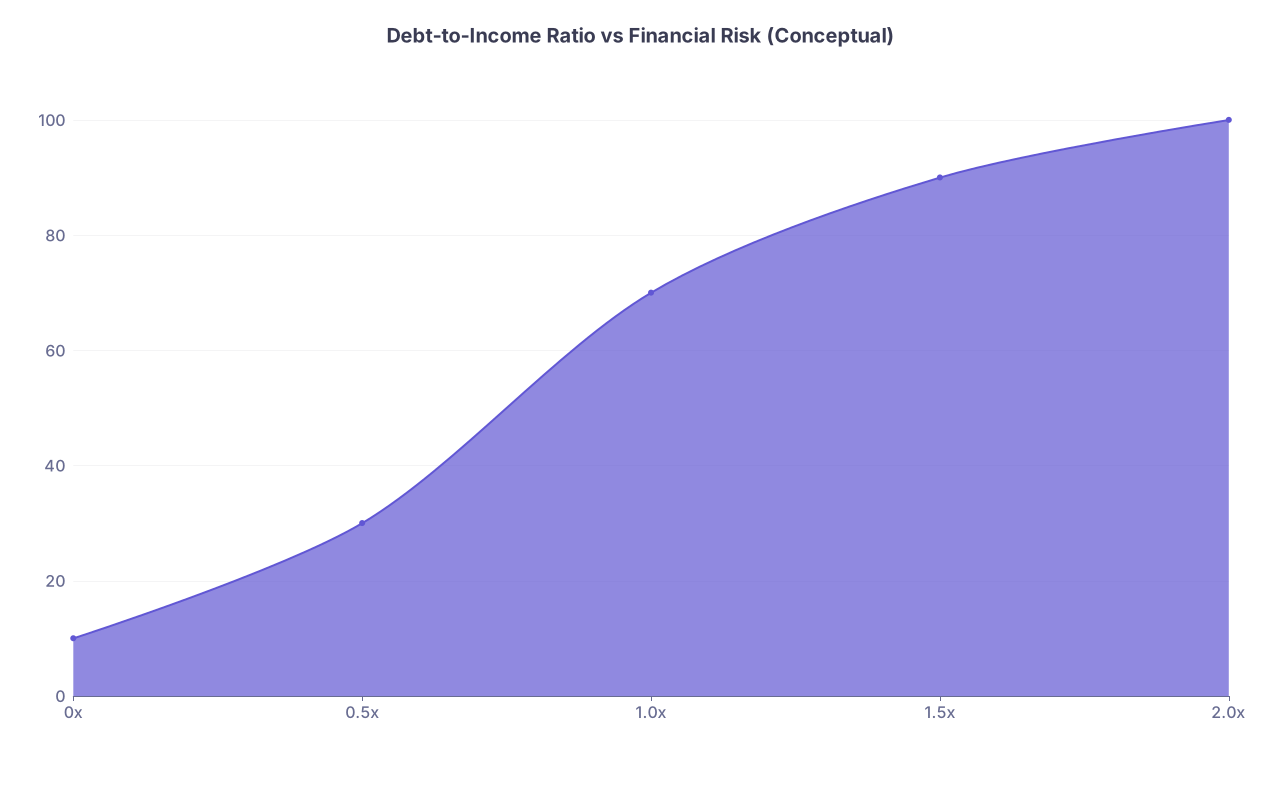
The risk curve is steep when debt exceeds income, then flattens. So an aggressive early sprint to get loans from 2× income down to <1× income, combined with parallel investing, often strikes the best balance.
9. Legal and Structural Considerations (Brief but Necessary)
Since you are in the “financial and legal aspects” phase, I will touch on structure. It does not change the math but it affects risk and after‑tax returns.
- Use appropriate entities: commonly LLCs for liability shielding and easier partnership structuring.
- Keep clean separation between personal student loan obligations and property entities.
- Coordinate depreciation, passive loss rules, and physician income with a CPA who understands real estate. Bad structuring can turn a 12% IRR into 8% after taxes.
- Do not personally guarantee every loan if you scale heavily without understanding the implications; one bad portfolio wipeout can drag your high physician income into bank workout negotiations.
Real estate’s tax efficiency is part of why modeling with 10–12% after‑tax IRR is reasonable. If you do not use those benefits because your structure is sloppy, the investment argument weakens relative to debt payoff.
10. What the Data Actually Say
Strip out emotions and anecdotes. When I run real models for physicians, here is the pattern that repeats:
If your loan rate is below ~4% and your real estate strategy can realistically target 9–12% IRR, then paying loans off aggressively before investing is usually mathematically inferior over 15–20 years.
Between 5–6% loan rate, it becomes a close call. If you are confident in your investing skills and you have a long horizon, early investing tends to win modestly. If you are risk‑averse or likely to underperform, payoff looks better.
Above 7% loan rate, early investing must be outstanding to justify not paying debt down first. Most physicians, especially new to real estate, are not outstanding investors on day one.
So the blanket advice “always kill student loans first” is too simplistic. The numbers do not support it in many real‑world physician cases, especially post‑refinance in a low‑rate environment.
Final Takeaways
The breakeven is not moral, it is mathematical: if your realistic after‑tax real estate IRR is materially above your student loan rate (by 3–5 percentage points), then minimum loan payments plus early investing often produce significantly higher wealth over 20 years.
High‑rate loans (>7%) are a fire: extinguish them quickly. Moderate loans (5–6%) demand modeling and honesty about your investing skill. Low‑rate loans (<4%) are usually better handled with steady payments while your capital compounds in scalable assets like well‑run real estate.