
The wrong tax regime can quietly erase 20–40% of a physician’s real estate profit. Location is not just cap rate and rent growth. The state tax code is equally decisive.
You already know the usual advice: “Texas and Florida have no income tax, so invest there.” That is incomplete at best, misleading at worst. The data show a much more nuanced picture once you combine:
- State and local income taxes
- Property taxes
- Entity‑level taxes and fees
- Depreciation and passive loss rules (federal overlay)
- Your personal situation: resident vs nonresident, W‑2 vs 1099 vs K‑1 income
Let me walk through this like an analyst, not a brochure writer.
The Core Tax Levers That Matter To Physician Investors
There are four primary tax levers that materially change your after‑tax yield on real estate:
State income tax on:
- Rental income (current cash flow)
- Depreciation recapture
- Capital gains on sale (including 1031 fail situations)
Property tax burden:
- Mill rates
- Assessment methodology (use‑value vs market, reassessment triggers)
- Exemptions / caps
Entity and “workaround” structures:
- State treatment of pass‑through entities (partnerships, S corps, LLCs)
- Pass‑through entity (PTE) tax elections to circumvent the $10k SALT cap
- Franchise / margin taxes that behave like corporate income taxes
Residency and sourcing rules:
- How states tax nonresidents on in‑state properties
- Whether moving to a no‑tax state before sale actually helps
- How aggressively high‑tax states pursue former residents
For a high‑earning physician—say $500k+ W‑2 income and a growing K‑1 stack—each 1% of tax drag on investment income is not trivial. It compounds over decades.
How Different State Regimes Change Your After‑Tax Yield
Let’s quantify this. Assume:
- You are in the top federal bracket (37%)
- Federal NIIT (3.8%) applies to passive income
- You hold a property producing:
- 6% annual cash‑on‑cost
- 2% annual appreciation
- Sale after 10 years with 25% gain over basis (after depreciation recapture)
Scenario A: Zero‑Income‑Tax State (e.g., Texas, Florida)
State income tax: 0% on rental income and gain.
Federal effective rates (simplified):
- Cash flow: 37% + 3.8% = 40.8% on taxable income (after depreciation)
- Long‑term capital gain: 20% + 3.8% = 23.8%
- Depreciation recapture: 25% + 3.8% = 28.8%
So if your property produces:
- $100,000 of taxable rental income → ~$59,200 after federal tax
- $1,000,000 long‑term gain at sale → ~$762,000 after federal tax
State drag: zero.
Scenario B: High‑Tax Coastal State (e.g., California)
Assume top marginal CA rate ~13.3%.
Effective combined rates:
- Cash flow: 40.8% federal + 13.3% state ≈ 54.1% (ignoring deductibility limits)
- Capital gains: 23.8% federal + 13.3% state ≈ 37.1% (CA taxes capital gains as ordinary income)
- Depreciation recapture: 28.8% federal + 13.3% state ≈ 42.1%
$100,000 of taxable rental income becomes ≈ $45,900 after tax instead of $59,200. That is a 22% lower after‑tax cash flow relative to the no‑tax state.
$1,000,000 long‑term gain: ≈ $629,000 after tax vs $762,000. A $133,000 difference on one disposition.
Across a 3–5 property portfolio and a 20‑year horizon, that gap runs into the seven figures. The math is not subtle.
Comparing Key State Regimes for Physician Real Estate
Here is a simplified comparison of popular states for physician investors, using broad averages and top brackets.
| State | Top Income Tax Rate | Typical Property Tax (Effective %) | PTE Workaround Available | Notes |
|---|---|---|---|---|
| Texas | 0% | ~1.6–2.2% | Yes | High property tax, no PIT |
| Florida | 0% | ~0.8–1.1% | Yes | No PIT, moderate property |
| Tennessee | 0% (wages) | ~0.6–1.0% | Yes | No PIT, low property tax |
| Nevada | 0% | ~0.5–0.9% | Yes | No PIT, business‑friendly |
| Arizona | ~2.5% flat | ~0.5–0.9% | Yes | Lower overall burden |
| North Carolina | 4.5% (phasing down) | ~0.7–0.9% | Yes | Competitive overall |
These numbers vary by county and year, but the ranking pattern is consistent: Texas trades zero income tax for heavy property tax; Florida and Tennessee offer no income tax with more moderate property tax; Nevada and Arizona add relatively low broad‑based burden.
The Hidden Killer: Property Tax vs Income Tax
Many physicians fixate on state income tax and ignore property tax. That is a mistake.
Imagine:
- Property 1: Located in State A, property tax 0.7%, state income tax on rental income 5%
- Property 2: Located in State B, property tax 2.0%, no income tax
Assume both properties:
- Value: $1,000,000
- Net operating income (NOI): $70,000 (7% of value)
State A:
- Property tax: $7,000
- State income tax on rental income: roughly 5% of taxable income. If taxable income after depreciation etc. is $50,000 → $2,500
- Total state tax burden ≈ $9,500
State B:
- Property tax: $20,000
- State income tax: $0
- Total state tax burden = $20,000
So in this realistic setup, the “no income tax” state more than doubles your state‑level drag on the property.
The break‑even point depends on:
- Your personal marginal state income tax rate
- The proportion of NOI that is actually taxable after depreciation and deductions
- Reassessment dynamics (when does property tax reset, at sale or annually)
This is why good physician investors run the full property‑level pro forma, not just look at the state income tax map.
Depreciation, PTE Workarounds, and the SALT Cap
For high‑income physicians, the federal SALT deduction cap ($10,000) turns state tax strategy into a higher‑stakes game. Any state income tax you pay above that cap is usually non‑deductible at the federal level.
To mitigate this, many states have adopted Pass‑Through Entity (PTE) taxes, which allow:
- The partnership/LLC (your real estate entity) to pay state income tax at the entity level
- The entity then deducts this tax against its income for federal purposes
- You receive a state credit on your individual return for your share of the PTE tax
Result: state tax becomes deductible at the entity level, bypassing the individual SALT cap.
This matters if:
- You invest via multi‑member LLCs/partnerships, not solely as an individual landlord
- You live in a PTE‑friendly state (most of the high‑tax and many mid‑tax states now offer this)
- You have large K‑1 income flowing from multiple syndications or joint ventures
The data point here: for a physician with $300,000 in annual pass‑through real estate income subject to a 10% state rate, a PTE workaround can restore deductibility on $30,000 of state tax, which at a 37% federal bracket means ~ $11,100 in annual federal tax savings. That is material.
No‑tax states obviously do not need this. But if you live in a 5–10% state and stack real estate income, the PTE structure is a core planning tool.
Residency vs Property Location: What Actually Gets Taxed Where
Two major misconceptions show up repeatedly in physician investor conversations:
- “If I move from California to Texas, California cannot tax my future real estate gains.”
False if the property is still in California.
States tax nonresidents on income sourced to that state. Real estate income and gains are sourced to the property location. If you own an apartment building in Los Angeles, California will tax:
- Rental income from that property
- Capital gains and depreciation recapture when you sell
Whether you are a California resident, a Texas resident, or living on Mars.
- “If I buy in Florida while living in New York, New York will tax that income anyway.”
Partially true, but incomplete.
- Florida will not tax your rental income or capital gains.
- New York, as your state of residence, can tax your worldwide income, including Florida rental income.
However:
- You are not double‑taxed in the classic sense. You generally get a credit for taxes paid to other states on the same income.
- Since Florida has no income tax, there is no credit. So New York collects full tax on your Florida income.
This leads to a clear rule: to fully capture the benefit of a zero‑income‑tax state on your real estate income, you generally need:
- The property in a no‑tax state and
- Your tax residence in a low‑ or no‑tax state
Otherwise your home state will pull the income back into its net.
Practical Ranking: Best State Types for Physician Real Estate Investors
Let’s rank state regimes from a pure tax efficiency perspective for a high‑income physician who is willing to relocate and structure entities intelligently.
Tier 1: Zero‑Income‑Tax, Moderate Property Tax, Business‑Friendly
- Florida
- Tennessee
- Nevada
- Wyoming (less liquid markets, but strong for asset protection and entity planning)
Characteristics:
- No state income tax on rental income or capital gains
- Property tax generally below national average or moderate
- Reasonable or strong landlord environments
For a physician who plans to:
- Live in one of these states, and
- Own properties there (or in other no‑tax states)
The effective state drag on real estate income can be close to zero.
Tier 2: Low‑Income‑Tax, Low‑to‑Moderate Property Tax, Growth Markets
- Arizona
- North Carolina
- Utah
- Idaho
- Georgia (outside some high‑tax local pockets)
These states typically:
- Have income tax in the 2–5% range
- Offer relatively low effective property tax rates
- Are in growth corridors with strong demographic and job trends
The data show that, in many cases, total state tax burden (income + property) on a well‑selected property in these states can beat a poorly chosen property in a “no income tax but high property tax” state.
Tier 3: Zero‑Income‑Tax, High Property Tax
- Texas
- Some sub‑regions in other states with local levies
Texas is the classic case.
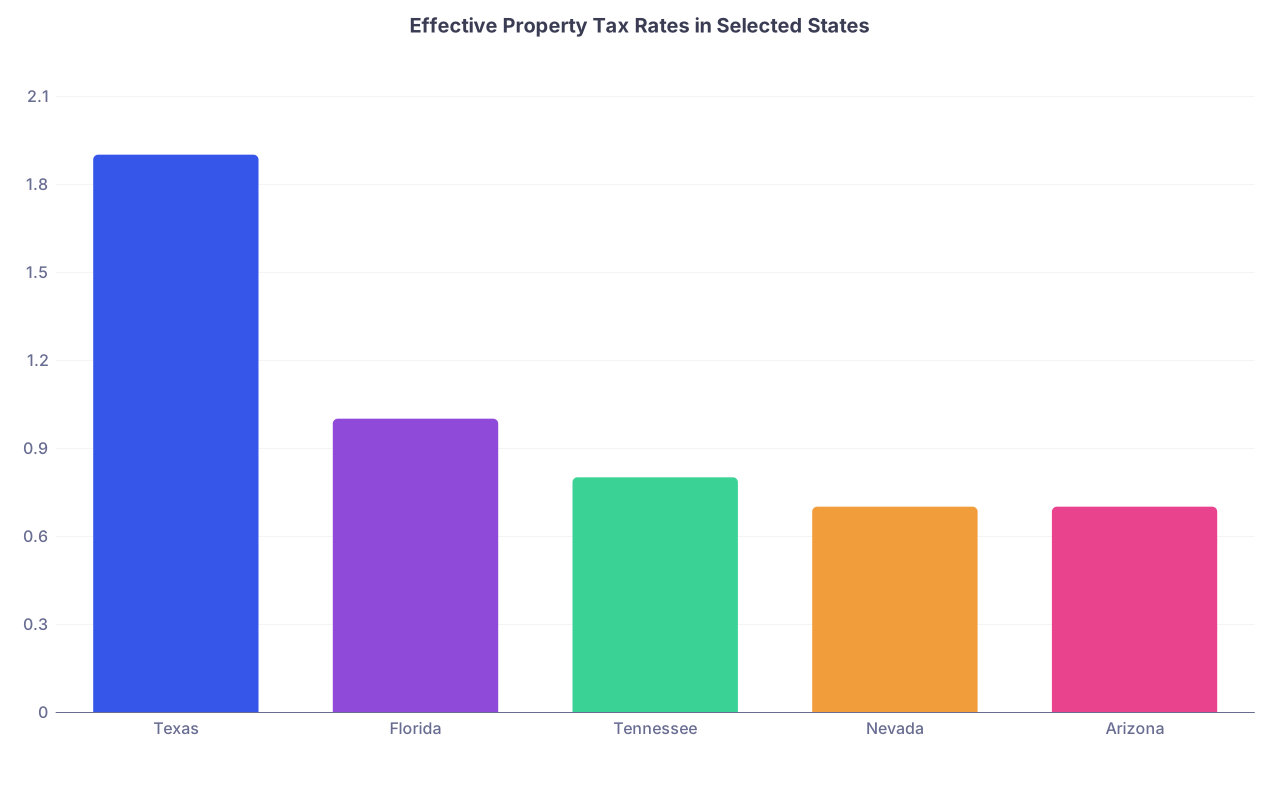
| Category | Value |
|---|---|
| Texas | 1.9 |
| Florida | 1 |
| Tennessee | 0.8 |
| Nevada | 0.7 |
| Arizona | 0.7 |
Texas works very well for:
- High‑yield properties where NOI is large relative to assessed value
- Shorter hold periods, where appreciation and tax drag on gain matter less
- Sophisticated investors who underwrite property tax escalation rigorously
It is less ideal if:
- Your returns are driven primarily by appreciation rather than current yield
- Local governments are aggressively raising rates or reassessments
But broadly, for many physicians, Texas is still favorable if you can manage property tax risk.
Tier 4: High‑Income‑Tax, High‑Cost, High‑Regulation Coastal States
- California
- New York
- New Jersey
- Massachusetts (less extreme but similar pattern)
Can you make money in real estate here? Absolutely. People do, especially with:
- Value‑add multifamily in supply‑constrained markets
- Medical office tied to large hospital systems
- Niche assets (labs, biotech, etc.)
But from a pure tax‑adjusted return standpoint, these are bad places to concentrate your long‑term real estate wealth if you have the option to invest elsewhere. Their role in a physician portfolio is usually:
- Concentrated in “home market advantage” deals where you have specific informational or operational edge
- Balanced by more tax‑efficient holdings out of state
How This Changes Real Numbers: Simple Case Study
Take a physician living in California considering two otherwise similar syndication deals:
- Deal A: 100‑unit multifamily in Phoenix, Arizona
- Deal B: 100‑unit multifamily in Dallas, Texas
Assumptions:
- Both projects:
- 5‑year hold
- Projected 15% IRR (pre‑tax)
- 7% average annual cash‑on‑cash
- Similar leverage
Tax elements:
- You are a CA resident the entire time
- Arizona state income tax ~2.5%
- Texas state income tax 0%
- Property tax embedded in the deal expenses already
From your perspective as a CA resident:
- Arizona deal income:
- Taxed by Arizona at 2.5% (at partnership level or on nonresident return)
- Also taxed by California at your marginal rate, but you get a credit for taxes paid to AZ
- Texas deal income:
- Not taxed by Texas
- Fully taxed by California at your marginal rate
Result: the difference in your after‑tax IRR between these two deals is driven almost entirely by:
- Minor timing differences in state credits vs no credits
- Any withholding / administrative friction
Net effect: from a California resident standpoint, Texas vs Arizona hardly matters on the state income tax side. California is the real problem.
If you later move to Nevada in year 3 and become a Nevada resident before the sale:
- Future income and gain from both deals will escape California tax (assuming you truly sever CA residency and manage sourcing properly)
- Arizona will still tax the Arizona property income and gain at 2.5%
- Texas will not tax the Texas property at all
Now the Texas deal becomes clearly superior on a tax‑adjusted basis for years 3–5 and on the exit.
The bigger decision lever was not “Texas vs Arizona”, but “California vs Nevada” for your personal tax residence.
Legal and Structural Layers Physicians Commonly Miss
Three recurring structural misses:
Holding entities in high‑tax states unnecessarily
- Example: You live in Florida. You invest in a Texas property. Your attorney sets up your LLC in New York because that is what they always do. Now New York may assert nexus and tax the entity or you. This is avoidable.
Poor alignment between residency planning and exit timing
- Selling a large asset or portfolio one year too early—before establishing residence in a low/no‑tax state—can cost mid six figures in incremental tax.
Not coordinating professional income planning with real estate
- Many physicians pursuing Real Estate Professional Status (REPS) and short‑term rental strategies ignore state‑level treatment. Some states diverge from federal passive/active classifications in ways that affect whether losses offset active income.
This is where a data‑driven, state‑specific CPA earns their fee. The spread between naïve and optimized state structuring for a seven‑figure portfolio is enormous.
When “Chasing Tax” Is a Bad Idea
One important caveat: optimizing for state tax alone is a rookie move.
A 3–5 percentage point difference in state tax rate is not worth:
- Sacrificing asset quality
- Entering weak tenant markets
- Accepting judicial environments that are hostile to landlords or creditors
- Ignoring your operational edge (you know one metro deeply, but invest across the country for tax reasons)
The data show that:
- A 2% difference in long‑term annual appreciation or rent growth completely overwhelms a 3–5% state income tax difference.
- Cap‑ex surprises and mis‑underwritten operating expenses often dwarf state tax drag.
You want states where:
- Demographic and job growth is positive
- Landlord/tenant law is predictable and not aggressively anti‑owner
- State and local tax policy is at least neutral, ideally favorable
- You (or your operator) can execute well operationally
Florida, parts of Texas, Arizona, North Carolina, and Tennessee frequently hit that combination. That is not an accident.

| Step | Description |
|---|---|
| Step 1 | Define personal tax residence goal |
| Step 2 | Consider FL, TN, NV, TX |
| Step 3 | Optimize within current state rules |
| Step 4 | Model 10 year state tax impact |
| Step 5 | Select markets with growth + favorable tax |
| Step 6 | Reevaluate deal criteria |
| Step 7 | Willing to relocate? |
| Step 8 | Focus on asset quality first |
Summary: Where The Data Point You
Condensing all of this into actionable guidance for a physician investor:
- State income tax matters, but property tax and your personal tax residence matter more over long horizons.
- The best overall regimes for physician investors tend to be no‑income‑tax states with moderate property tax and strong growth fundamentals—think Florida, Tennessee, Nevada—with Texas attractive if you rigorously underwrite property tax risk.
- The highest value comes from coordinating real estate location, entity structuring (PTE elections, LLC domicile), and personal residency timing, rather than chasing one “tax‑free” state in isolation.