
It’s late November. You’re in a cramped office across from your CPA. He scrolls through your return, taps a few keys, and says, “Looks like you’ll owe about $120k this year. You’ve had a good year. That’s just how it is.”
You mention your two rental properties. He nods vaguely, says, “Yeah, we deducted your expenses and depreciation. That’s all taken care of.”
You walk out thinking: “I’m doing real estate. I’m doing the smart stuff. Why does this still feel like I’m getting crushed?”
Here’s the problem: your CPA is probably a perfectly competent tax preparer. But he’s not a strategist. And he’s almost definitely not thinking like a high-income physician using real estate as a tax weapon.
Let me show you what they aren’t telling you—and what the attendings, partners, and quietly wealthy hospitalists are actually doing behind the scenes.
The Real Reason Your CPA Shrugs at Real Estate
Most CPAs working with physicians live in the world of W‑2 income, retirement plan contributions, and “maximize your 401(k).” They batch-process returns. They’re not building you a tax playbook.
Here’s the dirty little secret:
Real estate tax strategy for physicians is work. It requires understanding a mess of rules: passive vs non-passive, real estate professional status (REPS), material participation, cost segregation, bonus depreciation, grouping elections. Most general CPAs either:
- Don’t fully understand it
- Are terrified of misapplying it
- Don’t have time to walk a busy cardiologist or surgeon through what it actually takes
So you get the safe, default version: “We’ll deduct your expenses and depreciation. You’re doing fine.”
You’re not. You’re leaving tens of thousands—sometimes hundreds of thousands—on the table.
Let’s break down the loopholes they rarely explain properly.
The Big Door: Turning Real Estate Losses Into W‑2 Tax Shields
You already know this on a superficial level: rental real estate generates “paper losses” from depreciation that can offset rental income.
What you probably haven’t been told: with the right setup, those losses can offset your physician income.
This is the center of the whole game.
Passive vs Non-Passive: The Line No One Draws For You
The tax code splits income into passive and non-passive. You care about this more than you care about your last ICU call schedule.
- Your W‑2 income from the hospital? Non-passive
- 1099 income from locums, consulting, telemed? Still non-passive (active business)
- Rental income from real estate? By default, passive
Passive losses (from your rentals) can only offset passive income. So if you’re a standard W‑2 doc with a few rentals, here’s what happens:
- You show $50k in rental “loss” (mostly from depreciation)
- CPA says, “You can’t use that against your $600k salary. It’s a passive loss. It’ll carry forward.”
- That “loss” accumulates on your return year after year, like Monopoly money you never get to spend.
Unless you change the category.
The Two Paths That Actually Change the Game
There are exactly two doors that let you use those rental losses against your attending paycheck:
- Real Estate Professional Status (REPS) + material participation
- Short-term rental exception (STR rules)
Your CPA usually waves REPS away: “You’re too busy as a physician, you’ll never qualify.”
Sometimes they vaguely mention short-term rentals but do not tell you how to structure them so the losses hit your W‑2.
They’re wrong. Or at least, they’re lazy about it.
Real Estate Professional Status: The Loophole They’re Afraid Of
This is the one they whisper about at high-net-worth conferences and never fully explain in your 30‑minute tax meeting.
Here’s the core: if you (or your spouse) qualify as a Real Estate Professional and you materially participate in your rentals, those losses stop being “passive.” They become non-passive. Which means they can offset your medical income.
You want a simple version, not the sanitized IRS brochure.
The Actual Rules (Not the Vague Hand-Waving)
To qualify as a Real Estate Professional for tax purposes in a given year, you must:
- Spend more than 750 hours in real property trades or businesses in which you materially participate
- Spend more time in those real estate activities than in all other trades or businesses combined
Two critical points your CPA often glosses over:
- It does not have to be the physician who qualifies. It can be a spouse.
- You can make a grouping election to treat all your rental properties as one activity for material participation purposes. That’s a game-changer.
So in a classic scenario:
You’re a full-time anesthesiologist working 1.0 FTE. Your spouse is home with kids or working part-time. Your spouse becomes the Real Estate Professional. They manage the portfolio, hit 750+ hours, more time than any other job. Now the real estate side of the household is non-passive.
That’s how the six-figure tax savings actually happen.
Your CPA saying “well, you’re full-time, you’ll never qualify” without asking about your spouse? That’s malpractice-level lazy.
What “Material Participation” Actually Looks Like
The term “material participation” is where everyone gets fuzzy. Here’s the truth from the audit files and what specialists actually document:
The IRS has seven tests. Most RE-focused physicians and spouses use these:
- 500-hour test: You participate more than 500 hours in the activity
- Substantially all test: Your participation is substantially all the participation in the activity
- 100-hour + more than anyone else test
With a grouping election, you count hours across all rentals together.
What counts for hours?
- Finding properties, analyzing deals
- Meeting brokers, lenders, property managers
- Self-managing or overseeing managers (not just passive reviewing)
- Coordinating repairs, renovations, tenant issues
- Bookkeeping, reviewing financials, strategic planning
What doesn’t carry as much weight? Pure education. Binge-watching BiggerPockets doesn’t get you there.
Do people document this with time logs, calendars, spreadsheets? Yes—if they’re smart. The ones who end up on the wrong side of an audit always say the same thing: “We thought our accountant was handling it.”
Your CPA should be telling you to track this from day one. Many do not.
The “Cheat Code” for Physicians: Short-Term Rental Loophole
Now the fun one. The short-term rental (STR) exception.
There’s a specific carve-out that most generalist CPAs either barely understand or are terrified to touch:
Certain short-term rentals are not treated as “rental activities” for passive loss rules. That means they’re not automatically passive. You can avoid the whole REPS hurdle.
The tax code says: if your average guest stay is 7 days or less, and you materially participate, that activity is non-passive even without REPS.
Translation:
You can be a full-time surgeon working 60–70 hours/week, buy a well-run Airbnb, materially participate, do a cost seg study, generate a huge paper loss, and use that to offset your W‑2 income—all without qualifying as a Real Estate Professional.
Your CPA probably never sat you down and said: “If you want to wipe out $150k of taxes this year, we need to get you into a properly structured short-term rental and here’s the exact pattern we’ll use.”
But that’s what the sophisticated guys are doing.
How It Actually Plays Out
Here’s a stylized but realistic version I’ve seen more than once:
- 38-year-old cardiologist making $750k W‑2
- Buys a $1.2M vacation rental in a solid market (Scottsdale / Smokies / Florida panhandle)
- Puts $250k down, finances the rest
- Does a cost segregation study, front-loading depreciation
- Takes advantage of bonus depreciation on certain components
- Shows a paper loss of $300–400k in year one
- Because it’s a qualifying short-term rental and he materially participates, that loss offsets his cardiology income
- Six-figure federal tax refund or dramatically lower tax due
He’s not committing fraud. He’s just playing by the actual rules with better information and better advisors.
Your CPA, if they were really on your side strategically, would have brought this to you 2–3 years ago.
Cost Segregation & Bonus Depreciation: The Engine Under the Hood
Let’s talk about the phrase your CPA probably mentions once in passing and then never explains: cost segregation.
This is how you turn a boring 27.5-year depreciation schedule into a front-loaded tax weapon.
What Cost Seg Actually Does
Instead of treating the entire building as one 27.5-year asset, a cost seg study breaks the property into components:
- 5-year property (carpets, cabinets, certain fixtures)
- 7-year property
- 15-year property (land improvements, certain site work)
- The remaining 27.5-year stuff
Then you layer on bonus depreciation rules for the shorter-life pieces.
In high-income physician English:
You buy a $1M property. The building portion (let’s say $800k) might yield $200–$350k of first-year depreciation with a cost seg and bonus depreciation, instead of $29k/year on straight-line.
That’s why people use the phrase “shelter income” around real estate. Not because of rent checks. Because of front-loaded paper losses.
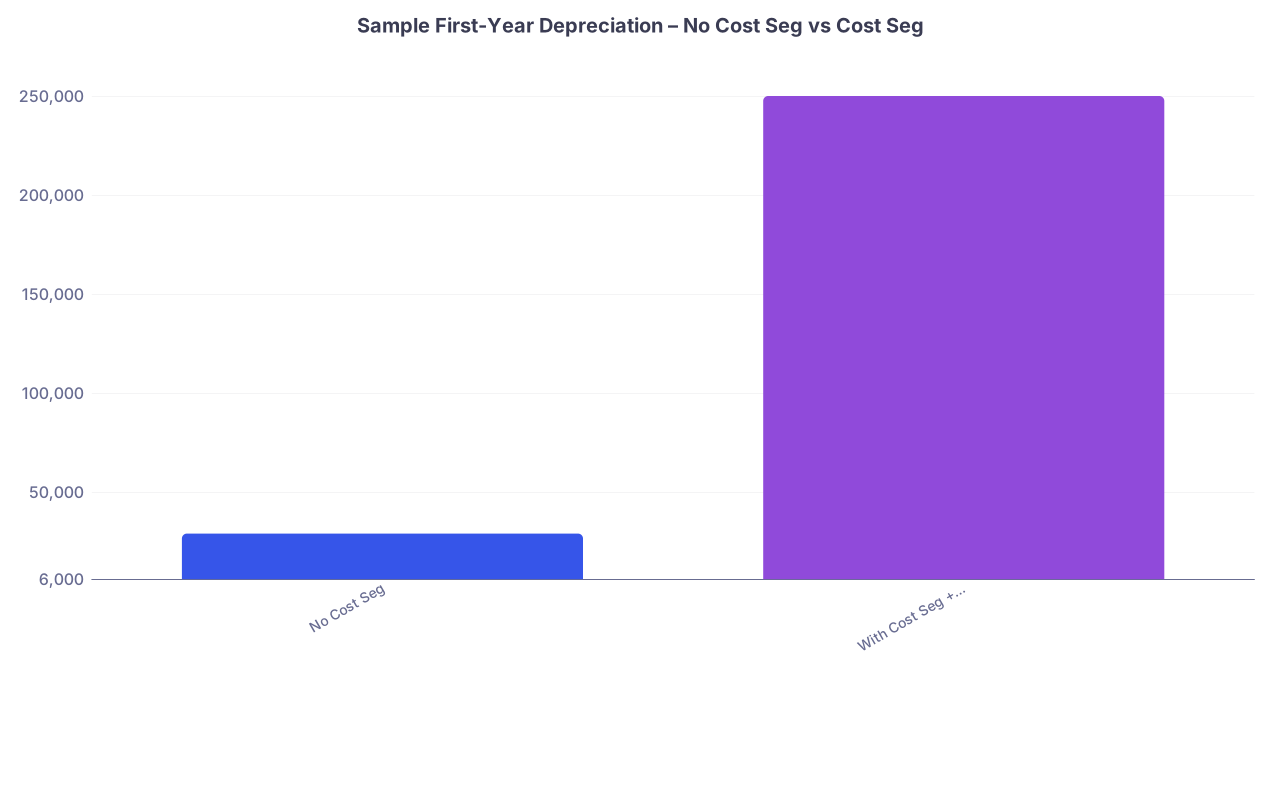
| Category | Value |
|---|---|
| No Cost Seg | 29000 |
| With Cost Seg + Bonus | 250000 |
Your CPA saying “we can look into cost segregation someday” isn’t good enough. You need them telling you when it makes sense, which properties justify the cost, and how it plugs into your W‑2 or 1099 picture.
Why Your CPA Defaults to “Conservative”
Here’s the uncomfortable truth: your risk tolerance and your CPA’s risk tolerance are not aligned.
- If you miss out on $150k of legal tax savings, you lose.
- If your CPA pushes the envelope and there’s an audit, they get uncomfortable, questioned, maybe sued, maybe reported.
So most of them stay in the safest possible lane.
I’ve heard this verbatim from CPAs talking off the record:
- “Docs don’t want audits; I just keep them boring.”
- “The problem with high-income clients is they want zero risk and zero tax, and that’s not real.”
- “Real estate professional status is fine if it’s the spouse and they really do it, but I don’t sit there and time-track for them. If they get audited, I’m not testifying about their hours.”
They undersell what’s possible to avoid being blamed later.
So they default you to: straight-line depreciation, passive loss carryforward, maybe a backdoor Roth, and some 401(k) deferrals. That’s retail-level planning for wholesale-level income.
You have to ask for strategy. Or better yet, you hire someone who already thinks this way.
How Sophisticated Physician Investors Actually Structure Things
Let me pull back the curtain on what the more advanced playbooks look like. Not vague “invest in real estate” nonsense. Actual patterns.
Pattern 1: The REPS Spouse + Long-Term Rentals
Classic dual-income household where the physician is maxed out on time:
- Physician: W‑2 or 1099, $500–900k
- Spouse: either no job or something very part-time and flexible
- Spouse becomes Real Estate Professional
- They buy multiple long-term rentals (SFH, small multis, some syndications where they actually qualify for material participation if structured right—more niche)
- Make a grouping election so all properties count as one for participation tests
- Do cost seg on larger deals (say $700k+ properties or small apartment complex)
- Generate $200–500k in non-passive losses year 1–2
- Knock down physician’s taxable income massively
Your CPA should be modeling this on a whiteboard with you and your spouse when you’re both in your early to mid-30s. But most of you are not getting that meeting.

Pattern 2: Full-Time Doc + One or Two Strategic STRs
For the doc who likes medicine, doesn’t want their spouse in a “job,” but still wants big tax offsets:
- Physician remains W‑2 or 1099, no REPS
- Identify 1–2 well-located short-term rentals with strong demand
- Self-manage or at least heavily participate first year to clearly hit material participation tests (100–500 hours, more than any manager, etc.)
- Do cost seg, front-load depreciation
- Use that non-passive STR loss to offset W‑2/1099 income
This can work even in a single year if planned well. For example: high-income surgeon has a monster 1099 year from locums or bonus-heavy comp, buys an STR Q1–Q2, front-loads the losses, and slashes that year’s tax bill.
Pattern 3: The Hybrid Portfolio For Long-Term Control
Once people get a taste of the tax leverage, they usually move to:
- A mix of long-term rentals for stability
- One or two strategic STRs for active loss generation
- Occasional refresh with new cost seg opportunities every few years
- Layered with defined benefit / cash balance plans on the practice side if they’re partners
At this level, their CPA is not a generic guy in a strip mall office doing 1040s for dentists and Uber drivers. They’re using someone who talks about “sequencing cost segs around your peak earning years” and “coordinating passive loss utilization with future business sale.”
If your tax meeting never mentions words like “grouping election,” “material participation test,” “STR exception,” or “cost seg timing,” you’re not in that world yet.
Entity Structure: LLCs, S‑Corps, and Other Half-Truths
You’ve probably been told some version of: “Put everything in an LLC for liability and tax benefits.”
Again, half-truth.
For rentals, the LLC is primarily a legal play, not a big tax game-changer. Most rental income is not subject to self-employment tax. You still get depreciation whether it’s in your name or an LLC.
The places where structure starts to matter more:
- When you have active real estate businesses (property management, flips, development)
- When you’re doing significant STR operations that could be seen as hotel-like services
- When you’re trying to separate risk between properties, portfolio segments, and your medical practice
A good real estate–savvy CPA isn’t just slapping every rental into a new LLC and calling it a day. They’re coordinating with your attorney to decide:
- Do we use a series LLC?
- Do we keep everything in one holding entity?
- Do we need an S‑corp for active business, but NOT for the rentals themselves?
If your CPA’s explanation was, “We’ll just create an LLC, that should save on taxes,” they’re oversimplifying to the point of being wrong.
How to Know If Your CPA Is Actually Playing This Game
You do not need to become a tax expert. You do need to be able to smell when someone is out of their depth.
Ask them, bluntly:
- “What’s your view on physicians using Real Estate Professional Status?”
- “How many clients do you have in active real estate, with cost seg studies done in the last 2 years?”
- “We’re considering a short-term rental. Can you explain how the STR exception works for non-passive treatment?”
- “Do you help clients track and substantiate material participation? How?”
- “If my spouse wanted to qualify for REPS, what would you have us set up this year?”
If they give you vague, conservative, or dismissive answers—“The IRS is cracking down on that,” “I don’t recommend that for most people,” “That sounds risky”—what they’re really saying is:
“I don’t know this well enough to defend it. So I’d rather you not do it.”
Your choice is simple: accept the generic plan and pay full freight, or find someone who actually runs this playbook weekly.
Quick Comparison: Typical CPA vs Strategic Physician Real Estate CPA
| Aspect | Typical CPA Answer | Strategic CPA Answer |
|---|---|---|
| Real Estate Professional Status | “You’ll never qualify.” | “Can your spouse qualify? Let’s structure it.” |
| Short-Term Rentals | “Just another rental.” | “Here’s how to use STR rules to offset W‑2.” |
| Cost Segregation | “Maybe someday if big enough.” | “Here’s when and how we’ll time your cost seg.” |
| Material Participation | “Keep some notes.” | “Here’s a log template and tests to target.” |
| Planning Meetings | Once a year at tax time | At least yearly with projections and scenarios |
What You Should Be Doing Next (Not Ten Years From Now)
If you’re a resident or new attending, this is foundation time. You’re not buying a 32‑unit in year one. But you can:
- Decide now if real estate will be a core wealth and tax strategy
- Start learning the language so you don’t get snowed by half-educated advisors
- Pay attention to your spouse’s career trajectory if REPS might be in play later
If you’re mid-career and already paying six figures in tax annually, the urgency is different. You’ve probably already lost a few hundred thousand in avoidable taxes. That stings. Good. Let it.
The next step is not buying another rental blindly. It’s fixing the team and the plan:
- Get a CPA or tax strategist who actually speaks fluent real estate and high-income physician
- Decide: REPS pathway? STR pathway? Hybrid?
- Map out: which year(s) are you going to hit big depreciation events to match your biggest income years?
- Build a documentation habit now so if the IRS ever asks, you’re not scrambling
You do not need to become the spreadsheet-obsessed landlord doing your own plumbing at midnight. But you do need to stop believing the story that “you’re doing all you can” because your CPA squeezed in another $3k of itemized deductions.
You’re playing a completely different game now.
With these loopholes on your radar—and a clear sense of what your current CPA isn’t telling you—you’re finally in a position to ask the right questions and demand real strategy.
From here, the next part of the journey is choosing and underwriting the right properties so the tax benefits are paired with solid investments. That’s where the real leverage shows up. But that’s a story for another day.