
The wealthy attendings at your hospital aren’t getting rich off their W-2. They’re quietly using their 401(k) and similar plans to seed real estate deals you never hear about.
Let me tell you what actually happens behind the scenes.
The chief of your department is not just maxing out the 401(k) into target date funds. He’s rolling old 401(k)s into self-directed accounts, using “boring” plan documents to wire retirement money into apartment syndications, private funds, and even hard-money loans on physician-owned deals. Legally. Quietly. While residents argue about which S&P 500 index fund to pick.
You can play this game too—if you understand the rules and the landmines.
How Attendings Really Move 401(k) Money Into Real Estate
First truth: you usually can’t invest directly in real estate from your active employer’s standard 401(k) lineup. The plan menu is designed by HR, the recordkeeper, and a big mutual fund company. They want you in funds they can administer and collect fees on, not in a 24‑unit building in Dallas.
So how do attendings get around this?
They use three main paths:
- Old 401(k)s from prior employers → rolled into a self-directed IRA (SDIRA) or solo 401(k).
- Independent contractor / side-gig income (locums, consulting) → solo 401(k) with self-directed options.
- Practice-owner retirement plans (for group practices, small hospitals) → custom-designed 401(k)s that allow “self-directed brokerage windows” or even private investments.
Here’s what it looks like in real life.
The cardiologist who left your academic center four years ago? She had a $450k 403(b) sitting there. She rolled it to a self-directed IRA custodian. Now that account owns LP interests in three multifamily syndications, a slice of an industrial fund, and a small note on a bridge loan to a developer. All retirement money. All tax-advantaged.
Your private practice ortho attending with two ASCs? Their practice 401(k) has a brokerage window. He rolls part of his balance to a self-directed IRA and invests in a surgical center expansion partnership where the retirement account is an LP, not him personally.
None of this shows up on hospital-wide “wellness” financial webinars. But it’s happening.
The Legal Structures They Use (That Nobody Explains to You)
The mechanism isn’t magic. It’s structure and paperwork.
There are four main vehicles:
- Traditional 401(k) at your employer
- Self-directed IRA (SDIRA)
- Solo 401(k)
- Self-directed brokerage window inside a group 401(k)
Let’s break them down without the fluff.
| Account Type | Real Estate Access | Who Qualifies | Typical Balance Use |
|---|---|---|---|
| Employer 401(k) | Very Limited | W-2 employees | Index funds, mutual funds |
| SDIRA | Broad | Anyone with IRA/rollover | Syndications, private deals |
| Solo 401(k) | Broad | Self-employed docs | Higher contributions |
| 401(k) + Window | Moderate-Broad | Group/practice docs | Brokerage, sometimes alts |
Self-Directed IRA: The Workhorse
Most attendings start with this.
When they leave an employer, they roll the old 401(k)/403(b) into a self-directed IRA with a specialized custodian. This custodian allows alternative investments: real estate, private equity, notes, etc.
Key point: the IRA—not you—becomes the investor on paper.
If your name is on the deal documents instead of “[Custodian] FBO Dr. Smith IRA,” someone screwed up.
The SDIRA custodian reviews the deal subscription, wires funds from the IRA, and holds the LP interest or note. All cash flows (distributions, interest, sale proceeds) go back into the IRA.
Attendings use this for:
- LP interests in multifamily syndications
- Private real estate funds
- Hard-money loans to local operators
- Occasionally, direct property ownership through an IRA-owned LLC (this is where it gets dangerous with rules)
Solo 401(k): The Power Tool Few Residents Know About
Your interventional radiologist who “does some locums on the side” and somehow accumulates large real estate positions? Watch his retirement structure.
If you have any legitimate self-employed income with no full-time employees (other than a spouse)—locums, consulting, speaking, chart review—you can set up a solo 401(k). In a solo 401(k), you’re both employee and employer, which means beefy contribution limits and, if you set it up correctly, self-directed options.
The sophisticated attendings do this:
- Form an LLC for their 1099/locums work
- Open a solo 401(k) plan for that LLC with a provider that allows self-directed investments
- Contribute aggressively (both employee and employer portions)
- Use that solo 401(k) to invest in real estate deals, often through a “checkbook control” 401(k) trust checking account
This is how someone with $120k of locums income can shovel $66k+ into a solo 401(k) and then deploy that into a real estate syndication—skipping the public markets entirely for a big chunk of their retirement allocation.
Brokerage Windows & Custom Group 401(k)s
Group practices and private groups have another lever: they control the plan design.
Your anesthesiology group or ortho practice may have:
- A 401(k) with a self-directed brokerage window (Fidelity, Schwab, etc.) that lets partners buy almost any security
- In some rare, more sophisticated cases, the plan document may allow investments into private placements, LP interests, or private REITs through that window
Here’s the quiet move: the senior partners hire a TPA (third-party administrator) who understands alternative investments. They’re not advertising this to every junior associate, because frankly, most juniors aren’t ready for that level of responsibility and risk. But the option is in the documents, and the partners use it.
The Real IRS Rules They’re Tiptoeing Around
The law actually allows retirement accounts to invest in real estate. What kills people are prohibited transactions and disqualified persons. This is where attendings who “DIY without reading” blow themselves up.
Here’s the blunt version of the rules they’re obeying (or should be):
You can invest retirement funds into real estate or real estate funds, as long as you:
- Don’t personally benefit now (only your retirement account benefits)
- Don’t transact with “disqualified persons”
- Don’t provide sweat equity or services
- Don’t commingle personal and retirement funds in the same exact deal structure without planning
Disqualified Persons: The People You Cannot Play With
The IRS list is specific. Your retirement account cannot buy from, sell to, or directly do deals with:
- You (the account owner)
- Your spouse
- Your lineal ascendants/descendants (parents, grandparents, kids, grandkids)
- Their spouses
- Any entity those people control
- Certain advisors and fiduciaries
So, the attending cannot do this with his SDIRA:
- Buy his vacation home in Vail from himself
- Use his IRA to fund his son’s first rental property
- Lend his SDIRA money to the LLC he personally owns to acquire a building
- Let his IRA-owned property pay him a “management fee”
But he can:
- Invest his SDIRA as an LP in an unrelated real estate fund or syndication
- Lend SDIRA money to an unrelated operator’s flip business
- Co-invest personally and via IRA in some deals, if it’s structured carefully and not self-dealing (this is advanced and requires a real ERISA attorney, not a blog post)
Sweat Equity & “You Can’t Fix the Toilets”
This is the rule most physicians miss when they “buy a duplex in an IRA” because some custodian’s glossy brochure made it sound sexy.
If your IRA owns a property:
- You cannot personally manage it in a material way
- You cannot fix things, swing hammers, do remodels, or even handle significant operations
- You cannot personally pay expenses or receive rent; it all flows through the IRA
- You cannot rent it to yourself, your kids, or your parents
That’s why most serious attendings don’t use IRAs to buy direct, hands-on rentals. They use them to invest passively as LPs in deals where they’re clearly not performing services.
UBTI / UDFI: The Tax Monster Behind the Curtain
Here’s another insider secret: not all “tax-advantaged” real estate in retirement accounts is actually tax-free.
If your retirement account invests in:
- A deal that uses debt (leverage), or
- An operating business, or something that looks like a trade/business
You can trigger taxes inside the retirement account—Unrelated Business Taxable Income (UBTI) or Unrelated Debt-Financed Income (UDFI).
Attendings in the know handle it like this:
- They understand that LP interests in leveraged multifamily can generate UBTI/UDFI inside an IRA
- They structure some investments through solo 401(k)s instead, because solo 401(k)s are exempt from UDFI on real estate debt (big advantage)
- They analyze K-1s and ask sponsors directly, “Will this deal generate UBTI for retirement account investors?”
- They accept that sometimes paying a bit of UBIT is fine if the underlying returns are strong enough
If your financial advisor has never mentioned UBTI when bragging about “private real estate in your IRA,” they’re either inexperienced with alts or they assume you’ll never be big enough for the IRS to care. Neither is great.
How Attendings Actually Execute a Deal From Their 401(k)/IRA
Let me walk you through what really happens when a physician uses retirement money to seed a real estate deal. Because the devil is in the sequence.

| Step | Description |
|---|---|
| Step 1 | Old 401k balance |
| Step 2 | Choose SDIRA or Solo 401k |
| Step 3 | Open account with custodian |
| Step 4 | Roll over funds |
| Step 5 | Review real estate deal |
| Step 6 | Submit documents in IRA name |
| Step 7 | Custodian wires funds |
| Step 8 | Deal sends returns to retirement account |
| Step 9 | Reinvest or hold in cash |
The steps you don’t see on Instagram:
- They identify a custodian that actually understands physician alt investing. They don’t use the first one that shows up on Google Ads.
- They coordinate a rollover from the old 401(k) to the SDIRA or solo 401(k). That can take 1–4 weeks. Real deal sponsors know this and often give “retirement account investors” a little more time for funding.
- They underwrite the deal like any other investment: sponsor track record, debt terms, fees, downside scenario. Smart attendings don’t treat “since it’s retirement money” as monopoly money.
- They complete subscription documents in the correct legal name of the retirement account. They attach custodian instructions, wiring details, and any additional forms.
- The custodian reviews for compliance, might flag prohibited transaction concerns, and then wires funds. This extra compliance step is why some deal sponsors groan when they hear “I’m coming in through my IRA.”
- When distributions hit, they go back to the custodian account, not to the physician’s personal checking. The doc then either reinvests or lets it build up until the next deal.
The deal sponsors who work with physicians often have a separate workflow just for IRA/401(k) investors, because the paperwork demands and timing are different. The polished operators have this dialed in. The mom-and-pop duplex syndicator often does not.
The Quiet Advantages (and Real Drawbacks) Attendings Consider
Smart attendings aren’t romantic about this. They’re clinical.
Why They Bother Using 401(k)/IRA Money for Real Estate
A few real advantages:
- Tax-deferral (traditional) or tax-free growth (Roth) on cash flow and capital gains
- The ability to diversify away from Wall Street without triggering current taxes
- Access to deals that have minimums too high for taxable cash while still building retirement wealth
- Roth conversions of beaten-down alt assets during downturns (this is ninja-level planning)
And a big, underappreciated one: psychological discipline. Retirement accounts are mentally “do not touch,” so physicians are less likely to panic-sell or fiddle with their allocation every time CNBC screams about something.
What They Don’t Like (That Marketing Never Mentions)
Here’s what attendings complain about over dinner:
- Custodian fees: SDIRA providers nick you with annual account fees, asset fees per holding, and transaction fees per deal. That 8% pref gets thinner.
- Slower moves: Need to hit a syndication funding deadline in 5 days? Good luck with an IRA rollover stuck in some legacy 403(b) system.
- Less flexibility: Once the money is tied into a 7-year hold inside a retirement vehicle, you can’t pull it out for a vacation home down payment or practice buy-in.
- Complexity: K-1s, UBTI filings, 990-T tax returns for IRAs, custodian paperwork. None of this is one-click Robinhood trading.
This is why the savvier physicians split their strategy: use taxable cash for deals where they want control, flexibility, and potentially more active involvement, and use retirement accounts for long-term, boring, passive positions where the tax-advantaged compounding matters most.
How Program Directors & Senior Attendings Actually Think About This
Let me be blunt: senior faculty rarely talk about this openly in front of residents or fellows.
Why?
Because the culture in academics is “we’re here to teach medicine,” not “here’s how to use a solo 401(k) to seed a 300‑unit in Phoenix.” Also, administrative leadership gets nervous when attendings start sounding like real estate gurus at noon conference.
But behind closed doors:
- In the surgeon’s lounge, someone is explaining to a junior partner how they rolled their old VA 401(k) into an SDIRA to get into a medical office building fund.
- In group practice partner retreats, they’re discussing whether to amend the 401(k) plan to allow alternative investments or just keep it simple to avoid regulatory headaches.
- In late-career attendings’ financial reviews, you’ll hear things like, “We shifted part of my rollover IRA into two industrial funds and a senior housing deal; the rest is in index funds.”
I’ve heard program directors say, almost verbatim: “The residents don’t need this yet. Let them pass their boards first.”
What they really mean: “I don’t want to be responsible for junior people blowing up their retirement on a buddy’s syndication.”
So the information stays informal. Whisper network. Private conversations. Deals shared via email to the “cool kids” list.
You want in? You need to know enough to ask specific questions: “Do you use any self-directed retirement accounts for your real estate?” That’s when attendings open up.
A Simple, Practical Progression if You’re Not an Attending Yet
If you’re still in training or early attending life, here’s how the ones who end up doing this successfully tend to progress. Not a formula. Just a pattern I’ve seen over and over.
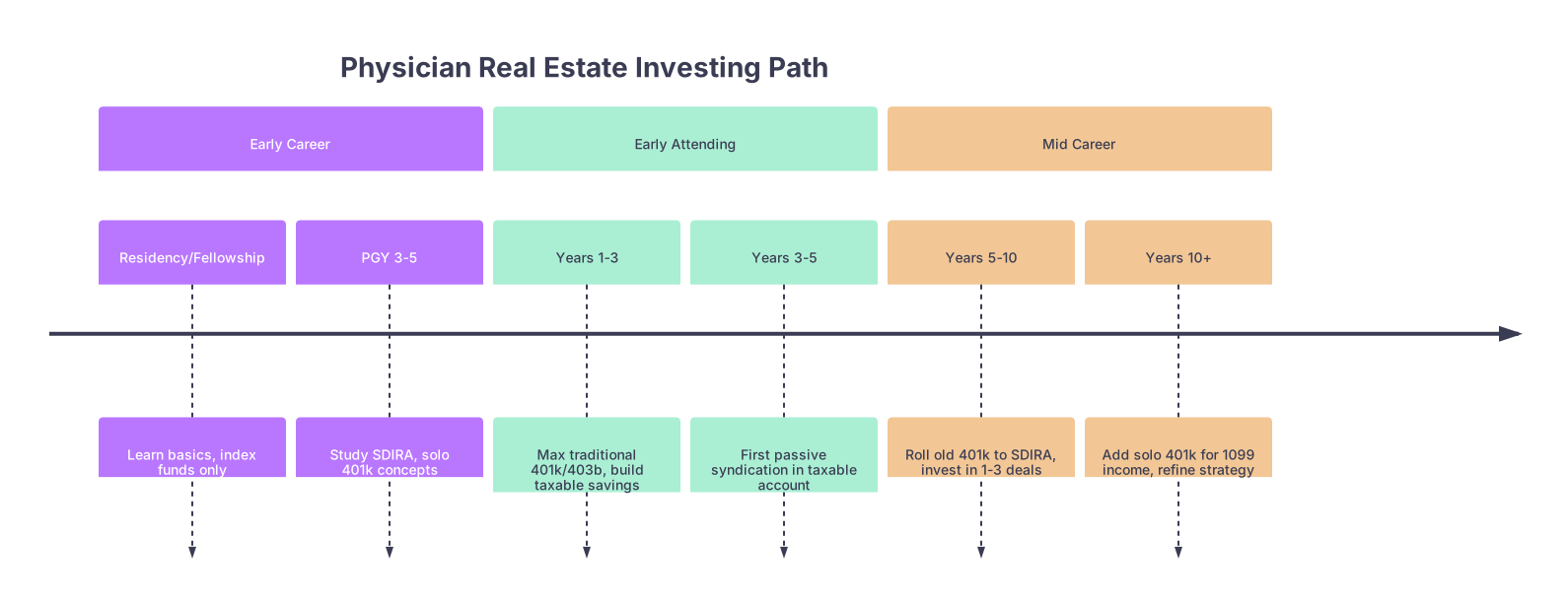
| Period | Event |
|---|---|
| Early Career - Residency/Fellowship | Learn basics, index funds only |
| Early Career - PGY 3-5 | Study SDIRA, solo 401k concepts |
| Early Attending - Years 1-3 | Max traditional 401k/403b, build taxable savings |
| Early Attending - Years 3-5 | First passive syndication in taxable account |
| Mid Career - Years 5-10 | Roll old 401k to SDIRA, invest in 1-3 deals |
| Mid Career - Years 10+ | Add solo 401k for 1099 income, refine strategy |
Notice what’s missing?
They don’t start their first year out of residency by shoving every retirement dollar into an opaque private fund because some guy from church is “doing apartments now.” They build a base in vanilla index funds, understand their cash flow and risk tolerance, then slowly add complexity.
The Mistakes That Quietly Blow Up Physician Retirement Accounts
Let me finish the core content with the errors nobody likes to admit publicly.
I’ve seen:
- An attending use his SDIRA to fund a friend’s flip business that was barely on paper. No proper docs, no security, no lien. The friend disappeared when the market turned. Retirement money gone.
- A doc invest IRA money into a deal where he was also the GP personally—clear self-dealing/prohibited transaction issues. He only found out after a real ERISA attorney explained the exposure. Fixing it was costly and nasty.
- A high earner do massive Roth conversions into a self-directed Roth IRA, deploy into risky development deals, and then lose principal. Great tax planning, terrible underwriting.
- A practice group open up the 401(k) to private deals without proper vetting. Partners loaded up on a single sponsor. Sponsor imploded. Morale and trust cratered.
The truth: the structure (SDIRA/solo 401(k)) is the easy part. The hard part is still deal quality, sponsor quality, and your own discipline.
If you’re going to copy what the wealthier attendings do with their 401(k)s, copy their skepticism and diligence too—not just the surface-level “I invest my retirement in real estate.”
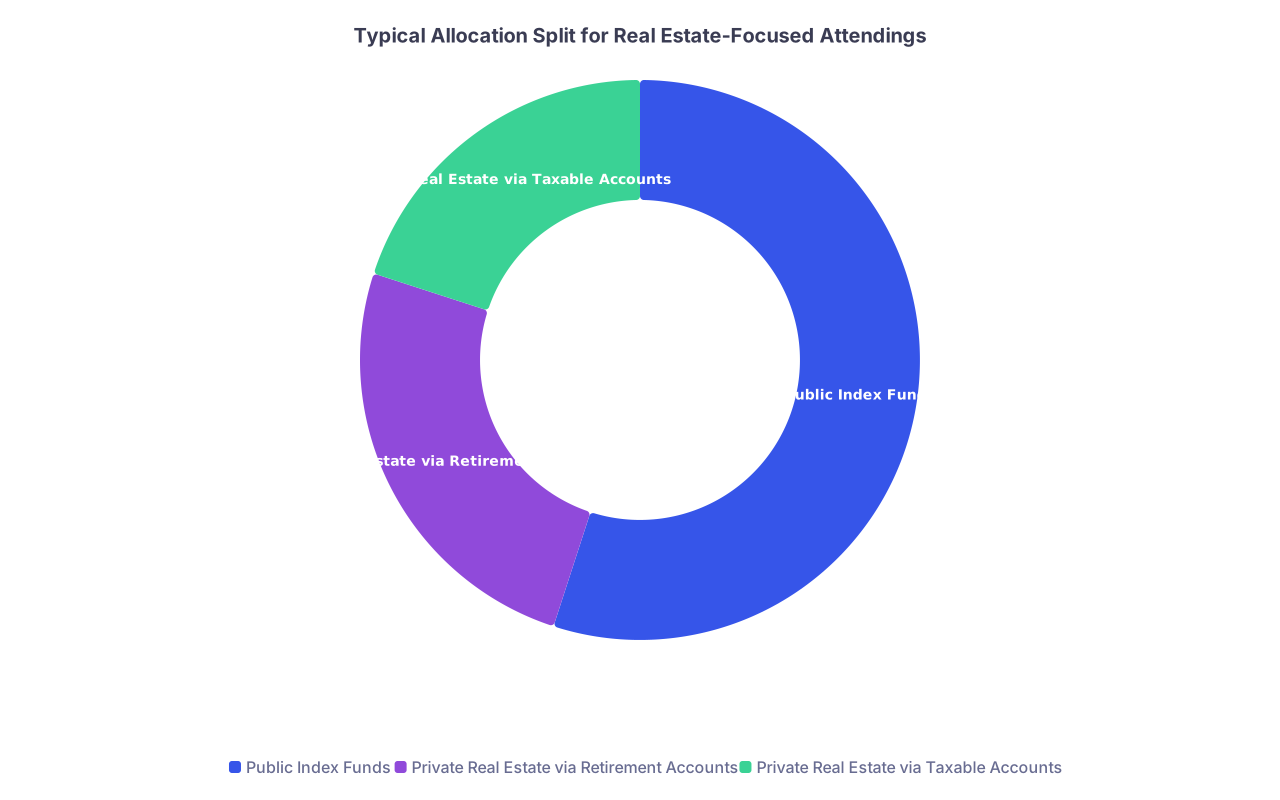
| Category | Value |
|---|---|
| Public Index Funds | 55 |
| Private Real Estate via Retirement Accounts | 25 |
| Private Real Estate via Taxable Accounts | 20 |
FAQs
1. Can I use my current hospital 401(k) directly to invest in a real estate syndication?
Usually no. Most hospital 401(k)/403(b) plans are locked into a limited fund menu and don’t allow direct investment in private deals. The standard path is to wait until you separate from that employer, then roll the old plan balance into a self-directed IRA or solo 401(k) (if you qualify) and invest from there. A minority of group/practice plans have a brokerage window or custom options, but big hospital systems almost never do.
2. Is it better to use a self-directed IRA or a solo 401(k) for real estate?
If you qualify for a solo 401(k) (legit self-employed income, no full-time employees), it’s usually superior for real estate. Solo 401(k)s avoid UDFI on leveraged real estate, can allow larger contributions, and often have cleaner “checkbook control” structures. Self-directed IRAs are easier to qualify for (any rollover IRA can become one) but are more exposed to UBTI/UDFI on leveraged deals and have some different compliance nuances. Many attendings end up with both over time.
3. How much of my retirement should I put into real estate deals?
There’s no magic number, but the attendings who stay out of trouble rarely go all-in. A common pattern among experienced physician investors: 10–30% of retirement assets in private real estate (across multiple deals and sponsors), with the rest in broad public markets. Early on, staying at the low end of that range while you learn is sane. If you’re even asking this question, you’re probably not the person who should be at 70% privates.
4. Do I need a lawyer or CPA involved for every real estate investment from my 401(k)/IRA?
For your first few deals using self-directed retirement money, yes—you should at least have an ERISA-savvy attorney and a CPA who understands UBTI review what you’re doing. After you’ve done several and are following a clear, compliant pattern (e.g., passive LP interests in cleanly structured funds/syndications), you won’t need a lawyer on each deal, but you should still have a CPA watching for UBTI and filing any 990‑T as needed. The people who skip professional advice to “save a few thousand” sometimes end up nuking six figures in tax advantages.
Key points:
- Attendings quietly use self-directed IRAs and solo 401(k)s—not their active employer 401(k)—to seed real estate deals, staying within strict IRS rules on prohibited transactions.
- The structure is only half the game; the real edge comes from disciplined deal selection, diversified sponsors, and understanding UBTI/UDFI and compliance.
- You can absolutely play this game, but you need to progress in stages—build a basic retirement foundation first, then layer in self-directed real estate with real legal and tax guidance, not sales pitches.