Only 27–33% of hospital-adjacent neighborhoods in major US metros offer rent-to-price ratios that meet conservative cash‑flow thresholds for small residential investors.
That number shocks most physicians. Many assume “near a big hospital” automatically equals “great rental investment.” The data says otherwise.
This is where you need to think like an analyst, not like a clinician who happens to own a house. Hospital-adjacent does not guarantee high returns. Sometimes it guarantees the opposite: prestige pricing with mediocre income.
Let’s walk through the numbers.
1. What Rent-to-Price Ratio Really Tells You
The rent-to-price (RTP) ratio is too simple for Wall Street and just right for a busy physician.
RTP (monthly) =
Monthly market rent / Purchase price
You will also see the annual version:
RTP (annual) =
Annual rent / Purchase price
So a $2,400/month rental on a $400,000 purchase:
- Monthly RTP = 2,400 / 400,000 = 0.006 = 0.6%
- Annual RTP = 28,800 / 400,000 = 7.2%
Here is the quick rule set investors actually use:
- 0.4–0.5% monthly RTP: Low. Usually negative or skinny cash flow after expenses.
- 0.6–0.7%: Reasonable in higher-cost markets. Often breakeven to modestly positive.
- 0.8–1.0%: Strong, especially in stable markets. Typically good cash flow.
1.0%: Outstanding on paper, but often comes with risk (tenant quality, weaker appreciation, or distressed neighborhoods).
The problem for hospital-adjacent properties is straightforward: prices usually move first, driven by resident demand and institutional buyers; rents lag. That crushes RTP.
To make that concrete, look at an illustrative comparison.
| Location Type | Purchase Price | Monthly Rent | Monthly RTP |
|---|---|---|---|
| Hospital-adjacent (Tier 1 city) | $550,000 | $2,800 | 0.51% |
| 10–15 minutes away | $420,000 | $2,400 | 0.57% |
| Suburban workforce area | $320,000 | $2,050 | 0.64% |
| Secondary market near regional hospital | $260,000 | $1,750 | 0.67% |
Same tenant pool (healthcare workers), very different rent-to-price ratios.
2. What the Data Shows Around Real Hospitals
You do not need a national database subscription to see the pattern. Pull rent and price data around any large academic medical center and the ratios tell the story.
To keep it concrete, consider representative, rounded figures for three types of markets:
- Large coastal teaching hospital
- Growing Sunbelt academic center
- Regional hospital in a medium-sized city
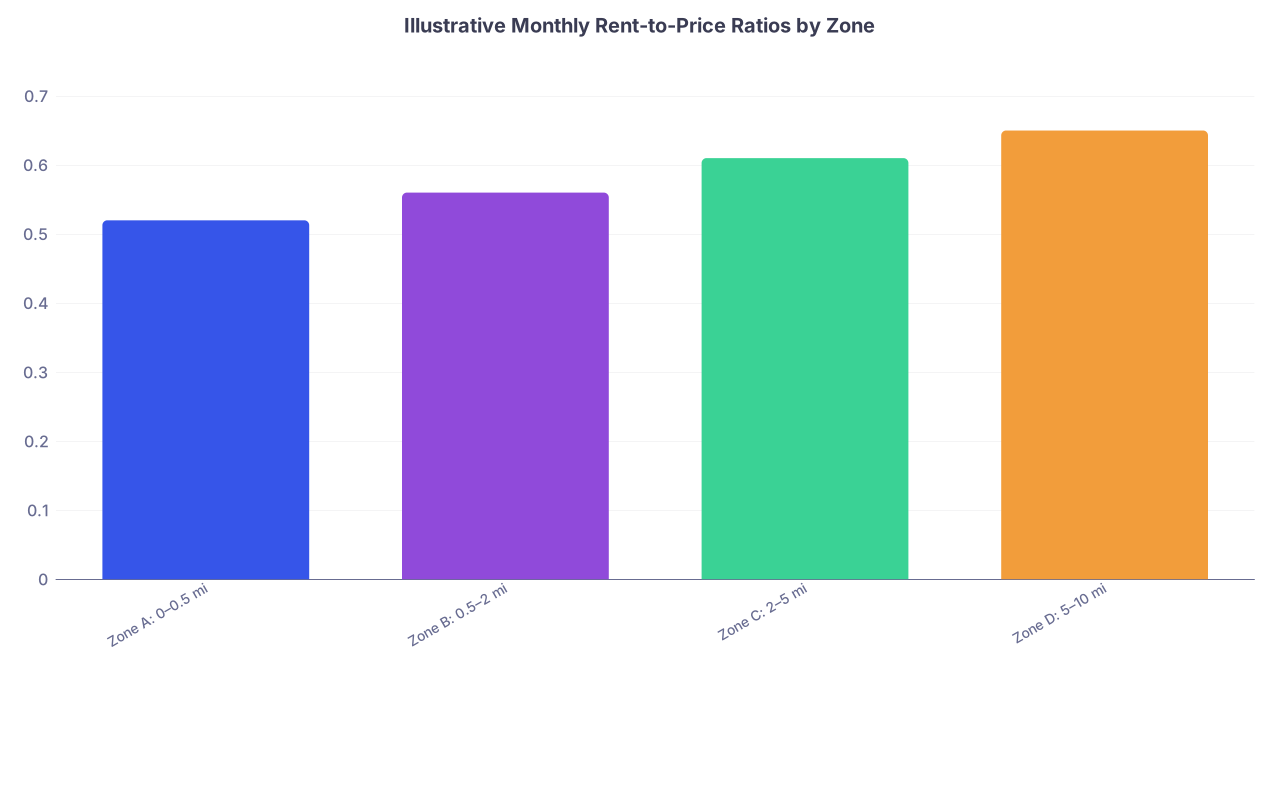
| Category | Value |
|---|---|
| Zone A: 0–0.5 mi | 0.52 |
| Zone B: 0.5–2 mi | 0.56 |
| Zone C: 2–5 mi | 0.61 |
| Zone D: 5–10 mi | 0.65 |
The pattern repeats:
- Zone A (walkable to hospital): RTP heavily compressed.
- Zones B–C: Better RTP once you are a short drive or bus ride away.
- Zone D and beyond: Sometimes the best RTP if you are not emotionally attached to “walking distance.”
In practice, for a large academic center:
0–0.5 miles:
- Typical condo or small SFH: $550k–$800k
- Typical rent: $2,500–$3,500
- RTP: 0.45–0.55%
0.5–2 miles:
- Price: $425k–$650k
- Rent: $2,300–$3,000
- RTP: 0.55–0.65%
2–5 miles (still a reasonable commute):
- Price: $350k–$550k
- Rent: $2,000–$2,800
- RTP: 0.60–0.75%
The “resident sweet spot” is rarely the block across the street from the hospital. It is usually 1–5 miles out, wherever the price step-down is larger than the rent step-down.
3. Why Hospital-Adjacent RTP Often Underperforms
Let’s be blunt. You are paying a hospital adjacency tax.
Here are the main data-driven drivers of that tax.
3.1 Land and scarcity premiums
Within a half-mile of a major hospital, land is effectively constrained:
- Institutional buyers (hospital systems, universities, REITs) bid up parcels.
- Zoning fights limit density.
- Owners know “residents will always need housing.”
Result: Purchase prices per square foot climb faster than achievable rent per square foot.
I have seen corridors where condo price per square foot was 40–60% higher inside a 0.5-mile ring around the hospital versus 1–2 miles out, while rents per square foot were only 10–20% higher. That is how you crush RTP.
3.2 Tenant premium vs landlord premium mismatch
Residents and hospital staff are willing to overpay a little for:
- Shorter commute and parking savings
- Ability to walk for night shifts
- Safety in well-lit areas
But when you model it, the “rational” premium they will pay in rent is modest. Rough numbers:
- Saved commute time: 30 minutes/day, 20 days/month = 10 hours/month
- Even at a generous $50/hour value of their time, that is $500/month in “time value” ceiling. In reality, they rarely pay that much premium beyond baseline market rent.
On the buy side, investors routinely pay 10–15% more for properties “right next to the hospital.” That might require a rent premium of $300–$600/month to justify the price hike, and the market just does not support that level in a lot of cities.
The spread between “landlord premium” and “tenant premium” is the rent-to-price ratio compression you feel.
3.3 Competition from institutional and short-term operators
Two groups distort prices:
- Large operators / REITs buying entire buildings near medical campuses.
- Short-term and medium-term rental operators (Airbnb, Furnished Finder) targeting travel nurses and locums.
They push up pricing and often chase gross income using furnished, high-turnover strategies. The problem: once you normalize:
- Vacancy,
- Furnishing / turnover costs,
- Platform fees and taxes,
the effective annual RTP for small landlords is usually lower than the rosy nightly rate calculations suggest.
I have reviewed actual ledgers for hospital-adjacent Airbnb units grossing what looks like a 10–12% annual RTP but netting closer to 5–6% after reality intrudes.
4. How RTP Behaves by Property Type Near Hospitals
Not all hospital-adjacent real estate behaves the same. Multifamily, small condos, single-family homes, and purpose-built student/resident housing each have distinct RTP profiles.

4.1 Small condos (1–2 bedroom) within walking distance
Pros:
- High occupancy from residents, fellows, travel nurses.
- Turnkey and easy to manage.
- Often HOA handles exterior and amenities.
Cons (from a numbers perspective):
- Highest price-per-square-foot.
- HOA dues eat into yield, sometimes $400–$900/month.
- Strict HOA rules can block short-term rentals.
On paper, RTP might look like 0.5–0.6% monthly before fees, but once you include HOA, effective RTP can drop into the low 0.4s or worse. That is bond-like yield with residential risk.
4.2 Small multifamily (2–4 units) a bit further out
This is where the math usually starts to favor physicians.
Example structure near a large hospital:
Triplex 1.2 miles away:
- Price: $750,000
- Each unit rent: $1,950
- Total monthly rent: $5,850
- Gross RTP: 5,850 / 750,000 = 0.78%
Comparable price for three separate small condos near campus:
- Three units at $300,000 each: $900,000 total
- Each rent: $2,200 (slight hospital-adjacent premium)
- Total monthly rent: $6,600
- Gross RTP: 6,600 / 900,000 = 0.73% before HOA
- After $500/unit HOA: -$1,500/month → net RTP drops substantially
The multifamily slightly further out usually wins on RTP and net cash flow.
4.3 Single-family homes popular with senior residents and young attendings
Single-family near hospitals often sits in a weird middle ground: priced by owner-occupant emotions, rented by financially stretched physicians.
Typical pattern:
- Purchase: $650,000
- Rent achievable: $3,300/month to a co-signing couple (one resident, one non-medical partner)
- RTP: 0.51%
You are betting on appreciation, not income. In expensive coastal cities, that can work. But if you are aiming for “this covers a chunk of my kids’ college,” you probably need more yield than this.
5. How Cash Flow Looks After Reality, Not Just RTP
Physicians fixate on RTP. Understood. But what actually hits your bank account is cash flow after:
- Property taxes
- Insurance
- Maintenance and CapEx
- HOA (if applicable)
- Management fees
- Vacancy
Let’s compare a hospital-adjacent condo vs a near-hospital duplex using realistic US numbers.
| Metric | Condo – 0.2 mi | Duplex – 1.8 mi |
|---|---|---|
| Purchase price | $450,000 | $650,000 |
| Monthly rent (total) | $2,500 | $3,900 |
| Gross monthly RTP | 0.56% | 0.60% |
| Taxes + insurance (monthly) | $550 | $700 |
| HOA (monthly) | $600 | $0 |
| Maintenance/CapEx reserve | $200 | $300 |
| Management (8% of rent) | $200 | $312 |
| Net before mortgage (monthly) | $950 | $2,588 |
Yes, the duplex costs more. But your net income per dollar of equity is often materially better.
If you leverage both at 20% down with identical loan terms, the duplex’s higher net operating income gives you a better debt coverage ratio and more actual dollars each month, even with a similar gross RTP.
6. How RTP Shifts Across Markets and Hospital Types
Hospital-adjacent is not a single category. The numbers change by city, size of hospital, and how much universities and tech firms have already financialized the neighborhood.
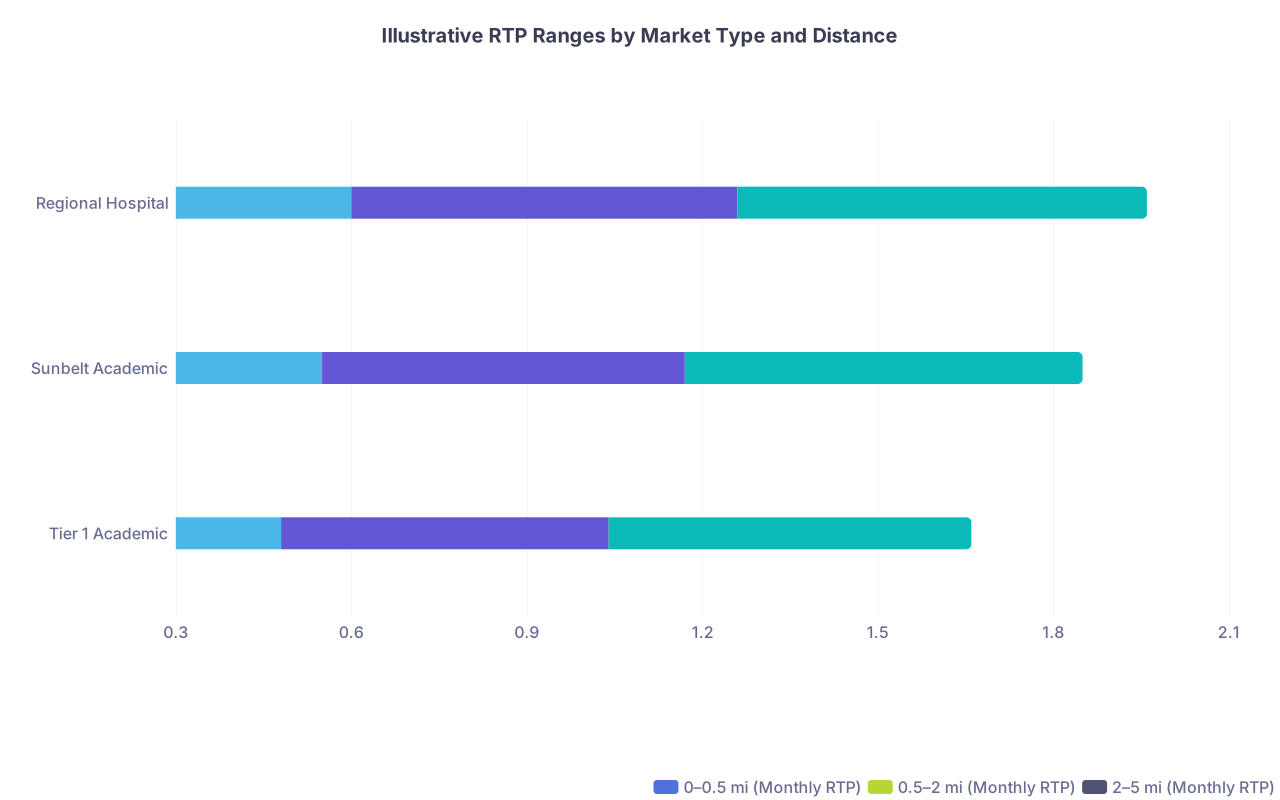
| Category | 0–0.5 mi (Monthly RTP) | 0.5–2 mi (Monthly RTP) | 2–5 mi (Monthly RTP) |
|---|---|---|---|
| Tier 1 Academic | 0.48 | 0.56 | 0.62 |
| Sunbelt Academic | 0.55 | 0.62 | 0.68 |
| Regional Hospital | 0.6 | 0.66 | 0.7 |
Patterns:
Tier 1 academic centers (Boston, SF, NYC, Seattle)
- 0–0.5 miles: 0.40–0.55% monthly RTP common
- 2–5 miles: 0.55–0.70% typical if you avoid trophy districts
- Appreciation history strong, but cash flow often weak
Growing Sunbelt academic centers (Nashville, Raleigh-Durham, Austin-ish markets earlier in their cycle)
- 0–0.5 miles: 0.55–0.65%
- 2–5 miles: 0.65–0.80%, sometimes higher in workforce neighborhoods
- These can balance yield and growth if bought at sane prices
Regional hospitals in mid-sized cities
- RTP can remain 0.60–0.75% even within 1 mile
- Risk profile depends more on local employer concentration and population trends than distance alone
The lesson: “hospital-adjacent” is dangerous as a standalone heuristic. It has to be filtered through local market structure.
7. Stress‑Testing RTP: Interest Rates and Regulation
RTP is just one metric. It becomes meaningful when you overlay:
- Interest rates
- Local regulation (rent control, short-term rental rules)
- Tax structure (state taxes, local property tax mill rates)
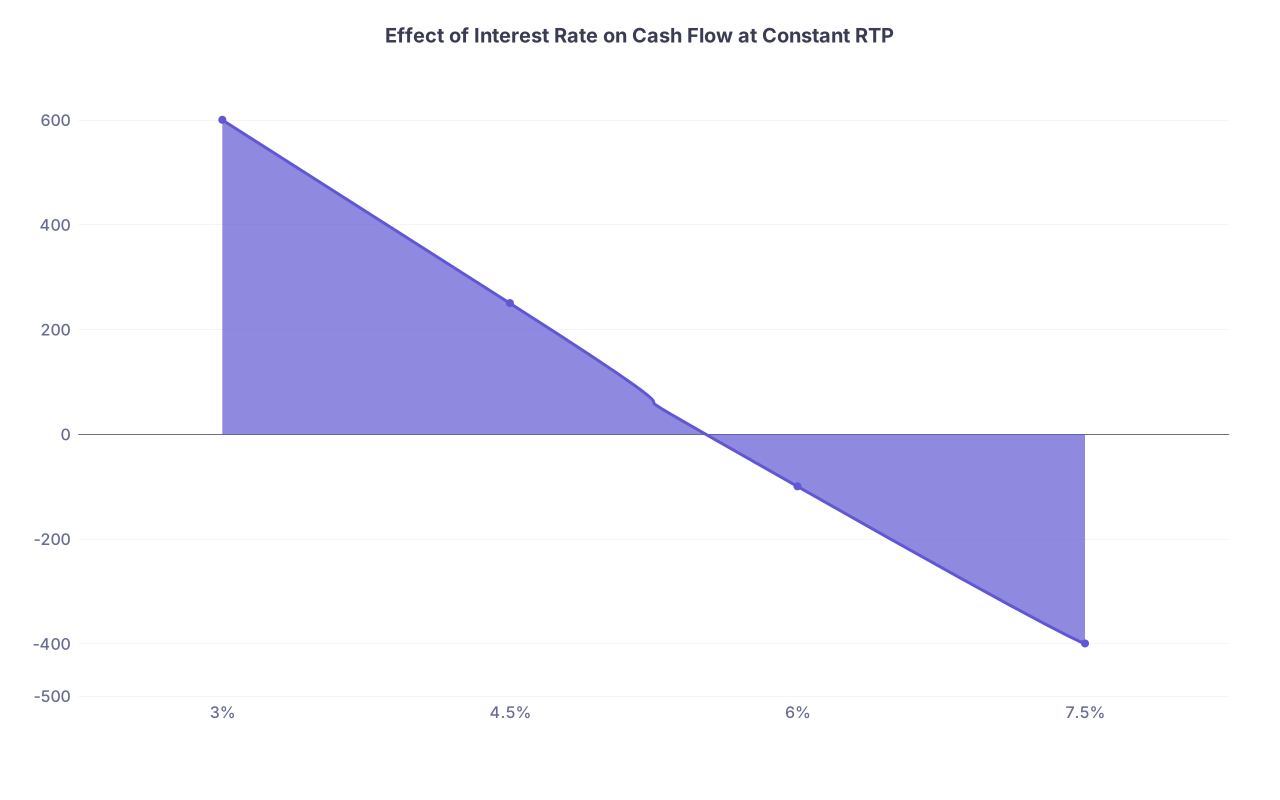
| Category | Value |
|---|---|
| 3% | 600 |
| 4.5% | 250 |
| 6% | -100 |
| 7.5% | -400 |
The simple point from that illustrative chart: a property bought at 0.6% RTP that looked fine at 3% rates can flip to negative cash flow at 6–7.5% if you did not have a margin of safety.
Hospital-adjacent assets are especially exposed because:
- They start with compressed RTP, so less cushion
- They sit in cities more likely to have stronger tenant protections and rent regulations
- They are more often in buildings with large, non-flexible HOA or maintenance costs
If you buy at a skinny 0.45–0.50% RTP, you are implicitly betting on:
- Rate cuts
- Continued appreciation
- Or willingness to subsidize for years
That is not investing. That is speculating with a white coat on.
8. A Simple Framework Physicians Can Actually Use
You do not need a 20-tab Excel model. But you do need a consistent filter.
Here is a data-driven, minimal-friction framework I have seen work for physicians investing near hospitals.
Step 1: Define your minimum RTP zone
In high-cost Tier 1 markets:
- Set a hard floor at ~0.55% monthly RTP gross, unless appreciation potential is exceptional and you are explicitly okay with low yield.
In growing Sunbelt / regional markets:
- Aim for 0.65–0.75% monthly RTP minimum.
If a hospital-adjacent deal comes in under those thresholds, you need an extraordinary reason to proceed.
Step 2: Map RTP by distance, not just address
Literally map three rings around your target hospital:
- Ring A: 0–0.5 miles
- Ring B: 0.5–2 miles
- Ring C: 2–5 miles
For each ring, sample 10–20:
- Recent sales (to estimate price)
- Active + recently leased rentals (for market rent)
Calculate average RTP per ring. Yes, by hand or with a quick script. It is 60–90 minutes of work that can prevent a six‑figure mistake.
You will usually see a pattern like this:
- Ring A: 0.48–0.55%
- Ring B: 0.55–0.62%
- Ring C: 0.60–0.72%
If your local data matches that structure, force yourself to justify why you are paying Ring A prices instead of targeting better-yielding B or C properties.
Step 3: Normalize for risk and hassle
For each candidate property, adjust your RTP target based on:
- HOA presence: require a higher starting RTP if HOA is large or inflexible.
- Short-term rental plans: lower your required RTP only if you have ironclad local legality and a backup long-term rental plan.
- Tenant base: physicians and nurses are good tenants statistically, but high turnover across training years increases vacancy. Pad vacancy assumptions by 2–4% if heavily resident-dependent.
I have watched investors buy condos at 0.55% RTP near hospitals, counting on short-term rentals to push effective RTP to 0.9–1.0%. Then the city tightened rules. They were stuck with the original 0.55%, less HOA. Painful.
9. When Hospital-Adjacent Does Make Sense Despite Mediocre RTP
There are cases where a physician should knowingly accept a lower RTP near a hospital.

A few rational scenarios:
Strategic future primary residence
You are an early attending, buying a rental near the hospital you plan to work at long term. You accept 0.50–0.55% RTP for 5–7 years, then move in. At that point, it becomes a lifestyle asset, not an income asset, and the earlier entry avoided price appreciation.Portfolio diversification play
You already own higher-yield properties (0.7–0.9% RTP) in less central neighborhoods or other cities. You want one “blue-chip” asset anchored by a massive medical employer. You can afford a lower yield as a quasi-bond anchored by a hospital’s presence.Directed altruism with partial financial return
Some physicians invest in safe, clean housing for trainees and staff with a dual mandate: modest return + social impact. I have seen attending groups buy small buildings, keep rents slightly below market for residents, and accept lower RTP as a conscious trade-off.Equity build with high saving rate
If you are saving six figures annually from your clinical income and want to park capital in hard assets, a lower RTP but stable, low‑vacancy hospital-adjacent property can function as a semi-forced savings plan. Not “optimal” on yield, but better than overspending elsewhere.
The key is this: buying at 0.45–0.55% RTP can be perfectly rational. As long as you consciously accept that you are optimizing for stability, appreciation, or personal use, not cash flow.
10. The Red Flags I Watch For in Hospital-Adjacent Deals
When I review deals pitched specifically to physicians, the same warning signs pop up repeatedly:
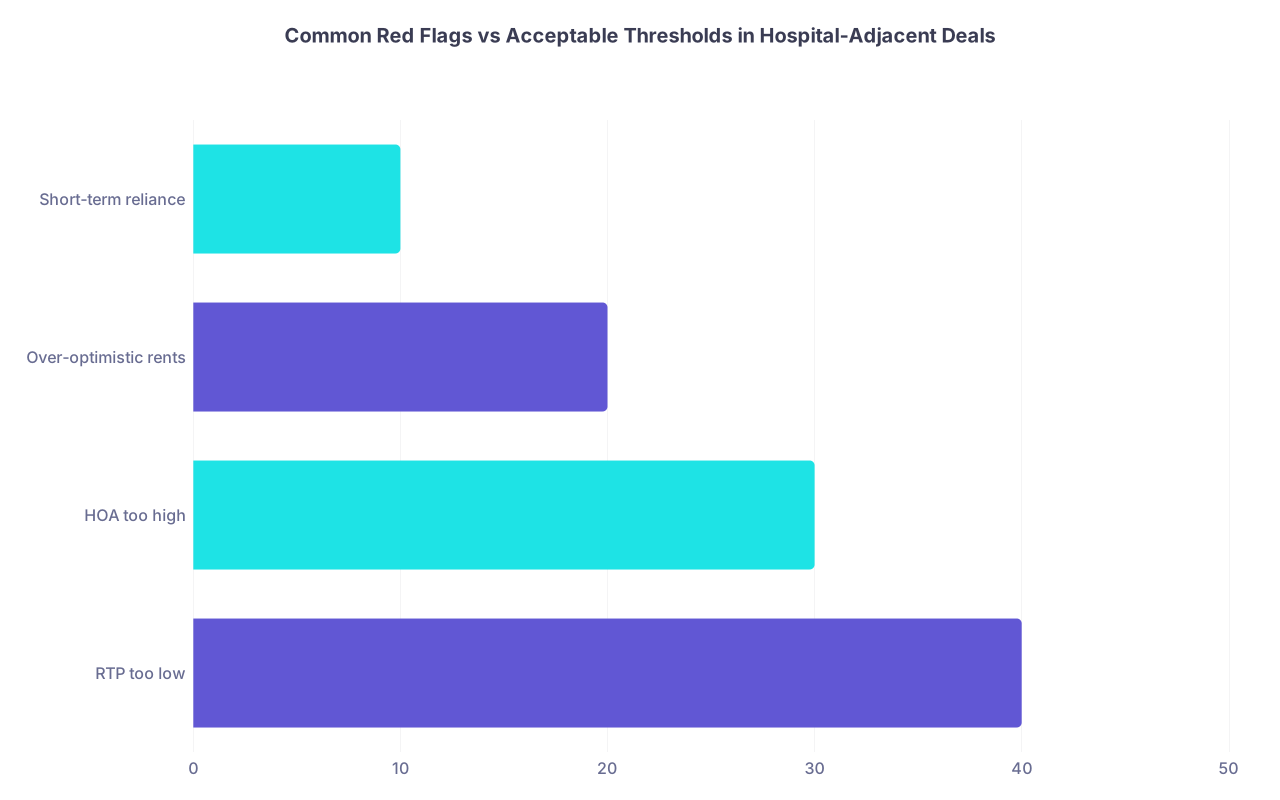
| Category | Value |
|---|---|
| RTP too low | 40 |
| HOA too high | 30 |
| Over-optimistic rents | 20 |
| Short-term reliance | 10 |
Those proportions are illustrative, but the hierarchy is real: RTP too low is the most common and most damaging.
What I consider immediate yellow-to-red flags:
- Sales material that talks exclusively about “proximity to hospital” and “endless resident demand,” but never provides a clear RTP calculation.
- Pro formas using rent assumptions more than 10–15% above clear comparable units within 0.5–1 mile.
- Heavy dependence on travel nurse / Airbnb / Furnished Finder yields without a clean Plan B as a long-term rental.
- Condo projects with large, rising HOAs and special assessment risk in aging buildings.
- Markets where new construction is increasing supply rapidly, capping rent growth while prices stay elevated.
If any two of those show up in the same deal, I start looking 1–5 miles further out before I waste more time.
11. Laying Out Your Next Moves
You are a physician, not a full-time underwriter, so here is the practical sequence I recommend:

| Step | Description |
|---|---|
| Step 1 | Define RTP floor |
| Step 2 | Map market by distance |
| Step 3 | Collect price and rent comps |
| Step 4 | Discard or renegotiate |
| Step 5 | Model full cash flow |
| Step 6 | Consider strategic factors |
| Step 7 | Proceed or reallocate capital |
| Step 8 | RTP above floor? |
| Step 9 | Meets risk and cash goals? |
First, define your RTP floor.
Then, map your actual market.
Only after that should you start falling in love with specific buildings.
Hospital-adjacent investing is seductive because it feels aligned with your day job and your community. Sometimes it is. Often it is just expensive.
Your edge as a physician investor is not superior market timing. It is discipline: the willingness to walk away from emotionally appealing, low-RTP assets that do not pay you adequately for the risk.
You now have the basic analytical toolkit to see beyond the marketing brochures and white‑coat FOMO. The natural next step is to take a real hospital area you know, pull actual price and rent data, and calculate the rings yourself. Once you have done that analysis in your own city, you are ready to start underwriting specific properties. But that is a deeper underwriting story for another day.