
The worst financial wounds physicians take are not from the markets. They are from staying stuck in bad deals out of shame, confusion, or fear of lawyers.
You got sold a “can’t miss” real estate syndication, fund, or JV. Now the distributions stopped, the sponsor got quiet, the updates are vague, and your stomach drops every time you see that investment on your balance sheet. You do not need more generic “due diligence” lectures. You need a blueprint to legally get out, minimize damage, and prevent repeat injuries.
That is what this is.
1. First, Diagnose the Damage Like a Professional
You cannot treat what you have not properly diagnosed. The worst move is to flail around firing off angry emails and threats without knowing what you are holding.
Start by building a “case file” on the investment.
Step 1: Pull every document, not just the glossy pitch deck
You need the legal documents, not the marketing fluff:
- Private Placement Memorandum (PPM)
- Operating Agreement (LLC) or Limited Partnership Agreement (LPA)
- Subscription Agreement
- Investor Questionnaire / Suitability docs
- Side letters or email promises (yes, those matter)
- All investor updates and financial reports
- Your wiring instructions / proof of funds
Create a single folder (digital or physical). Name it something simple: “XYZ Deal – Legal”. You are building the chart before you round on this patient.
Step 2: Map the core facts on one page
Open a blank page and answer, in plain English:
- Entity name:
- Type of deal: (e.g., multifamily syndication, development, DST, fund)
- Your role: Limited partner? Member? Note holder?
- Amount invested:
- Date funds wired:
- Promised hold period:
- Promised or marketed returns:
- Current status: (e.g., distributions stopped, K-1 delays, sponsor unresponsive)
- Red flags seen so far:
This one-page summary becomes gold for later: attorneys, regulators, and even your own clarity.
Step 3: Distinguish between “bad outcome” and “bad behavior”
Not every losing investment is a scam or something you can exit early. The law cares about conduct, not your regret.
You are looking for:
- Misrepresentation
- Were you told one thing in email or webinar, but the legal docs say something very different?
- Omission of material facts
- Key risks, conflicts of interest, side deals, or fees never mentioned.
- Breach of contract / operating agreement
- Sponsor not following distribution waterfall, reporting requirements, voting rules.
- Self-dealing or conflicts
- Sponsor paying themselves fees from capital calls while the asset underperforms.
- Possible fraud
- Falsified financials, fake rent rolls, fabricated “under contract” claims, Ponzi-style distributions.
If this starts to sound familiar, you have more options than you think.
2. Know Your Actual Exit Options (Not the Fantasy Version)
Real talk: in most private real estate deals, you cannot just “sell your shares on Tuesday.” Liquidity is intentionally limited.
But “no easy exit” is not the same as “no options.”

Option A: Internal transfer or buyout rights
Go back to the operating or partnership agreement. You are looking for any of these:
- Right of first refusal clauses
- Member buyout provisions
- Redemption rights (rare but powerful)
- Key events that trigger sale or exit
Common patterns:
- The agreement might allow you to sell your interest to:
- Another investor in the deal
- A third party, subject to manager approval
- The sponsor or entity under a valuation formula
If there is a process, follow it exactly. Written notice. Deadlines. Required forms. Use email and certified mail to document everything.
Option B: Secondary sale – finding a buyer
Even if there is no explicit “exit button,” you can sometimes:
- Sell your interest to:
- Another physician investor
- A family office or accredited investor who likes distressed positions
- Another LP in the same deal
Reality check: you will probably take a discount. The question is not “Can I get my money back?” The question is “Is it better to get 40–70 cents on the dollar now vs. risk total loss later?”
| Exit Path | Speed | Typical Recovery | Requires Sponsor Consent? |
|---|---|---|---|
| Internal buyout (per docs) | Medium | Moderate | Sometimes |
| Secondary sale to another LP | Medium | Low–Moderate | Usually |
| Litigation / arbitration | Slow | Variable | No |
| Regulatory complaint | Very slow | Indirect | No |
| Wait for asset disposition | Slow | Unknown | No |
Option C: Negotiated exit with the sponsor
This is where a lot of physicians leave money on the table because they are too angry or too passive.
You can propose:
- A partial buyout of your equity
- A structured payout over time
- Conversion of your equity into a note (debt) with payment terms
- A swap into another, more stable asset run by the sponsor
Key points if you do this:
- Do not start with threats.
- Start with: “We both want this cleaned up. Here is a practical way.”
- Show that you understand the docs and your rights. That changes the tone.
Sponsors often prefer a negotiated, quiet solution to an LP who is:
- Organized
- Documenting everything
- Credibly prepared to escalate
3. How to Build Legal Leverage Without Burning the World Down
You want pressure, not chaos. Think like a surgeon planning a high-risk case: controlled, precise, fully documented.
Step 1: Stop relying on verbal conversations
Everything important goes to email. Phone calls are fine, but follow up with written summaries:
“Per our call today, you stated that…”
You are building a paper trail. Judges and arbitrators love timelines and written records. So do regulators.
Step 2: Form an investor group (properly)
Sponsors are much more responsive to 10 unified investors than 10 scattered complaints.
How to do this without violating privacy or starting a mutiny:
- Reach out individually to other LPs you know are in the deal.
- Ask: “Would you be open to a coordinated information request and perhaps a group consult with counsel?”
- Use BCC on initial group emails until everyone agrees to share contact info.
You are not forming a mob. You are forming a plaintiff pool and a negotiation bloc.
Step 3: Send a formal, structured information request
This is more than “What is going on???”
You want specifics:
- Updated financials (P&L, balance sheet, rent roll)
- Bank statements for deal-level accounts (sometimes)
- Explanation for variance from original pro forma
- Status of loans (maturity dates, defaults, covenant breaches)
- Details of any capital calls and use of funds
Have one person (or an attorney) send it, signed with names or as “Concerned LP Group representing X% of equity.”
Attach dates. Give a reasonable response deadline (10–14 days).
4. When and How to Bring in Attorneys – Without Getting Milked
You do not need a $900/hour Wall Street lawyer to send a basic demand letter. But you absolutely should not DIY serious legal action.
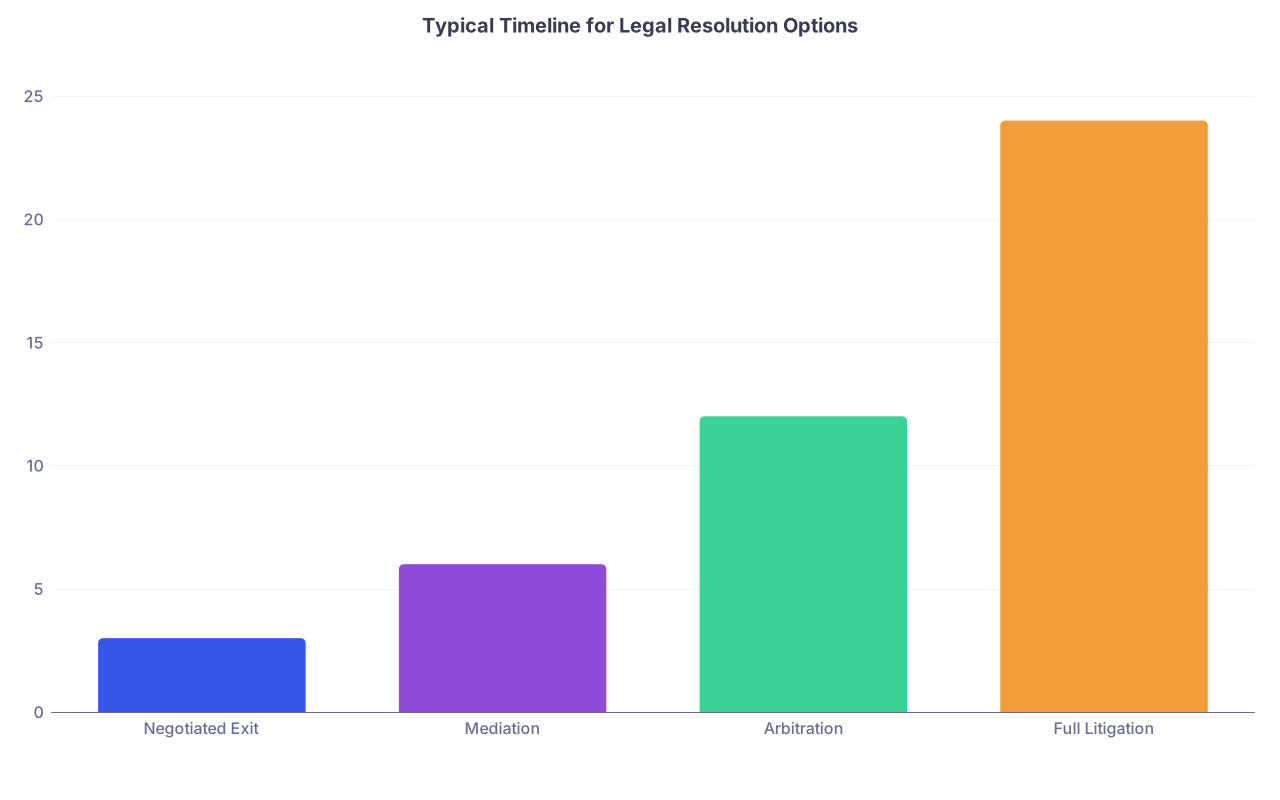
| Category | Value |
|---|---|
| Negotiated Exit | 3 |
| Mediation | 6 |
| Arbitration | 12 |
| Full Litigation | 24 |
(Values approximate duration in months)
What kind of attorney do you actually need?
Look for:
- Securities litigation or investment fraud experience
- Real estate syndication / private placement background
- Preferably someone who has dealt with FINRA/SEC issues
Avoid:
- Generic “business law” attorneys who have never read a PPM
- Lawyers whose first instinct is “Let’s sue everyone, immediately” without cost-benefit analysis
How to make the initial consult efficient
Before you meet:
- Send your one-page summary
- Attach:
- PPM
- Operating Agreement / LPA
- Subscription Agreement
- Key email promises or pitch materials
- List your top 3 goals:
- Exit if possible
- Recover as much capital as is rational
- Avoid throwing good money after bad
Then ask direct questions:
- What legal theories do you see? (e.g., misrepresentation, breach of fiduciary duty)
- Is this likely arbitration or court?
- What is a realistic range of outcomes in similar cases you have handled?
- What fee structure is possible? (contingency, hybrid, hourly with cap)
If you feel like you are being “sold” litigation rather than advised, walk.
5. Regulatory and Professional Pressure: The Quiet Weapons
Not every toxic investment justifies a full-blown lawsuit. Sometimes, the threat of regulatory attention is enough.

| Step | Description |
|---|---|
| Step 1 | Identify Problem |
| Step 2 | Review Documents |
| Step 3 | Group Investors |
| Step 4 | Demand Info |
| Step 5 | Negotiate Exit |
| Step 6 | Consult Attorney |
| Step 7 | Monitor and Document |
| Step 8 | Regulatory or Legal Action |
| Step 9 | Sponsor Responsive |
| Step 10 | Evidence of Misconduct |
Potential oversight bodies (US-focused)
- SEC (Securities and Exchange Commission) – for unregistered offerings, fraud, misleading statements
- State securities regulator – often more responsive for smaller deals
- FINRA – if broker-dealers or financial advisors were involved
- State real estate commission – for licensed agents who mis-sold investments
You strengthen any potential complaint by:
- Having all docs organized
- Showing clear misstatements (marketing vs legal docs vs reality)
- Demonstrating a pattern (multiple investors with same issue)
Do not threaten regulators lightly. Use it when:
- You see obvious misrepresentation or omissions.
- The sponsor is stonewalling.
- You have at least some email or written evidence.
An attorney can also send a letter that quietly hints at regulatory exposure without going nuclear on day one.
6. Special Situations: Capital Calls, Loan Defaults, and “We Need More Money”
Toxic deals often enter a death spiral:
- Asset underperforms
- Sponsor cuts or stops distributions
- Lender pressures or declares default
- Sponsor issues capital calls
- LPs are told: “If you do not send more money, you will be wiped out”
Here is how to think about it logically, not emotionally.
Step 1: Separate “save the deal” from “protect my capital”
Ask:
- How much new money are they asking for relative to original investment?
- What precisely does this new capital do?
- Cure a loan default?
- Fund necessary capex that should have been budgeted?
- Pay operating expenses? (red flag)
- What is the plan if this money is raised? Is there a pro forma version 2.0?
If all you hear is vague “we just need runway,” be very skeptical.
Step 2: Understand dilution and consequences of not funding
The operating agreement should spell out what happens if some LPs fund the capital call and others refuse:
- Common outcomes:
- Non-funders get diluted
- Non-funders convert to a lower class of equity
- Non-funders face forced buyout at discount
Sometimes, not funding is still the rational move. Think triage: you do not pour blood products into a hopeless bleed without a surgical plan.
Step 3: Coordinate with other LPs
Capital calls are a key moment to:
- Demand full transparency from sponsor
- Band together to insist on:
- Detailed plan
- Adjusted fees (sponsor takes a haircut)
- Tighter reporting
- Changed management if necessary
I have seen investor groups get meaningful concessions here: reduced asset management fees, sponsor subordinating their promote, or bringing in a professional third-party operator.
7. Cutting Your Losses and Moving On (Without Repeating the Same Mistake)
At some point, you may decide:
- “I will take 50% back now and be done.”
- “I will ride it to zero but not spend another dollar or another hour on this.”
That is not failure. That is risk management.
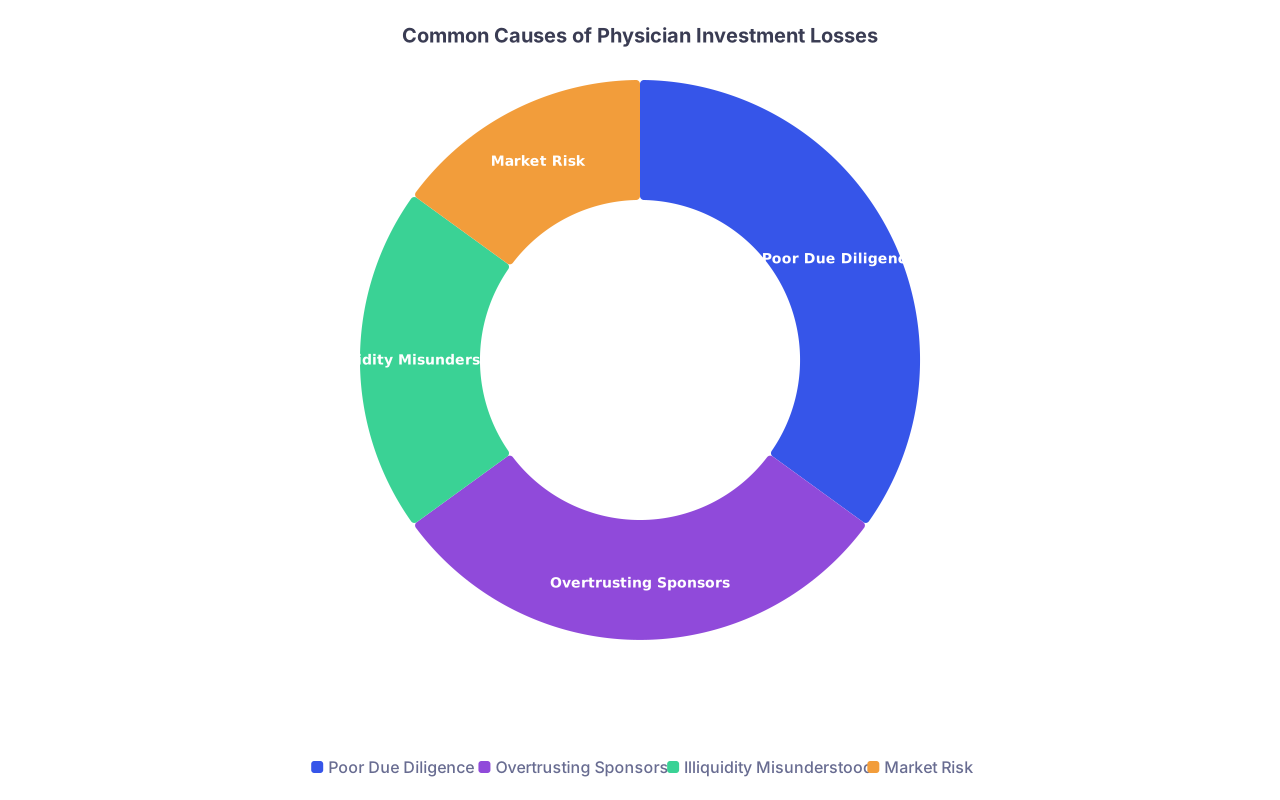
| Category | Value |
|---|---|
| Poor Due Diligence | 35 |
| Overtrusting Sponsors | 30 |
| Illiquidity Misunderstood | 20 |
| Market Risk | 15 |
Conduct a post-mortem like you would on a bad outcome
Ask:
- Where exactly did I miss the signs?
- Did I:
- Read the PPM fully?
- Compare the pitch deck to the legal docs?
- Understand the fee structure?
- Check the sponsor’s track record beyond testimonials?
- Was there social pressure? (friend, partner, colleague pushing the deal)
- Did I invest too much relative to my net worth?
Then turn it into rules.
Example guardrails for future deals:
- Max 5% of net worth per single private deal
- At least one independent third party (not paid by sponsor) reviews key docs
- Never invest within 48 hours of first seeing a deal
- No deals where sponsor cannot clearly explain downside scenarios and past failures
8. A Practical, Stepwise Protocol You Can Follow This Week
Here is the “Problem Solver” version. Concrete. Sequential.

Phase 1 – Clarity (Days 1–3)
- Gather every document (PPM, operating agreement, emails).
- Build a 1-page summary of:
- Basic deal terms
- Your investment
- What went wrong
- Create a simple timeline of:
- Investment date
- Key communications
- When problems started
Phase 2 – Internal Leverage (Days 4–10)
- Re-read:
- Exit clauses
- Transfer restrictions
- Capital call language
- Reporting requirements
- Reach out to at least 2–3 other investors you know:
- Confirm whether they are seeing the same issues.
- Draft and send a calm but firm information request:
- Specific documents
- Specific dates
- Reasonable deadline
Phase 3 – Strategic Escalation (Weeks 2–4)
- If the sponsor responds:
- Analyze the data with other LPs.
- Ask: “Is a negotiated exit or internal restructure possible?”
- If the sponsor stonewalls or answers vaguely:
- Book a consult with a securities / investment litigation attorney.
- Send them your organized packet in advance.
- Decide with counsel:
- Negotiate quietly?
- Send a formal demand letter?
- Prepare for arbitration / mediation?
- Consider regulatory complaints?
Phase 4 – Resolution and Recovery (Months 2–12+)
- Execute whichever path you choose:
- Secondary sale
- Negotiated buyout
- Legal / arbitration process
- Strategic “sit tight and document” while asset plays out
- Once the dust settles:
- Conduct a written post-mortem.
- Set explicit investing rules for future deals.
9. Mistakes I See Physicians Make Over and Over
If you remember nothing else, avoid these.

Waiting too long
- Years go by, statutes of limitation close, records disappear, sponsors go bankrupt or vanish.
Confusing shame with strategy
- “I am smart, I should have known better” is not a legal position. It just keeps you stuck.
Going solo against a coordinated sponsor
- Sponsors often have their own counsel and talking points ready. A scattered group of LPs is easy to play off against each other.
Throwing good money after bad blindly
- Funding every capital call without demanding structural changes is how you double your losses.
Hiring the wrong lawyer
- The real estate closing attorney who did your house is not the person you want for securities litigation.
Ignoring the learning opportunity
- The tuition from a painful deal is already paid. Failing to extract lessons is the real loss.
FAQs
1. Is it ever worth suing over a $50,000 or $100,000 bad real estate deal?
Sometimes yes, often no. The math matters. If your potential recovery after legal fees, time, and stress is marginal, a full lawsuit may be irrational. However, two situations can justify it:
- You are part of a group of investors with a large combined claim, so legal costs are shared.
- There is clear fraud or egregious misconduct, and an attorney is willing to take a contingency or hybrid arrangement.
Many physicians get value from a strong demand letter, negotiation, or arbitration short of full-blown litigation. That is often the sweet spot for mid-sized losses.
2. Can I just walk away and write the investment off on my taxes?
You cannot just “decide” it is worthless. For most passive private investments, you need either:
- A clear taxable event (sale, liquidation, abandonment), or
- Evidence that the investment is wholly worthless under IRS standards.
A CPA familiar with real estate and partnership taxation can guide you. The worst approach is informal: ignoring K-1s, not filing appropriately, or making up a loss without support. That can come back to haunt you in an audit.
3. My colleague who referred me to the deal feels guilty. Should I involve them?
Treat colleagues separately from sponsors. Most physician referrers are not the architects of the deal; they were also investors sold the same story. Exceptions:
- If your colleague was paid referral fees, carried interest, or had a formal role, your attorney will want to know.
- If they made specific misrepresentations to you, that may matter.
But usually, your focus should stay on the sponsors, issuers, and anyone who legally structured and marketed the investment. Preserve relationships with colleagues when you can; you will need honest conversations about what you both missed.
4. What if the deal is bad but not fraudulent – am I just stuck?
“Bad but not fraudulent” still leaves room for constructive action. You may be able to:
- Negotiate better terms (reduced fees, revised waterfall, more reporting).
- Replace or supplement the sponsor with a professional operator.
- Sell your interest at a discount to someone who specializes in distressed positions.
- At least ensure you stop putting new money into a structurally broken situation.
You might not get a clean escape, but you can almost always improve your position if you act early, get organized, and use the right experts.
Open that bad deal folder today and create your one-page summary. If you cannot clearly explain what you bought, when it broke, and what your legal documents actually say, your first problem is not the investment. It is the lack of a plan.