
Your real estate will not sink you. Your lack of a cash reserve strategy will.
Most physicians buying rentals or syndications are doing one of three things:
- Guessing how much cash to hold.
- Copying rules that were made for middle-income W‑2 workers.
- Trusting the “we always distribute quarterly” line from sponsors.
All three are lazy. And dangerous when you earn $300K–$800K and start stacking seven-figure real estate exposure.
Let me walk you through a real cash reserve system that actually fits a physician’s income, tax structure, and risk profile. Not a blog-quote “3–6 months of expenses.” A real framework you can run on a spreadsheet and update once a quarter.
Step 1: Separate Your “Cash Buckets” Before You Blow Up Your Plan
Most physicians mix everything together: checking balance, “emergency fund,” down payment savings, future tax payments, and “extra” cash for the next deal.
That is how people think they are fine at $150K in the bank…and then cannot fund a capital call without wrecking their life.
You need distinct buckets with rules.
Here is the minimum structure:
Personal Emergency Fund (PEF)
- Purpose: Protect your life if income stops (disability, job loss, practice implosion).
- Location: High-yield savings or money market.
- Access: You never touch this for real estate. Ever.
- Target:
- Employed physician: 4–6 months of personal expenses.
- Self-employed / practice owner: 6–12 months of personal expenses.
Tax Reserve (TR)
- Purpose: Federal, state, and local taxes on W‑2/1099 and real estate income.
- Location: Separate savings or brokerage cash sweep.
- Access: Off-limits for deals.
- Target:
- Simple employed doc, no big K‑1 surprises: 15–25% of gross income.
- 1099 + K‑1s from syndications: 25–35% of gross income until your CPA proves you actually need less.
Real Estate Operating Reserves (REOR)
- Purpose: Vacancies, repairs, legal, insurance spikes, rate resets, capital calls.
- Location: Often split – some held at property level, some centrally by you.
- Access: Only for property-related needs.
- This is the heart of this article. We will build this properly.
Opportunity / Deployment Fund (OF)
- Purpose: Dry powder for new investments when things go on sale (or when you want into a great deal fast).
- Location: High-yield savings or short-duration Treasuries / money market in brokerage.
- Access: You can deploy this at will.
- Target: Depends on your deal flow. 3–12 months of your usual investment pace.
If you do not separate these, you will “borrow” from your tax reserve to cover a furnace replacement, then “borrow” from your emergency fund to cover an April tax bill, then panic-sell assets at a bad time.
Fix the buckets first. Then size them.
Step 2: Build a Real Estate Cash Reserve Formula That Matches Your Portfolio
I will give you a formula I actually use with high-earning professionals. You can modify it, but do not wing it.
A. For Directly Owned Rentals (Single-Family, Small Multifamily)
You need two layers:
- Property-level reserves (sitting in that property’s account).
- Global reserves (sitting in a central account you control).
Baseline numbers I like:
Property-level reserve per unit:
- $3,000–$5,000 per single-family or condo.
- $2,000–$4,000 per door for small multifamily (2–10 units), with a higher number for older properties.
Global reserve:
- 1–2% of total property value or
- 3–6 months of total portfolio PITI + operating expenses.
Here is a very simple structure that works for most physicians:
Property Level: $4,000 per single-family, $3,000 per multifamily unit
Global Level: 3–4 months of total portfolio expenses (mortgage + taxes + insurance + utilities common areas + property management)
You can model this in a quick table:
| Portfolio | Units | Property-Level Reserve | Monthly Expenses | Global Reserve (4 months) | Total REOR Target |
|---|---|---|---|---|---|
| 3 SFH | 3 | 3 × $4,000 = $12,000 | $6,000 | $24,000 | $36,000 |
| 8 units | 8 | 8 × $3,000 = $24,000 | $12,000 | $48,000 | $72,000 |
| 12 units | 12 | 12 × $3,000 = $36,000 | $18,000 | $72,000 | $108,000 |
If those numbers feel high to you, that tells me one thing: you are underestimating risk because expenses have not hit you yet.
B. For Syndications / Funds / Passive LP Interests
You do not control the operating account. But you still need to protect yourself against:
- Suspended distributions.
- Capital calls.
- Tax bills from “phantom income” or gains.
So your reserve logic changes. Think in exposure bands.
A simple, physician-appropriate rule set:
- For the first $250K of passive real estate: hold 10–15% as reserve.
- From $250K to $1M: hold 5–10%.
- Above $1M: hold 5% minimum, then adjust based on the actual leverage and risk profile of your deals.
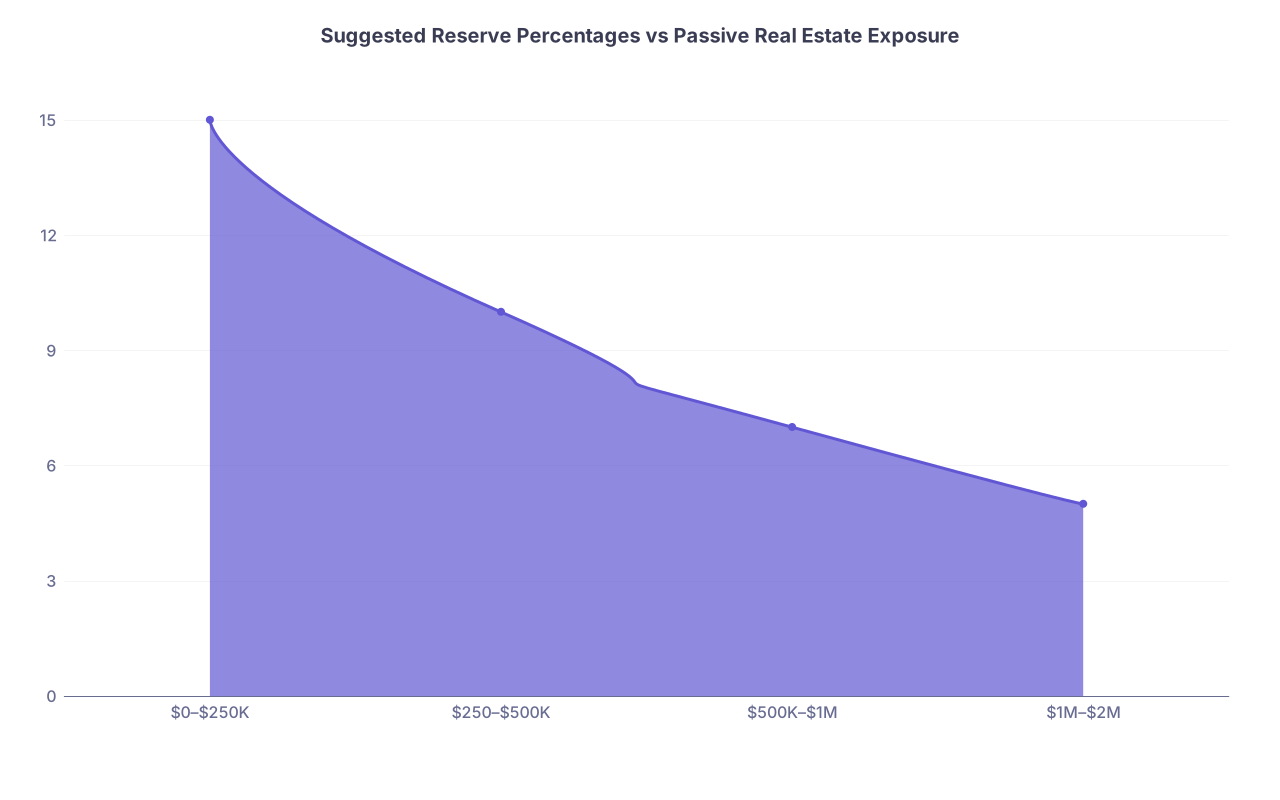
| Category | Value |
|---|---|
| $0–$250K | 15 |
| $250–$500K | 10 |
| $500K–$1M | 7 |
| $1M–$2M | 5 |
So if you have:
- $400K total in syndications:
- First $250K @ 12% = $30K
- Next $150K @ 8% = $12K
- Total: $42K REOR for passive holdings
Tie this reserve into the same real estate reserve pool used for your direct holdings. Just track how much is “for LP positions” versus “for rentals.”
Step 3: Align Reserves With Physician Income Volatility (You Are Not a School Teacher)
Physician income is high but not guaranteed. You face:
- Contract non-renewals and group politics.
- RVU changes that slice your bonuses.
- Partnership buy-in obligations.
- Practice overhead spikes (malpractice, rent, staff).
Your real estate reserve strategy has to respect your income risk, not just your rental risk.
Think about three income profiles:
Stable Employed Physician (Hospital / Large Group)
- Sleep pretty well.
- Strong W‑2, predictable base salary, maybe RVU bonus.
- For you:
- Personal EF: 4–6 months expenses.
- Real estate reserves: Use mid-range values of the formulas above.
- Tax reserve: 20–25% of gross unless CPA says otherwise.
High RVU / Eat-What-You-Kill / 1099
- Income swings 20–40% year to year.
- You pay own benefits, malpractice, retirement, etc.
- For you:
- Personal EF: 6–9 months expenses.
- Real estate reserves: Use upper end of the ranges (e.g., $5K per SFH, 6 months portfolio expenses).
- Tax reserve: 25–35% of gross, no excuses.
Practice Owner / Multi-Entity / High Leverage
- Your life already has business risk baked in.
- Often making $500K–$1M+, but cash can choke if collections drop.
- For you:
- Personal EF: 9–12 months expenses.
- Practice EF: 1–3 months of overhead (this is separate from personal).
- Real estate reserves: Upper range, and closer to 2% of property value global reserve if portfolio is large.
- Tax reserve: Work with CPA monthly. Assume 30–40% combined for planning.
The mistake I repeatedly see: a practice owner surgeon with 20 staff, two office leases, and four syndication positions…holding the same emergency fund and reserves as a hospitalist employee.
You cannot copy rules from lower-risk colleagues. The risk is stacked on you; your reserves must respond to that.
Step 4: Decide Where to Park the Cash (And Avoid Getting Cute)
Cash reserves are not there to make you rich. They are there to prevent you from doing something stupid under pressure.
But you can at least avoid being dumb with them.
Use a tiered storage model:
Tier 1 – Immediate Liquidity (0–3 days)
Where:
- High-yield savings accounts (FDIC insured).
- Money market accounts at your main bank or brokerage.
What:
- Personal EF (at least 50–100% of target).
- Tax reserve for the current year.
- A portion of real estate operating reserves (at least 1–2 months of expenses).
Rule: This tier is boring on purpose. If you brag about the yield, you messed up the mandate.
Tier 2 – Short-Term, Very Low Risk (3–7 days)
Where:
- Treasury money market mutual funds.
- Short-duration Treasury ETFs or individual T‑Bills (3–12 months).
- High-grade ultra-short bond funds (careful with credit risk).
What:
- The “extra” layers of REOR beyond 2 months of expenses.
- Opportunity fund cash you are not deploying immediately.
Liquidity consideration: You need cash within days if your loan rate adjusts badly or a capital call hits. Treasuries and money market funds are typically fine. Do not push further out the risk curve.
Tier 3 – Do Not Put Reserves Here
Let me be blunt about the things that are not reserves:
- Stocks or broad equity index funds.
- Bond funds with significant duration or credit risk.
- Crypto. Hard stop.
- Private credit or interval funds with limited liquidity.
- More real estate.
Those can be part of your investment strategy. They are not your cushion.
Step 5: Build a Simple Decision Tree for Using Reserves
You need explicit rules for when you tap reserves, and which bucket you hit first. Otherwise, everything becomes “I’ll just use the savings and make it up later.”
Here is a clean decision flow:

| Step | Description |
|---|---|
| Step 1 | Unexpected Expense |
| Step 2 | Use Personal EF |
| Step 3 | Use Regular Cash Flow or Delay |
| Step 4 | Use Property Level Reserve |
| Step 5 | Use Operating Budget |
| Step 6 | Use Global RE Reserves |
| Step 7 | Rebuild Property Reserve |
| Step 8 | Pause New Investments until Reserves Rebuilt |
| Step 9 | Personal or Property? |
| Step 10 | Life Threatening or Income Loss? |
| Step 11 | Required to Protect Asset? |
| Step 12 | Exceeds Property Reserve? |
Translate that into practical rules:
Personal emergency?
- Job loss, new disability, family medical disaster → Personal EF only.
- You do not raid RE reserves to keep lifestyle going. You cut lifestyle.
Property at risk?
- Roof failure, major system failure, legal threat, code/permit issues → Property-level reserve first.
- If that is insufficient → Global real estate reserves.
- New countertops for “nice-to-have” upgrades? That is not a reserve use. That is capex planning.
Capital call or syndication issue?
- Reasonable capital call to protect a viable asset → RE reserves or opportunity fund.
- Throwing good money after obviously bad sponsor behavior or hopeless deal → Case-by-case. I would not automatically bail out every deal.
After any major use of reserves → automatic pause on new investments until you are back to your target reserve levels. No exceptions.
This is how you avoid the cascade where:
- You invest aggressively.
- Expenses jump.
- You cover from savings “just this once.”
- A second event hits while you are exposed.
- You panic-sell things at a loss.
Step 6: Make the Strategy Dynamic – 90-Minute Quarterly Review
Physician life is busy. If your system takes six hours a month, you will not do it.
You need a quarterly 90‑minute check-in that updates your reserves without fuss.
Here is the checklist you actually follow:
Update Portfolio Snapshot (15 minutes)
- List each property, its current approximate value, mortgage balance, and monthly expenses.
- List each syndication/fund with current basis (invested capital, not projected value).
- Total up:
- Direct property value.
- Direct portfolio monthly expenses.
- Passive real estate exposure (invested capital amounts).
Recalculate RE Reserves Target (20 minutes)
- Direct rentals:
- Property-level:
- SFH: # × $4,000 (or your chosen number).
- Multifamily: units × $3,000 (or your number).
- Global: 3–6 months of portfolio expenses.
- Property-level:
- Syndications/LP:
- Use your tiered % formula based on total invested.
- Sum = Updated REOR Target.
- Direct rentals:
Check Actual Cash vs Target (10 minutes)
- How much in:
- Property-specific accounts.
- Central reserve accounts (Tier 1 + Tier 2).
- Compare Actual RE Reserves vs Target RE Reserves:
- If short: set a monthly auto-transfer from your clinical income.
- If excess: either:
- Move down to Opportunity Fund, or
- Deploy to pay down risky debt (HELOC, variable rate, etc.).
- How much in:
Scan for Income/Risk Changes (15 minutes)
- Has your job changed (new contract, RVU system, bonus structure)?
- Have you taken on new practice overhead?
- Any big new liabilities (college decision, new house, family support)?
- If risk increased materially: bump your targets:
- Personal EF +1–3 months.
- RE reserves +1–2 months of expenses or +0.5–1% of property value.
Tax Reserve Check (15 minutes)
- With CPA or using a tax projection tool.
- Estimate current year liability based on:
- W‑2 + 1099 income.
- K‑1s and projected real estate losses/gains.
- Adjust your tax reserve contributions:
- Increase if your real estate is starting to generate positive income.
- Decrease cautiously only if you consistently over-save and your CPA confirms.
Document and Decide (15 minutes)
- One-page summary:
- Current reserves by bucket.
- Targets.
- Gap or surplus.
- Action items: “Transfer $X/month to reserves until December,” “Move $30K from HYSA to T‑bills,” etc.
- Schedule next review.
- One-page summary:
This can be a Sunday morning exercise with coffee. Once the structure is built, it is plug-and-play.
Step 7: Integrate Debt Strategy With Reserves (Especially HELOCs and Adjustables)
A surprising number of physicians think a HELOC is a “reserve.” That is backwards.
A HELOC is access to more leverage. Helpful during opportunity, dangerous during stress.
Here is how to treat different debt types:
Fixed-rate 30‑year mortgages on investment properties
- Lower immediate risk.
- You can hold lower end of your reserve bands if everything is fixed and long-term.
Adjustable-rate (ARMs), interest-only, bridge loans
- You must assume payments can jump significantly.
- Hold extra:
- 1–2 additional months’ portfolio expenses in reserves or
- 0.5–1% of total property value on top of existing global reserve.
- If you have a large ARM exposure rolling in the next 2–3 years, build a specific rate reset reserve bucket.
HELOC or personal LOC used for down payments
- This is leveraged down payment. Not inherently wrong.
- Risk control:
- Do not treat HELOC capacity as reserves. Zero.
- Keep at least 50–100% of your HELOC balance mirrored in cash or quickly liquid assets until the deal is de-risked (stabilized, refi complete, etc.).
Consumer debt (credit cards, car loans) floating around
- Before you grow real estate reserves aggressively, clean this up.
- A physician with $25K at 18% APR and a $1M real estate portfolio is misallocating risk.
Big picture: reserves reduce your fragility. Leverage increases it. Size reserves based not just on asset size, but on how leveraged and rate-sensitive everything is.
Step 8: Coordinate With Your CPA and Attorney (So Your Strategy Survives Contact With Reality)
The best cash reserve strategy dies quickly if it ignores:
- Tax timing.
- Legal structure.
- Lender covenants.
You need a quick run-through with two people: your CPA and your real estate attorney (or asset protection attorney).
What to check with your CPA:
- How real estate losses and depreciation are actually affecting your tax bill.
- Likelihood of future K‑1 surprises (big gains when assets sell, recapture events).
- Estimated quarterly payments required to avoid penalties – especially when you start getting real distributions.
- Whether your real estate activity is passive or non-passive for tax purposes.
Goal: Align your Tax Reserve bucket with actual projected liability so you do not rob reserves to cover April surprises.
What to check with your attorney:
- Entity structure:
- Where are reserves held?
- Are you accidentally co-mingling funds across entities in a way that destroys asset protection?
- Operating agreements (for partnerships/LLCs):
- Capital call rules.
- What happens if you do not meet a capital call?
- Any provisions that require minimum cash at the entity level?
Sometimes, keeping large reserves inside an entity makes sense (for asset protection). Other times, holding more centrally under your personal umbrella but outside high-risk entities is better. That depends on your state laws and structure.
Do not guess that part. Spend an hour with your lawyer; it is cheaper than being sloppy.
Step 9: Example: Putting It All Together for a Mid-Career Hospitalist
Let me make this concrete.
Profile:
- 42-year-old hospitalist, W‑2, making $320K/year.
- Married, two kids.
- Personal monthly spending: $12K (all-in).
- Real estate:
- 3 single-family rentals, each $300K value, PITI+expenses per property: $1,800/month.
- 2 multifamily LP deals, $100K each (total $200K passive).
- Debts:
- Primary home fixed-rate 3%.
- Rental mortgages all 30‑year fixed. No HELOCs.
Here is the build:
Personal EF
- Stable employed → 4–6 months personal expenses.
- Target: 5 months × $12K = $60K in high-yield savings.
Tax Reserve
- W‑2 hospitalist with some passive losses from real estate, no crazy K‑1 gains yet.
- Use 22% of gross as working estimate until CPA refines:
- $320K × 22% ≈ $70K.
- Keep that growing in a separate tax account, adjusting quarterly with CPA.
Direct Rental Reserves
- Property-level: 3 × $4,000 = $12K in each property’s own checking or a consolidated rental account with clear tracking.
- Global:
- Total rental expenses: 3 × $1,800 = $5,400/month.
- 4 months global reserve: 4 × $5,400 = $21,600.
- Total direct rental REOR: $12K + $21,600 = $33,600.
Passive Real Estate Reserves
- $200K in syndications.
- Tiered rule: first $200K @ 12% = $24K.
- So LP RE reserve: $24K.
Total Real Estate Operating Reserves (REOR)
- Direct: $33,600
- LP: $24,000
- Total: $57,600
Placement
- At least $20K of REOR in immediately available high-yield savings.
- Remaining ~$37K in a Treasury money market or 3–6 month T‑bills ladder.
Opportunity Fund
- Wants to buy one new property per year needing ~ $80K down.
- Holds $40K–$60K as an opportunity fund, separate from reserves.
So total recommended cash balance (excluding taxable investments):
- Personal EF: $60K
- Tax Reserve: ~$70K (adjusting with CPA)
- REOR: ~$58K
- Opportunity Fund: ~$50K
Total: around $238K in cash-like instruments, with clear roles. For a $320K earner with a seven-figure real estate exposure, that is entirely appropriate.
When he calls me saying, “I have $150K, I want to put it all into the next fourplex,” the answer is: No. Fund your buckets first.
Step 10: When Can You Safely Relax Reserves?
You do not need to live your entire life at maximum paranoia.
You can lighten reserve intensity when:
- Your real estate portfolio is largely unleveraged (low or no mortgages, fixed rates, long-term clarity).
- Your clinical income is stable and diversified (multiple contracts, ancillary income, larger savings).
- You have large, easily liquidated taxable investments (broad index funds, not locked private deals) that effectively act as a second-line backup.
What I rarely recommend: going below the baseline framework you built. Instead of cutting reserves, you adjust by:
- Reducing growth pace.
- Paying down risky debt.
- Building your taxable brokerage so that your “Plan B” resources outside of formal reserves are bigger.
Key Takeaways
- Treat cash reserves as a system of buckets with rules, not a random bank balance.
- Size real estate reserves using clear formulas tied to units, expenses, leverage, and passive exposure – not vague comfort levels.
- Protect your physician income and sleep by keeping reserves boring, liquid, and separate from your urge to chase the next deal.