The default asset protection plan for physicians is delusional optimism.
“Nothing’s going to happen. I have good insurance.” That works—until it does not. If you are stacking meaningful real estate outside your retirement accounts, you need to stop thinking like a W‑2 employee and start thinking like a target.
Let me break this down specifically: LLCs and trusts do two completely different legal jobs. Mixing them up, or half‑implementing both, is how smart physicians end up with very expensive structures that do almost nothing in court.
This is about structuring real estate for physicians—not generic asset protection theory. Different risk profile. Different types of plaintiffs. Different mistakes.
The Real Risk Landscape for Physician Landlords
Before arguing LLC vs trust, you need clarity about what you are actually defending against.
The big buckets:
- Clinical malpractice claims
- Personal liability unrelated to medicine (car accidents, personal guarantees, divorce)
- Real estate–related claims (tenant injury, habitability, contractor injury, accidents on site)
- Predatory litigation once someone finds out you own eight doors free and clear
Insurance is your first line—yes. But every malpractice defense lawyer I know has stories where policy limits were at risk or exceeded. And plaintiff attorneys routinely run asset checks before deciding how hard to push.
Real estate is an easy target. Visible. Recordable. Often unprotected.
So the questions you should be asking:
- If a tenant sues over a deck collapse, how far can that claim reach? Just that property? All your properties? Your brokerage account and kids’ 529s?
- If you are hit with a seven‑figure personal judgment unrelated to real estate, can a creditor take the equity in your rentals?
- If you die unexpectedly, do these properties get tied up in probate for 18–24 months while your spouse tries to deal with residency schedules, kids, and lawyers?
LLCs and trusts answer different sets of these questions.
What an LLC Actually Does for Your Real Estate
An LLC is a liability containment box. That is its core job. Full stop.
Not tax magic. Not secrecy fairy dust. A box.
You can use that box in two main ways:
- To isolate property-level risks (a tenant falling through that rotten deck)
- To silo assets from each other and from your personal balance sheet
Core Asset Protection Function
When structured and used correctly, an LLC:
- Shields your personal non‑LLC assets from LLC‑level claims
- Can insulate one property from problems at another property (if you use separate entities)
- Adds a layer of difficulty for creditors chasing you personally from reaching LLC‑owned assets
That “when used correctly” caveat is where most physicians fall apart.
Common sloppy behavior I see constantly:
- Buying with personal cash and “planning” to deed into an LLC later (and never getting to it)
- Deeding a property into an LLC but never changing leases, insurance, or bank accounts
- Using one big LLC for everything you own in three different states
- Signing personal guarantees, then believing the LLC magically erases that
Here is what competence looks like.
| Scenario | Recommended Structure |
|---|---|
| First single family rental | Single member LLC in your home state or property state |
| Small portfolio (2–5 units, same state) | One LLC, consider series LLC if available and cost effective |
| Higher‑value or risky property (short‑term rentals, pools) | Separate LLC for that property |
| Large portfolio (10+ doors or mixed states) | Holding LLC plus individual property LLCs or series cells |
The details (state choice, series LLCs, parent‑subsidiary models) are nuanced, but the principle is consistent: one entity should not be allowed to sink the entire ship.
How LLCs Actually Protect You in Real Estate Lawsuits
Two directions matter:
- Inside‑out risk – Something happens at the property.
- Outside‑in risk – Something happens in your life, and a creditor wants your property equity.
Inside‑out:
- Tenant trips on broken stairs at Property A
- Tenant sues owner of Property A
- If Property A is titled in “123 Main Street LLC,” that is the defendant
- Judgment is limited to assets of that LLC (property equity, LLC bank account), not your personal portfolio, assuming no personal negligence and no veil‑piercing issues
Outside‑in:
- You cause a multi‑car accident on the way to the hospital
- Policy limits not enough; plaintiff attorneys get a personal judgment
- They look at what you own. If properties are titled to LLCs, they have to attack your membership interest, which is harder for them in many states
- Some states offer “charging order” protection, limiting them to economic distributions only, not forcing a sale of the property
That second category (outside‑in) depends heavily on state law. Nevada, Delaware, Wyoming get marketed aggressively. For a practicing physician with real property physically located in another state, that marketing is often more noise than substance; the property state’s law still matters.
What Trusts Actually Do (And What They Do Not Do)
Most physicians think “trust” means “asset protection.” That is usually wrong.
Revocable living trusts—what most estate attorneys set up:
- Do not protect assets from your creditors during your lifetime
- Do not shield you from lawsuits
- Do not add a liability wall the way an LLC does
What they do:
- Avoid probate
- Centralize management if you are incapacitated
- Control distributions after your death
- Provide some degree of privacy (depending on state and recording practices)
Irrevocable trusts are a different beast:
- Can provide real asset protection if:
- Properly drafted,
- Properly funded,
- Done before there is a known or foreseeable claim
- Usually require you to give up some direct control
- Can have adverse tax and financing consequences if done badly or too aggressively
So you have to be extremely specific:
- Revocable living trust = estate planning tool, not a shield
- Irrevocable trust (properly structured) = potential shield, at the cost of control and complexity
Yet every year I see physicians pay $10–20k for shiny “asset protection trusts” that are nothing more than revocable living trusts with a sales pitch.
LLC vs Trust: You Are Solving Different Problems
The right comparison is not “LLC or trust?” It is:
- LLC = day‑to‑day liability management and siloing risk
- Trust = ownership wrapper, estate planning, legacy, sometimes advanced protection
You often want both, layered.
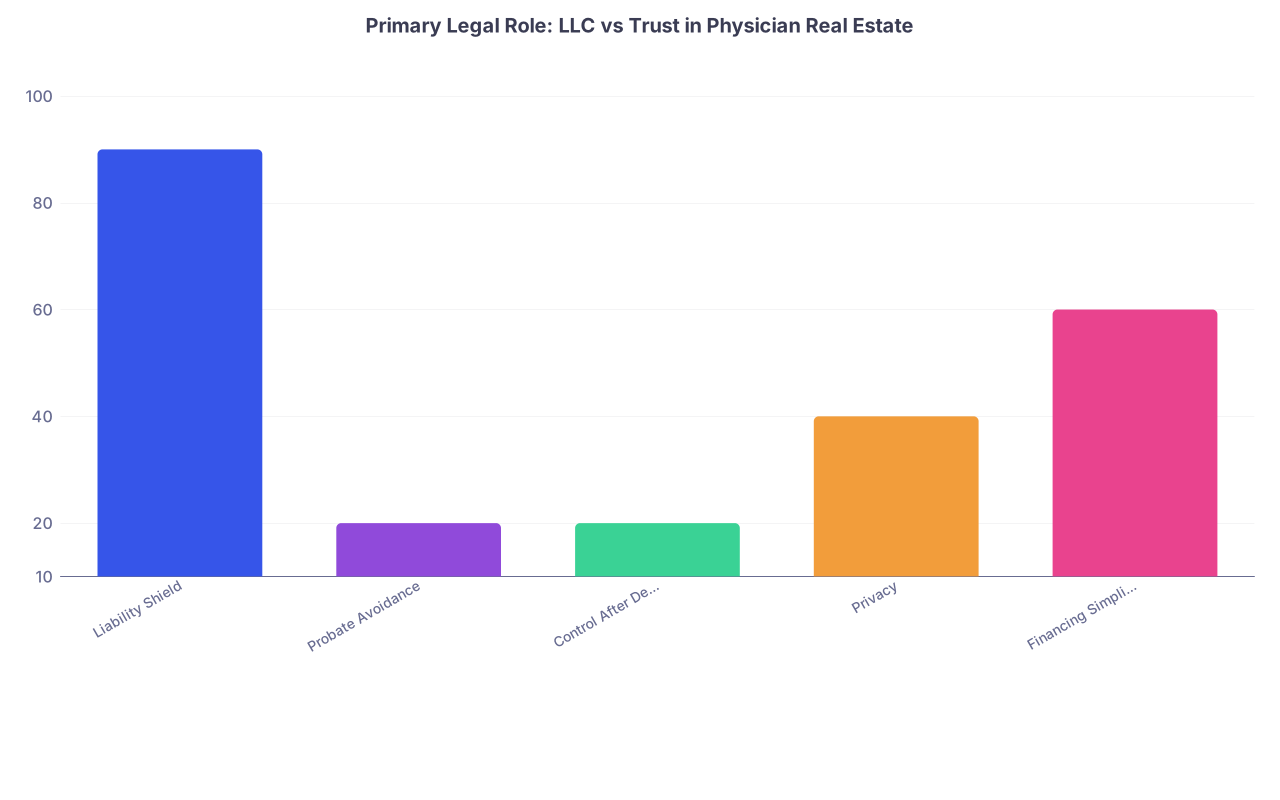
| Category | Value |
|---|---|
| Liability Shield | 90 |
| Probate Avoidance | 20 |
| Control After Death | 20 |
| Privacy | 40 |
| Financing Simplicity | 60 |
Interpretation:
- LLC dominates liability shielding
- Trust dominates control after death and probate avoidance
- Privacy and financing sit in the middle and depend heavily on state law and lender behavior
Let us walk through specific physician‑relevant scenarios.
Scenario 1: The Classic “Doc with 3 Rentals” Problem
You are a hospitalist or anesthesiologist in your 40s. Married. Three single family rentals in your state. About $1.2M total market value, $400k equity. You have a revocable living trust that your estate attorney did five years ago.
Here is a competent structure, step by step.
- Form a basic LLC in your home state or the property state. You own 100% of it as an individual—initially.
- Retitle each property into the LLC. That means:
- Deed changes
- Leases updated to list LLC as landlord
- Insurance policies updated to name the LLC as insured/additional insured
- Rent flows into an LLC bank account
- Check loan covenants. Most conventional lenders tolerate post‑closing transfers into a single‑member LLC, but you do it quietly and with your attorney’s blessing.
- Assign your LLC interest to your revocable living trust.
- Now your trust owns the LLC
- Upon your death, your successor trustee steps into ownership and management without probate
Liability shield flows like this:
- Tenant sues → LLC is defendant → exposure limited to LLC assets
- You die → properties do not hit probate → trust owns LLC, and distributions follow your instructions
You get:
- Asset segregation (one LLC; you might or might not split later depending on growth)
- No extra estate planning complexity
- Clean transition for your spouse and kids if you get hit by that 3 a.m. drunk driver
No offshore structures. No Wyoming layering circus. Just standard, boring, effective.
Scenario 2: Building a Larger Portfolio or Group Practice Syndicate
Different picture now. You and two cardiology partners are syndicating deals or buying a 20‑unit building. Or you personally are moving toward 20+ doors.
You must separate three concepts:
- Operating entity – Manages the deal, takes fees, holds bank accounts
- Property ownership entity – Owns title to the building
- Your personal estate plan – How your ownership flows if you die or are incapacitated
A common structure:
- 123 Main Street LLC (property owner)
- Doctor Capital Management LLC (the GP or manager entity)
- Each physician investor owns membership units in 123 Main Street LLC, often through their revocable trust or a specially drafted family trust
Now, where do trusts come in?
- For you personally: Your revocable trust (or better yet, a physician‑specific estate plan) owns your membership interest in 123 Main Street LLC. That way your LP/GP interest transfers cleanly.
- For advanced families: You might use irrevocable trusts (e.g., spousal lifetime access trust, SLAT; or a dynasty trust for kids) to own some or all of your real estate LLC interests, to move appreciation out of your estate.
In that advanced case, asset protection looks like this:
- Tenant injury → 123 Main Street LLC on the hook (inside‑out risk managed)
- Personal lawsuit against you → They can try to get at your membership interest in the LLC, but:
- That interest may be held by a discretionary irrevocable trust
- That trust may have spendthrift provisions and its own jurisdictional protections
- You have separated beneficial enjoyment from legal ownership
This is where the asset protection/estate planning/tax planning triad finally starts to make sense. But the complexity is justified only if your net worth and risk profile justify it.
Key Tax Differences: LLC vs Trust for Real Estate
Let us be blunt: almost all of this is tax transparent in the basic physician use cases.
- Single‑member LLC with you as the owner → disregarded entity for federal tax → you report on Schedule E as if you owned it directly
- Revocable living trust → grantor trust → tax‑invisible → still Schedule E
- Multi‑member LLC → partnership → Form 1065 and K‑1s to owners
- Irrevocable trusts → can be either grantor or non‑grantor, and this matters a lot
What physicians screw up is depreciation and income shifting when they over‑complicate trust structures.
Three rules:
- Owned by you or your revocable trust or your single‑member LLC? Tax treatment is the same.
- Irrevocable trust owning rentals? Confirm who gets depreciation deductions and whether passive loss rules play differently.
- Some “asset protection trusts” sit in high‑tax states or pay trust tax rates on retained income (which climb very quickly). That can be a nasty surprise.
You do not pick LLC vs trust for tax reasons in 90%+ of standard physician real estate situations. You pick them for liability and estate reasons, then confirm you are not causing adverse tax effects.
Privacy, Public Records, and Being a Physician Target
There is a quiet, ugly reality: some plaintiffs’ lawyers actively search property records and corporation databases once they know they have a physician defendant. You can hear it in strategy meetings:
“He has three houses and a couple of rentals. We are not settling this for policy limits.”
Can LLCs and trusts help with privacy? Yes—but only to a degree.
What is Actually Public
Typically public:
- Property deeds and parcel data (owner name, mailing address)
- LLC filings (registered agent, possibly managers/members depending on state)
- Trust names if you record deeds directly into “The John Smith Revocable Trust”
Less visible:
- Beneficiaries of trusts
- Underlying ownership when you use layered entities and corporate trustees
- Operating agreements and trust instruments (unless disclosed in litigation)
Basic steps that improve your privacy without going full‑conspiracy:
- Title properties in LLCs, not in “Dr. Jane Smith” personally
- Consider using nondescript LLC names (“Oak Ridge Holdings LLC,” not “Smith Cardiology Investments LLC”)
- Keep revocable trust names bland and non‑identifying (“Smith Family Trust” is better than “Dr. Smith Neurosurgery Trust”)
For advanced plays, some physicians use:
- Wyoming/Delaware holding LLCs as members of state‑level property LLCs
- Trusts as members of LLCs (so your personal name never shows on corporate records)
- Professional registered agents instead of your home address
Here is the catch: if you are sued and things get serious, plaintiffs’ counsel can usually peel back these layers with subpoenas. Privacy is a speed bump, not an impenetrable wall. It still helps, because many cases settle before that effort is justified.
Where LLCs Beat Trusts, and Where Trusts Beat LLCs
Let me be very direct.
LLCs win at:
- Isolating property‑level risk
- Creating clear business boundaries between assets
- Managing multiple owners with different contribution and distribution rules
- Fitting cleanly into banking and insurance workflows
Trusts win at:
- Skipping probate
- Centralizing incapacity planning (who runs your rental portfolio if you are in the ICU)
- Controlling distributions to heirs who may or may not be responsible
- Long‑term legacy and dynasty planning
Neither is optional if you plan to grow a seven‑figure real estate side portfolio as a physician.
| Function | LLC | Revocable Trust |
|---|---|---|
| Shields personal assets from tenant lawsuits | Strong | Weak |
| Avoids probate for rental properties | No | Yes (if properly funded) |
| Manages co‑owners and syndications | Strong | Awkward |
| Controls distributions to kids after death | Weak | Strong |
| Easy with conventional lenders | Usually | Medium (needs coordination) |
Notice how complementary they are. The right question is “How do I layer them?” not “Which one do I pick?”
Common Physician Mistakes (And How to Fix Them)
I will list these bluntly, because I see them over and over.
- Owning rentals in your own name
- Fix: Form an LLC, retitle, update leases and insurance, coordinate with lender and CPA.
- Deeding directly into your revocable trust and thinking you have liability protection
- Fix: Use the trust to own the LLC. The LLC owns the property. The trust does not replace the LLC.
- Using one LLC for everything forever
- Fix: As equity and door count increase, split high‑risk / high‑equity properties into separate entities.
- Buying expensive “asset protection trust” packages without understanding control
- Fix: Ask, in writing: “Is this revocable or irrevocable? Who is the grantor? Who files the tax return? What happens if I am sued next year?” If the answers are vague, walk.
- Ignoring estate planning entirely while building a significant portfolio
- Fix: Basic revocable trust, pour‑over will, powers of attorney, and beneficiary designations that reflect your real estate assets and LLCs.
Here is a mental model:
- LLC = fire doors between compartments of your financial building.
- Trust = building’s ownership and inheritance blueprint.
You would not put fire doors in the wrong places just because a salesperson told you to. Same logic here.
Practical Implementation Timeline for a Busy Physician
Let me map this to an actual calendar. This is what it looks like when done like a professional, not as a panic project the week you close on property number five.
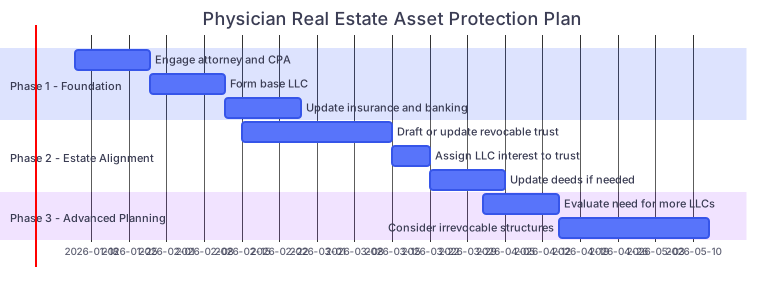
| Task | Details |
|---|---|
| Phase 1 - Foundation: Engage attorney and CPA | a1, 2026-01-15, 2w |
| Phase 1 - Foundation: Form base LLC | a2, after a1, 2w |
| Phase 1 - Foundation: Update insurance and banking | a3, after a2, 2w |
| Phase 2 - Estate Alignment: Draft or update revocable trust | b1, 2026-02-15, 4w |
| Phase 2 - Estate Alignment: Assign LLC interest to trust | b2, after b1, 1w |
| Phase 2 - Estate Alignment: Update deeds if needed | b3, after b2, 2w |
| Phase 3 - Advanced Planning: Evaluate need for more LLCs | c1, 2026-04-01, 2w |
| Phase 3 - Advanced Planning: Consider irrevocable structures | c2, after c1, 4w |
Notice the order:
- LLC basics first (so you stop bleeding risk now).
- Trust alignment second (so your family is not left with a mess).
- Advanced strategies only after you actually have something worth over‑engineering.
Short‑Term Rentals, High‑Risk Properties, and “Problem Assets”
Physicians love short‑term rentals and small multifamily properties. Plaintiff attorneys love them too.
These are not vanilla single family long‑term rentals. Higher guest turnover. More injuries. More ambiguity about who is in control on site.
For these, I usually recommend:
- Separate LLC per “problem” property or per small cluster if equity is modest
- Higher umbrella and commercial liability coverages specifically endorsed for STR/midterm use
- For large portfolios of STRs, series LLCs (in states where they are respected and insurable) or a parent LLC with child entities can make sense—but only with an attorney who actually understands series entities.
Where do trusts fit in? Exactly the same place as before:
- Your revocable trust or estate plan owns the LLCs
- If you are doing aggressive tax/estate moves, you may push some LLC interests into irrevocable trusts or family limited partnerships
The key principle remains: do not let a slip‑and‑fall at your ski Airbnb take down your entire investment life.
When to Consider Irrevocable Trusts as a Physician Investor
Most of you are not there yet, and that is fine.
Irrevocable trusts in this context are typically justified when:
- Your net worth (including practice equity and investments) is approaching or exceeding estate tax thresholds for your jurisdiction
- You are in a high‑risk specialty, have a large visible real estate portfolio, and have a zero‑tolerance approach to creditor exposure
- You want to lock in generational planning (e.g., dynasty trust) while you are still early in your building phase
What you must understand before signing anything:
- You are giving up some degree of control or direct access.
- Undoing these later is hard, sometimes impossible without court involvement.
- The trust needs a real funding plan—transferring minority LLC interests, not just “we will think about it.”
Often the move is:
- Keep day‑to‑day control and GP roles in manageable LLCs you control
- Move LP or non‑voting membership interests into properly structured irrevocable trusts for spouse/children
- Coordinate with your malpractice coverage and umbrella policies so your insurance and entity planning reinforce each other
This is not a do‑it‑yourself domain. Any time you see “asset protection trust” plus “offshore” plus “one‑size‑fits‑all,” assume you are the product.
The Real Answer: LLCs + Trusts, On Purpose
If you want a one‑sentence rule for physician real estate:
Own properties in LLCs. Own the LLCs through trusts. Coordinate both with a CPA who understands real estate and an attorney who has actually defended asset structures in litigation, not just sold them in seminars.
You are not trying to become bulletproof. That is a fantasy.
You are trying to:
- Make yourself a less attractive litigation target
- Segregate risk so one bad event is survivable
- Ensure that, if something happens to you, your family is not stuck in probate court trying to figure out how to refinance a rental you owned personally with no clear plan
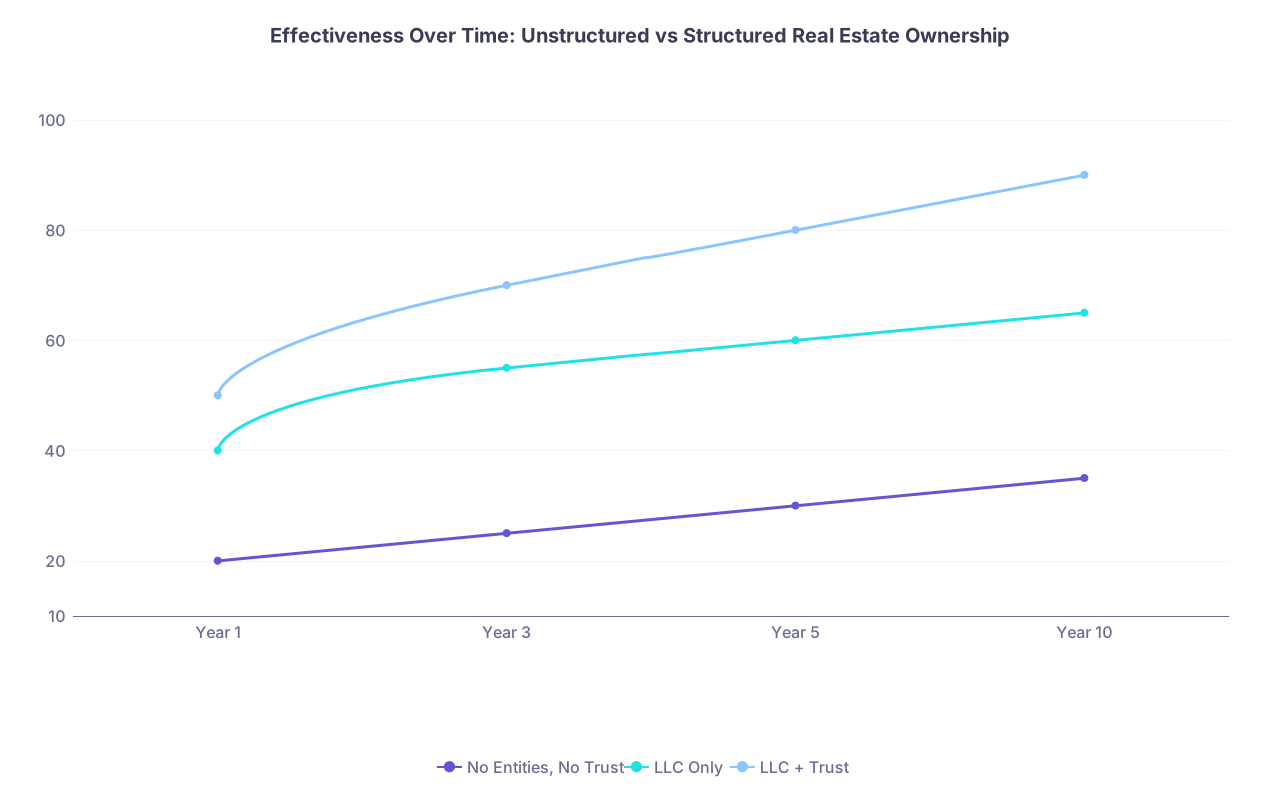
| Category | No Entities, No Trust | LLC Only | LLC + Trust |
|---|---|---|---|
| Year 1 | 20 | 40 | 50 |
| Year 3 | 25 | 55 | 70 |
| Year 5 | 30 | 60 | 80 |
| Year 10 | 35 | 65 | 90 |
That graph is conceptual, but the trajectory is real: the more your portfolio grows, the more the combination of LLCs and trusts matter.
You are a physician stepping into real estate, not a full‑time developer. You do not need a Wall Street‑level structure tomorrow. You do need a deliberate plan, implemented early enough that it is boring rather than surgical.
Start with one LLC. Align it with your existing revocable trust. Clean up your deeds, leases, and insurance. Then, as your number of doors and equity increase, revisit whether you need multiple LLCs, advanced trusts, or family entities.
Once those pieces are in place, you can worry about the next layer—tax optimization, partnerships, and scaling your portfolio beyond your own balance sheet. But that is the next phase of the journey, and it deserves its own playbook.