
The phrase “guaranteed cash flow” in real estate is marketing fiction. For a physician investor, treating it as fact is how you end up funding someone else’s retirement instead of your own.
Let me be blunt: the most dangerous number in any real estate deal is not the projected IRR or “equity multiple.” It’s the monthly or annual cash flow they tell you you’ll receive as if it were a pension check backed by the U.S. government. It’s not. And what you do before you wire money determines whether that cash flow survives the first interest rate hike, insurance spike, or occupancy dip.
You’re a physician. Which means:
- People assume you have money.
- People assume you don’t have time.
- People assume you won’t read the fine print.
That combination is catnip for slick “passive income” pitches promising safe, predictable distributions. The reality is very different.
Let’s tear this apart properly.
The “Guaranteed Cash Flow” Lie
In the real world, cash flow is not guaranteed. It’s engineered—and often engineered mostly on Excel, not in reality.
Sponsors love to say things like:
- “8% preferred return, paid quarterly.”
- “Targeting 6–7% annual cash-on-cash from year 1.”
- “Stabilized asset with long-term leases, dependable cash flow.”
Those sound like guarantees. They are not. At best they are targets. At worst, they are bait.
Here’s what the data and deal structures actually show:
- “Preferred return” is a priority of distribution, not a promise of payment. If the property doesn’t generate enough distributable cash, that “8% pref” just accrues on paper. No one goes to jail; you just don’t get paid.
- Early distributions are frequently return of your own capital, dressed up as income. I’ve reviewed K-1s where investors were bragging about “8% cash flow” while their capital account was steadily dropping.
- Most pro formas assume smooth occupancy and rent growth. Real properties don’t behave that way. Collections hiccup, HVAC dies, property tax reassessments happen, insurance doubles after a storm three states away.
You’d never accept a “guaranteed cure rate” from a med student quoting a PowerPoint. Yet many physicians accept “guaranteed cash flow” from a sponsor whose entire “underwriting” is a spreadsheet with 3% rent growth every year.
The core myth: that if the slide deck shows 7% annual distributions, it’s just a matter of waiting for the deposits.
Reality: those distributions are contingent on a chain of assumptions, any of which can break.
Where Cash Flow Actually Comes From (and How It Dies)
Before you can verify anything, you need to understand what you’re verifying.
Net cash flow to investors comes from this basic equation:
Collected rents + other income – (operating expenses + capital expenses + debt service + reserves) = Distributable cash
Every “guaranteed” cash flow depends on a few choke points.
Choke Point 1: Collections vs. “Pro Forma” Rent
A sponsor shows you “$1,500/month per unit” and 95% occupancy. Look great? Maybe. But what matters is:
- Actual average collected rent over the past 12–24 months
- Concessions (free month, discounts) to get those leases
- Bad debt and delinquency trends, especially post-2020
You want to see whether the “projected” rents are anywhere near what residents are demonstrably willing and able to pay.
Choke Point 2: Operating Expenses
Underwriting games usually live here. I’ve seen multifamily OMS claiming 35% expense ratios in markets where historical data shows 45–50% is normal.
Big red flags:
- Unrealistically low repairs & maintenance for older properties
- Under-budgeted property taxes (in many states, purchase triggers reassessment)
- Insurance estimates that haven’t been updated post-2022 premium spikes
- Property management fees missing “lease-up fees,” admin fees, etc.
When expenses rise 10–20% above underwriting—which is common—your neat 7% cash-on-cash evaporates.
Choke Point 3: Debt Structure
This part gets glossed over in the nice glossy deck.
Key killers of cash flow:
- Floating-rate debt with minimal or no interest rate caps
- Short interest-only periods that end before the business plan truly stabilizes
- Aggressive leverage ratios that leave no margin for revenue dips
When interest expense jumps or amortization kicks in, your “guaranteed cash flow” checks can drop to zero overnight.
What Physician Investors Must Verify – Not Assume
You’re used to protocols and checklists. Here’s the same idea for your capital.
There are five things you absolutely must verify before you believe any cash flow projection.
1. Verify the Source of Distributions: Profit vs. Principal
Ask this directly:
“Are projected year 1 and year 2 distributions fully covered by projected net operating income after reserves, or is any portion modeled as a return of capital?”
And then verify it yourself.
You want to see:
- Projected Net Operating Income (NOI)
- Less: debt service
- Less: reasonable reserves (capex and operating)
- What’s left is what’s truly available for distributions.
If the deck shows 7% cash-on-cash, but actual post-debt-and-reserves cash only supports 3–4%, the rest is likely just your capital coming back early to make the numbers look pretty.
| Year | NOI ($) | Debt Service ($) | Reserves ($) | True Cash Flow (%) | Advertised Distribution (%) |
|---|---|---|---|---|---|
| 1 | 800,000 | 500,000 | 150,000 | 3 | 7 |
| 2 | 850,000 | 500,000 | 150,000 | 3.5 | 7 |
| 3 | 900,000 | 500,000 | 150,000 | 4 | 7 |
If this is the math, the “guaranteed” 7% is just accelerated return of your own money.
2. Verify the Assumptions Against Market Reality
Some things to compare against real sources:
- Rent growth: compare to local historical data, not sponsor’s fantasy curve.
- Occupancy: check trailing 12-month actuals and comps.
- Expense ratios: compare to benchmarks for that asset type and market.
A decent sanity test:
- For stabilized multifamily, total operating expenses are often 40–50% of effective gross income.
- If the pro forma shows 30–35% with no compelling explanation, that “guaranteed” cash flow is probably smoke.
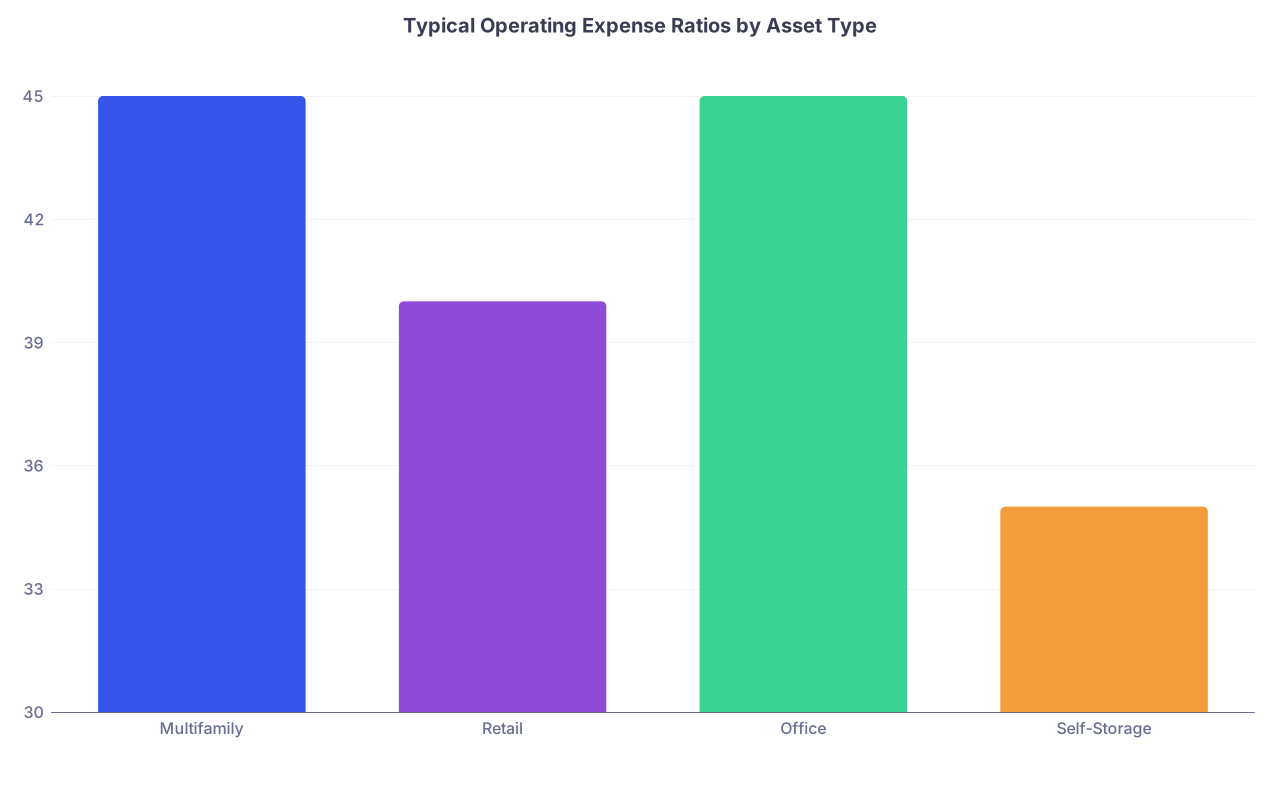
| Category | Value |
|---|---|
| Multifamily | 45 |
| Retail | 40 |
| Office | 45 |
| Self-Storage | 35 |
If their underwriting is way outside these ranges, they’d better have a very specific, credible reason—and documentation to back it.
3. Verify the Debt Terms and Rate Risk
You should know, in plain English:
- Is the loan fixed or floating?
- If floating, what’s the index, spread, and interest rate cap?
- When does the interest-only period end?
- What happens to monthly payments if rates rise 200–300 bps?
This is the part sponsors often rush past during webinars. Don’t let them.
Ask for a simple sensitivity table: “Show me cash flow to investors at current rates, +1%, and +2%.” If at +2% your distributions go to zero, then they’re not “guaranteed” by anything except a hope that macro conditions cooperate.
Legal Reality: What “Guaranteed” Actually Means (and Doesn’t)
Let’s walk into the legal side, because this is where physicians routinely fool themselves.
The typical private real estate deal you’ll see is structured as a 506(b) or 506(c) Regulation D offering. The operating agreement and PPM (Private Placement Memorandum) are full of language like:
- “No assurance can be given that the Company will achieve its investment objectives.”
- “Distributions are not guaranteed and may be suspended at any time at the Manager’s discretion.”
- “Investors should be able to afford a complete loss of their investment.”
And yet, the marketing slide deck says: “8% preferred return – paid quarterly.”
Those two documents are not in conflict. Why?
Because “preferred return” is a waterfall priority, not a legal guarantee. It means:
- If the property generates distributable cash,
- And if the Manager chooses to distribute it,
- It will flow to you in a specific order (e.g., first to investors up to 8%, then to the sponsor).
If condition #1 fails, the preference is academic.
You think you’re buying a bond. Legally, you’re buying an illiquid equity interest with fully disclosed risk of total loss.
What the PPM Usually Tells You (That You Ignore)
Common buried truths in PPMs:
- Distributions may be financed from loan proceeds or capital contributions (code for: they can literally borrow or use new money to pay “cash flow”).
- Manager has broad discretion to withhold reserves, even if it reduces current distributions.
- There’s often no obligation to make catch-up payments on missed preferred returns.
If you don’t read this, you’re operating on vibes, not facts.
The Physician-Specific Trap: False Safety in “Passive Income”
Let’s talk about why physicians are particularly vulnerable to the “guaranteed cash flow” myth.
You’re trained in:
- Pattern recognition
- Protocol adherence
- Trusting specialized expertise
So when a sponsor shows up with:
- Professional-looking decks
- A podcast appearance or two
- An “invest with us while you sleep” pitch
You instinctively treat them like a specialist consultation. “They do this full-time; I’ll defer.”
But here’s the difference: in medicine, the specialist’s incentives are somewhat aligned with yours. In syndications, the sponsor often gets:
- Acquisition fees
- Asset management fees
- Refinance fees
- Disposition fees
…whether or not your cash flow ever matches the projections.
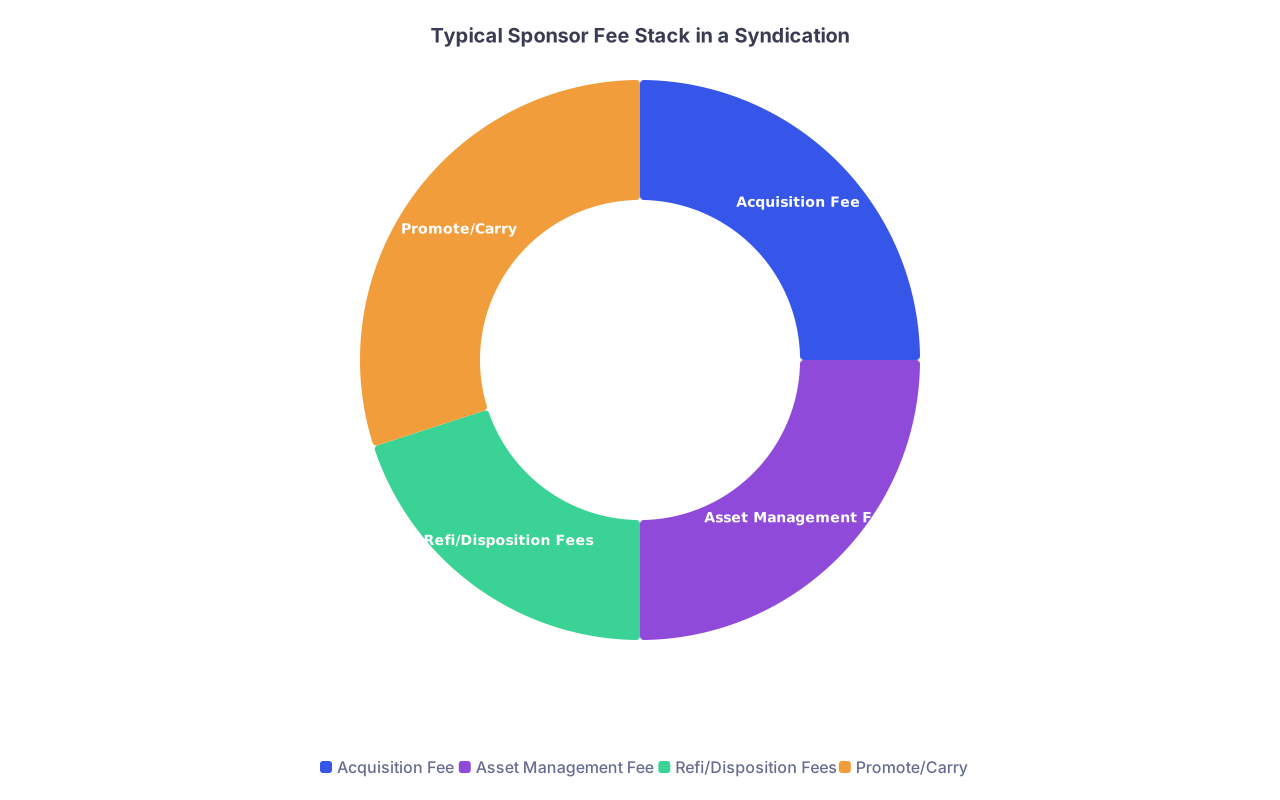
| Category | Value |
|---|---|
| Acquisition Fee | 25 |
| Asset Management Fee | 25 |
| Refi/Disposition Fees | 20 |
| Promote/Carry | 30 |
Those cash flow checks you’re dreaming about? They might be lower priority than the sponsor’s fee schedule.
A Practical Verification Framework (That Takes Less Time Than a Clinic Session)
You don’t need to turn yourself into a full-time underwriter. You do need a minimum standard that any “guaranteed cash flow” deal must clear.
Here’s a simple framework you can apply in 30–60 minutes per deal.
Step 1: Translation – From Marketing to Mechanics
Use a piece of paper or spreadsheet and write:
- Projected year 1 and 2 cash-on-cash
- Assumed occupancy
- Assumed rent growth
- Expense ratio
- Debt terms (fixed/float, IO period, amortization start)
If any of those cells are empty, you don’t understand the cash flow source. That’s a problem.
Step 2: Stress Test – Light but Honest
Ask:
- What if occupancy is 5% lower?
- What if expenses are 10–15% higher?
- What if interest rates are 2% higher than their base case (or cap cost was underestimated)?
If under any of those modest changes the distributions collapse, then the “guaranteed” narrative falls apart. That doesn’t automatically kill the deal, but it should kill the illusion.
Step 3: Documentation – Backing Up the Story
Request or review:
- Trailing 12-month (ideally 24-month) profit and loss for the property
- Insurance and property tax bills
- Rent roll with lease expirations and concessions
- Loan term sheet (or at least a summary with specifics, not hand-waving)
If the sponsor is unwilling or slow to share these, you’re dealing with theater, not business.

| Step | Description |
|---|---|
| Step 1 | See 7 percent cash flow claim |
| Step 2 | Request underwriting and T12 |
| Step 3 | Pass or reprice |
| Step 4 | Check assumptions vs market |
| Step 5 | Stress test cash flow |
| Step 6 | High risk - proceed carefully |
| Step 7 | Consider investing |
| Step 8 | Get full data? |
| Step 9 | Rent, expenses, debt realistic? |
| Step 10 | Still stable under stress? |
This is not a full institutional underwriting model. It’s the difference between flying blind and flying with instruments.
The Only “Guarantees” You Actually Have
Let me be very direct:
In private real estate deals, there are exactly three things that are effectively “guaranteed”:
Your capital will be illiquid.
You will not be able to pull it out when it’s convenient for you. If you need liquidity, you’ll be negotiating from a position of weakness—if you can sell at all.Your legal documents will favor the sponsor.
I’ve never seen a PPM where the manager didn’t have sweeping discretion and very limited liability. If something goes wrong, your recourse is usually: complain, vote with other LPs, or sue (expensive, slow, uncertain).If the deal underperforms, the marketing deck will not save you.
Those pretty charts and “guaranteed” phrases mean nothing once you sign the subscription docs acknowledging 40 pages of risk factors.
Everything else—cash flow, appreciation, tax benefits—is conditional.
The Quiet Upside: Verified Cash Flow Is Boring… and That’s Good
Here’s the contrarian twist: once you throw out the myth of guaranteed cash flow, you can actually build a more reliable income strategy.
You start choosing:
- Deals with conservative leverage, even if the projected IRR is lower.
- Sponsors who show ugly-but-realistic year 1–2 cash flow, not fairy tales.
- Assets with verifiable in-place performance you can cross-check.
You stop chasing the highest “guaranteed” number and start looking for the most credible one.
The physicians I’ve seen do best over a decade are rarely the ones in the flashiest deals. They’re the ones in:
- Boring suburban multifamily with modest but stable distributions.
- Medical office with long-term credit tenants and known lease terms.
- Industrial with simple operations and transparent expense structures.
Their cash flow isn’t guaranteed. It’s underwritten, verified, and resilient.
The Bottom Line: What You Should Remember
Three core truths to keep in your head every time someone waves “guaranteed cash flow” at you:
Cash flow isn’t guaranteed; it’s conditional. It depends on specific assumptions about rents, expenses, and debt that you can and should verify against real data.
Preferred returns and projections are not promises. They’re distribution priorities and marketing targets living inside legal documents that explicitly say you may get nothing.
Your best defense is a simple, repeatable verification process. Translate the pitch into mechanics, stress test the assumptions, and demand documentation. If the numbers only work on a perfect day in a perfect market, walk away.