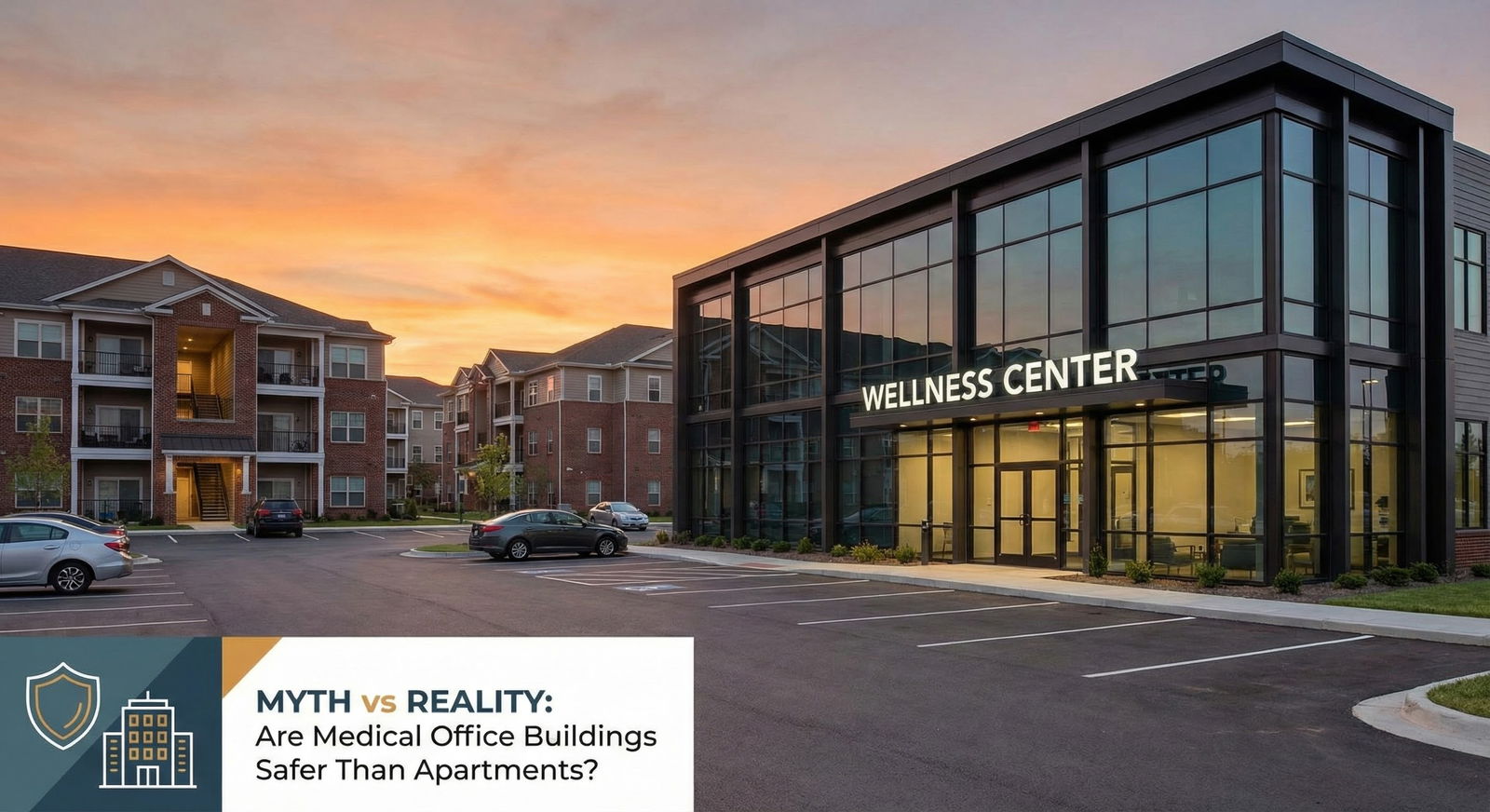
Medical office buildings are not “safer” investments than apartments. They are different risk bundles dressed up as stability.
The comforting story physicians hear at conferences and from slick brokers is simple: “You understand medicine. Medical tenants are stable. Healthcare is recession-proof. Medical office buildings are perfect for doctors.”
That story is half‑true and dangerously incomplete.
If you are a physician stepping into real estate, you need to stop thinking in slogans like “MOBs are safer than apartments” and start thinking in cash flow probabilities, lease structures, and lender behavior when things go sideways.
Let’s pull this apart.
The Core Myth: “Medical Is Recession-Proof, So MOBs Are Safer”
The myth goes like this: people always need healthcare, so medical office tenants always pay rent, so medical buildings are inherently lower risk than apartments.
What the data actually show is more nuanced.
Healthcare is relatively resilient at the industry level. That does not mean:
- Every medical practice is profitable
- Every specialty is equally stable
- Every landlord gets paid on time
- Every lender treats MOBs like gold
COVID already stress-tested this fantasy. Elective surgeries stopped. Outpatient volumes dropped. Private practices burned through cash. Some tenants asked for rent relief. Some defaulted. Landlords with unleveraged, long-term, hospital-backed leases mostly sailed through. Landlords with small private practices on short-term leases had a very different experience.
Meanwhile, people did not suddenly stop needing shelter. Multifamily collections dipped in some markets, but on the whole, apartments outperformed many commercial asset classes.
So the real question is not “Is medical safer than apartments?” but “Which specific risk are you actually taking?”
To see this clearly, compare how income and risk tend to behave in each asset class.
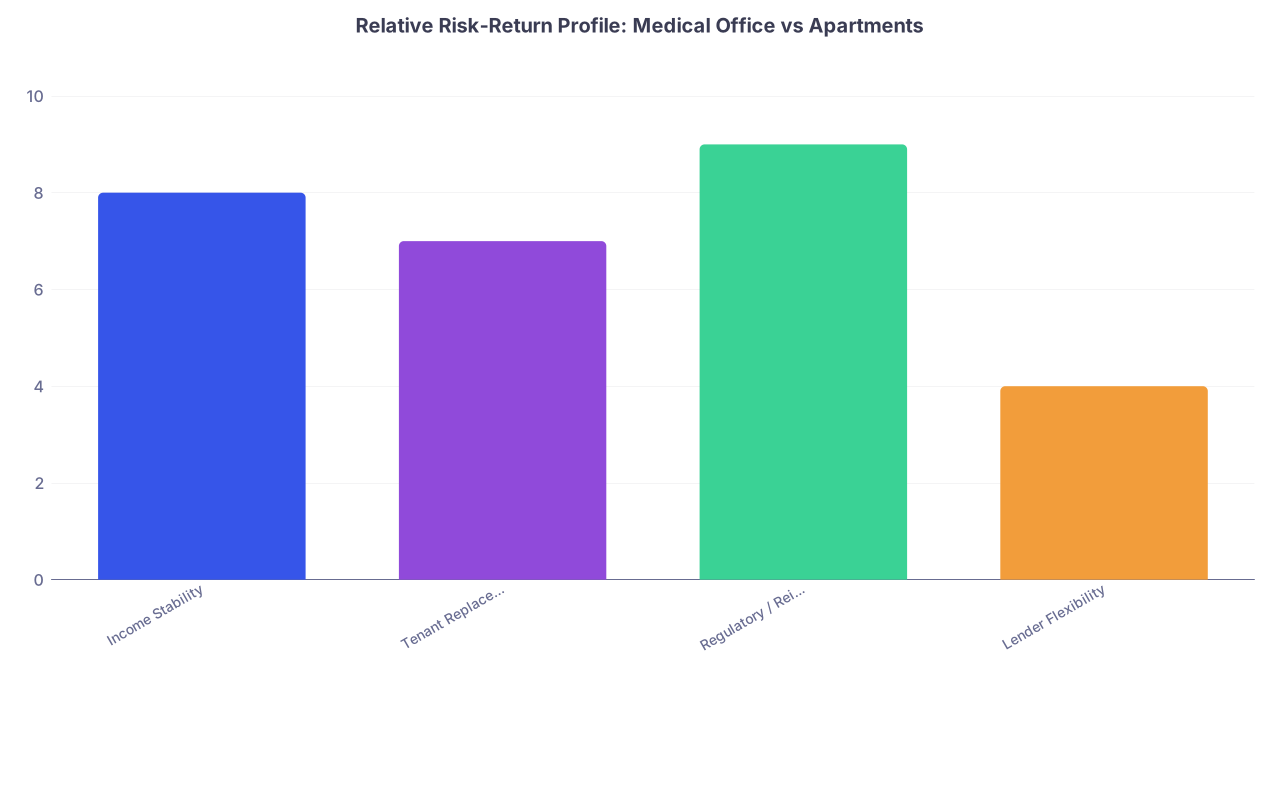
| Category | Value |
|---|---|
| Income Stability | 8 |
| Tenant Replacement Difficulty | 7 |
| Regulatory / Reimbursement Risk | 9 |
| Lender Flexibility | 4 |
(Scale 1–10, higher = more challenging/greater risk from a small investor’s standpoint; here I’m highlighting that the “hidden” pain points of MOBs are often tenant replacement and policy/reimbursement risk, plus tougher lenders.)
Lease Structures: Stability vs Fragility
This is where a lot of the “safety” narrative around MOBs comes from: the leases look beautiful.
Medical Office Leases
Medical office leases—especially for larger tenants—often have:
- Longer terms (7–15 years vs 1-year apartment leases)
- Built-in rent escalations
- Triple-net or modified gross structure (tenants pay some or all expenses)
- Stronger credit if the tenant is a hospital system or large group
On paper, this is landlord heaven. You lock in a tenant for 10 years, they pay most of the operating costs, and you just collect the spread.
But there are traps:
Concentration Risk
In a 20,000 sf medical building with 4 tenants, losing one is a 25% revenue hit. Losing the anchor can implode the value of the whole building.In a 50-unit apartment building, losing one tenant is 2% of rent. Annoying, not catastrophic. Vacancy is spread across many smaller payers.
Downtime and Re-Leasing Costs
Replacing medical tenants is slow and expensive. Build-outs are highly specialized—exam rooms, plumbing, lead-lined walls, med gas lines—so new tenants may demand massive TI (tenant improvement) packages.I’ve seen landlords write $60–$100 per square foot TI checks to secure a 10-year medical lease. You do not do that in apartments. When a 1-bed turns over, you paint, patch, clean, maybe replace a stove, and you are done.
Dependence on Specific Business Models
Your revenue depends not just on “healthcare demand,” but on whether that specific practice’s business model survives regulatory changes, reimbursement cuts, local competition, or a buyout from a hospital that decides to move them into its own on-campus building instead of your property.
Apartment Leases
Apartment leases are boring:
- Short terms (usually 12 months)
- Landlord pays most expenses
- Tenants have weaker credit profiles
Yet boring cuts both ways. When a tenant fails, you replace them quickly, usually with minimal capital outlay. Demand for workforce housing exists in almost every market, every year. You can adjust rents annually, sometimes faster than expenses grow.
So yes, a 10-year MOB lease from a hospital looks “safer” than 50 one-year apartment leases. But if that single tenant leaves or “goes dark,” your “safety” evaporates instantly.
This is not theoretical—it’s playing out all over the country with private equity–rolled practices, hospital consolidations, and ASCs migrating into on‑campus or hospital-owned buildings.
Income Sensitivity: Who Can Actually Stop Paying You?
The safest tenant is not the one “in healthcare.” It’s the one that must stay in your space to generate revenue and can keep paying you even under stress.
Medical Tenants: Sticky but Vulnerable
Medical practices tend to be sticky. Moving is a hassle: patient confusion, licensing, payor updates, IT, equipment, build-outs. That stickiness is real.
But their ability to pay is tied directly to:
- Procedure volumes
- Payor mix (Medicare, Medicaid, commercial)
- Reimbursement rates and regulatory changes
- Ownership structure (private vs PE-backed vs hospital employed)
Which means your “stable rent check” is indirectly exposed to:
- CMS rule changes and fee schedule cuts
- Surprise billing regulations
- State-level scope-of-practice battles
- Hospital system politics and joint-venture turmoil
During one outpatient surgery center deal review I sat through, the pro forma assumed flat reimbursement and 5% volume growth annually. Then CMS proposed a cut to that very CPT-heavy service line and local commercial payors followed. That rosy DSCR margin shrank fast—long before the building changed hands.
Apartment Tenants: Individually Fragile, Collectively Predictable
Individual apartment tenants are one job loss away from missing rent. But in aggregate, across dozens or hundreds of units, the income stream becomes more statistical and less binary.
Vacancy rates in stable markets tend to fluctuate within a band. Rents may flatten in recessions, but your occupancy doesn’t typically go to zero because a policy memo in Washington cut an RVU conversion factor.
So: MOB income is less volatile when the system is stable, but more policy-sensitive and concentration-heavy. Apartment income is more micro-volatile (some tenants struggle monthly) but more macro-resilient and diversified.
Lending Reality: Banks Love MOBs—Until They Don’t
Brokers love telling physicians: “Banks love medical office. You’ll get great terms.”
Sometimes true. If:
- You have a long-term anchor lease from a creditworthy tenant
- Debt service coverage ratio (DSCR) is strong
- The building is mostly stabilized
- Your personal financials are solid
What they don’t emphasize is how unforgiving that same lender can be if occupancy drops, a key tenant leaves, or DSCR slips.
In commercial loans backed by MOBs:
- Recourse is common. Your personal guarantee can and will be called.
- Covenants matter. Fall below required DSCR or occupancy and the bank can trigger cash sweeps, force reserves, or refuse to refinance.
- Exit risk is real. If cap rates expand or lender appetite for medical tightens, you might be stuck feeding capital into a property you cannot refinance on decent terms.
Multifamily, especially in certain markets, often enjoys:
- Deeper, more liquid lending markets (agency debt, local banks, credit unions)
- More forgiving views of temporary vacancy because housing demand is core
- More established, commoditized underwriting standards
You do not get a “physician discount” on bad numbers in either space. But MOB debt is more sensitive to a handful of leases and those tenants’ perceived credit.
Vacancy and Turnover: Long Vacancies vs Frequent Ones
Another myth: “Medical tenants stay forever, so there’s almost no vacancy.”
Reality: when MOB vacancy happens, it can be brutal.
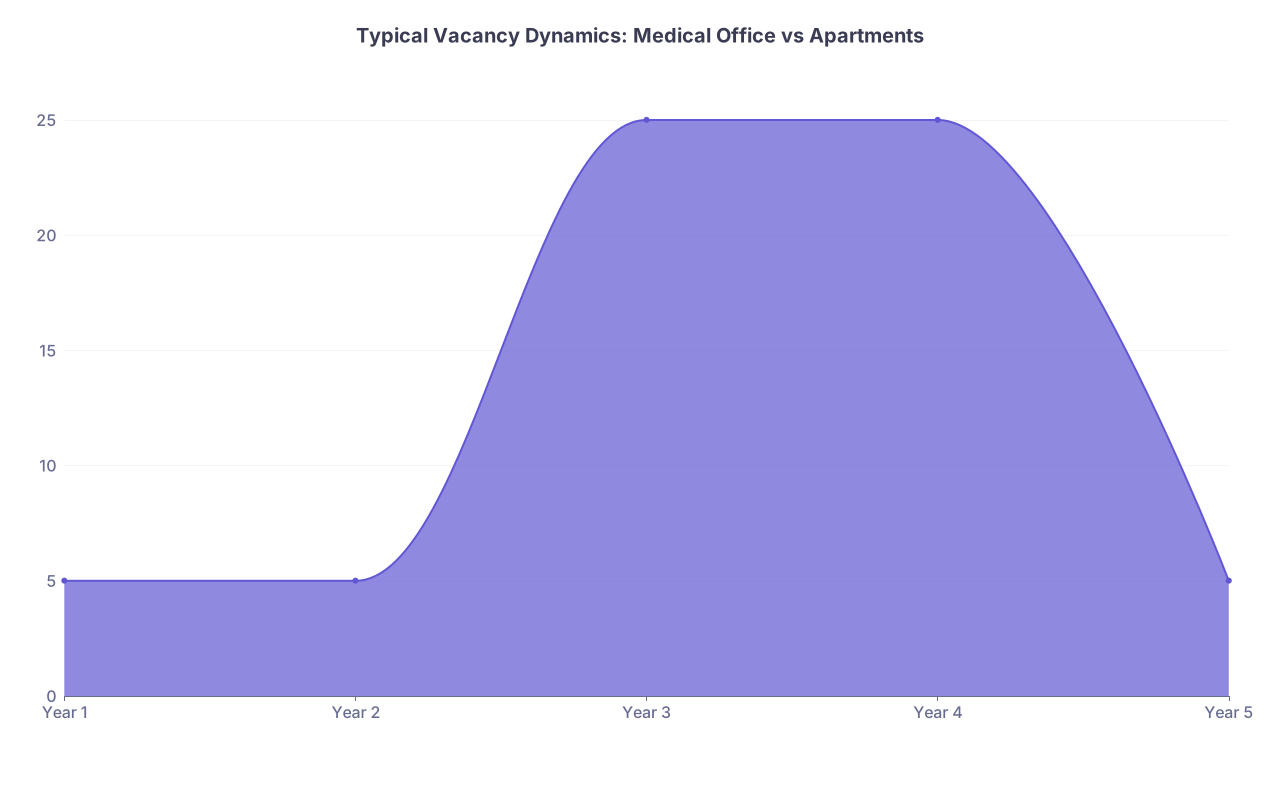
| Category | Value |
|---|---|
| Year 1 | 5 |
| Year 2 | 5 |
| Year 3 | 25 |
| Year 4 | 25 |
| Year 5 | 5 |
Consider two scenarios on a small building:
A 15,000 sf MOB, 3 tenants. One 5,000 sf group leaves at end of term. You might sit on that space for 12–24 months, negotiating LOIs, waiting on CON approvals or health system politics. You cover full debt service the entire time.
A 30-unit apartment building. You always have some units turning over. But in a decent market, vacant units typically lease in weeks, not years. There’s a constant churn, but not usually multi-year black holes of zero income.
The length of downtime matters more than the rate of vacancy on a spreadsheet. A 10% “vacancy” that’s just one unit for 5 weeks every year is not the same as 0% for 9 years then 50% for 2 years.
MOB investors tend to underestimate downtime and re-leasing risk because they’re staring at current leases instead of thinking through end-of-term reality.
Legal and Regulatory Landmines: Stark, AKS, And Use Clauses
Here’s where apartments are delightfully simple compared with medical office.
With apartments, your legal headaches are mostly:
- Fair housing compliance
- Landlord-tenant law
- Local code and habitability standards
Annoying, but well-trodden ground.
Medical office brings a more exotic mix:
Stark Law and Anti-Kickback Statute (AKS)
If physicians who refer to an entity are also tenants or owners in the building, rent and investment terms must be at fair market value and commercially reasonable. That’s not just “be reasonable”; it’s a compliance minefield, especially in joint ventures with hospitals or imaging labs.Use Restrictions and Exclusivity Clauses
One tenant might have an exclusive on imaging, or orthopedics, or primary care. That can limit your ability to backfill space later and strangles leasing flexibility.Certificate of Need (CON) constraints
In CON states, the ability of a tenant to open or expand certain service lines in your building may hinge on state approvals, politics, and competitor objections. Good luck underwriting that.Healthcare-specific build-out codes
ADA, fire safety, accreditation standards, radiation shielding, med gas codes. You’re not just building generic office. You’re building quasi-clinical environments—and retrofitting them if regulations change.
If you are a physician and also an owner or investor in the building, all of this ties back into your personal legal risk. Mishandling Stark or AKS is not just “oops, we lose the lease.” It can be civil or criminal exposure if you get too cute structuring “sweet deals” with your own group or referral partners.
Apartments can absolutely generate lawsuits and headaches, but they rarely intersect with federal fraud and abuse statutes.
Diversification: Unit Counts vs Tenant Quality
Let’s talk concentration in a more systematic way.
| Feature | Medical Office Building | Apartment Building |
|---|---|---|
| Number of paying entities | 1–10 tenants | 20–200 tenants |
| Income if 1 tenant defaults | Often 10–50% lost | Usually 0.5–5% lost |
| Re-leasing time | 6–24 months common | 1–3 months common |
| TI / turnover cost per space | High ($20–$100+/sf) | Low to moderate (unit-level) |
| Policy/regulation sensitivity | High (healthcare-specific) | Moderate (local housing policy) |
The usual physician instinct is to chase “quality tenants” over “lots of tenants.”
That instinct is not always wrong. But if you over-concentrate in a few “quality” medical tenants, you are betting your entire capital stack on the ongoing success of a small number of businesses and a specific reimbursement environment.
Apartments, by contrast, are the definition of small, independent payers. People move in, move out, change jobs, change roommates—yet the aggregate demand for housing remains stubbornly persistent.
So Which Is Actually Safer For a Physician Investor?
Let me be blunt.
If you are early in your real estate journey, working full-time as a clinician, and you want to build durable, semi-passive income with tolerable downside, a small-to-mid-sized medical office building is not automatically safer than an apartment deal. Often it’s the opposite.
Medical office can be an excellent play if:
- You deeply understand the local healthcare ecosystem
- You know the actual financial health of your tenants (not just their specialty label)
- You underwrite policy and consolidation risk, not just current rent rolls
- You are comfortable with higher re-leasing risk and bigger capital calls when tenants roll
Apartments can be an excellent play if:
- You buy in markets with real demand drivers (jobs, population, supply constraints)
- You stay away from war zones and negative migration markets
- You underwrite conservatively on rents and capex
- You’re prepared to manage tenant churn or hire management that can
The problem is not “MOBs are bad” or “apartments are always better.” The problem is physicians buying the narrative that medical office = safe because it feels familiar and respectable.
Familiar does not equal low risk. Respectable does not equal resilient.
The question you should ask is not “Is medical safer than apartments?” but:
- “Where am I concentrated?”
- “How fast can I recover from a bad tenant outcome?”
- “What happens if the current reimbursement environment shifts against my anchor?”
- “Do I actually want to be in the business of underwriting healthcare policy risk on top of my clinical life?”
You can make—or lose—money in both. The investors who survive are the ones who recognize that “medical” is not a magic shield. It’s a different battlefield.
Years from now, you won’t brag about whether your building had a stethoscope on the door. You’ll remember which risks you understood, which ones you ignored, and whether you were honest with yourself about the difference.

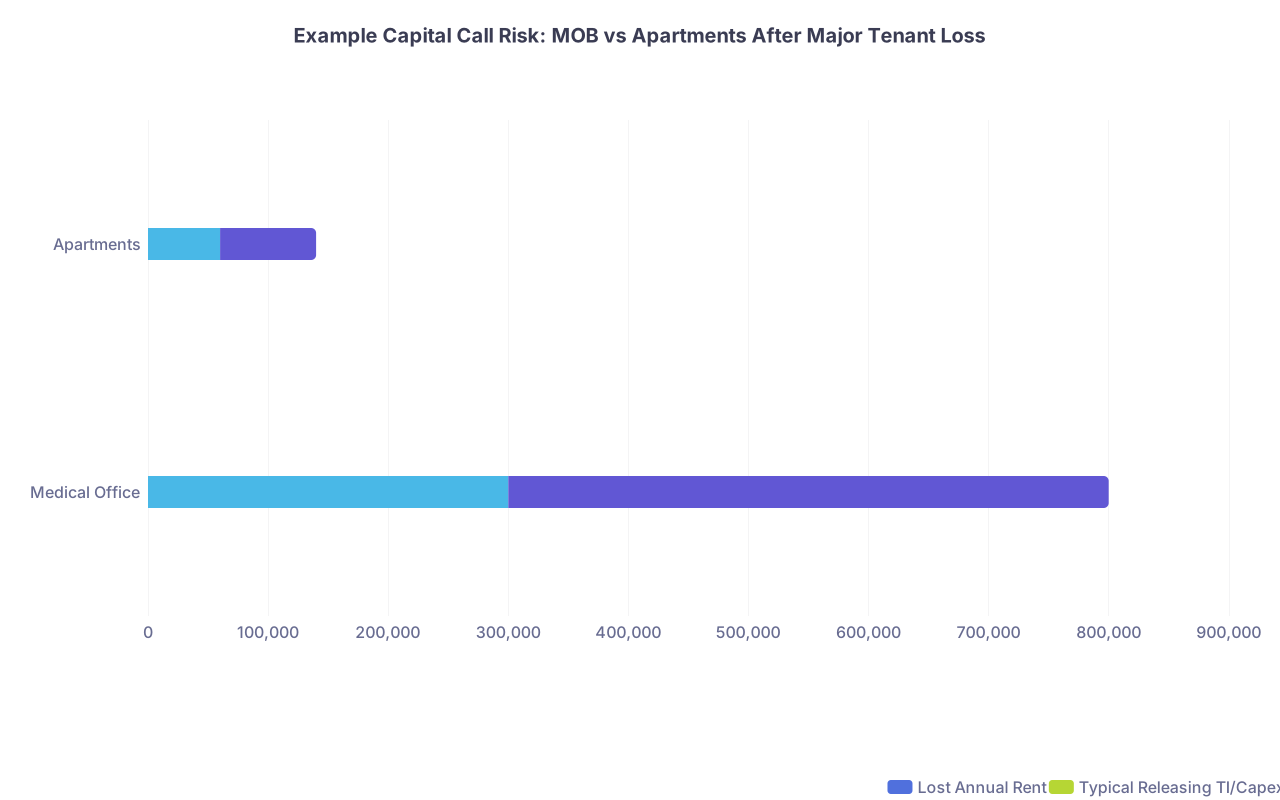
| Category | Lost Annual Rent | Typical Releasing TI/Capex |
|---|---|---|
| Medical Office | 300000 | 500000 |
| Apartments | 60000 | 80000 |


| Step | Description |
|---|---|
| Step 1 | Physician Investor |
| Step 2 | Consider MOB but assess tenant concentration |
| Step 3 | Consider apartments in strong markets |
| Step 4 | Underwrite tenant business models carefully |
| Step 5 | Partner with experienced MOB operator |
| Step 6 | Focus on diversified unit count and stable demand |
| Step 7 | Comfort managing tenants |
| Step 8 | Understands healthcare policy risk |