
The idea that “real estate hedges physician income risk” is wildly overstated, frequently misused, and sometimes flat-out wrong.
Real estate can diversify your income. It can sometimes move differently than your clinical earnings. But a clean, reliable “hedge” against your physician income? The data does not support that as a general rule.
Let’s separate myth from math.
What People Think “Real Estate Hedge” Means vs Reality
When physicians say “I want real estate to hedge my income,” I usually hear some version of:
- “If my clinical income goes down, rent checks will keep coming.”
- “Healthcare is stable but changing, real estate is more predictable.”
- “If I get burned out, I want passive income to protect me.”
- “Medicine and real estate are uncorrelated, so I’m safer.”
Sounds nice. Very shareable on podcasts and at conference happy hours.
The actual question you should be asking is more specific:
Do rental incomes and real estate returns reliably move differently than physician incomes across economic and policy shocks, such that they reduce your overall risk?
That’s what a hedge is. Not “more income.” Not “I like doors and drywall.” A hedge means when one side gets punched, the other side holds or rises.
On that definition, the answer is: sometimes, in narrow situations; often no; and for many doctors, the biggest risks aren’t hedged at all by real estate.
Step 1: Understand What Actually Threatens Physician Income
Before you can hedge risk, you have to define what you’re hedging against.
For most US physicians, private practice or employed, income risk clusters into a few buckets:
Policy / reimbursement risk
- Medicare cuts
- RVU changes
- Prior auth insanity, denials, payer mix shifts
These are slow-burn, multi-year erosions of earning power.
Contract / employment risk
- Group dissolves or gets acquired
- Hospital closes a service line
- Noncompete issues forcing relocation
- Loss of partnership track or bonus structure
These are career-level shocks, not month-to-month wiggles.
Health and disability risk
- You can’t operate, can’t take call, or can’t work full-time.
- This can cut income by 50–100% overnight.
Local market / specialty risk
- Oversupply of your specialty in your city
- Hospital opens its own competing practice
- State-level legal changes (for example scope of practice shifts)
Most of this has very little to do with the S&P 500, interest rates, or national unemployment in the short term. That’s crucial.
Your income risk is hyper-specific: payer contracts, local hospital politics, your own health, your specialty.
Remember that when you hear someone say “Physician income is risky, so buy an apartment building.”
Step 2: What Does the Real Estate Data Actually Say?
Let’s talk about how real estate behaves as an asset class, not as a marketing story.
I’m pulling from a mix of long-run US data sets:
- Federal Reserve (FHFA house price index)
- NCREIF (institutional commercial real estate)
- Private REIT and rental data compilations
- Academic work on real estate and labor income correlations
Broad patterns that actually show up:
Real estate is not a low-volatility magic box
- US residential prices nationally have long-term real appreciation around 0–1% per year above inflation.
- The volatility and drawdowns are very real (see 2008–2012, where some markets dropped 30–50%).
Real estate values and rents are tied to the same macro forces that hit hospitals
- Employment, interest rates, credit conditions, local population, and income levels.
- Healthcare isn’t fully cyclical like construction, but it’s not immune to recessions either—pricing pressure increases, elective volume dips.
Income from real estate tends to be modest relative to underlying risk unless you use leverage
That leverage introduces its own fragility.Correlations
Academic work consistently shows:- Real estate returns are positively correlated with broad economic activity and labor income, not negatively.
- They’re somewhat diversifying vs stocks, but that’s not the question. You’re asking about diversification vs physician earnings.
So you don’t have two engines pulling in opposite directions. More like two engines both attached to the same macroeconomic airplane, with slightly different throttle settings.
Where Real Estate Can Provide a Hedge – Narrow But Real
Let’s talk about the small slice of truth in the “hedge” narrative, because there is one.
There are a few scenarios where certain types of real estate genuinely offset specific physician income risks.
Hedging local practice income with out-of-market rentals
If almost all your risk is concentrated in one hospital/health system in, say, Cleveland, and you buy rentals in Phoenix and Atlanta, you’ve:- Reduced your geographic concentration risk.
- Created an income stream tied to different local economies and job markets.
Your hospital system can cut call stipends by 30%. Phoenix rents don’t care.
Hedging policy risk with assets influenced by different policy levers
Medicare slashes reimbursement for cardiology? That hurts your take-home. But:- Existing fixed-rate mortgages don’t auto-adjust.
- Rents respond more to local wages and supply, not CMS fee schedules.
That’s not a perfect hedge, but it’s at least a different set of drivers.
Hedging disability / personal health risk (somewhat)
If you can’t work full-time at 55, a portfolio of stabilized rentals or equity in larger syndicated deals can keep paying out.
The key: these had to be built earlier, while you were healthy and working. And they had to be structured so they don’t require your active labor.
Notice what’s not here: “buy three heavily leveraged local short-term rentals and you’re hedged against burnout.” That’s fantasy.
Where the Hedge Story Breaks Down Completely
If you actually map physician risks to real estate risks, there are glaring mismatches.
1. Systemic shocks hit both
Recession, interest rate spikes, credit crunch. The stuff that stresses hospital margins also hits real estate.
- In downturns, physicians can see frozen hiring, lower bonuses, reduced elective volume.
- Real estate can get whacked by:
- Falling prices
- Higher cap rates
- Tenants losing jobs
- Financing drying up
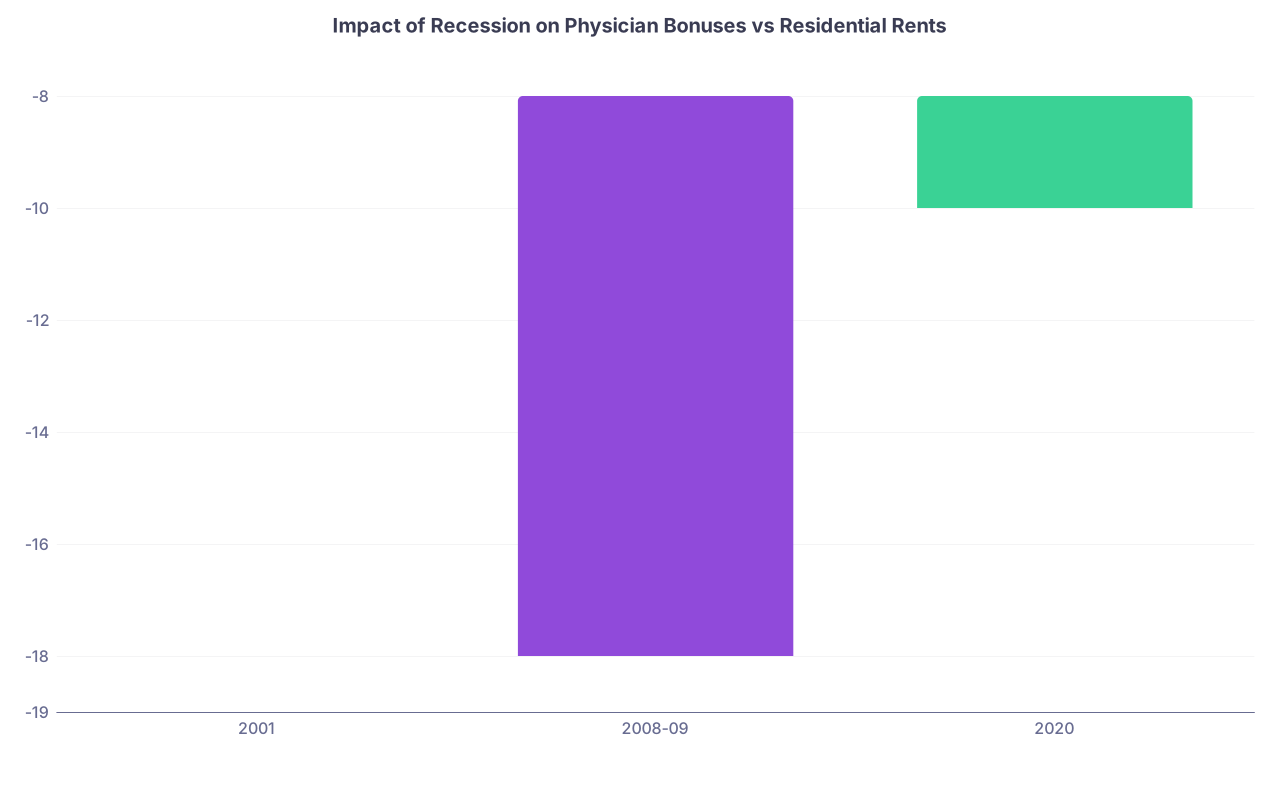
| Category | Value |
|---|---|
| 2001 | -8 |
| 2008-09 | -18 |
| 2020 | -10 |
(Think of these as rough percentage changes in average physician bonus pools vs rent changes; bonuses move much more, but directionally they both get hit.)
You do not get the clean “stocks down, bonds up” type hedge you see in classic portfolios.
2. Leverage turns “hedge” into amplified risk
Most physician real estate investing is leveraged. Which means:
- If your income drops, the pain is compounded:
- Less free cash to cover vacancies, CapEx surprises, or refis.
- Tight lending conditions make refinancing harder right when your personal risk increases.
The dark version of the story is:
- Group slashes comp by 20%
- Same year, rates jump, operating costs go up, 2 of your 6 units are vacant
- Now your “hedge” is demanding capital calls
I’ve watched this up close. The doctor started selling index funds at the worst possible time to keep the loans current.
That’s not hedging. That’s concentration of risk into a correlated, leveraged asset.
3. Local concentration quietly ruins diversification
Most physicians buy:
- In their own city
- In neighborhoods they know
- With tenants whose incomes depend on the same regional job market as their patients
Your W-2 is from the big regional hospital.
Your tenants mostly work for the same big employers or in industries that serve them.
Local recession? You and your tenants both get squeezed.
You didn’t hedge income risk. You made your balance sheet more exposed to your local economic microclimate.
Comparing What Actually Hedged Risk vs What Just Felt Good
Let’s be very unsexy and compare options like an adult.
| Strategy | Hedged What Best? | Correlated With Local Job Market? | Requires Active Work? |
|---|---|---|---|
| Local rentals (leveraged) | Long-term inflation, housing demand | High | Yes |
| Out-of-state rentals | Local economic / practice risk | Lower to moderate | Yes |
| Passive syndications / funds | Some local / specialty risk | Varies by market mix | Low |
| Disability + term life insurance | Personal health / family risk | No | Very low |
| Broad stock/bond index funds | Employer / specialty-specific risk | Low to moderate | Very low |
The honest takeaway: the cleanest “hedge” against physician income is diversified, liquid financial assets plus proper insurance.
Real estate can be layered on top of that to add diversification and long-term inflation protection. But it’s not the core hedge. It’s the satellite, not the sun.
The Legal and Structural Nuance Physicians Conveniently Ignore
You asked for financial and legal aspects, so let’s talk about the stuff glossed over in the “doors not dollars” memes.
Asset protection is not the same as income hedging
LLCs are great. So are umbrellas and malpractice coverage. But:
- An LLC can shield your other assets from a tenant lawsuit.
- It does not prevent your rental portfolio from going underwater during a downturn.
- It does not guarantee you cash flow when you need it.
I’ve seen docs spend more time obsessing over Wyoming vs Delaware LLCs than over the actual debt structure and DSCR (debt service coverage ratio) of their deals. Legally protected, financially fragile. That’s backwards.
Recourse loans tie your personal risk to the property
For many small investors (which includes most physicians):
- Bank wants a personal guarantee.
- That means: if the deal blows up, they’re coming after you, not just the property.
So if you’re thinking “I’m hedged because worst case, I hand the property back,” check your loan docs. Often, that option is fiction.
Partnership agreements can add a new layer of risk
In syndications or joint ventures, the operating agreement matters more than the Instagram pro forma.
You need to understand, in plain English:
- Who can call capital, and under what conditions
- What happens if you don’t meet a capital call
- Who can force a sale
- Who gets paid first in a bad scenario (hint: usually the bank and then the sponsor, you’re later in line)
Hydrating your “hedge” with opaque legal obligations is not risk management. It just hides the risk behind PDFs you never bothered to read.
So When Does Real Estate Make Sense for a Physician?
Notice I’m not anti–real estate. I’m anti–lazy narrative.
Real estate makes sense for you if:
You’ve already handled the basics:
- Disability insurance in place.
- Term life if anyone depends on your income.
- A real emergency fund.
- You’re already investing steadily in broad, low-cost index funds.
You are clear about your objective:
- Long-term wealth building and partial diversification.
- Not “emergency hedge for next year’s RVU cut.”
You structure it to reduce—not magnify—your fragility:
- Reasonable leverage, fixed-rate debt where possible.
- Solid cash reserves for each property.
- Not overly concentrated in your own zip code.
You’re honest about the work:
- Direct rentals are a second job.
- Syndications push the work to others but add opaque risk.
At that point, yes, a modest, well-structured real estate portfolio can make your overall financial life more resilient. But that resilience comes as much from how conservatively you run it as from the fact it’s “real estate.”
Stop Asking “Is Real Estate a Hedge?” Ask This Instead
Here’s the better question set:
- What specific income risks do I face in the next 5, 10, 20 years?
- Which of those are best addressed by:
- Insurance?
- Liquid diversified assets?
- Geographic diversification?
- Career flexibility or additional skills?
- Where does real estate logically fit in that plan?
You might discover that the most powerful “hedge” against income loss is:
- Lower fixed lifestyle costs
- Healthy savings rate into simple, liquid assets
- A disability policy you actually understand
- Willingness to change jobs or locations if the market shifts
Real estate then becomes one more useful—but imperfect—tool, not the talisman everyone wants it to be.
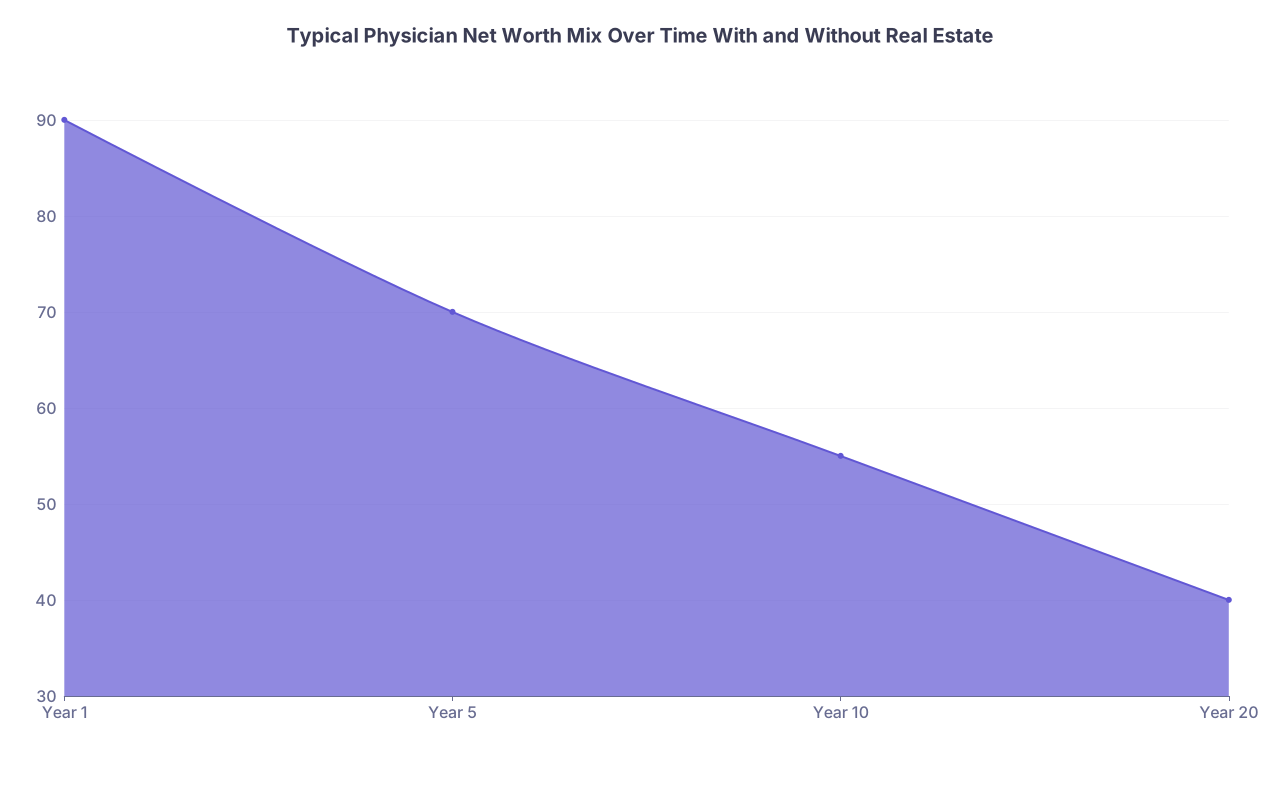
| Category | Value |
|---|---|
| Year 1 | 90 |
| Year 5 | 70 |
| Year 10 | 55 |
| Year 20 | 40 |
Think of that as your percentage of net worth tied to your human capital (future physician earnings) shrinking over time as you build financial assets—real estate included. That’s the real hedge: owning more things that are not you.

| Step | Description |
|---|---|
| Step 1 | Physician Income Risk |
| Step 2 | Build liquid portfolio |
| Step 3 | Diversify skills and geography |
| Step 4 | Buy proper insurance |
| Step 5 | Consider out of market real estate |
| Step 6 | Use conservative leverage |
| Step 7 | Stocks and bonds |
| Step 8 | Optional - add real estate |
| Step 9 | Main Concern |

The Short Version, Without the Sales Pitch
Three things to walk away with:
Real estate is not a clean, reliable hedge against physician income. It’s a sometimes-useful diversifier that often shares the same macro risks and can amplify your problems if overleveraged or locally concentrated.
The best hedges to physician income risk are boring: disability and life insurance, high savings rates, broad index funds, and genuine career flexibility. Real estate belongs after, not before, those pillars.
If you do choose real estate, treat it like what it actually is: a business with legal and financial complexity, not a magic shield. Conservative leverage, geographic diversification, and clear legal structures matter more than the story someone told on a podcast.
You are not “hedged” because you own doors. You’re hedged when losing your job or taking a 30% RVU cut doesn’t threaten your family, your house, or your sanity—because your balance sheet and protections were built with reality, not myths, in mind.