
The most overrated rule in physician real estate is simple: “Always buy near hospitals.” It sounds smart. It feels safe. And it’s led a lot of high-income docs into mediocre, over-priced deals they justify as “low risk.”
Let me be blunt: proximity to a hospital is not a risk management strategy. It’s a lazy proxy people use when they do not want to underwrite a deal properly.
You are not buying a hospital. You are buying cash flow, risk, and leverage wrapped in a physical box. That box might be across the street from a Level I trauma center or ten miles away in a boring suburb. The cap rate does not care.
Let’s pull this apart.
Where the “Near Hospitals” Rule Comes From (And Why It’s Broken)
The logic behind “always buy near hospitals” usually goes like this:
- Hospitals are big, stable employers.
- Hospitals attract doctors, nurses, techs, staff.
- Those people need housing.
- Therefore, real estate near hospitals must be safe and in demand.
Nice story. Very comforting. Also incomplete to the point of misleading.
I keep seeing the same pattern:
Physician gets excited about “investing like a doctor.” Buys a duplex or small apartment building 0.3 miles from a regional medical center. Pays a premium because “you can’t beat this location.” Then wonders why:
- Cash-on-cash returns are 3–4% at best
- Tenants churn every 12 months
- Property is noisy, older, and chronically maintenance-heavy
- Property taxes and insurance creep up but rents barely move
The problem isn’t the hospital. The problem is assuming the hospital magically fixes everything else that’s mediocre about the deal.
You do not get a free pass on fundamentals because there’s a helipad down the street.
What the Data Actually Shows About “Hospital-Proximate” Real Estate
There is surprisingly little rigorous data showing that “near hospitals” outperforms basic neighborhood fundamentals like income growth, school quality, or crime trends.
What we do know, from multiple housing and urban studies data sets:
- The strongest long-term appreciation tends to occur in areas with rising incomes, good schools, and constrained home supply.
- Rent growth tracks job growth broadly, not just proximity to a single employer.
- Health systems consolidate, downsize, and relocate more than most doctors realize.
In other words, the best predictors of long-term performance are market quality and deal quality — not whether you can see an ER sign from the parking lot.
Here’s how hospital-adjacent deals often actually perform relative to more “boring” but fundamentally stronger neighborhoods.
| Metric | Near Hospital Urban Core | Strong Suburban Area |
|---|---|---|
| Purchase price per unit | Higher | Moderate |
| Initial cap rate | Lower | Moderate/Higher |
| Tenant turnover | High | Moderate |
| Noise/traffic externalities | High | Low/Moderate |
| Long-term family demand | Lower | Higher |
There are exceptions, of course. A hospital-adjacent property in a genuinely gentrifying urban corridor with diverse employers nearby can do great. But that’s because the neighborhood is strong — not because someone built an ICU there in 1994.
The Risk Nobody Talks About: Single-Employer Dependency
For physicians, hospitals feel permanent. You trained there. You round there. It seems unimaginable that a 500-bed facility would materially contract, move services, or close entire lines.
Yet if you look at health system news over the last decade, the pattern is obvious:
- Rural hospitals closing or converting to outpatient/urgent care
- Inpatient services shifting to newer campuses in more affluent suburbs
- Entire OB or psych units shut down because “service line restructuring”
- Ownership changes to for-profit systems with aggressive cost-cutting
Your rental a block away is now tied to the fortunes and strategic decisions of a single employer with zero obligation to support your property value.
Compare that to a property near:
- A mixed-use employment hub (medical, tech, education, logistics)
- A state university with health sciences, engineering, and business
- A diversified suburban corridor with multiple mid-sized employers
Multiple employers mean more resilience. The “single employer” risk that you would never accept in a stock portfolio somehow becomes acceptable in real estate because it’s a hospital and you emotionally trust hospitals.
That is not investing. That is familiarity bias dressed up as strategy.
Who Actually Lives Near Hospitals?
Another myth: “If I buy near a hospital, my tenants will be residents and attendings just like me.”
Sometimes. More often, here’s what I see in actual rent rolls around large hospitals:
- Night-shift techs and nurses
- Travel nurses on 3–6 month contracts
- CNAs, environmental services, billing staff
- Mixed-income renters with zero connection to the hospital
There’s nothing wrong with any of those tenants. But they don’t justify paying a 10–20% purchase premium because you’re picturing a cardiologist renting your unit.
Physicians, especially attendings with kids, are usually not choosing the 40-year-old six-unit building two blocks from the main hospital for their primary residence. They’re in:
- Newer construction townhomes
- Quiet suburbs with school districts you recognize
- Gated communities 10–25 minutes away
So if your entire thesis is “I’ll always have physicians as tenants,” you’re basing your investment on a demographic that mostly does not want your product.
Let me visualize the mismatch.
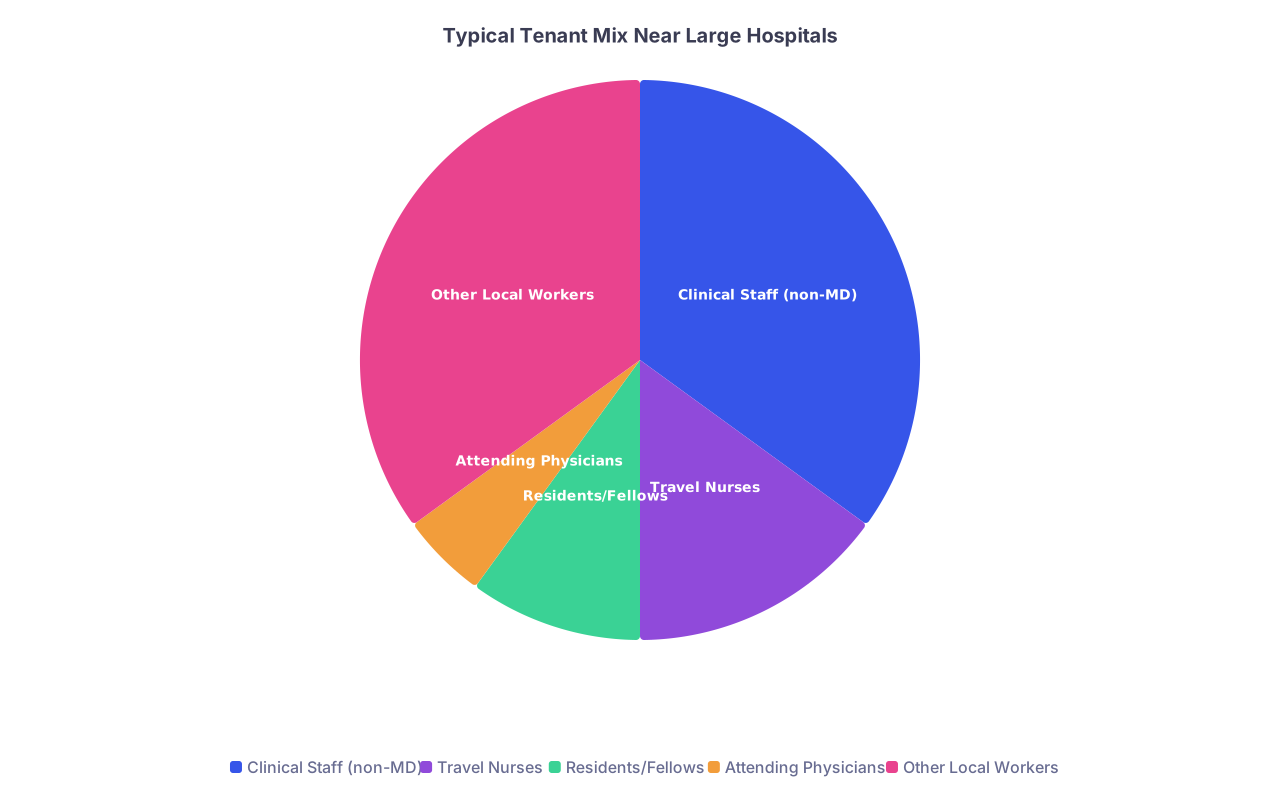
| Category | Value |
|---|---|
| Clinical Staff (non-MD) | 35 |
| Travel Nurses | 15 |
| Residents/Fellows | 10 |
| Attending Physicians | 5 |
| Other Local Workers | 35 |
Notice the small slice that’s actually the high-income cohort physicians imagine when they buy “doctor-adjacent” properties.
The Real Drivers of Returns (Hint: Not the Helipad)
I’ve watched too many docs anchor on “distance to hospital” and ignore the brutal math:
- Purchase price relative to realistic market rent
- Operating expenses, property taxes, insurance
- Renovation and CapEx requirements
- Vacancy and turnover risk
- Financing terms and interest rate sensitivity
Your IRR doesn’t care how long it takes someone to walk to the OR.
When you strip out the emotional comfort, the key question is simple:
Is this the best deployment of your next $100k–$300k in capital given your risk profile?
Sometimes the answer will genuinely be yes for a hospital-adjacent deal:
- Strong cap rate relative to neighborhood comps
- Solid, diversified tenant base, not just hospital workers
- Stable or improving crime and school trends
- No crazy future development risks (highways, zoning changes, etc.)
But often, when you underwrite honestly, you’ll find a property 10–20 minutes away in a more stable, less noisy neighborhood that gives you:
- Better entry price
- Comparable or higher rent
- Lower turnover
- Better long-term appreciation drivers
Hospital walkability is nice, but it is a feature, not a thesis.
Legal and Liability Landmines Physicians Forget About
This is the part most “doctor landlord mastermind” webinars skip.
Being near a hospital doesn’t just change who wants to rent from you. It changes how tight your legal risk profile needs to be.
Guess who gets sued aggressively when there’s a tenant dispute, injury, or habitability issue?
The high-income landlord who’s easily searchable as “Dr. So-and-so, cardiologist at the hospital across the street.”
A few specific headaches I’ve seen up close:
- Tenants using “I work for the hospital” as leverage in disputes (“I’ll report this to Risk Management and the CMO; you’ll be done here.”)
- Claims of discrimination or retaliation that drag on because you’re an attractive target with obvious deep pockets
- Informal arrangements with residents or staff that ignore fair housing and proper documentation (“It’s just a fellow; we know each other.”)
You need the same legal discipline for a property five miles away, but the visibility and social proximity are dialed up near a hospital.
At a minimum, if you insist on buying close to where you practice:
- Keep ownership in a properly structured LLC, not your personal name
- Avoid renting directly to colleagues you supervise or evaluate
- Use professional management, not “I’ll just text you” arrangements
Living and working in the same micro-bubble where you’re also the landlord can be a conflict-filled mess, not a convenient side hustle.
The Lifestyle Trap: When “Convenience” Kills Returns
Doctors love convenience. You tolerate enough chaos in clinical life, so in your investing life you want simple, nearby, “easy” properties.
That’s how you end up justifying:
- Overpaying because “I can drive by after work”
- Ignoring soft demand signals (higher vacancy, lower quality tenants) because “this area will always be fine with the hospital here”
- Under-charging rent to colleagues because “I don’t want awkwardness at M&M”
Your desire to avoid hassle quietly destroys your yield.
You’d never buy a publicly traded REIT just because the building is close to your clinic. You’d look at:
- Funds from operations
- Debt ratios
- Dividend coverage
- Asset mix and geographic diversification
But in real estate you control, you let “I can see this from the parking garage” replace proper underwriting. That’s not a strategy. That’s proximity bias and laziness.
Here’s the uncomfortable comparison.
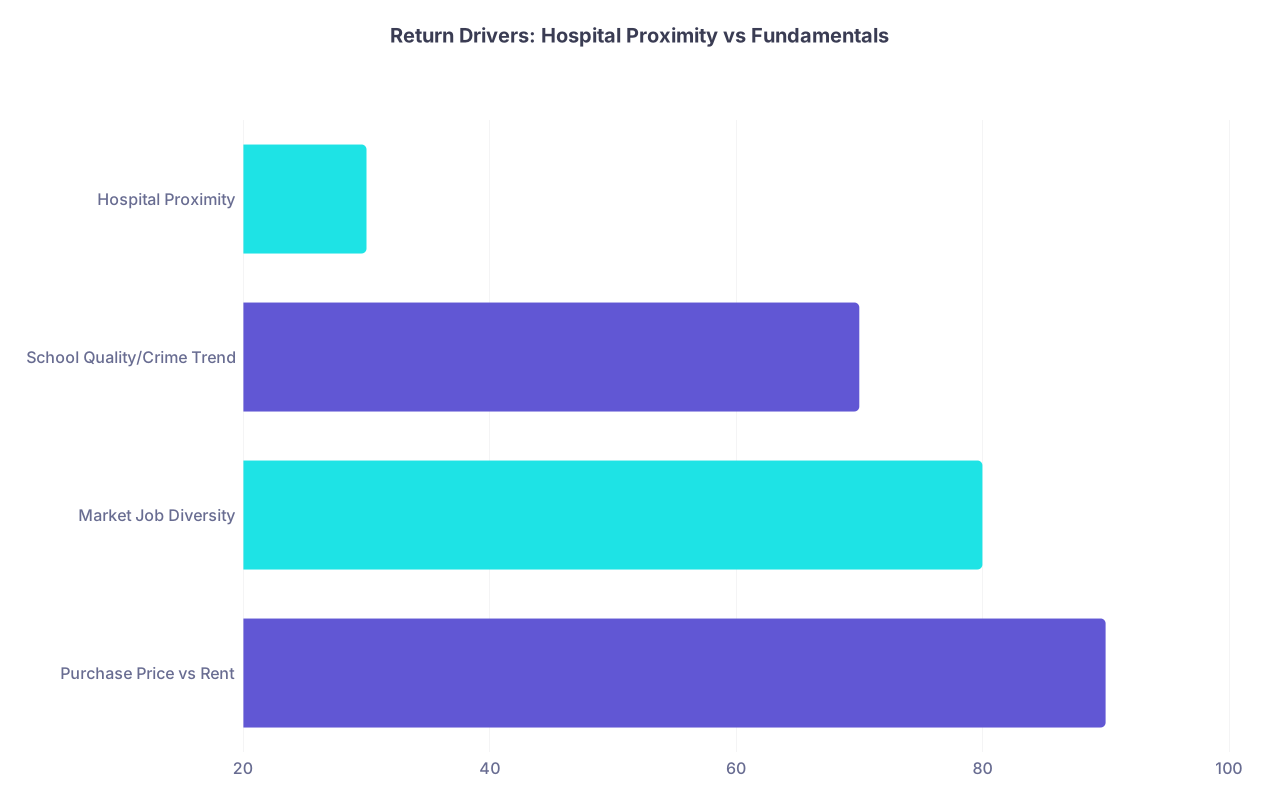
| Category | Value |
|---|---|
| Purchase Price vs Rent | 90 |
| Market Job Diversity | 80 |
| School Quality/Crime Trend | 70 |
| Hospital Proximity | 30 |
If I have to choose between a solid deal 15 minutes away or a mediocre deal across from the hospital, I will take the solid deal every time. And so should you.
When “Near a Hospital” Actually Helps — And How To Use It Correctly
Let’s be fair. Proximity to a major hospital can be an asset when it fits inside a broader, rational thesis instead of replacing one.
It helps when:
- The property type matches the tenant profile: small studios, 1-beds, or furnished mid-term rentals for travel nurses, not 5-bed McMansions.
- You’re explicitly playing a mid-term rental strategy (30–180 days) with corporate housing contracts or travel nurse platforms.
- The numbers pencil even if half your tenants had nothing to do with healthcare.
The right way to use the “near hospitals” factor is as a secondary or tertiary filter:
- Start with market fundamentals: population and job growth, income trends, supply/demand balance.
- Then look at submarkets with good schools, low crime trajectory, and reasonable taxes.
- Within those, evaluate specific properties on cap rate, cash flow, and renovation needs.
- Then — and only then — give a small bonus point if a particular property also happens to be within a walkable radius to a durable employment hub like a major hospital campus that’s part of a broader, growing corridor.
It’s the fourth lever, not the first.
Here’s what that looks like mentally.

| Step | Description |
|---|---|
| Step 1 | Start with capital to invest |
| Step 2 | Pass on area |
| Step 3 | Identify strong submarkets |
| Step 4 | Screen for good deals on numbers |
| Step 5 | Bonus if numbers still work |
| Step 6 | Still invest if fundamentals solid |
| Step 7 | Market fundamentals strong |
| Step 8 | Property near major employer |
Compare that to the naïve version most physicians run:
“Is it near a hospital? Yes? Great, must be safe, I’m in.”
A Quick Reality Check Example
Let’s walk through a simplified scenario I’ve literally seen versions of:
Option A: 4-plex, 0.5 miles from a major academic hospital
- Purchase: $900k
- Monthly rent total: $6,000
- Taxes/insurance/expenses: $2,500
- Net before debt: $3,500/month
Option B: 4-plex, 15 minutes away in a stable suburb
- Purchase: $750k
- Monthly rent total: $5,400
- Taxes/insurance/expenses: $1,900
- Net before debt: $3,500/month
Same net operating income. But you’re paying $150k more for the privilege of saying “it’s walking distance to the hospital.”
You have more leverage risk, more capital tied up, and no better cash flow. And if the core city continues to struggle with crime or taxes, that “prime” location becomes a liability.
This is exactly the kind of trade I see physicians make because they are anchored to that single phrase: “you can’t go wrong near a hospital.”
You very much can.
The Bottom Line for Physicians
Let me distill this without the comforting fluff.
- “Near a hospital” is not a moat. It’s one small factor that often gets overweighted because of your personal familiarity with hospitals.
- The real drivers of returns — purchase price, rents, expenses, market quality, tenant base — still decide whether the deal is good or bad.
- You’re better off buying a fundamentally strong property in a diversified, growing area 10–20 minutes from the hospital than a mediocre asset next door and hoping the helipad saves your IRR.