It’s 8:45 p.m. You just finished sign-out, grabbed lukewarm coffee from the physician lounge, and opened Zillow “for five minutes.” Now you’re looking at a condo three blocks from your hospital… and a small multifamily in another state with double the cash-on-cash return.
You’re asking the right question: is investing near your hospital actually better, or are you leaving money on the table by not going out-of-state?
Here’s the answer you’re looking for: neither is “better” by default. They’re different tools. And different tools solve different problems.
Let’s walk through how a smart physician actually decides.
Step 1: Start With Your Real Goal (Not Instagram’s)
First decision: what are you really trying to get out of real estate right now?
There are only a few honest answers:
- I want long-term wealth and equity growth.
- I want near-term cash flow to offset my W-2 income.
- I want diversification and tax benefits, but minimal time/brain damage.
- I want a future home (for myself, family, or kids).
- I want to learn the game hands-on with training wheels.
Your answer matters more than geography.
Here’s how “near hospital” vs “out-of-state” tends to line up:
| Primary Goal | Near Hospital Fit | Out-of-State Fit |
|---|---|---|
| Long-term wealth | Good | Excellent |
| Near-term cash flow | Usually poor | Often strong |
| Hands-off investing | Moderate | Strong (with team) |
| Future personal use | Excellent | Weak |
| Learning hands-on | Excellent | Harder |
If you’re in a high cost-of-living area (NYC, SF, Boston, DC, Seattle), cash-flowing near your hospital is often fantasy. Those properties win on appreciation and “owning your backyard,” not income.
If your hospital is in a moderate or lower cost-of-living area (Midwest, South, some suburbs), local can absolutely work. But you still need to run the numbers—not rely on “I know this neighborhood.”
Step 2: Understand What “Near Hospital” Really Buys You
Investing near your hospital gives you four specific advantages.
Eyes on the property.
You can drive by on the way to clinic. You can spot problem tenants or deferred maintenance yourself. That physical presence is not nothing, especially for your first deal.Local insight that data can’t see.
You hear nurses complain about a new crime hotspot. You know which side of Main Street everyone avoids after dark. You know that one “up-and-coming” neighborhood has been “up-and-coming” since before you were born and never actually improves. I’ve watched physicians avoid very expensive mistakes using that gut-level knowledge.Easier to start small and messy.
Want to self-manage at first? Want to do light value-add? It’s infinitely easier if the property is 15 minutes away and not a 3-hour flight.Lifestyle benefits.
You might:
- Buy a place you’ll live in now, then convert to a rental later.
- Shorten your commute.
- House-hack, rent extra rooms to residents, or own a condo your kids can use during med school.
Now the part people gloss over: local also brings real downsides.
- High prices = low cash flow (or negative after expenses).
- You get emotionally attached to the neighborhood or the property.
- You’re tempted to over-improve because “I’d like to live here someday.”
- Your local market might already be peaking or heavily dependent on one employer (your hospital).
So “near hospital” is not automatically safer—just more familiar.
Step 3: What Out-of-State Actually Offers (When Done Correctly)
Out-of-state investing is popular in physician circles for one simple reason: numbers that finally make sense.
The elevator pitch is usually:
- Lower purchase prices.
- Higher rent-to-price ratios.
- Better cash flow.
- Professional management handles everything.
That can all be true. I’ve seen physicians in coastal cities buy duplexes in the Midwest that cash flow $300–$500 per door per month while similar capital locally would barely break even.
But the truth is less sexy:
- You are 100% dependent on your team.
- You cannot fix a bad purchase with frequent visits.
- Travel, time zones, and communication friction are real.
Here’s what out-of-state is good for:
- Pure financial plays. You care about cap rate, yield, risk-adjusted return. Not whether your attendings live nearby.
- Scaling beyond local constraints. Once you’re on property 3–5, your salary and local inventory might be the bottleneck. Out-of-state breaks that.
- Asset diversification. Different state laws, different employers, different economic drivers. Less concentrated risk than owning 5 doors in a 3-block radius near the same hospital.
Where doctors get burned:
- Chasing “cheap” markets with no real job base.
- Trusting the first turnkey company that bought them lunch at a conference.
- Buying in D-class neighborhoods because the cash-on-cash return looked like a crypto chart.
Step 4: The Only Framework That Matters: Your Market vs Other Markets
You do not decide local vs out-of-state based on vibes. You decide based on side-by-side numbers and risk.
Here’s a simple comparison framework. Do this in Excel or even on a notepad.
Take:
- One representative property near your hospital.
- One representative out-of-state property you could realistically buy.
Then compare:
| Metric | Near Hospital Example | Out-of-State Example |
|---|---|---|
| Purchase price | $550,000 | $220,000 |
| Monthly rent | $3,000 | $2,200 |
| Property tax (annual) | $8,000 | $3,000 |
| Insurance (annual) | $1,800 | $1,400 |
| Est. maintenance | 8–10% of rent | 8–10% of rent |
| Professional mgmt | 0–10% (optional) | 8–10% (mandatory) |
| Net cash flow / mo | Maybe negative / tiny | Often positive |
Then factor in risk:
- How diverse is the local economy vs the out-of-state city?
- Landlord-tenant laws (tenant-friendly vs landlord-friendly).
- Property insurance trajectory (coastal and high-risk weather areas are brutal).
- Your own ability to intervene if things go sideways.
To visualize the tradeoff most physicians actually face:
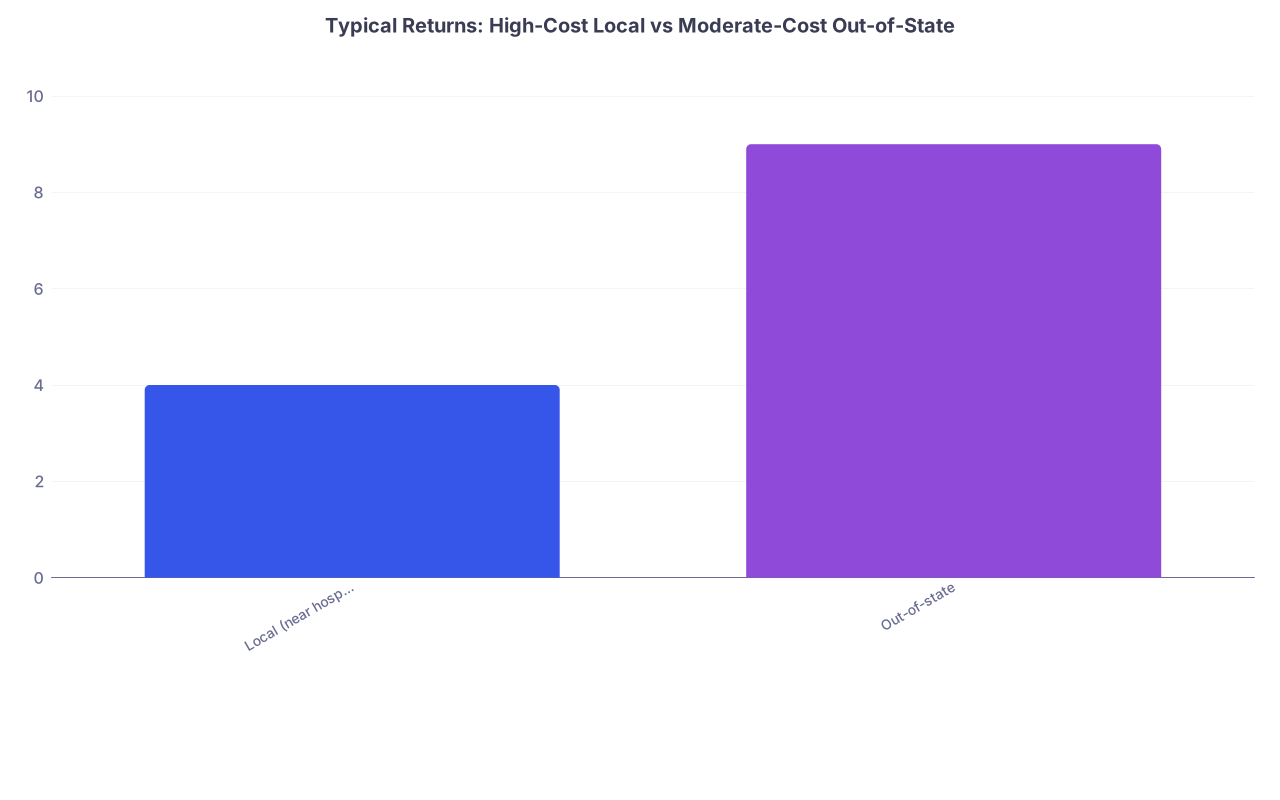
| Category | Value |
|---|---|
| Local (near hospital) | 4 |
| Out-of-state | 9 |
Think of this as “target total annual return” (cash flow + principal paydown + appreciation). It’s not universal, but it’s common: local deals often rely on appreciation; out-of-state deals often rely on cash flow.
Step 5: The Legal and Liability Angle Most Doctors Ignore
You’re in the “financial and legal aspects” phase, so let’s talk about the stuff that keeps your malpractice carrier happy.
Landlord–Tenant Law
Every state is different. Some are absolutely slanted toward tenants. Some are balanced. A few are extremely landlord-friendly.
Near your hospital:
- You already know the culture.
- You probably know colleagues who own rentals here.
- Your personal attorney might already be licensed in your state.
Out-of-state:
- You must rely on an attorney licensed in that state.
- Eviction timelines, security deposit rules, late fee rules, and habitability standards can be very different.
- Screwing this up can cost you more than your first year of cash flow.
Entity Structure (LLCs, etc.)
Owning local property:
- Forming an LLC in your home state is straightforward.
- Your CPA already files there.
- You understand your own state’s filing and franchise tax issues (or at least your CPA does).
Owning out-of-state property:
- Often requires an entity in the state where the property sits, or registering your home-state LLC as a “foreign entity.”
- You may now have to file state tax returns in multiple states.
- You’ll deal with multiple sets of annual filing fees and compliance rules.
One property in another state is manageable. Five properties in three states without a plan? That becomes a mess. And yes, I’ve seen physicians discover three years late that they should have been filing a separate state return all along.
Liability Exposure
Near hospital:
- Tenants are more likely to figure out you are “Dr. So-and-so from the hospital” if you self-manage or your name surfaces.
- Malpractice judgments aside, you do not want extra plaintiff attention on your personal wealth.
Out-of-state:
- More anonymity in practice, but still:
- Use LLCs correctly.
- Maintain separation: separate bank accounts, proper leases, no mixing personal use.
Either way: do not own rentals in your own name once you get serious. And do not let your white coat reputation bleed into your landlord profile.
Step 6: Time, Brain Space, and Who Will Actually Manage This
You’re not a full-time investor. You’re a physician. Your scarcest resource is not money; it’s attention.
Here’s how local vs out-of-state usually plays out from a time perspective:
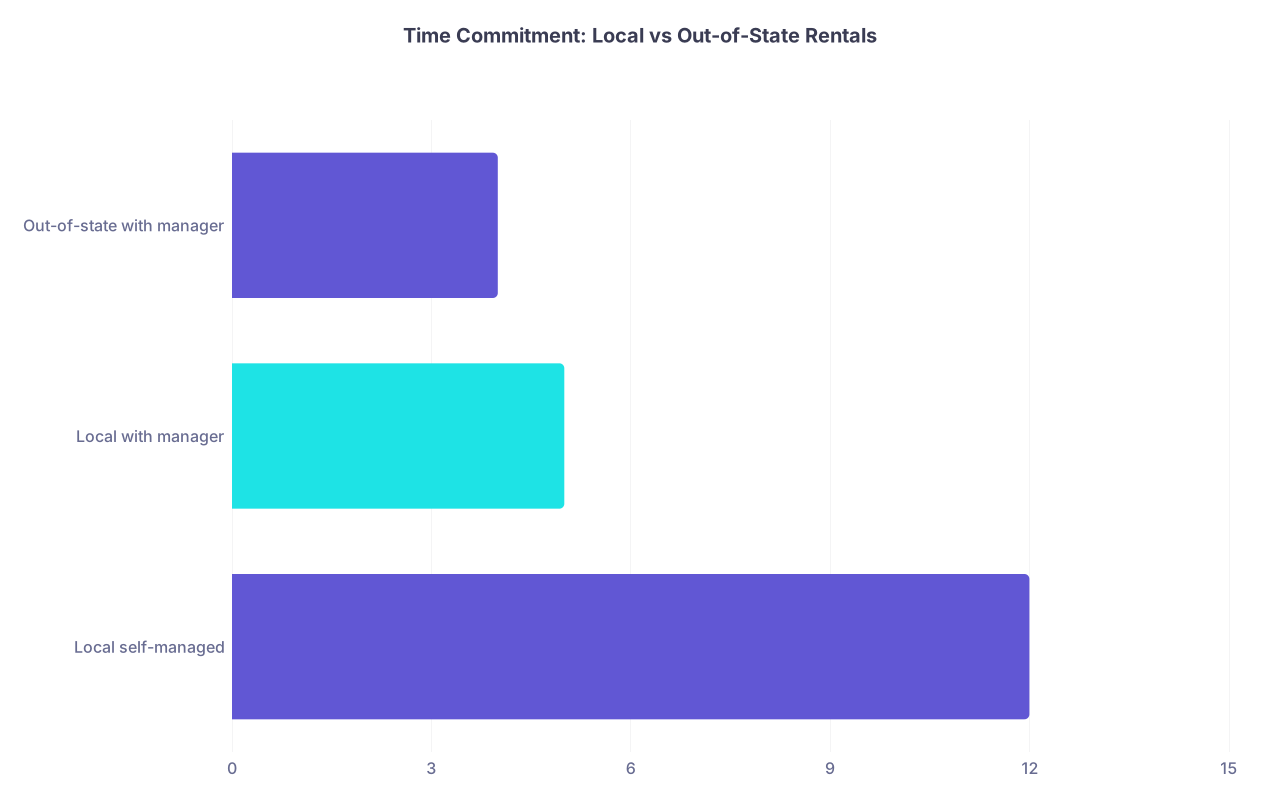
| Category | Value |
|---|---|
| Local self-managed | 12 |
| Local with manager | 5 |
| Out-of-state with manager | 4 |
Think of those numbers as “hours/month during the first year.”
Local self-managed:
- You’ll get the 2 a.m. plumbing call.
- You’ll coordinate vendors.
- You’ll do showings or at least be heavily involved.
- You’ll learn a ton. You’ll also swear a lot.
Local with manager:
- You still get dragged in for decisions.
- Easier to verify if your manager is actually doing their job (you can drive by, meet them, show up unexpectedly).
Out-of-state with manager:
- You must be excellent at:
- Screening the manager.
- Setting clear expectations.
- Reading reports and catching red flags early.
The bottom line: if you already feel underwater with clinical plus family plus call, heavy involvement real estate is a bad idea. For you, out-of-state with a strong team or local with professional management is more realistic.
Step 7: A Practical Decision Tree You Can Actually Use
Here’s the no-nonsense version of how I’d advise a typical attending or senior resident:

| Step | Description |
|---|---|
| Step 1 | Define primary goal |
| Step 2 | Local rentals ok to consider |
| Step 3 | Explore out-of-state markets |
| Step 4 | Local may be best first deal |
| Step 5 | Build out-of-state team first |
| Step 6 | Start with one local property |
| Step 7 | Use professional management |
| Step 8 | Cash flow now or long term wealth |
| Step 9 | Local market yields 1 percent rent rule? |
| Step 10 | Local prices stable or rising? |
| Step 11 | Time for self management? |
If I had to compress this into blunt rules:
- If you want to learn the ropes and your local numbers are not insane → one small property near your hospital is a great starter rep.
- If your local market is a coastal zoo and everything is 0–3% cap rate → do not force it; start researching two or three landlord-friendly states.
- If you’re already making $400k+ and time is tight → do not chase every leaky faucet; use property management from day one, local or remote.
Example Scenarios (So You Can See Yourself in One)
Scenario 1: Academic Hospital in Boston
- Condo near hospital: $750k, rents for $3,200/month.
- After mortgage, HOA, taxes, insurance: you’re negative or barely breakeven.
- Appreciation historically strong, but rent laws are tight, property taxes rising.
Verdict: This is a lifestyle or long-term appreciation play, not a cash-flow rental. If you want income, you’ll likely do better out-of-state. If you want to own where you might live and don’t care about near-term income, local can be reasonable.
Scenario 2: Community Hospital in Midwestern City
- Duplex 10 minutes from hospital: $260k, rents $1,350 per side.
- Mortgage + taxes + insurance + 10% maintenance + 8% management still leaves $400–600/month positive.
Verdict: You can absolutely invest near your hospital here. I’d probably buy one local, learn, then decide if I want to add more locally or diversify out-of-state.
Scenario 3: You’re a PGY-2 Considering First Purchase
You may move for fellowship. Your salary is limited. You’re still figuring out your specialty.
Verdict: Do not overcomplicate this. Either:
- House-hack something close to your hospital you could keep as a rental later if numbers work, or
- Sit tight, build cash, and plan something more thoughtful after you know where you’ll actually settle.
Visualizing a Balanced Strategy
Many physicians do best with a mixed approach over time:
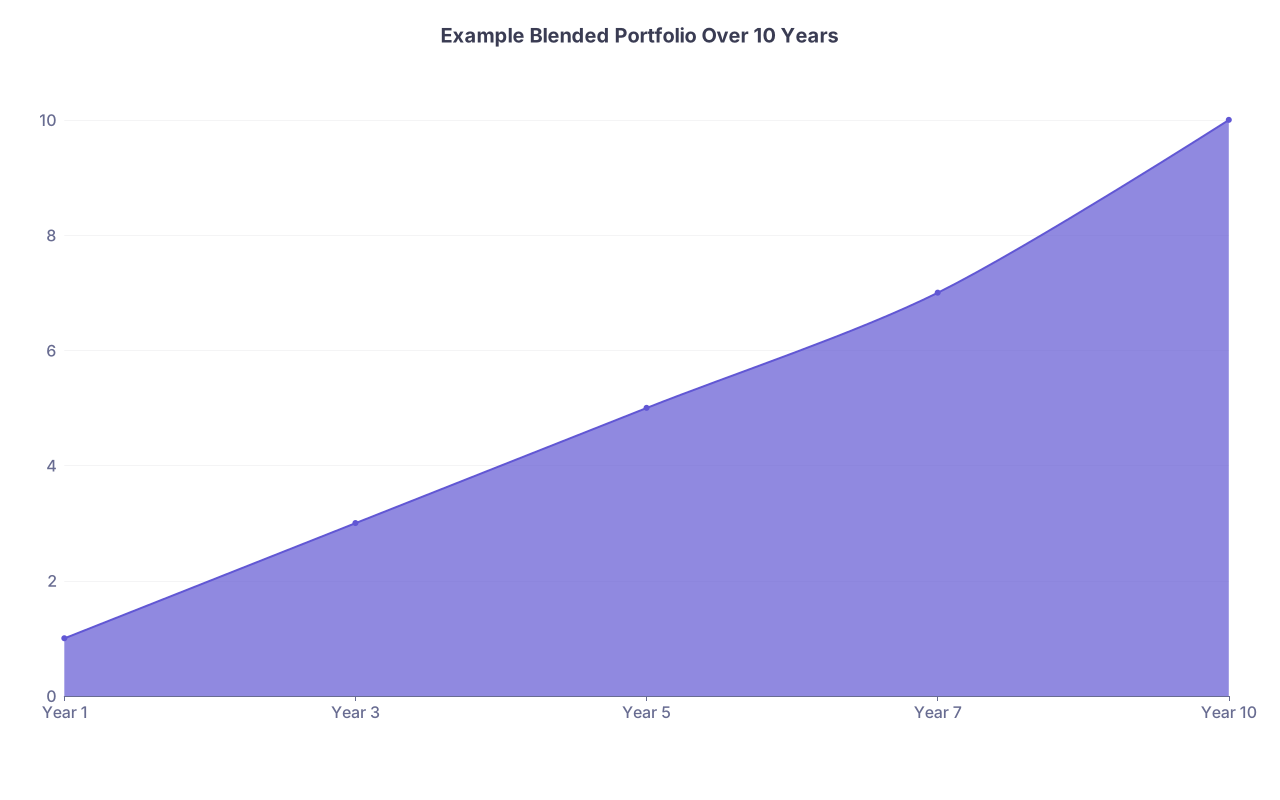
| Category | Value |
|---|---|
| Year 1 | 1 |
| Year 3 | 3 |
| Year 5 | 5 |
| Year 7 | 7 |
| Year 10 | 10 |
Interpretation:
- First 1–2 properties: local (near hospital or same metro).
- Properties 3–6: strongest out-of-state market you’ve vetted.
- Later: maybe one more local for lifestyle/future child housing, plus more diversified remote if it still makes sense.
It does not have to be all local or all out-of-state. You’re allowed to evolve.




FAQs: Investing Near Hospital vs Out-of-State
If I can only buy one property to start, should it be near my hospital or out-of-state?
If your local market isn’t absurdly overpriced, I’d lean toward one local property first, especially if you want to actually learn real estate, not just outsource everything. Being able to drive by, meet your property manager, and see tenant quality with your own eyes is hugely valuable early. If you’re in a truly insane market where nothing comes close to cash flowing, skip local and pick one carefully vetted out-of-state market with strong property management and landlord-friendly laws.Are out-of-state investments too risky for a first-time physician investor?
They’re not automatically too risky, but the operator risk is higher. You don’t know the neighborhood, you’re picking a team remotely, and you’re trusting photos and pro formas. If you’re the type who skim-reads contracts and hates doing due diligence, out-of-state is a bad first move. If you’re methodical, willing to interview multiple managers, and comfortable saying no, you can start out-of-state safely—just don’t rush.What legal issues change when I invest in another state?
Three big ones:
- You may need an LLC in that state or to register your existing LLC as a foreign entity.
- You’ll probably owe state income tax on rental income there and need to file a return.
- You must follow that state’s landlord–tenant laws, which may differ sharply from your home state.
This is why involving a CPA and a real estate attorney early is not optional if you plan to build a serious out-of-state portfolio.
Should I self-manage a property near my hospital to save money?
If it’s your first property, and you genuinely have some bandwidth, self-managing for 6–12 months can be incredibly educational. You’ll understand what good vs bad management looks like later. But if you’re already stretched thin with call, kids, and academic work, forcing yourself into self-management is dumb. One nightmare tenant will erase any management fee savings and then some. Know yourself.How do I pick a good out-of-state market as a physician?
Start with fundamentals: growing or stable population, diverse job base, reasonable landlord laws, and property taxes that don’t eat half your rent. Then look for places where the rent-to-price ratio at least gives you a shot at cash flow after all expenses. Do not chase the highest yield on paper; chase the best mix of stability, team quality, and numbers that work. And always talk to at least two or three independent property managers before choosing a city.Is buying a condo near my hospital a good investment if it just breaks even?
It can be, but only if you’re honest about why you’re buying it. If this is primarily a lifestyle or future-use purchase (you want to live there now or later, or you want a place for a kid in med school), breaking even cash flow-wise might be acceptable. If your stated goal is cash flow or pure investing, then a break-even condo in a high-cost area is usually a poor choice compared with a solid out-of-state rental that actually produces income.What’s a smart “hybrid” strategy for a busy attending?
One pattern that works well:
- Buy one local property (near hospital or nearby suburb) to learn and gain comfort.
- Once you understand the mechanics, add one or two out-of-state properties in a market with great management and numbers.
- Use professional management everywhere from day one.
This gives you familiarity and control locally, plus better income and geographic diversification remotely—without turning real estate into a second full-time job.
Key takeaways:
- “Near my hospital” is not automatically better. It’s better for learning, control, and lifestyle. Out-of-state is usually better for cash flow and scaling.
- Make the decision by comparing real numbers and risk, not comfort level or marketing hype.
- If you’re unsure, one well-bought local property as a starter, then carefully chosen out-of-state deals, is often the most sane path for physicians.