
You’re post-call, half-asleep on the couch of a too-expensive apartment near the hospital. Your co-intern just mentioned he pays nothing out of pocket for housing because his “tenants cover the mortgage.” He called it “house hacking.”
You’re wondering: Is that actually realistic for a medical student or resident, or is this just Instagram-finance nonsense?
Here’s the short, direct answer:
House hacking can be realistic for medical students and residents — but only if (1) you have stable enough cash flow, (2) you buy conservatively, and (3) you treat it like a business, not a fantasy. For many, it’s too much risk and distraction. For a focused minority, it’s one of the best financial moves they’ll ever make.
Let’s break it down like a consult: what it is, when it works, when it’s dumb, and the legal/financial traps you absolutely cannot ignore.
What “House Hacking” Actually Means (In Real Life, Not on TikTok)
House hacking = you live in part of a property and rent out the rest to offset your housing costs.
Common versions for trainees:
- Renting out extra bedrooms in a single-family home you live in
- Owning a duplex/triplex/fourplex, living in one unit, renting the others
- Buying a condo/townhome and taking on a roommate or two
- Less common: buying a property near your med school or hospital and renting by the room to classmates/residents
The key piece: you are both resident/student and landlord.
That means leases, repairs at inconvenient times, screening tenants, and making sure the numbers work after vacancies, repairs, and that one tenant who always pays three days late.
If that sounds miserable to you, house hacking is probably not for you. If it sounds like a tolerable trade for cutting your housing cost by 50–100%, keep reading.
Is It Realistic in Training? The Core Tradeoffs
For medical students and residents, three constraints matter most:
- Time – Will landlording pull you away from studying/patient care?
- Money – Can you handle the upfront costs and the occasional bad month?
- Geography – Will you be there long enough to justify buying?
Let’s make this concrete with a simple decision flow.

| Step | Description |
|---|---|
| Step 1 | Thinking about house hacking |
| Step 2 | Probably skip it |
| Step 3 | Build cash first |
| Step 4 | Maybe rent rooms in someone else place |
| Step 5 | Run detailed numbers |
| Step 6 | Walk away from deal |
| Step 7 | Consider moving forward |
| Step 8 | Will you stay 3+ years? |
| Step 9 | Have emergency savings? |
| Step 10 | Comfortable being landlord? |
| Step 11 | Cash flow positive with buffer? |
My view, after watching a lot of residents and students try this:
- Most medical students: House hacking with ownership is usually a stretch unless you have strong family financial backing, are staying in one city 4+ years, and can stomach risk. Renting a cheap place with roommates is usually smarter.
- Many residents (3–7 year programs): House hacking can be very realistic, especially:
- In lower-cost-of-living (COL) cities
- If you’re in a 4+ year program
- If you’re reasonably handy or at least organized enough to manage contractors
The danger is not that it’s impossible. The danger is that people buy the wrong deal with no margin of safety because they’re tired of paying rent.
The Numbers: Does a Typical Resident House Hack Actually Work?
Let’s walk a very typical resident scenario.
You’re a PGY-1 in internal medicine in a mid-COL city. You’re looking at a duplex:
- Purchase price: $350,000
- 5% down on owner-occupied loan: $17,500
- Closing + inspection + appraisal + minor repairs: ~$8,500
- Total cash needed: ~$26,000
Financing:
- 6.5% interest, 30-year fixed, 5% down
- P&I: about $2,100/month
- Taxes + insurance: about $450/month
- Total PITI: ~$2,550/month
Income:
- You live in one unit.
- The other unit rents for: $1,800/month
- You charge your co-resident $900 to share your unit.
So gross rent: $2,700/month.
Now subtract reality:
- Vacancy + nonpayment reserve (5%): -$135
- Repairs/CapEx (8–10%): say -$220
- Landlord utilities/yard/snow average: -$150
- Property management? If you self-manage: $0. If you hire: maybe 8–10% of collected rents.
Result:
- Net operating income (NOI) roughly: $2,700 − $135 − $220 − $150 = $2,195
- Mortgage + taxes + insurance: ~$2,550
- Cash flow: -$355/month
- BUT your personal housing cost is that -$355.
If you rented your own 1-bed apartment near the hospital, maybe you’d pay $1,600 yourself. In this example, your effective housing cost is $355 vs $1,600.
That’s a win.
Now, reality check:
- If rents are softer, or you can’t find a roommate, you can easily swing to -$1,000/month.
- If AC dies and you need $6,000 you did not budget, things get ugly.
- If you’re on nights and a toilet explodes, you’re dealing with that or paying someone who will.
Bottom line: yes, the math can work, and it can work well. But it’s fragile if you’re undercapitalized and optimistic.
Here’s a quick snapshot comparing scenarios.
| Option | Monthly Cost to You | Upfront Cash | Hassle Level |
|---|---|---|---|
| Solo 1-bed rental | High | Low | Low |
| Roommate in rental | Medium | Low | Medium |
| House hack - rent rooms | Low to zero | Medium | High |
| House hack - small duplex | Low to medium | High | High |
Financial and Legal Landmines You Can’t Ignore
Here’s where a lot of trainees get burned. They assume “I’m a doctor, banks will love me,” skip the details, and end up in a legal or financial mess.
1. Financing: How Lenders Actually Look at You
As a med student:
- No income. Just loans.
- Zero chance of a traditional mortgage unless you have a co-signer with real income/assets.
- “Doctor loans” usually require proof of attending income, not MS3 summer vibes.
As a resident:
- You often can qualify, especially with:
- Physician mortgage programs (low down payment, no PMI, more lenient on student debt)
- W-2 contract and future-dated offer letter
But:
- Lenders will still look at debt-to-income ratio, including your student loans (even if in IDR).
- Underwriters may count only a portion of projected rental income (often 75%) until there’s a track record.
Do not assume the bank’s approval means the deal is smart. It only means they’re okay if you take the risk.
2. Legal Landlord Responsibilities
You’re not “just renting a room to a buddy.” In most states, you’re a landlord. That comes with:
- Required disclosures (lead paint, mold, etc.)
- Obeying local landlord-tenant laws (security deposit rules, eviction process, habitability standards)
- Fair housing rules — you cannot discriminate based on protected classes, even if it’s a room in your house (varies by state, but do not play games here).
At minimum, you need:
- Written lease, not a handshake
- Separate bank account for rental activity
- A real plan for what happens if they stop paying
If you’re in a big city (Boston, NYC, San Francisco), rules are typically stricter and more tenant-friendly. That’s not necessarily bad, but it means you must understand the framework.
3. Zoning and Occupancy Laws
Plenty of cities limit:
- How many unrelated adults can live in one unit
- Using basements/attics as bedrooms
- Short-term rentals (Airbnb etc.)
I’ve seen residents buy a “5-bedroom” single-family, plan to rent to 4 classmates, then discover the city considers it a 3-bedroom with a 2 unrelated tenant limit. That can blow up the entire math.
You solve this by:
- Pulling the zoning code from the city website
- Checking occupancy limits and definitions of “family” vs “unrelated”
- Confirming with a local real estate attorney before closing
4. Insurance and Liability
If you have tenants, you need landlord coverage, not just a standard homeowner policy.
- You: homeowner portion
- Tenants: their own renter’s insurance (you can require this in the lease)
- Consider extra liability coverage (umbrella policy), especially as a future/high-earning physician
One lawsuit from a tenant injury on an icy driveway is not something you want coming after your personal assets and future earnings.
When House Hacking Makes Sense vs When It’s Dumb
Let me be blunt.
Good candidate scenarios
- You’re a PGY-1 in IM, FM, Peds, Psych, or a long surgical program in a low- to mid-COL city (think Rochester MN, St. Louis, Kansas City, Birmingham, Cincinnati, etc.).
- You know you’ll be there 4+ years and possibly fellowship there too.
- You have $20–40k saved (or legitimately gifted) and would still have 3–6 months of expenses left after closing.
- You’re willing to treat this as a business: screen tenants, enforce leases, keep records.
Bad candidate scenarios
- You’re a third-year med student with loans only and no clear match location.
- You matched to a 3-year program in a very high COL coastal city where entry-level properties are $700k+.
- You have no savings and plan to “just use credit cards if something comes up.”
- You hate conflict and can’t imagine telling a co-resident their late rent means they have to leave.
Frankly, the worst version is: minimal savings, maximal optimism, and a plan that only works if everything goes right. That is not a plan; that is hoping the call schedule fairy also fixes your roof.
Practical Steps If You’re Seriously Considering It
If you’re not sure whether to move forward, this is the process I’d follow.
1. Run brutally conservative numbers
- Assume rent 10–15% lower than the current listing/estimate
- Assume 10% vacancy
- Budget at least 10% of gross rent for repairs/CapEx
- Include realistic utilities/landscaping/snow costs
- Add property management cost even if you’ll self-manage (as a proxy for your time and a future backup plan)
If the deal still looks decent after that, it’s worth a deeper look.
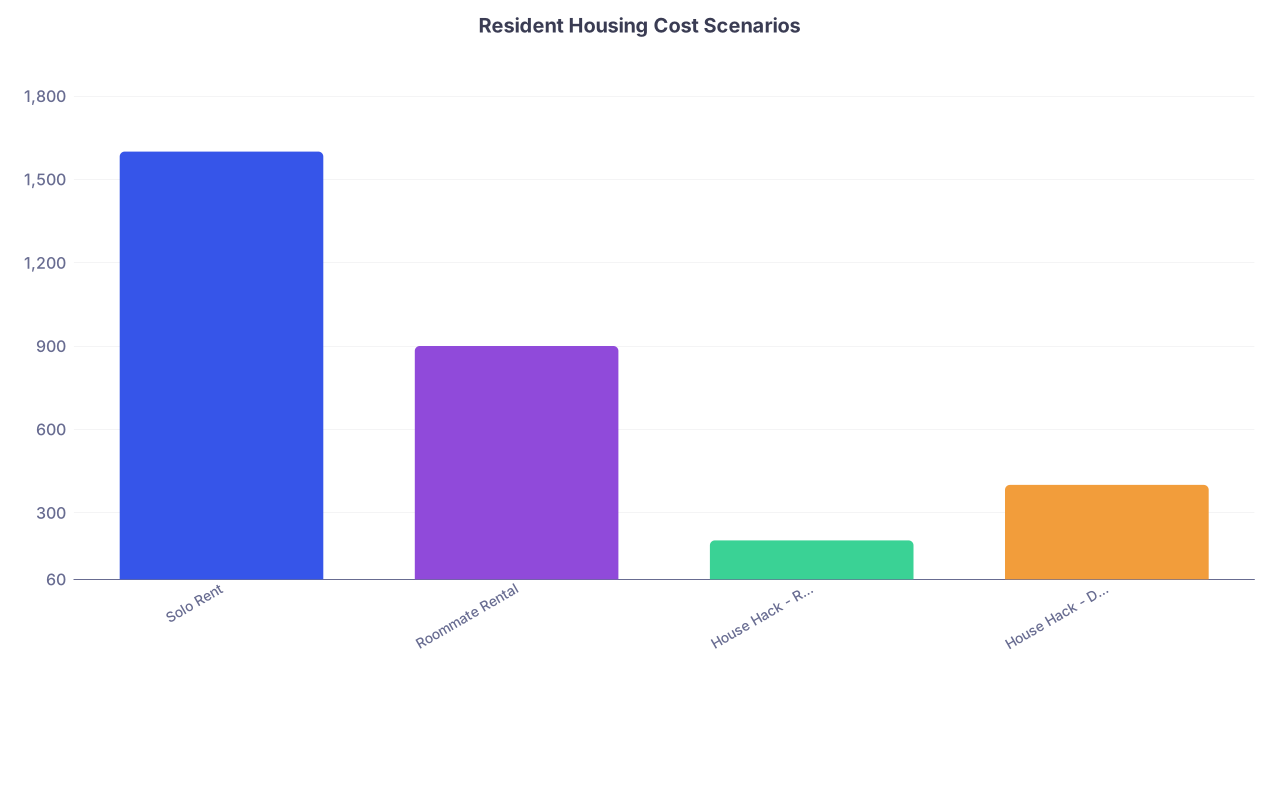
| Category | Value |
|---|---|
| Solo Rent | 1600 |
| Roommate Rental | 900 |
| House Hack - Rooms | 200 |
| House Hack - Duplex | 400 |
2. Decide your “landlord involvement” level
You’ve got three basic choices:
- Self-manage entirely
- Use property management from day one
- Self-manage while you live there, plan to hire management if/when you move out
Residents with brutal call schedules sometimes underestimate how little bandwidth they’ll have for tenant issues. Honestly assess yourself.
3. Talk to three key people locally
Not your co-resident with a BiggerPockets account. Actual professionals:
- A local real estate agent who works with investors, not just owner-occupiers
- A real estate attorney in your state (one paid consult is cheap insurance)
- A lender with physician loan experience
Bring them a specific property example and ask them to punch holes in it.
4. Think ahead: exit strategies
Ask yourself:
- If I need to leave the city in 3 years, can this rent as a pure rental and still cover expenses?
- Would I be comfortable being a long-distance landlord (with property management)?
- Worst case, if I sell, what does my break-even sale price look like after closing costs?
If your only exit is “sell at the same or higher price than I paid,” that’s too fragile.
Realistic Alternatives That Still Improve Your Finances
If you like the idea of house hacking but not the risk/complexity, there are lighter-weight alternatives for trainees:
- Rent a 3-bedroom house near the hospital, put the lease in your name, choose the roommates — essentially “soft house hacking” without ownership risk.
- Live slightly farther from the hospital in a cheaper area, accept a longer commute but drastically lower rent.
- Focus on aggressively lowering lifestyle costs and building a cash reserve during residency so post-attending real estate investing is far easier and safer.
The truth: you don’t need to house hack as a trainee to end up wealthy as a physician. It can be an accelerator, not a requirement.

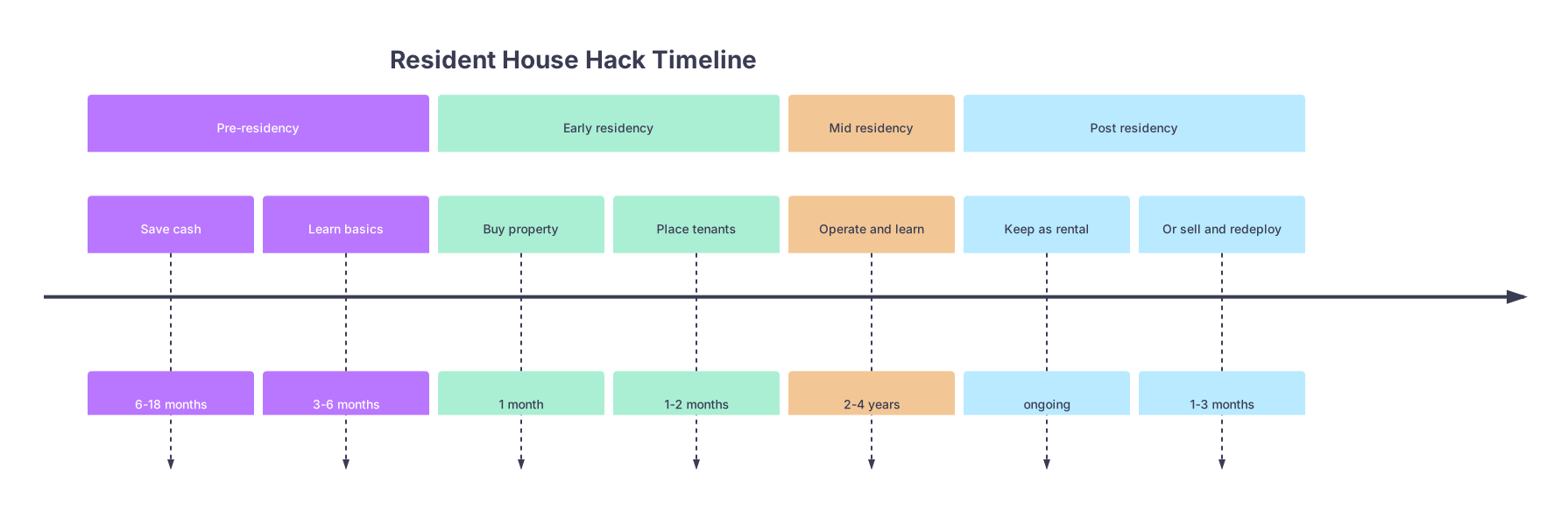
| Period | Event |
|---|---|
| Pre-residency - Save cash | 6-18 months |
| Pre-residency - Learn basics | 3-6 months |
| Early residency - Buy property | 1 month |
| Early residency - Place tenants | 1-2 months |
| Mid residency - Operate and learn | 2-4 years |
| Post residency - Keep as rental | ongoing |
| Post residency - Or sell and redeploy | 1-3 months |
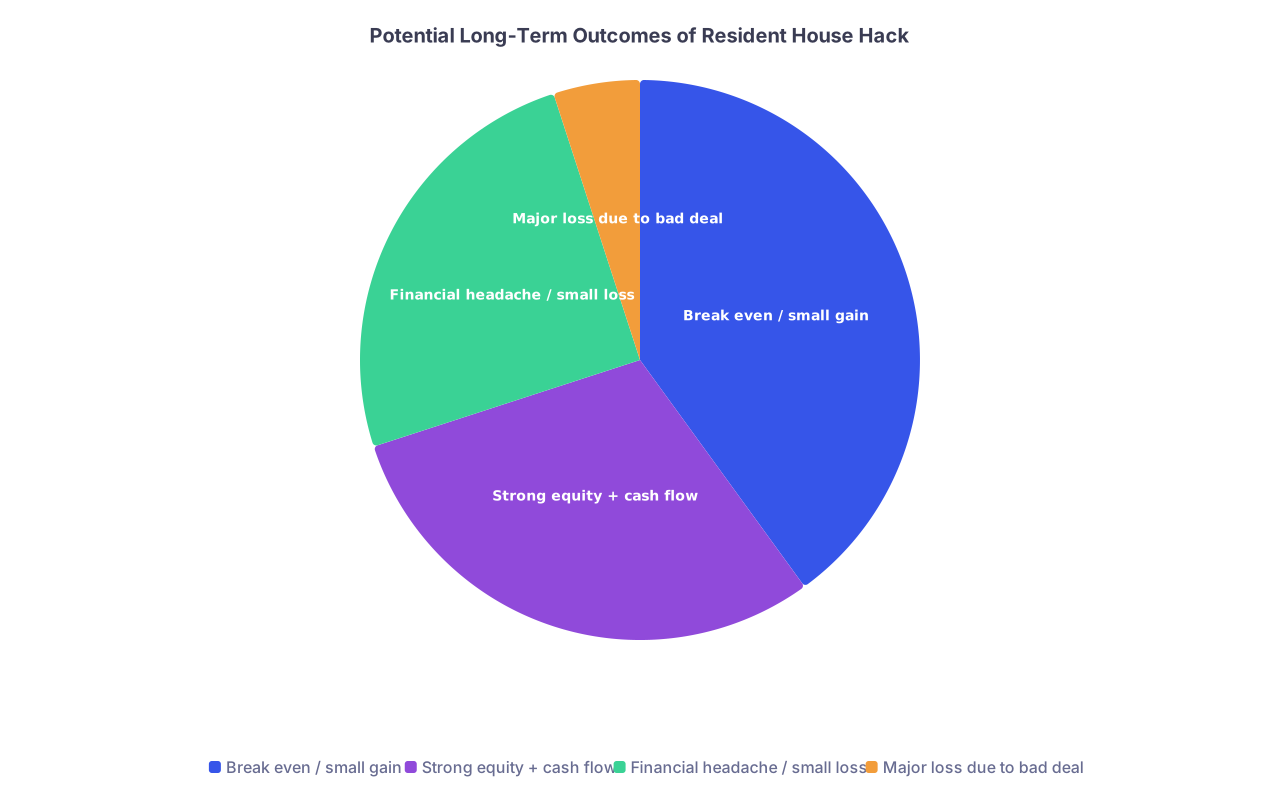
| Category | Value |
|---|---|
| Break even / small gain | 40 |
| Strong equity + cash flow | 30 |
| Financial headache / small loss | 25 |
| Major loss due to bad deal | 5 |
FAQs: House Hacking for Medical Students and Residents
1. Is it ever smart for a medical student to house hack?
Occasionally, yes, but it’s rare. It can make sense if:
- You’re in a 4-year program and highly likely to do residency in the same city
- You have real cash savings or strong family support
- Housing prices are reasonable and rents support the mortgage even if you move out
Most med students are better off renting cheaply, taking roommates, and preserving flexibility for the Match.
2. How much cash should a resident have before house hacking?
Bare minimum, I’d want:
- 5–10% down payment (depending on loan)
- 2–3% of purchase price for closing/initial repairs
- And at least 3–6 months of total living expenses still sitting in cash after closing
If you drop to under one month of reserves the day you close, you’re gambling. On call. With no backup.
3. Do I need an LLC to house hack as a trainee?
For a typical owner-occupied house hack (you living there, renting rooms or a unit), most lenders actually won’t let you take title in an LLC for standard residential financing. Many resident house hackers buy in their personal name and then layer protection with:
- Strong insurance (including umbrella policy)
- Good leases and risk management
- Possibly an LLC or other structure later, when they refinance or add more properties
Talk to a real estate attorney and insurance agent in your state; do not copy some random online structure.
4. What if my co-resident roommate stops paying rent?
Treat them like any other tenant. Step one is talking and understanding what’s going on. But you need to:
- Have a written lease that spells out late fees, timelines, and consequences
- Keep communication in writing once there’s an issue
- Be willing to enforce the lease, up to and including eviction if necessary
Mixing “co-resident friend” with “tenant” is risky if you’re not emotionally willing to draw lines. If you know you can’t do that, don’t rent to close colleagues.
5. How do I find a good house hack property near my hospital?
You look for boring, not flashy:
- Small multifamily (duplex/triplex/fourplex) within a reasonable commute
- Or single-family with a logical layout for roommates (multiple baths, decent common space)
- In an area safe enough that medical trainees would actually want to live there
- Where rents clearly support at least 70–80% of your all-in monthly cost even with conservative assumptions
Work with an investor-savvy agent and run actual numbers, not vibes.
6. What’s one sign I should absolutely walk away from a house hack deal?
If the deal only works when you:
- Assume zero major repairs needed
- Assume you’ll always have full occupancy at top-of-market rent
- Assume you’ll “figure it out later” on legal/landlord issues
— then walk. A real deal still makes sense after you beat it up with conservative assumptions.
Open a spreadsheet right now and model your current housing cost versus a simple house hack scenario in your actual city, using conservative numbers. If you don’t like what you see on the spreadsheet, you’ll hate it even more at 2 a.m. post-call with a broken water heater.