
What actually happens if you buy your first rental in your own name, a tenant slips, sues you, and you’re a high‑earning physician with real assets to lose?
Let’s answer the question you’re really asking: “Do I need an LLC for my first real estate property… or is this overkill for where I am right now?”
Here’s the direct answer:
If you’re a physician buying your first long‑term rental, you usually don’t need an LLC on day one. It’s often smarter to start in your personal name with proper insurance, then move to an LLC structure once you hit a certain scale or risk profile.
But there are real pros and cons, and if you get this wrong, it gets expensive and annoying fast.
Let me walk you through how to think about it—physician‑specific, not generic blog nonsense.
The Real Question: What Are You Actually Protecting?
You’re not a broke 25‑year‑old house hacker. You’re a physician with:
- High W‑2 or 1099 income
- Retirement accounts
- Maybe brokerage investments
- Maybe a personal home
You’re wondering: “If something goes wrong at this property, can they come after everything?”
Here’s the key distinction most people miss:
- Malpractice / professional risk (patient care) → covered by malpractice, not by an LLC on your rental.
- Landlord / property risk (tenant injuries, disputes, property hazards) → this is where LLCs and insurance matter.
An LLC for your rental does nothing to shield you from malpractice claims. It’s not a magic “doctor protection shield.”
The LLC is for landlord liability, not professional liability.
So now the real question becomes:
For my very first rental, is an LLC the best (or necessary) way to limit landlord risk?
Often, the honest answer is:
Not yet. Not for property #1.
What an LLC Actually Does (And What It Doesn’t)
Think of an LLC as a container.
If set up and used correctly, an LLC:
- Separates the assets inside the LLC (that rental) from your personal assets
- Makes it harder for a plaintiff to reach beyond the LLC to your personal house, brokerage account, etc.
But:
- It doesn’t protect you from your own gross negligence (e.g., knowingly ignoring obvious safety issues).
- It doesn’t replace good insurance.
- It doesn’t help at all with malpractice lawsuits.
So the ideal setup, eventually, is:
- Property in an LLC
- Strong landlord policy
- Umbrella liability policy on top
But it’s a mistake to assume “LLC = safe, no LLC = exposed.” Reality is more nuanced, especially for one property.
Why Many Physicians Don’t Start With an LLC for Property #1
I’ll be blunt: for the first property, an LLC is often more hassle than benefit.
Here’s why.
1. Financing Is Simply Easier in Your Personal Name
Lenders love W‑2 physicians. They don’t love brand‑new LLCs with no track record.
Buying your first property:
In your own name:
- More lenders, more competitive rates
- Standard 15‑ or 30‑year fixed mortgages
- Lower down payment options (depending on property type and lender)
In a new LLC:
- Often commercial or “business purpose” loans
- Higher rates, more fees
- Larger down payments
- Shorter terms, more underwriting friction
You can often buy in your name, then transfer to an LLC later (via a deed, often a quitclaim or warranty deed), once you’re stabilized and more experienced.
Does this technically violate some “due on sale” clauses in mortgages? Yes. Has that been aggressively enforced for small residential rentals where the borrower is still the guarantor and still paying on time? Almost never. Banks care about getting paid.
2. Cost and Complexity Are Real (Even If You Can Afford Them)
Setting up an LLC isn’t rocket science, but doing it really right (as a physician with assets) shouldn’t be a $49 online form either.
You’re looking at:
- State filing fees (anywhere from ~$50 to several hundred per year)
- Possibly a registered agent
- CPA and/or attorney time to do this properly
- Separate bank account, bookkeeping, operating agreement
Is that going to bankrupt you? No.
Is it worth adding that complexity before you even know if you like being a landlord? Often no.
I’ve watched plenty of physicians spend more time fiddling with entity structure than analyzing deals. That’s backward.
3. Insurance Does 80–90% of the Heavy Lifting at This Stage
For one property, here’s where your real protection comes from:
- A solid landlord policy (not a standard homeowner’s policy)
- An umbrella policy (typically $1–5M) sitting on top of your underlying policies
Most real lawsuits never pierce beyond the insurance. Plaintiffs’ attorneys usually aim where the money is easy: the policy limits.
So a common pattern I see:
- Property #1–3 → title in personal name, very strong insurance + umbrella
- Property #4+ (or higher‑risk assets) → move to LLCs / series LLCs / trust‑plus‑LLC setups, with professional legal help
When an LLC Does Make Sense for Your First Property
There are times when I’d tell a physician: “Yeah, set up the LLC from day one.”
1. If You’re Buying All Cash
No lender, no loan underwriting headache. In that case:
- Put the property directly into an LLC at purchase.
- Title, insurance, and leases all in the LLC’s name.
This is common for high‑earning physicians doing a modest first deal (e.g., $150–300K single‑family in cash).
2. If It’s a Higher‑Risk Type of Property
Risk isn’t just about price; it’s about use.
I’d lean toward an LLC early if:
- It’s a short‑term rental (Airbnb/VRBO) with many different guests cycling through.
- It’s in a more litigious jurisdiction (certain states are just lawsuit‑happy).
- It’s a small multifamily with more tenant interactions and more common areas.
Still pair it with good insurance, but in these situations, the extra layer is more justifiable.
3. If You Already Know You’re Building a Portfolio
If you’re certain you’re going to 5–10 units and beyond, you can justify building the structure correctly up front:
- One “holding company” LLC
- One property‑specific LLC per property (or a series LLC if your state supports it and your attorney likes it)
- Clean bookkeeping from day one
This is more like building a small business. Makes sense to start correctly if you’re committed, not dabbling.
How to Decide: A Simple Framework for Physicians
Use this quick filter for property #1.

| Step | Description |
|---|---|
| Step 1 | First Rental Property |
| Step 2 | Strong case for LLC now |
| Step 3 | Consider LLC + insurance |
| Step 4 | Build LLC structure now |
| Step 5 | Buy in personal name + strong insurance |
| Step 6 | All cash purchase |
| Step 7 | High risk property type |
| Step 8 | Plan to own 5 plus units soon |
Let’s put more words around that:
If you’re financing, normal long‑term rental, not sure you’ll own more than 1–2:
- Buy in your personal name.
- Title insurance + landlord policy + umbrella.
- Reevaluate LLC once you have more doors or more clarity.
If you’re all cash OR clearly building a real portfolio OR doing STRs / higher‑risk use:
- Talk to a real estate attorney in your state.
- Consider starting with an LLC from day one.
What About Taxes? Is an LLC a “Tax Hack” for Doctors?
Short answer: No, not by itself.
A single‑member LLC by default is a disregarded entity for tax purposes. The IRS basically pretends it doesn’t exist. Income flows to your Schedule E the same way as if you held it in your own name.
The “LLC = tax savings” myth is wildly overhyped.
You get most of your major real estate tax benefits without an LLC:
- Depreciation
- Expenses (interest, repairs, management, travel, etc.)
- Potential bonus depreciation / cost segregation on larger properties
Where entities can matter for taxes:
- Partnerships (multi‑member LLCs) and allocation of income/losses
- More advanced setups (LLC owned by an S‑Corp for active flipping/wholesaling businesses—not typical for passive rentals)
For a straightforward, buy‑and‑hold rental, the tax picture is basically the same LLC vs no LLC.
So if you’re thinking, “I’ll set up an LLC to pay less tax,” that’s the wrong reason.
A Practical Setup I Recommend Often for Property #1
If you’re a physician buying your first simple rental (e.g., a long‑term single‑family), here’s a very sane, low‑drama starting point:
- Buy in your personal name using a standard mortgage (if financing).
- Get a proper landlord policy with liability coverage (don’t keep a homeowner’s policy on a rental).
- Add a $1–5M personal umbrella policy that sits on top of your home + auto + rental.
- Use professional property management if you don’t want to be personally handling tenant interactions (this also reduces some personal risk).
- Keep clean records from day one (income, expenses, receipts).
Then, once you have:
- 2–4 doors, or
- Clear commitment to keep scaling
…sit down with a real estate‑savvy attorney + CPA and ask one pointed question:
“Given my portfolio, my state, and my total net worth, how would you structure my entities over the next 5–10 years?”
That’s where LLCs shine—as part of a portfolio‑level plan, not as a reflexive checkbox on property #1.
Quick Comparison: LLC vs Personal Name for Your First Rental
| Factor | Personal Name | LLC From Day One |
|---|---|---|
| Financing | Easier, better terms | Harder, often higher rates |
| Legal setup cost | Minimal | Filing fees, attorney, CPA |
| Liability baseline | Insurance + umbrella | LLC + insurance + umbrella |
| Tax treatment | Schedule E | Usually the same (disregarded entity) |
| Complexity | Low | Moderate to high |
Common Pitfalls Physicians Run Into
I’ve seen these mistakes enough times to be annoyed by them:
LLC with no insurance
This is like a great lock on a door with no actual door. You want both.Buying in your name, then transferring to LLC without talking to lender or attorney
Many do this and it’s fine. Some create title or insurance problems because they don’t coordinate properly. Don’t wing it.Over‑engineering the structure before property #1
I’ve watched physicians spend months debating holding companies, Wyoming vs Delaware, series LLCs… with zero offers made. That’s procrastination dressed up as planning.Assuming malpractice and landlording are the same legal risk
They’re not. If you’re losing sleep about “being a doctor with assets,” talk separately to your med‑mal and asset‑protection attorney. Don’t try to solve it all with a rental LLC.
How to Talk to a Lawyer Without Getting Steamrolled
You don’t need to walk into a law office and say, “I want an LLC.” That’s how you end up with something you might not need.
Instead, say this:
“I’m a physician buying my first [type of property] in [state]. I want a sensible level of protection without unnecessary complexity. For one property, would you recommend:
- Strong insurance only,
- Title in my personal name,
- Or an LLC from day one?
And what would change your answer—more units, STRs, certain states?”
Good attorneys appreciate a client who is clear on the tradeoffs, not just chasing buzzwords.
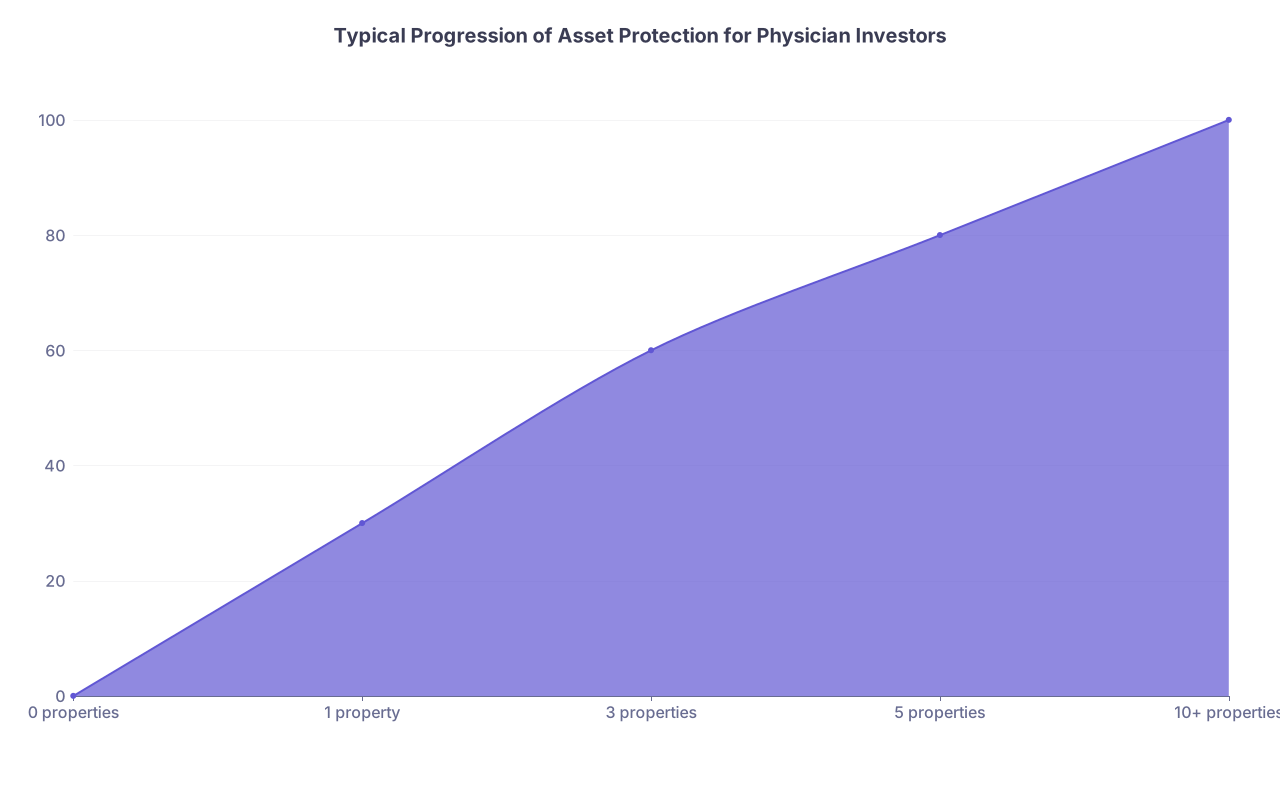
| Category | Value |
|---|---|
| 0 properties | 0 |
| 1 property | 30 |
| 3 properties | 60 |
| 5 properties | 80 |
| 10+ properties | 100 |
(0 = no formal structure, 100 = full multi‑LLC + trust + insurance setup. The trend is the point: structure builds over time.)
FAQ: Physicians, First Rentals, and LLCs

1. Can I start in my personal name and move the property into an LLC later?
Yes, this is very common.
The usual flow:
- You close in your personal name (better loan terms).
- Once the property is stable and insured, you work with a real estate attorney to deed it into your LLC.
- You update your insurance so the LLC is the named insured.
Technically, this can trigger the due‑on‑sale clause in your mortgage. In practice, if payments are current and you’re the same underlying borrower, lenders usually don’t care. But talk to your attorney and, ideally, your lender before you do it.
2. How much liability insurance should I carry as a physician landlord?
For most high‑earning physicians with one rental, a common pattern is:
- Landlord policy with $500K–$1M liability
- Personal umbrella policy $1–5M on top
If your net worth is >$2–3M, I’d lean toward a $5M umbrella. It’s surprisingly cheap relative to your income and risk.
Ask your insurance agent directly:
“If I get sued as a landlord, what’s my total stack of liability coverage? Show me the numbers.”
If they can’t clearly answer, find a better agent.
3. Does having an LLC for my rental protect my personal home from lawsuits?
If the LLC is set up and operated correctly, and the lawsuit is about the LLC’s property, then yes—your personal residence is usually outside that “container.”
But a few caveats:
- Plaintiffs can still sue you personally if you were personally negligent.
- If you personally guaranteed a loan, lenders can still come after you for that debt.
- Some states have homestead protections that already partially shield your residence.
So the LLC helps, but it’s not an invincibility cloak.
4. I’m doing a short‑term rental (Airbnb). Should I skip the LLC?
I wouldn’t “skip” the LLC conversation here.
STRs have:
- Higher guest turnover
- More people on the property
- More “hotel‑like” risks (falls, parties, alcohol, pools, etc.)
For these, I usually recommend:
- Very strong STR‑appropriate insurance (not a standard landlord policy)
- Serious look at an LLC from day one, especially if you’re all cash or can get reasonable financing through an entity
Talk specifically to someone who insures STRs; don’t assume your standard agent understands the nuances.
5. I’m a high‑earning surgeon with no rentals yet. What’s the single best first move?
Not an LLC.
The best first move is:
- Get educated enough to buy one good, boring, cash‑flowing rental.
- Buy it (likely in your own name).
- Pair it with strong insurance + umbrella.
Then, once you know you actually want to be in this game, bring in an attorney and CPA to design your long‑term structure.
Bottom line:
- You usually don’t need an LLC for your first rental as a physician, especially if you’re financing and it’s a basic long‑term rental.
- Insurance + umbrella do most of the work early; LLCs become more valuable as your portfolio and risk grow.
- Don’t let entity structure delay your first good deal. Get one solid property under your belt, then build the sophisticated structure once you know you’re in this for real.