
The most common question physicians ask about real estate is the wrong one.
“How many rentals do I need?” is incomplete. The better question is:
“How much net cash flow do I need, and what’s the most efficient way to get it?”
Let me answer the thing you actually care about: replacing clinical income.
Below is the practical framework I’d give a busy attending in clinic between patients. No fluff. Numbers, assumptions, and what it really takes.
Step 1: Define What “Replacing Clinical Income” Actually Means
You cannot replace what you haven’t defined.
For most physicians, “replace my income” means:
- Cover current after-tax take-home pay
- Maintain lifestyle without picking up a stethoscope
- Have a buffer for inflation, vacancies, and surprises
Let’s put numbers on it.
Say you’re:
- A hospital-employed internist making $300,000 W-2
- After taxes, retirement contributions, and benefits, your take-home is roughly $15,000–$16,000/month (varies by state and deductions)
Your true replacement target isn’t $300k.
It’s about $15,000/month in reliable, relatively passive income.
Most physicians underestimate this and ignore taxes on real estate income. Big mistake.
Quick Rule of Thumb
Whatever your current monthly net pay is from your employer:
- Target 1.2–1.5x that amount in real estate net cash flow
- That margin covers:
- Vacancy
- Repairs and CapEx
- Tax drag once depreciation runs thin
So if you net $15k/month clinically, aim for $18k–$22k/month in real estate cash flow to feel truly “replaced.”
Step 2: Understand What One Typical Rental Actually Produces
This is where fantasy dies.
Most physicians wildly overestimate how much a single rental produces because they look at rent instead of net cash flow.
Let’s take a very standard long-term rental example in a decent Midwest/Southeast market.
- Purchase price: $300,000
- Down payment: 25% ($75,000)
- Mortgage + taxes + insurance: ~$1,800/month
- Rent: $2,400/month
Now subtract real expenses
(not the fake napkin math your Realtor gives you):
- Property management (8–10%): ~$200–$240
- Repairs + CapEx reserves: $200–$300
- Misc/ HOA / Leasing fees (averaged): $50–$100
You end up with something like:
- Gross rent: $2,400
- Mortgage/Taxes/Insurance: -$1,800
- Other expenses/reserves: -$450 (avg)
Realistic net cash flow: ~$150/month–$250/month per door
That’s $1,800–$3,000/year for a $75,000 cash investment.
Good property, stable tenant, reasonable market. Not a disaster. Not amazing.
Now do the math:
You want $18,000/month and each door gives you $200/month.
You’d need 90 rentals of that type.
That’s absurd for a full-time physician.
So what does that tell you?
If your plan is “buy a bunch of $200/month long-term rentals,” you will burn out before you get close.
You either need:
- Higher cash-flowing assets, or
- Fewer but bigger properties, or
- Different strategies (short-term, mid-term, syndications, small multifamily, etc.)
We’ll get there.
Step 3: Realistic Cash Flow Ranges by Strategy
Let’s ballpark what different property types can produce per unit in solid (not unicorn) scenarios.
| Strategy | Net Cash Flow / Unit | Typical Price Range |
|---|---|---|
| Single-family (L-T) | $150–$300 | $200k–$400k |
| Small multifamily | $250–$500 | $400k–$1.5M |
| Mid-term rentals | $400–$800 | $250k–$600k |
| Short-term rentals | $500–$1,500 | $300k–$800k |
| Syndication (per $100k) | $600–$1,000 | $50k–$250k minimum |
These are post-expense, post-reserve numbers in functioning markets with professional management. I’ve seen higher. I’ve seen plenty lower. But this is a useful planning range.
Now let’s plug this into your income replacement goal.
Step 4: Concrete Scenarios – How Many Rentals Do You Actually Need?
Let’s assume you want $20,000/month of net cash flow to fully and safely replace a $300–350k attending job.
Scenario A: Only Standard Long-Term Rentals
Assume $250/month per door (decent but not extraordinary).
- Needed: $20,000 ÷ $250 = 80 units
At 25% down on $300k properties:
- Each property needs $75,000 cash
- 80 properties → $6,000,000 purchase price
- Equity needed ≈ $1.5M in down payments alone
Plus:
- Years of acquisition
- Lending friction after 10 mortgages
- Asset management complexity
Conclusion: Pure single-family long-term rentals are a terrible solo strategy for a full-time doc trying to fully replace clinical income.
Scenario B: Small Multifamily Focus
Example: 4-plex, purchase price $800,000, 25% down.
- Cash in: $200,000
- Net cash flow per unit: $350/month (moderate)
- 4 units → $1,400/month per building
To reach $20,000/month:
- $20,000 ÷ $1,400 ≈ 14–15 such buildings
- That’s 56–60 units total
- Capital needed: 15 × $200,000 ≈ $3,000,000 in equity
Still heavy, but you’ve cut door count and complexity per dollar of cash flow.
Scenario C: Short-Term / Mid-Term Rental Heavy
Assume you selectively buy properties that:
- Net $1,000/month each after all costs and reserves (this is achievable in strong vacation or travel nurse markets with good operations).
To hit $20k/month:
- $20,000 ÷ $1,000 = 20 properties
If each property needs $100k all-in (down payment + setup), you’re looking at $2M in capital.
Operationally more intense, but you can outsource to good STR / mid-term managers if you’re willing to accept slightly lower net.
Scenario D: Blended Strategy (Most Realistic for Physicians)
This is what I see serious physician investors actually do.
Example blend:
- 5 small multifamily buildings: $1,500/month each → $7,500/month
- 6 well-chosen short/mid-term rentals: $1,200/month each → $7,200/month
- $400k in syndications at 8% cash-on-cash: ≈ $2,666/month
- 4 boring single-family long-term rentals: $250/month each → $1,000/month
Total ≈ $18,366/month.
You’re in the ballpark. A few more units, or some mortgage pay-down to boost free cash flow, and you’re there.
This blended approach spreads risk, uses your high savings rate intelligently, and doesn’t require you to become a full-time property manager.
Step 5: How Much Capital Does a Physician Actually Need?
Cash flow is only half the story. The barrier is capital.
Let’s assume:
- You’re a mid-career physician
- You can save/invest $100k–$200k per year without ruining your life
- You’re willing to commit 10–15 years to building a portfolio
That gives you $1M–$3M in invested capital over a decade or so.
How that translates into “number of rentals” depends on how efficiently you deploy it.
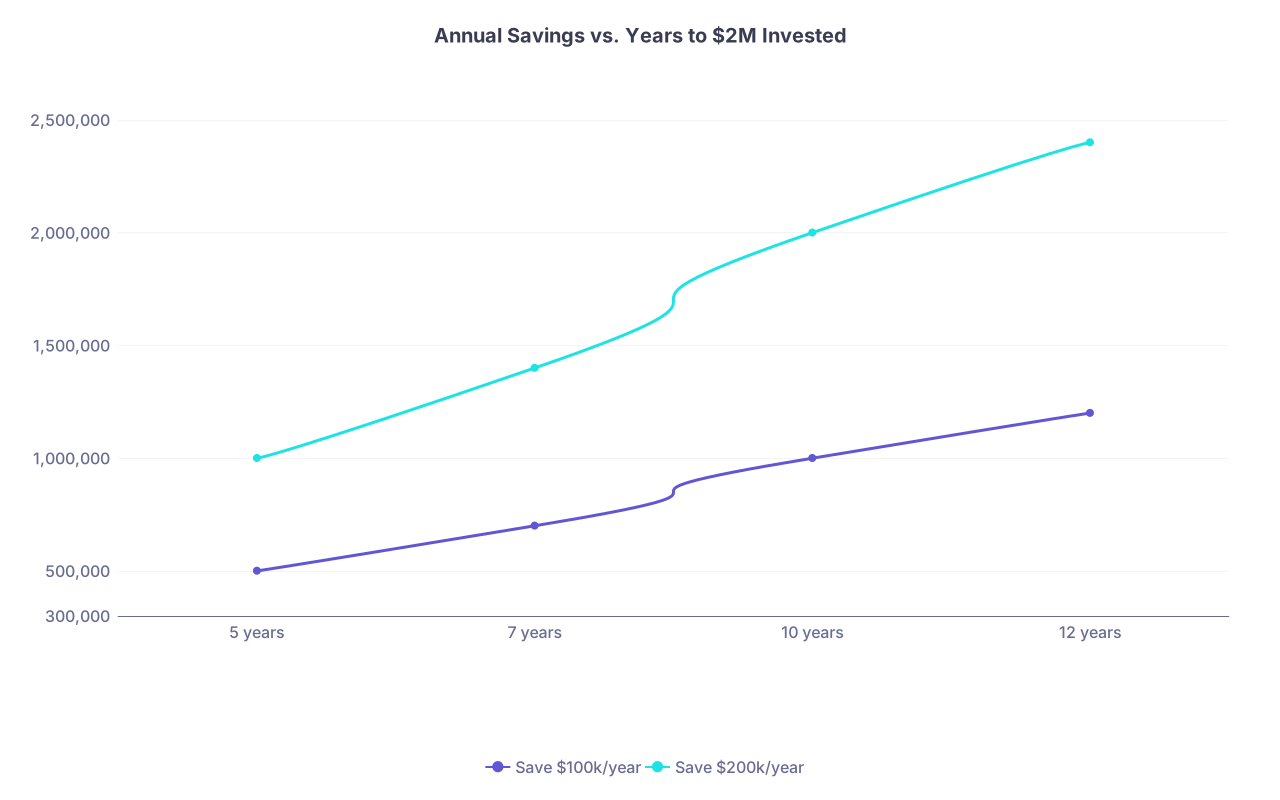
| Category | Save $100k/year | Save $200k/year |
|---|---|---|
| 5 years | 500000 | 1000000 |
| 7 years | 700000 | 1400000 |
| 10 years | 1000000 | 2000000 |
| 12 years | 1200000 | 2400000 |
If you deploy $2M intelligently into:
- Mixture of small multifamily, mid-term/short-term, and some syndications
- Targeting an average 8–10% cash-on-cash across the portfolio
You’re looking at:
- $2,000,000 × 0.08–0.10 = $160,000–$200,000/year
- That’s $13,000–$16,700/month
You are very close, or already there, especially if:
- Mortgages are being paid down
- Rents rise over time
- You supplement with part-time/locums for a few years during the transition
So the real path for a physician is rarely “x number of rentals.”
It’s “$1.5M–$3M of well-placed capital, producing 8–12% cash-on-cash, diversified across 15–40 doors and a few passive stakes.”
Step 6: Use a Simple Framework, Not Door Count
If you want something you can write on a sticky note, use this.
Define Target Monthly Income
- Target = 1.2–1.5 × current monthly take-home pay
Pick a Realistic Cash-on-Cash Target
- Conservative: 6–8%
- Reasonable for active/leveraged rentals: 8–12%
Solve for Capital Needed
- Capital Needed = Target Annual Income ÷ Cash-on-Cash
Example:
You want $240k/year passive and think you can hit 9% blended returns.
- $240k ÷ 0.09 ≈ $2.67M invested capital
Then the “how many rentals” question is secondary:
- Could be 10 properties at $250k equity each + some syndications
- Could be 25 smaller doors with lower equity per door
- Could be 6 larger multifamily + a couple of STRs
The exact door count doesn’t matter. The cash flow per dollar of equity does.
Step 7: Common Physician Miscalculations (That Make the “Number of Rentals” Useless)
I’ve watched physician colleagues blow years making these mistakes:
Counting appreciation as “income”
Appreciation is great, but it doesn’t pay your grocery bill unless you refi or sell.Ignoring reserves
If your spreadsheet doesn’t include reserves for CapEx (roofs, HVAC, turnovers), your cash flow is fantasy.Underestimating management and overhead
Self-managing while working 60+ hours a week is not a strategy. It’s self-harm.Chasing door count over quality
Ten bad $100/month doors are worse than three good $700/month doors.Forgeting tax phase-out
In early years, depreciation shields income. But as W-2 drops and RE status changes, your tax picture shifts. Don’t assume today’s shelter lasts forever.
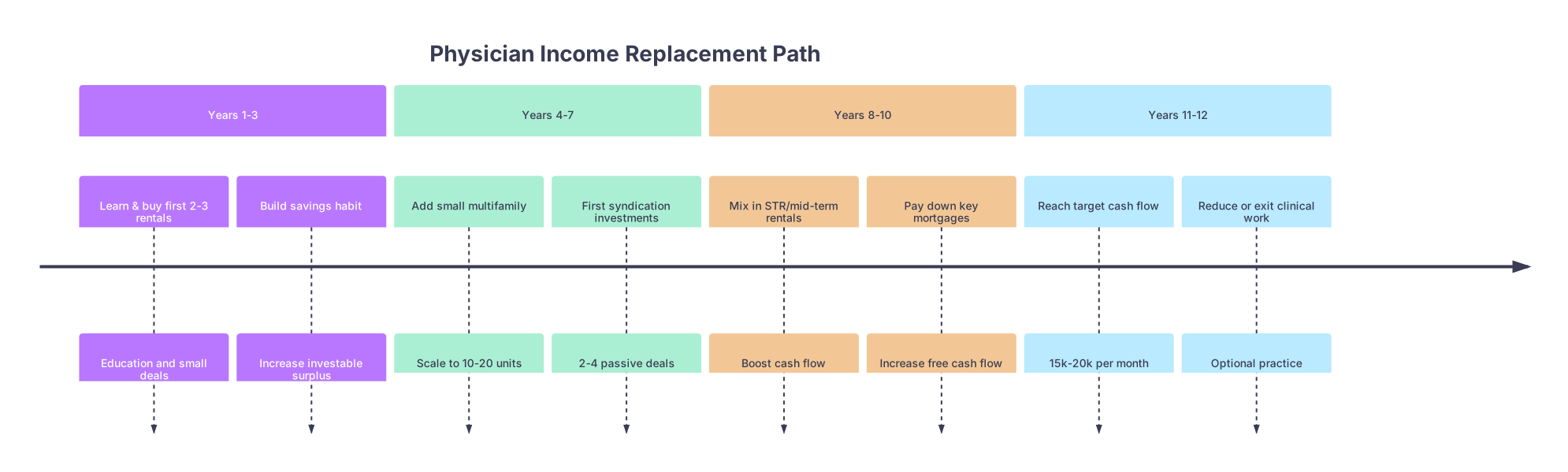
Step 8: A Quick Visual – From Clinical to Real Estate Income
Here’s how the progression might look over a 12-year horizon for a motivated but sane physician investor.
| Period | Event |
|---|---|
| Years 1-3 - Learn & buy first 2-3 rentals | Education and small deals |
| Years 1-3 - Build savings habit | Increase investable surplus |
| Years 4-7 - Add small multifamily | Scale to 10-20 units |
| Years 4-7 - First syndication investments | 2-4 passive deals |
| Years 8-10 - Mix in STR/mid-term rentals | Boost cash flow |
| Years 8-10 - Pay down key mortgages | Increase free cash flow |
| Years 11-12 - Reach target cash flow | 15k-20k per month |
| Years 11-12 - Reduce or exit clinical work | Optional practice |
This is not fantasy. But it’s also not overnight.
Step 9: So… How Many Rentals Does a Physician Need?
Here’s the blunt, synthesized answer:
- If you rely purely on boring single-family long-term rentals with $200–$300/month cash flow, you’ll need 50–100+ units. That’s usually not worth it for a physician.
- If you focus on higher-yield strategies (small multifamily, selectively chosen short/mid-term rentals, and some syndications), you’re usually talking:
- 15–40 total doors
- Plus $500k–$1M in passive syndication/ fund investments
- Total equity deployed: roughly $1.5M–$3M over 10–15 years
In practice, most physicians who truly replace clinical income with real estate hit their goal with:
- A portfolio that throws off $15k–$25k/month
- A blended mix of active and passive real estate holdings
- A door count in the 15–40 range, not 100+
The exact number of rentals isn’t the metric that matters.
What matters is: monthly net cash flow / total equity and whether that meets your life target.
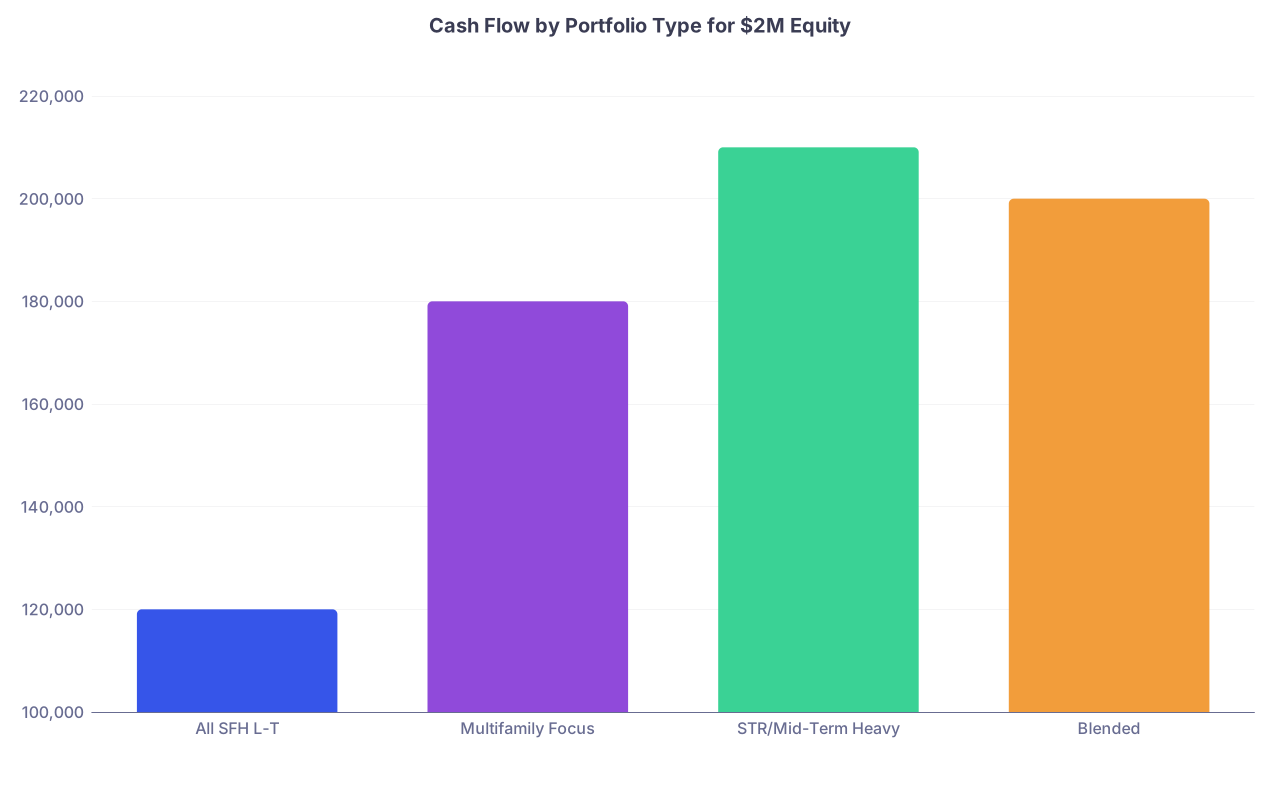
| Category | Value |
|---|---|
| All SFH L-T | 120000 |
| Multifamily Focus | 180000 |
| STR/Mid-Term Heavy | 210000 |
| Blended | 200000 |
FAQs
1. Is it realistic to fully replace a $400k+ physician income with rentals alone?
Yes, but with caveats. Replacing a $400k salary means you probably need $20k–$25k/month in net cash flow. That typically requires $2M–$4M of equity deployed intelligently. Possible over 10–20 years for high-earning physicians, especially couples, but not quick or casual. Most stop part-time before they fully “replace” everything.
2. Should I pay off rentals early to boost cash flow, or keep them leveraged?
Early in your investing life, leverage is your friend. Later, debt-free or low-LTV properties dramatically increase free cash flow and stability. A very common pattern: grow a leveraged portfolio, then spend 5–10 years aggressively paying down the best-located assets until a core group of properties is largely or fully paid off. That’s when cash flow jumps and “replacement” feels permanent.
3. Are syndications enough to replace my income without owning rentals directly?
They can be, if you have enough capital. At a stable 7–9% cash yield, you’d need around $2.5M–$3.5M invested to produce $200k–$250k/year. Many physicians combine both: a steady base from syndications plus a smaller personal portfolio of high-cash-flow rentals they control.
4. What cash-on-cash return should a physician realistically target?
If you’re completely passive and risk-averse, 6–8% is fine. If you’re doing some active work (selecting markets, underwriting deals, buying small multifamily/STRs), you should aim for a blended 8–12% over time. If someone’s pitching consistently higher with no risk, walk away. That’s sales, not reality.
5. How soon should a resident or fellow start buying rentals?
Early is good, reckless is not. If you have high-interest debt, zero emergency fund, or no idea how to analyze a deal, slow down. For residents/fellows, one well-bought house hack or live-in rental in training can be fantastic. But don’t stretch thin with multiple leveraged properties before you even know where you’ll practice long term.
6. What’s the single best metric to track on my path to replacing clinical income?
Stop obsessing over door count. Track this instead:
Annual net cash flow ÷ total invested equity = cash-on-cash yield.
Your two targets:
- Grow total annual net cash flow to your life number (say $200k+).
- Keep blended cash-on-cash in the 8–12% range over the long term.
If both are true, you won’t care how many rentals you own. You’ll care that you no longer have to round in the morning.
Key points:
- Decide on a monthly cash flow target, not a door count.
- Plan on needing $1.5M–$3M of well-placed equity over a decade or so.
- Expect a blended, diversified portfolio—not 100 single-family rentals—to actually replace your physician income.