
Last night, a hospitalist friend of mine finished a brutal 14‑hour shift, got to her car, and saw three missed calls from her property manager. Her tenant hadn’t paid rent. Again. Her stomach dropped. She still had student loans, daycare costs, and a mortgage… and now this.
If you’re on a 24‑hour call schedule and a tenant stops paying, it feels like your entire financial life is built on quicksand. I know that mental spiral. “What if they never pay again? What if I get sued? What if I’m at the hospital when the sheriff goes to the property? Can I lose my medical license over this?”
Let’s walk through what actually happens when your tenant stops paying, what the legal and financial fallout really looks like, and how to structure things so you’re not managing an eviction from a call room between codes.
First: What Actually Happens When They Stop Paying (Not the Horror-Movie Version)
You notice the fear way before the facts:
You see that first “Rent not received” email from your property manager, or your auto-deposit just… doesn’t hit. Your brain immediately jumps to: “I’m going to be in housing court at 8 a.m. post-call, I’ll say the wrong thing, get sued, lose everything.”
The reality is more boring. Also more fixable.
Here’s the actual sequence in most states when a tenant stops paying, simplified:
- They miss the due date.
- There’s usually a grace period (often 3–5 days).
- A late fee may apply per the lease.
- You or your property manager sends a pay or quit notice (often 3–10 days).
- If they still don’t pay, you file an eviction/unlawful detainer.
- Court date is set (weeks to months later).
- Judge rules: either they pay, move out, get a payment plan, or you win possession.
- Sheriff/constable enforces the move‑out if needed.
Notice what’s not on that list: “Physician‑landlord must personally appear in court every time and abandon patients on call.”
No. In many jurisdictions, an attorney or property manager can appear for you (varies by state, but it’s extremely common investors never step foot in court).

| Step | Description |
|---|---|
| Step 1 | Rent Due |
| Step 2 | Grace Period Ends |
| Step 3 | Late Fee Added |
| Step 4 | Pay or Quit Notice |
| Step 5 | Back To Normal |
| Step 6 | File Eviction |
| Step 7 | Court Hearing |
| Step 8 | Writ and Sheriff |
| Step 9 | Case Closed |
| Step 10 | Tenant Pays? |
| Step 11 | Judgment For Landlord? |
Does it still suck? Absolutely. Does it instantly blow up your medical career? No.
The Ugly Part: What It Does To Your Cash Flow When You’re Already Overextended
This is the part that keeps most physicians up at night: “If rent stops, can I still make my payments?”
You basically get hit on three fronts:
- No incoming rent
- Ongoing expenses don’t stop
- Extra legal/property management costs
Let me put numbers on this, because the vague “it’ll be fine” isn’t helpful when you’re already catastrophizing.
Say:
- Monthly rent: $2,200
- PITI (mortgage, property tax, insurance): $1,700
- Utilities/HOA you cover: $150
- Property management: 8% of rent ($176 when rented, maybe minimum fee when vacant)
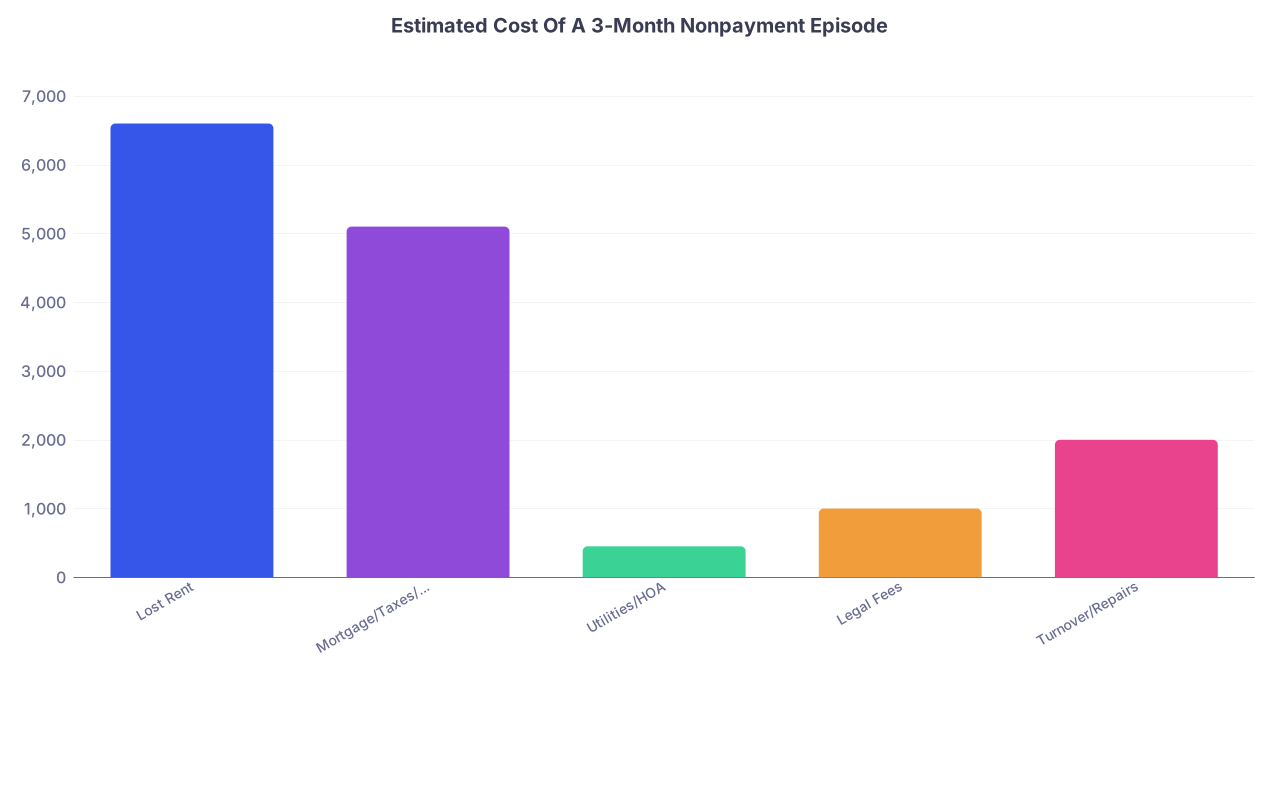
If they stop paying and it takes 3 months to resolve (which is not unusual), you’re looking at something like:
- Lost rent: 3 × $2,200 = $6,600
- You still pay mortgage/tax/insurance: 3 × $1,700 = $5,100
- Utilities/HOA: 3 × $150 = $450
- Attorney/filing fees: very roughly $500–$1,500
- Turnover/repairs (if they leave messy): $1,000–$3,000 is common
So a single stubborn nonpaying tenant can easily mean a $7,000–$12,000 hit.
| Category | Value |
|---|---|
| Lost Rent | 6600 |
| Mortgage/Taxes/Insurance | 5100 |
| Utilities/HOA | 450 |
| Legal Fees | 1000 |
| Turnover/Repairs | 2000 |
Now imagine layering that on top of:
- $2–4k/month student loan payments
- Childcare
- Your own primary home mortgage
- Maybe another rental
You don’t need me to tell you why this feels terrifying.
Here’s the blunt truth: if your rental only works financially when the tenant pays full rent every single month with no vacancy, you’re overleveraged. You’re running your rental like a resident living paycheck to paycheck. One missed payment and you’re done.
The fix is not “hope you get perfect tenants.” The fix is system-level protection.
Legal Reality Check: What You’re Actually On The Hook For (And What You’re Not)
You’re probably scared of two things:
- Being sued into oblivion
- Getting in legal trouble that affects your license
Let me separate fiction from the stuff you really should worry about.
1. Can a single nonpaying tenant ruin you legally?
Financially, they can definitely hurt. But legally, the nonpayment case itself is straightforward. Tenancy law is a machine that runs on:
- The lease
- State/local statutes
- Whether proper notices were served
- Whether payment was actually made or not
You’re not going to court to defend your character. You’re enforcing a contract.
What actually creates legal nightmares is when landlords:
- Do illegal “self‑help” evictions (changing locks, shutting off utilities, harassing the tenant)
- Discriminate or appear to discriminate
- Ignore local rent control/just‑cause ordinances
- Mishandle security deposits
So yes, you can absolutely get into deep legal mess as a landlord… but it’s usually because the landlord panicked or got arrogant and went “off script.”
As a busy physician, your best move is honestly kind of boring: delegate.
2. Could this touch your medical license?
I’ve yet to see a board action that started with, “Doctor had a nonpaying tenant.”
Where boards perk up:
- Criminal convictions (fraud, violence, financial crimes)
- Repeated civil judgments for dishonest or exploitative conduct
- Pattern of discriminatory housing practices
So if you start illegally locking people out or threatening them, that could eventually become part of a narrative about your professionalism/ethics. But a normal, by‑the‑book eviction process? No. That’s just life as a landlord.
This is why you use:
- A local landlord‑tenant attorney
- A competent property manager
- Written, repeatable processes
So you never end up arguing with a tenant in a hallway while you’re post‑call and exhausted.
Operational Reality: How Do You Handle This While On 24‑Hour Call?
This is the part nobody tells you on those “Doctors should invest in real estate!” podcasts. Everyone talks about “passive income.” Almost no one talks about your ED shift clashing with a 9 a.m. hearing.
If you’re on 24‑hour call, you cannot run a DIY eviction process. Period. It’s not about intelligence, it’s about time and bandwidth.
Here’s what actually works for physicians:
1. Property Manager With Real Eviction Experience
Not just “We lease your unit and collect rents.” You want: “We handle evictions end‑to‑end, coordinate with attorneys, post notices, go to court if allowed.”
Questions to ask (and yes, be this blunt):
- “How many evictions have you handled in the last year?”
- “Walk me through your exact process when someone doesn’t pay on the 1st.”
- “Who actually goes to court?”
- “How often do you need the owner to show up?”
If the answer is “we rarely have evictions,” that’s not actually reassuring. It often means they don’t have a real system; they’re just hoping tenants behave.
2. Clear Authority: What Can They Do Without You?
You don’t want a manager who emails you at 7:13 a.m.: “Hi! What do you want to do about this?” while you’re scrubbing in.
You want a written agreement that says, for example:
- They send late notices automatically after X days
- They serve pay‑or‑quit notices on a fixed timeline
- If rent is still unpaid by Day Y, they’re authorized to turn it over to a specific attorney
- They can approve legal steps up to $____ without needing your immediate sign‑off
Then your role becomes: sign documents when you’re off, check status updates weekly, not hourly.
| Task | You Or Manager? |
|---|---|
| Sending late notices | Manager |
| Serving pay-or-quit notice | Manager |
| Hiring eviction attorney | Manager |
| Attending routine court | Manager/Attorney |
| Approving large settlements | You |
Worst-Case Scenario: Stack It Up Honestly
Let me lean into your anxiety for a second and actually stack the worst case. Because when you see the shape of it, it stops feeling like a monster in the dark.
Absolute worst realistic scenario (not Hollywood):
- Tenant stops paying for 3–6 months
- You have to file eviction
- They fight it or stay till the end of legal process
- They leave the unit in rough shape
- Rental market softens; you take a lower rent with the next tenant
You’re out $10k–$20k over a year. That’s painful. That’s a whole attending salary chunk.
But… it’s not unrecoverable if you’ve structured your finances like a grown‑up investor, not like an intern with a credit card.
Compare that to the horror stories:
- Losing your primary home? Only if you were already skating on thin ice and had no reserves.
- Bankruptcy? Rare, usually requires multiple properties going bad at once + no cash + lots of other debt.
- Medical license issues? Again, only if you start doing illegal/immoral nonsense as a landlord.
The enemy here isn’t the tenant as much as it is leverage + no reserves + no systems.
How To Protect Yourself Before This Happens (So You Can Actually Sleep Post‑Call)
You can’t 100% prevent nonpaying tenants. You can absolutely cut the damage dramatically.
Here’s what actually matters:
1. Reserves That Don’t Live In Fantasy Land
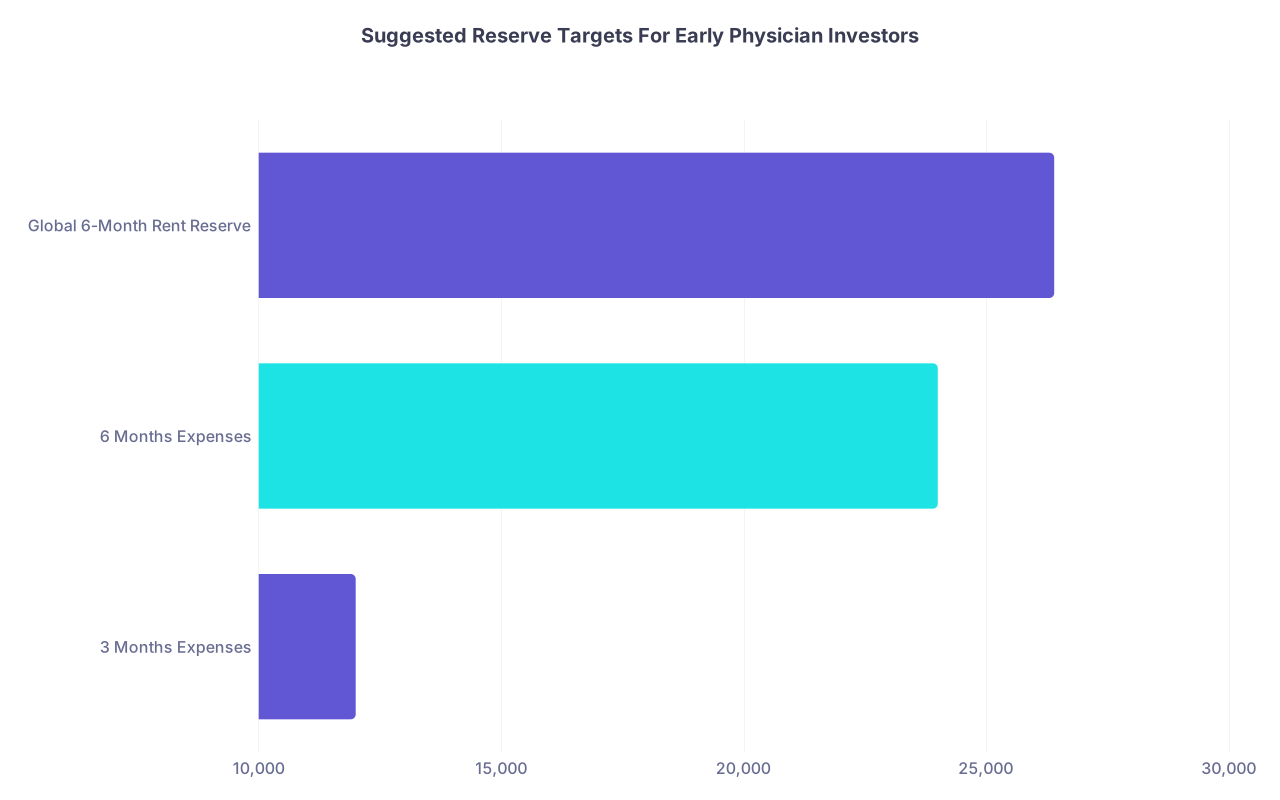
“Three months of expenses” is the usual advice. That’s too thin for a high‑income but time‑starved physician. I’d rather you shoot for:
- 6 months of PITI + fixed costs per property if you’re early in your career and still on call
- Or at least a global real estate reserve of one full month’s rent per door × 6, parked in a boring high‑yield savings account
So if you own two rentals at $2,200 each, that’s:
6 × (2,200 + 2,200) = $26,400 as a target reserve.
You won’t hit that overnight. But you can build toward it intentionally instead of “hoping rents keep coming.”
| Category | Value |
|---|---|
| 3 Months Expenses | 12000 |
| 6 Months Expenses | 24000 |
| Global 6-Month Rent Reserve | 26400 |
2. Landlord‑Tenant Attorney On Speed Dial (Not When You’re Already In Crisis)
Have someone you can email: “Nonpayment, lease attached, what’s next?” and they send back step 1, 2, 3.
You don’t want to be Googling “how to evict tenant in [state]” at 1 a.m. in the resident workroom.
3. Insurance + Entity Structure
Nonpayment itself is usually not something insurance covers (except in very specific rent guarantee products, which are rare and often not worth the cost). But you still want:
- An LLC for each property or per group of properties (talk to your CPA/attorney about what makes sense)
- A solid landlord policy with liability coverage
- Umbrella insurance (personal) on top
This doesn’t prevent nonpayment, but it prevents nonpayment + some injury claim from crossing over into “your personal assets and career are at risk.”
Mental Side: Managing The Anxiety While Still Investing
Let me be honest: real estate is not a good fit if you need 100% control and zero chance of stress. Tenants are human; some will lose jobs, get divorced, or just be irresponsible.
But being a physician‑landlord doesn’t have to mean:
- Fielding angry calls between consults
- Going to court post‑call half asleep
- Refreshing your banking app every morning on rounds
You design whether it’s a second job or mostly a line on your net worth spreadsheet.
What’s helped the physicians I’ve seen do this sanely:
- Treating the first bad tenant as tuition. “Okay, this is my $8,000 course in landlording. I’m buying systems with this pain.”
- Writing down a playbook: “If rent not received by Day X, here’s the flow.” Then handing that playbook to the manager and attorney.
- Accepting that 95% of the time, rent just comes in. The 5% of chaos is the cost of the asset class, not a personal failure.

FAQs
1. Do I have to go to court if my tenant stops paying?
Not always. In many states, your attorney or property manager can appear on your behalf for a standard eviction/unlawful detainer. Some jurisdictions require the owner to appear at least once, but even then, hearings are usually short. A good attorney can sometimes settle before the hearing (cash for keys, agreed move‑out). Your first step should be asking your property manager and attorney what’s typical locally, before you’re in crisis.
2. What if I’m post‑call and they need a decision from me immediately?
This is where pre‑delegation saves you. You should sign a management agreement that spells out exactly what your manager is authorized to do without you—serving notices, filing, hiring the usual attorney up to a certain fee threshold. The only things that should require you in real time are big decisions (e.g., settlement for several thousand dollars), and even then you can set expectations: “If I don’t respond within 24 hours, proceed with X default.”
3. Should I just sell the property if I get one nonpaying tenant?
Not automatically. If the numbers still make sense long‑term (cash flow, appreciation, loan amortization, tax benefits), one ugly episode doesn’t necessarily mean the investment is bad. It might mean your screening, reserves, or management structure need work. That said, if this experience reveals that you’re overleveraged, losing sleep constantly, and have zero margin for error, selling and resetting your strategy is a reasonable move—not a failure.

4. Can I just manage everything myself to save money?
You can. But if you’re on 24‑hour call or heavy inpatient schedules, it’s risky. The property management fee (say 8–10% of rent) often costs less than the financial and emotional chaos of trying to DIY while sleep‑deprived. Self‑management works better if you have flexible outpatient hours, live close to the property, and enjoy dealing with tenants and vendors. If reading this entire article makes your chest tighten, you’re probably in the “hire a manager” camp.

Two things to keep in your head when the panic hits:
- A nonpaying tenant is a financial problem, not a career‑ending scandal.
- Systems, not willpower, are what protect you—reserves, a manager, an attorney, and clear rules for what happens when rent doesn’t show up.
You’re already handling life‑and‑death calls at 3 a.m. You can handle a tenant who stops paying—just don’t try to do it alone, half awake, from the call room.