
You’re post-call, sitting at your kitchen table, half-eaten takeout next to your laptop.
Your inbox has that one email from your real estate syndication: “Important Update on Your Investment.”
Your heart drops before you even click it.
You skim: “capital call,” “projected returns updated,” “unexpected cost overruns,” “sponsor exploring options.” And suddenly your brain is sprinting 20 steps ahead:
What if this whole thing blows up?
What if the deal fails?
Can they come after my W‑2 income?
Did I just screw up my kids’ college fund?
Let’s walk straight into the nightmare scenarios you’re playing in your head and untangle what actually happens when a real estate partnership implodes.
Because yes, things can go badly. But the way most physicians fear it will go? That Hollywood disaster version? That’s usually not how the law, or the capital stack, works.
First: What “imploding” really means (vs what you’re imagining)
Most people hear “the deal is in trouble” and immediately picture bankruptcy court, personal lawsuits, and wage garnishment.
In reality, for a typical passive physician investor in a syndication or fund, “imploding” usually looks like this:
- You don’t get the returns you were promised.
- You may lose some or all of your invested capital.
- The timeline gets stretched way beyond what was projected.
- Communication from the sponsor becomes spotty or defensive.
- The property might be sold in a “fire sale” or handed back to the bank.
Financially painful? Yes. Life-ruining? Usually not.
The disaster level depends heavily on what you invested in and how the structure was set up.

The “capital stack” reality check: who actually gets crushed first
This is the part your anxiety never remembers: there’s a pecking order when things go bad.
In a standard syndicated deal (apartment, self-storage, etc.) you typically have:
- The bank or senior lender
- Maybe a mezzanine lender or preferred equity
- The limited partners (that’s you, usually)
- The general partner/sponsor
Here’s the ugly truth and the tiny silver lining in one sentence:
You get hurt before the sponsor gets rich, but you usually get hurt after the bank gets paid and before anyone comes knocking on your personal door.
To make this concrete:
| Role | Typical Risk Level | Personal Asset Exposure? |
|---|---|---|
| Senior Lender | Lowest | Secured by property |
| Mezz / Pref Eq. | Medium | Higher loss risk |
| Limited Partner | High | Usually just investment |
| General Partner | High+ | Possible guarantees |
The lender’s protected by the property as collateral.
You’re protected by the LLC/LP structure, as long as you stayed a true passive investor and didn’t sign something you didn’t understand.
The person who’s often in the actual legal crosshairs? The sponsor who guaranteed the loan.
Is that comforting? A little. Is it still sickening to imagine your $50–200k evaporating? Absolutely.
Worst-case financial outcomes: what you’re really facing
Let’s go straight to what’s probably looping in your mind.
1. “Do I lose all my money?”
Worst case as a passive limited partner: yes, you can lose 100% of your invested capital.
Not common, but not imaginary either. I’ve seen:
- A value-add multifamily deal that missed on rent growth, hit a rate spike, couldn’t refinance, and sold at basically just enough to pay off the loan and transaction costs. LPs: 100% capital gone. Sponsor: years of work, no promote, reputation hit.
- A small retail center where a big anchor tenant left early, COVID hit, financing tightened, and the lender eventually took the property. LPs: wiped out.
That’s the real top-of-the-ladder risk for you: your check goes to zero.
Not negative. Zero.
2. “Can they come after my salary, house, or 401(k)?”
Everyone’s nightmare: “They’re going to sue me and garnish my attending paycheck.”
In a properly structured deal where:
- You invested as a limited partner (LP) or as a member of an LLC
- You did not sign on the loan as a guarantor
- You didn’t personally commit fraud or do something insane
…your maximum financial exposure is typically your investment amount.
Limited partnership / LLC structure exists specifically to separate your personal assets from the business.
Where this can go sideways:
- You personally guaranteed the loan (rare for passive docs, more common if you did a small JV or direct deal with friends).
- You invested through some sloppy structure with no true liability shield.
- You “helped manage” something in a way that pulls you closer to general partner territory without protection.
But in most physician syndication scenarios? The nightmare of “they take my house” is just… not how this works.
Is it possible with weird facts and bad documents? Sure. Is it the base case? No.
Legal fallout: lawsuits, audits, and the ugly-but-boring reality
The word “lawsuit” is doing a lot of heavy lifting in your head right now.
Here’s how this usually goes in a blow-up:
- The property struggles. Cash flow stops. Distributions pause.
- The sponsor sends increasingly tense updates. Maybe a capital call.
- If it continues, lender gets nervous. Covenants, forbearance, threats.
- If no fix, the lender either forces a sale or forecloses.
- LPs get what’s left (if anything) after loan, fees, and expenses.
Could there be lawsuits? Yes. But they’re far more likely to be:
- LPs vs Sponsor (alleging misrepresentation, breach of fiduciary duty, etc.)
- Lenders vs Sponsor/Guarantor
- Occasionally regulators, if there was serious securities nonsense
You, as an LP, are much more likely to be in a group of plaintiffs than sitting there as a defendant.
What actually causes LPs to get burned in court isn’t “the market turned.” That sucks but isn’t illegal. It’s things like:
- Sponsor straight-up lied about occupancy, expenses, or financials
- Sponsor commingled funds between deals
- Sponsor paid themselves fees they weren’t entitled to
- Sponsor failed to follow the operating agreement or PPM
Does that protect your money? Not necessarily. Suing a sponsor doesn’t magically bring a bad property back to life. Sometimes there’s just no blood left in the stone.
But the scenario where you get personally dragged into court because the deal underperformed? That’s not how these securities are set up.
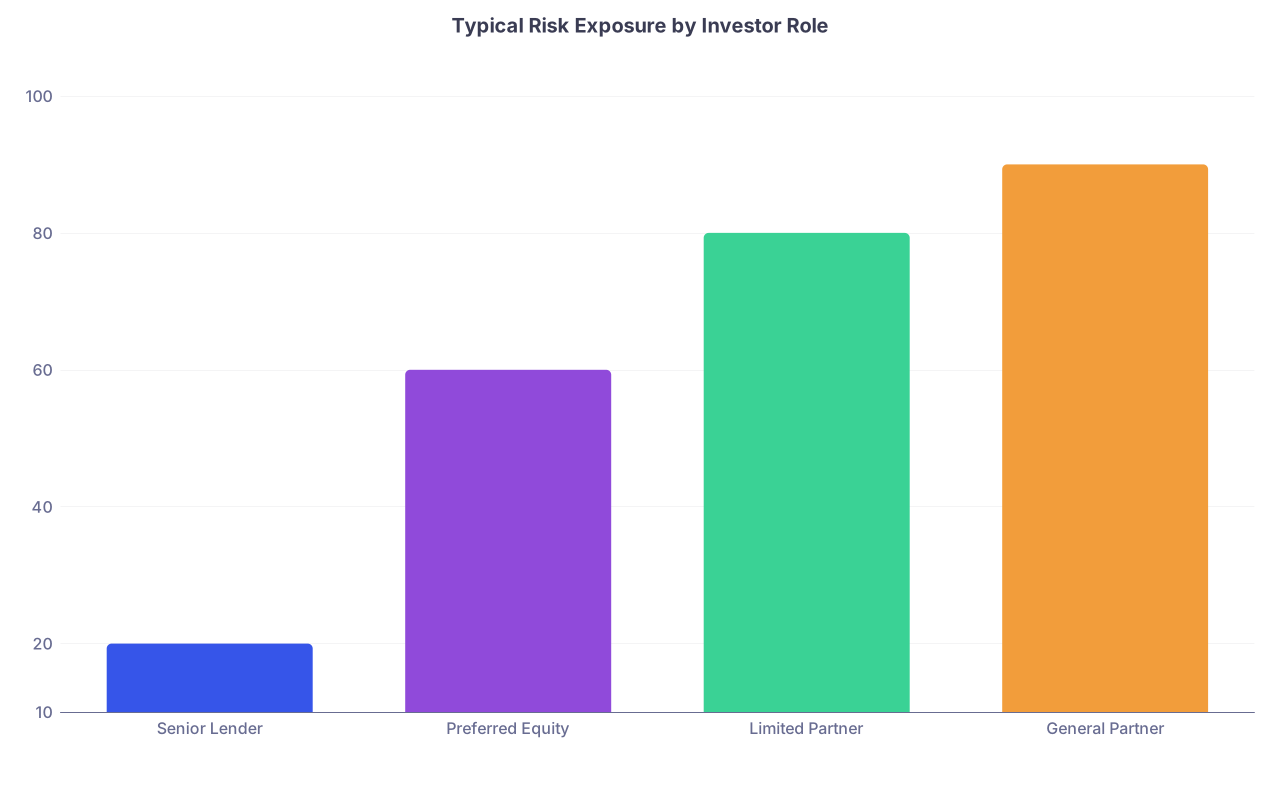
| Category | Value |
|---|---|
| Senior Lender | 20 |
| Preferred Equity | 60 |
| Limited Partner | 80 |
| General Partner | 90 |
The psychological worst case: being trapped and in the dark
Honestly, the thing that wrecks people more than the money is the limbo.
You know the deal’s struggling. Maybe:
- Distributions stop with a vague “conserving cash” email.
- Updates go from monthly to quarterly to “whenever.”
- You can’t sell your interest because there’s no secondary market.
- The K-1 shows losses but that doesn’t make you feel better.
- You’re too embarrassed to tell colleagues or your spouse how bad it looks.
This is the part you didn’t really factor in when you saw those “15–20% IRR” slides on the webinar.
You thought: “Either this works or it doesn’t.”
You didn’t think: “I might be stuck anxious and uninformed for 3–5 years.”
Practically, in this limbo phase, you might face:
- Tax complexity with K-1s from a zombie deal
- Awkward conversations at home about “how safe” that investment actually was
- A lingering sense of shame that makes you freeze on future investing, even in better opportunities
This is still not “life-ruining,” but it is very emotionally expensive. And you’re feeling it already, just reading this.
Capital calls: the “do I throw good money after bad?” panic
You get the email: “We need additional capital to protect the asset.”
Your brain: “Is this a shakedown? If I don’t pay, do I get wiped out?”
Here’s the harsh reality:
- Saying no to a capital call can mean getting diluted or even wiped out economically.
- Saying yes can mean sinking more into a deal that still might die.
Worst case outcomes around capital calls:
- You decline. The deal limps forward without you. Your existing stake gets heavily diluted. You’ve effectively written off your original investment.
- You answer the call. Sponsor still can’t turn the ship. Property eventually sold or foreclosed. You’ve lost not just initial capital, but the extra you put in.
There is no “safe” choice. Only “manage-the-damage” choices.
You don’t lose legal rights or protections if you say no. You might just lose more of the economics. That’s it.

| Step | Description |
|---|---|
| Step 1 | Capital Call Email |
| Step 2 | Increased Basis |
| Step 3 | Partial or Full Recovery |
| Step 4 | Higher Total Loss |
| Step 5 | Dilution or Loss of Rights |
| Step 6 | Smaller Share of Upside |
| Step 7 | Original Capital Lost |
| Step 8 | Contribute More Money |
| Step 9 | Deal Recovers? |
| Step 10 | Deal Recovers? |
Joint ventures and “friend deals”: where things actually CAN get personal
Most of what I’ve said so far applies to standard syndicated, SEC-papered deals with a clear GP/LP separation.
But let’s talk about the stuff that really blows up messily: small partnerships with friends, colleagues, or a local broker who “knows a guy.”
Examples:
- You and two partners buy a 4‑plex in your personal names or a poorly set-up LLC.
- Everyone “chips in” and casually “helps manage” without clear roles or agreements.
- Someone signs as a guarantor “just to get the loan through.”
- You use a template operating agreement you barely skim.
Worst case here can be much worse:
- One partner stops paying their share of expenses, you either cover or the property/credit gets wrecked.
- The loan goes into default. The guarantor (maybe you) gets sued by the bank.
- Internal fights turn into ugly lawsuits, forcing a sale at a bad time.
- If the structure’s bad enough, plaintiffs in a lawsuit (tenant injury, etc.) might be able to reach personal assets outside the deal.
Small JVs are where physicians accidentally take active risk without understanding it.
If something’s keeping you up at 2am, it’s often not the big SEC‑compliant syndication—it’s that half-baked “we’ll figure it out as we go” side project you did with a buddy.

What actually protects you when things go sideways
You don’t fix a collapsing deal after the fact. You protect yourself before you wire money.
Unsexy, but this is where worst-case outcomes get capped.
Things that make a blow-up survivable:
- You limited each deal to an amount you can mentally (and financially) afford to lose.
- You read the PPM and operating agreement enough to know:
- Are you an LP or are you functionally a GP?
- Who’s guaranteeing the debt?
- What are the rights if the sponsor goes silent?
- You diversified across multiple deals/sponsors/asset types instead of going all-in on One Perfect Syndication.
- You invested only through proper entities (LLC, LP, etc.), not as “John Smith, individual” thrown into some random structure you didn’t understand.
Again, this doesn’t stop deals from failing. It just keeps failure from spreading into the rest of your financial life.
If your partnership is already imploding: damage control, not denial
If you’re not reading this hypothetically—if your deal is clearly in trouble—your brain is probably bouncing between panic and avoidance.
Here’s the calmer version of “what now”:
- Get all the documents in one place: PPM, operating agreement, subscription docs, loan guarantees if any.
- Identify your actual role: LP, member, manager, guarantor, or something else.
- Confirm: Did you personally guarantee anything? If yes, that deserves real legal review.
- Clarify what’s truly at risk: is it just this investment, or are you entangled elsewhere?
- Talk to a real estate/ securities attorney who works with investors, not just your cousin who does divorces.
Worst case scenario for you personally often shrinks once someone dispassionate walks through the actual agreements.
I’ve watched multiple physicians go from “they’re going to take my paycheck and house” to “this sucks, I probably lost $100k, but it stops there.”
That shift doesn’t make the loss okay. But it pulls you out of that free-floating doom loop and into concrete, manageable reality.

The part your future self will care about
Here’s the uncomfortable truth: if you stay in real estate long enough—especially as a passive investor—you will almost certainly have at least one deal go badly. Maybe very badly.
The question your future self will ask isn’t, “Did I avoid all losses?”
It will be, “When something blew up, did I:
- Overexpose myself to one shiny deal because the projected IRR made my eyes light up?
- Ignore structure and documents because they felt boring and I trusted the sponsor’s charisma?
- Stay frozen and ashamed after a loss, or learn and adjust my process?”
There are physicians right now who lost six figures in a 2010–2012 era deal, learned from it, and are now sitting on large, diversified portfolios that dwarf those early mistakes.
And there are others who lost $25k once, swore off everything outside their W‑2, and now feel permanently behind on building any real wealth.
Years from now, you probably won’t remember the exact phrasing of that terrifying “Important Update” email. You’ll remember what you did next—whether you let the worst-case scenarios in your head control you, or whether you let them inform better, sharper decisions going forward.