
Dual-Physician Couple: How to Coordinate a Joint Real Estate Strategy
What actually happens when your attending contracts, your call schedules, and a seven-figure mortgage all hit at the same time—and the two of you are both physicians trying to “do real estate right”?
If you’re a dual-physician couple, you’re not normal buyers or investors. You have high income, weird hours, training timelines that don’t sync, and malpractice risk hanging over everything. If you just “wing it” with real estate like your non-med friends, you’ll make expensive mistakes.
Let’s build you a joint real estate strategy that works with:
- Two careers
- Two malpractice profiles
- One (or more) properties that will not own you
I’ll walk through this like we’re sitting at your dining table with a legal pad: where you are now, what you want, and exactly how to structure things so the real estate supports your life instead of dictating it.
Step 1: Get Clinically and Logistically Honest
Before you talk loans, LLCs, or tax strategy, you need to answer some non-glamorous questions.
A. Map your careers on a timeline
Pull out your phones and literally write this out: from today to 10 years from now.
Include:
- Current roles (PGY level or attending status)
- Contract end dates
- Board exams
- Known or likely fellowship plans
- Visa issues (if any)
- Desired geography (short and long term)
Now mark:
- “We must be in City X” dates
- “We’re probably movable” windows
- “We’re free agents” periods
Then look at that and ask: Where does long-term home base realistically fit?
If both of you are in residency now and not yet sure where you’ll match for fellowship or first job, do not pretend you know your “forever city”. That fantasy is how people end up with underwater condos in random fellowship towns.
In that case, your early strategy usually looks like:
- Rent where you train (or buy something that’s clearly a short-term, investment-minded play).
- Treat “forever home” planning as a post-attending decision once at least one of you has a stable job in a target city.
If one of you already has a stable attending contract in a region you want long-term, that’s a different story. Then a primary home plus planned nearby investments can actually make sense.
B. Get brutally clear on lifestyle vs financial priorities
You need to rank (not just list) the following:
- Stability in one city vs job flexibility
- Kids’ schooling / proximity to family vs chasing the best comp offers
- Early financial independence vs “we want the dream house now”
- Tolerance for landlord headaches vs preference for passive investments
You don’t have to agree on everything, but you do need to agree on:
- What’s non-negotiable.
- What’s aspirational but flexible.
- What’s purely “nice if it happens”.
Without this, you will fight about houses, and your real estate will reflect the argument, not a plan.
Step 2: Decide Your Primary Real Estate Role(s)
As a dual-physician couple, you can wear different hats in real estate. You need to pick which combination actually fits your constraints.
Common role setups:
| Setup | Who Does What |
|---|---|
| Both Passive | Both invest in syndications/REITs, minimal active management |
| One Active, One Passive | One spouse handles direct properties, other focuses on career |
| Both Active | Both involved in acquisition, management, and strategy |
| Hybrid Home + Passive | Own primary home, use excess cash for passive real estate |
A. Both of you “active” investors? Be careful.
Two full-time clinical jobs + kids + on-call + multiple rentals + DIY management is how people melt down.
If you both want to be involved, define clear lanes:
- One leads acquisition, underwriting, lender communication.
- The other leads operations: leasing decisions, property manager oversight, bookkeeping.
If you both “kind of do everything,” you will both drop the ball on the same things. I’ve watched this happen over and over.
B. One active, one primarily passive
This is usually the smart path.
Examples:
- One spouse takes point on any local rental(s), BRRRR projects, or small multifamily.
- The other keeps 90% of their mental energy for clinical work and has veto power on major deals.
Write this down plainly: “Spouse A is primary lead for real estate. Spouse B has veto power on any deal over $X or any property that requires more than Y hours/month.”
That sentence alone will save you dozens of arguments.
Step 3: Primary Residence vs Investment – Don’t Confuse the Two
You need separate strategies for:
- Where you live
- Where your money lives
They overlap, but they’re not the same.
A. Buying the attending house too early
Classic scenario:
- Both of you land attending jobs in the same city.
- First year, you’re both exhausted but now “rich.”
- Realtor says, “With your combined income you can easily afford up to $1.8M.”
- You buy at the top of your pre-approval because it “locks in the school district.”
Three years later, one of you wants to switch jobs an hour away, or leave the state entirely. Now the house owns you.
Instead, set hard rules for the primary home:
- Cap total housing (PITI + HOA) at 20–25% of combined gross income, not “whatever the bank approves.”
- Do not buy your “forever house” until at least one of you has:
- Finished the first contract cycle, and
- You can look at your department and realistically say, “I’d be fine staying or moving but I’m not desperate to leave.”
If both of you are still in the “I might leave tomorrow if someone annoys me” phase, rent or buy modest.
B. Can your primary house double as an investment?
Sometimes, yes. But only if you treat it like a potential investment from day one.
That means:
- You buy something that could cash flow (or at least break even) if you had to move and rent it out.
- You run the numbers assuming it becomes a rental in 3–5 years: realistic rent, expenses, vacancy.
- You don’t over-customize so much that tenants would hate it or you can’t attract a broad market.
House hacking? Great in theory. In practice, very few dual-attending couples want residents or students living in their basement once they finally have money. Be honest about that.
Step 4: Asset Protection and Legal Structure for Two Physicians
You both have target signs on your backs. Malpractice, car accidents, random lawsuits. Your real estate needs basic protection baked in.
A. Understand what protects you and what doesn’t
What actually helps:
- Adequate liability limits (home, auto + umbrella)
- LLCs for investment properties (not your primary home)
- Proper titling (tenancy by the entirety where available, or community property rules)
- Not co-mingling personal and property funds
What people overrate:
- Super complex spider webs of shell LLCs before you even own your first duplex
- Trusts before you’ve dealt with basics like umbrellas and correct titling
B. Who owns what?
Here’s where dual-physician gets interesting. Both of you have professional liability risk. So some of the standard “spouse with lower risk owns everything” tricks do not apply.
Three main buckets:
- Primary residence
- Investment property(ies)
- Passive investments (syndications/funds/REITs)
1. Primary residence
Options depend on your state:
- In some states, tenancy by the entirety gives solid protection for your primary residence against the creditors of just one spouse. If available, it is usually what you want for the home you live in.
- In community property states, rules differ. You need a local attorney to walk through how judgment creditors can reach your house.
Generally:
- Do not put your primary home into an LLC. Lenders don’t like it, you lose some consumer protections, and it can complicate your mortgage terms.
- Do carry a large umbrella policy (think $2M–$5M+) that sits on top of your auto and home policies.
2. Investment properties
Here, LLCs are your friend.
Baseline structure for your first few doors:
- Each property in its own LLC or
- A small portfolio of similar properties in one LLC (e.g., “3 single family homes in the same city”)
You both can be members of the LLC, but you should talk with a CPA and attorney about:
- Whether to allocate ownership 50/50 or based on contributions.
- Whether one spouse is the manager for decisional clarity.
Keep everything separate:
- Separate bank account per LLC.
- Separately tracked books (even if it’s just simple software).
- Leases signed between tenant and the LLC, not you.
3. Syndications, funds, and passive deals
These are usually held in your personal names, a joint taxable brokerage account, or a holding LLC. This is more about tax planning than liability, because these are typically limited liability investments by nature.
If you have dramatically different income levels in a given year (say one spouse goes part-time or academic), you might decide who invests in whose name to optimize things like QBI (qualified business income) or bracket management. That’s a CPA conversation, but it should be proactive, not “whatever form we filled out on the sponsor’s portal.”
Step 5: Debt, Risk Tolerance, and “We Both Make Good Money” Syndrome
You will get approved for more debt than you should responsibly take.
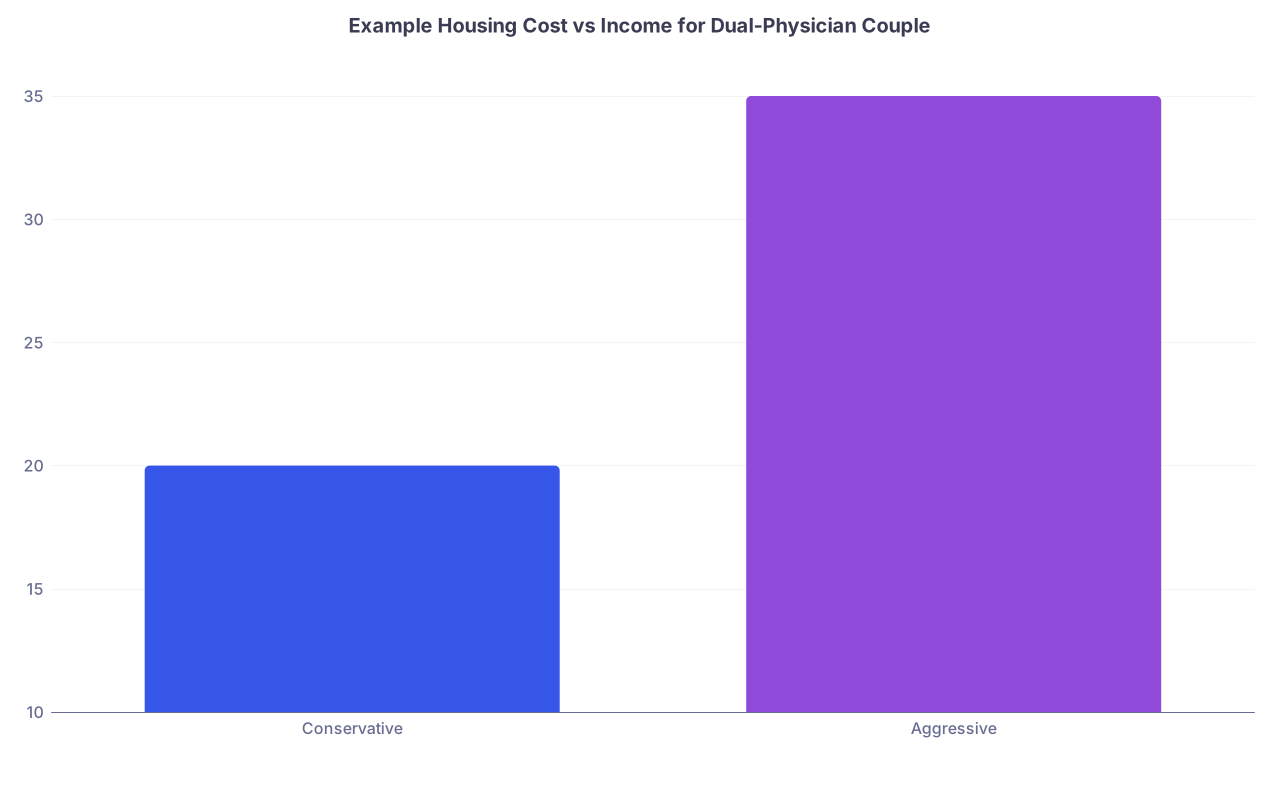
| Category | Value |
|---|---|
| Conservative | 20 |
| Aggressive | 35 |
That chart? That’s the percentage of gross income going to housing I see among physician couples. The “aggressive” ones end up trapped.
A. Create your own borrowing rules
Write these down and actually stick to them:
- Max total housing (primary + vacation home mortgages) = 20–25% of combined gross.
- Max total debt service (all mortgages + minimum student loans + car loans) = 30–35% of gross.
- Stress-test every deal at one income for six months: if one of you quits, gets sick, or takes an unpaid sabbatical, do you stay solvent?
Run the numbers:
| Scenario | Monthly Net Income | Monthly Debt (Mortgages + Loans) |
|---|---|---|
| Both working | $28,000 | $7,500 |
| One out for 6 months | $14,000 | $7,500 |
| Locums backfill (partial) | $20,000 | $7,500 |
If the one-income scenario makes you sweat, your real estate is too aggressive.
B. Student loans vs real estate
A lot of dual-physician couples try to do everything at once:
- Max 401(k)/403(b)
- Pay down loans aggressively
- Buy big house
- Start real estate portfolio
You can’t push four levers to max and still sleep.
Pick two to prioritize for the next 3–5 years. Example:
Phase 1 (first 3 years attending):
- Moderate loan payoff + retirement accounts to match level.
- Rent or modest home, no big investing. Build cash and stability.
Phase 2 (years 4–7):
- Strategic refi or PSLF resolution.
- First investment property or first 1–2 syndications.
Phase 3 (after that):
- Expand portfolio once your system works and your careers are reasonably stable.
Doing less but doing it cleanly beats owning three headache properties you resent.
Step 6: Who Manages What Day to Day?
If you buy even one rental, you’ve basically added a small business.
You must decide:
- Who is “on call” for real estate emergencies vs clinical calls.
- How much of your time you’re willing to give up for a slightly higher return.
A. Division of labor
Common pattern I see work:
- One spouse: acquisitions, lender relationships, tax planning coordination, portfolio-level decisions.
- Other spouse: has right of veto on big moves and reviews major contracts, but is only lightly involved operationally.
Or, if one has a more predictable schedule (say outpatient clinic vs trauma surgery):
- That person handles communication with property managers, approves repairs, deals with unexpected issues.
- You outsource as much as possible (property management, bookkeeping) and accept slightly lower returns for much lower stress.
If both of you have chaotic schedules and you buy a house that requires you to be high-touch landlords to cash flow, you’ve just volunteered for another residency.
B. Always use property management unless:
- The property is in your city
- You have predictable non-clinical time
- You are deliberately doing this to learn the business and you go in with your eyes open
Most dual-physician couples should start with property managers. Then see if you still want more involvement.
Step 7: Tax Planning as a Two-Physician Household
You are in high brackets. The tax tail starts to wag the dog if you’re not careful.
No, you probably are not going to qualify for Real Estate Professional Status (REPS) if both of you are full-time clinicians. Stop trying to force it. The IRS is not stupid.
But you can still:
- Use depreciation from rentals and syndications to offset passive income.
- Harvest losses intelligently when investments underperform.
- Decide which spouse claims what, if one takes on a part-time role.
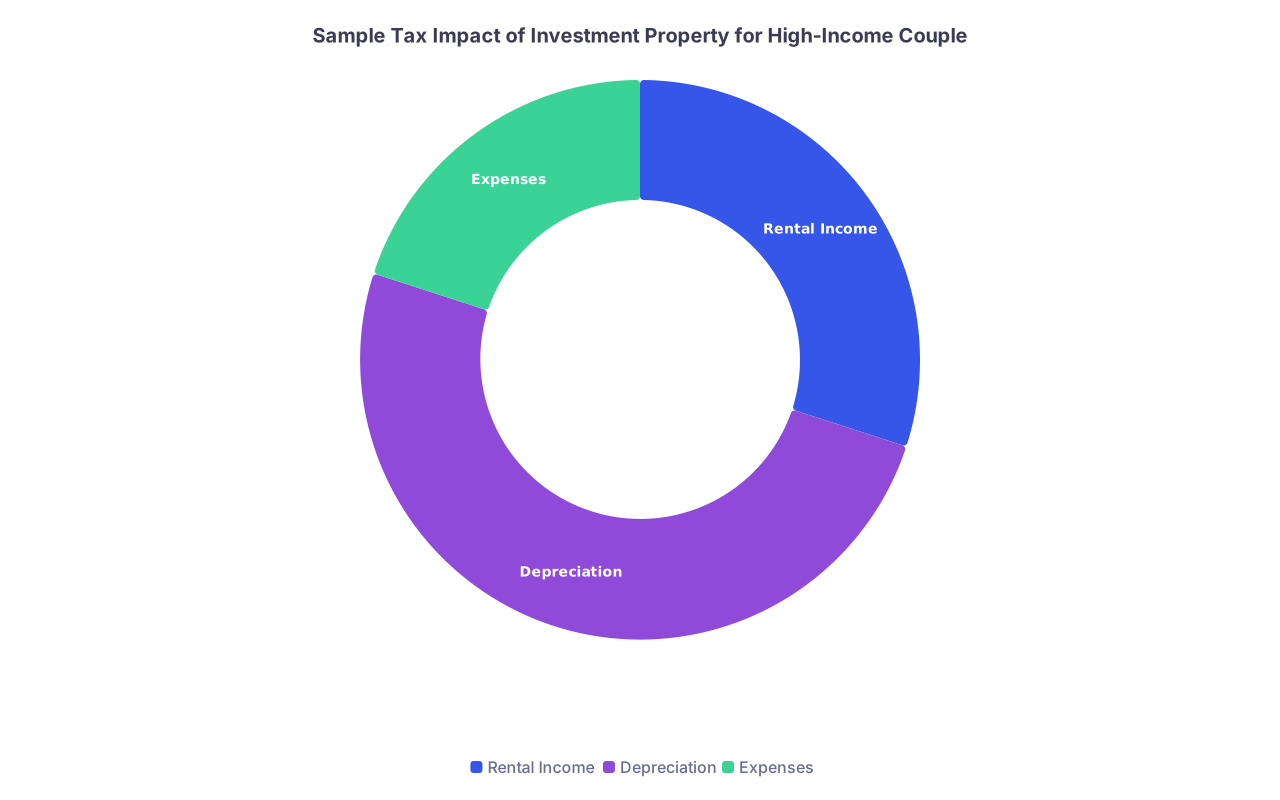
| Category | Value |
|---|---|
| Rental Income | 30 |
| Depreciation | 50 |
| Expenses | 20 |
Roughly, for a standard residential rental, paper losses from depreciation can often offset most or all of the rental income, so on-paper cash flow can be lightly taxed or temporarily shielded. That’s useful but not magic.
Your real advantage as a dual-physician couple is cash. You don’t have to stretch to buy deals. Use that power for:
- Better down payments → lower risk.
- Saying no to mediocre deals because you’re not desperate for the tax angle.
- Structuring your portfolio to be durable, not hyper-optimized for year one deductions.
Get a CPA who:
- Works with physicians and real estate investors.
- Is willing to actually plan in Q2–Q3, not just file in March.
- Understands entity structures (LLCs, S corps for side businesses, etc.).
Do not just send your 1099s to a random franchise tax prep desk.
Step 8: How to Actually Make Joint Decisions Without Constant Fights
You’re both smart. You’re both trained to argue from evidence. That can be a disaster for big money decisions.
So formalize your decision process a bit.
A. Set investment “guardrails”
Agree on:
- Max total capital committed to real estate over next 3 years.
- Max per-deal check size without extra review.
- Max percent of your net worth tied up in any one property or one syndication sponsor.
For example:
- “Over the next 3 years, we’ll commit up to $400k towards real estate beyond our primary home. No more than $150k per single deal. No more than 20% of our net worth in any one asset.”
Now when a “great” deal appears, you’re checking it against pre-agreed rules, not how persuasive the salesperson (or one spouse) is that week.
B. Use a simple deal memo
Before you say yes to anything over, say, $50k, you both see a one-page summary that includes:
- Total cash required
- Expected timeline (years)
- Best case / base case / worst case scenarios
- Impact on your monthly cash flow
- Exit strategies (if you need to sell early, then what?)
This sounds formal. It’s not. It’s how you stop “I thought you said it was low risk” fights two years later.
Step 9: Sample Joint Strategies for Common Dual-Physician Situations
Let’s pull it together with a few real-world patterns I’ve seen work.
Scenario 1: Two residents, different specialties, uncertain geography
- Both PGY-2. One is IM aiming for cards. Other is anesthesia, undecided.
- Student loans: high. Savings: low.
- Geography 3–5 years out: genuinely unknown.
Strategy:
- Rent near training.
- No local purchases unless it’s a very obvious investment play (small multifamily near a major hospital with clear numbers) that can function as a rental long term.
- Focus on building a cash cushion and finishing training with options.
- Real estate “education phase” now: learn, maybe invest tiny amounts in REITs or a very small passive deal to get exposure.
Scenario 2: One attending stable, one changing jobs soon
- Spouse A: hospitalist, stable job in a city you both like.
- Spouse B: finishing fellowship, will job hunt next year.
Strategy:
- Buy a modest primary in the stable city if you both like it long term and numbers work.
- Do not stretch for the dream house until B’s job is confirmed and you’ve lived through at least one B contract cycle.
- Skip active local rentals for now; if you want exposure, do a small passive investment in a well-vetted syndication while you both settle into attending life.
Scenario 3: Two established attendings in same city, want wealth and flexibility
- You’re 5+ years in. Good savings. Steady jobs but not emotionally tied to them.
- You like your city enough to stay 10+ years.
Strategy:
- Cap primary home at 1–1.5x combined gross income, not “max bank approval.”
- Add 1–3 local rentals with property management, each in its own LLC.
- Layer in 1–2 passive deals per year, up to a pre-set allocation.
- Use extra cash to buy down risk (strong reserves, low leverage, no HELOC abuse for speculative stuff).
Now your real estate is an income engine, not a vanity project.
Step 10: Keep Your Eye on the Real Goal
You’re not doing this to collect doors. Or to impress the other attending in the physician lounge who won’t shut up about his “portfolio.”
You’re doing this so that:
- Neither of you feels trapped in a toxic job because of a mortgage.
- You can drop to 0.8 FTE or switch to academia without panicking.
- You can say yes to things you actually want—time with kids, a sabbatical, a lower-paying dream role—because your housing and real estate are aligned with your life.
To get there:

| Step | Description |
|---|---|
| Step 1 | Map Careers 10 Years |
| Step 2 | Define Priorities |
| Step 3 | Choose Roles Active or Passive |
| Step 4 | Decide Primary Home Rules |
| Step 5 | Plan Investment Structure |
| Step 6 | Set Debt and Risk Limits |
| Step 7 | Assign Day to Day Roles |
| Step 8 | Execute First 1 to 2 Deals |
| Step 9 | Review and Adjust Annually |
And through all of this, you keep coming back once a year, looking at the plan, and asking, “Does this still match where our careers and lives are going?”
When it doesn’t, you adjust before the properties box you in.
You’re a dual-physician couple. That means you have more income, more complexity, and more opportunity than most. Coordinated well, your real estate strategy can buy you real autonomy in how and where you practice.
You’ve now got the framework. The next move is deciding what your first or next real estate decision will be under this lens—primary home, first rental, or a clean “pause” while you finish training. Once that’s set, then we can talk about deal selection and vetting specific investments. But that’s the next chapter in your story.