
The way most high-risk specialists hold their real estate is reckless.
If you’re in a high malpractice risk specialty (OB, neurosurg, ortho, EM, anesthesia, high-risk IM), and your rentals are in your personal name or sloppily held LLCs, you’re building wealth in a house made of glass.
Let’s fix that.
You’re not trying to outsmart the IRS or commit fraud. You’re trying to prevent one bad lawsuit from burning down everything you’ve worked for. There’s a difference. Judges can smell games. But they also respect clean, legitimate, businesslike structures.
This is about that structure.
1. Get Your Threats Straight: What Can Actually Take Your Stuff
Most physicians mix all their fears into one blurry mess: malpractice, tenants, divorce, partners, the IRS. Different threats. Different defenses.
Here’s the basic reality for you as a high-risk specialist:
- Malpractice / professional liability
- Personal liability (car accident, personal guarantees, credit cards)
- Real estate liability (tenant slips, contractor falls, carbon monoxide, dog bite, etc.)
You deal with #1 via malpractice insurance, tail, and sometimes excess/umbrella policies. Your real estate structure is mainly about #2 and #3.
Two directions of risk you care about
Think of it like this:
- Outside-in risk: Malpractice plaintiff wins a judgment against you personally. Can they take your rental properties?
- Inside-out risk: Tenant sues your LLC that owns a rental. Can they reach your other properties or your W-2 income and personal assets?
You need to isolate both directions. That’s the game.

| Category | Value |
|---|---|
| Malpractice | 90 |
| Real Estate Liability | 70 |
| Personal Liability | 60 |
| Business/Partnership Disputes | 40 |
2. Stop Doing This: Common Physician Real Estate Mistakes
I keep seeing the same dumb structures from surgeons and OBs who “have a guy” that set it up. If you’re doing any of these, you’ve got work to do.
- Owning rentals in your personal name “for simplicity”
- One LLC holding 10+ doors across multiple states
- Mixing practice and real estate in the same entity
- Personally guaranteeing everything without a strategy
- Putting kids or spouse randomly on deeds “for protection”
You don’t fix malpractice risk with wishful thinking and quick-claim deeds to your cousin.
You fix it with a clear, boring, defensible structure.
3. Core Principles: How to Think About Structuring
Before I give you the “do this, not that,” you need the rules of the game.
Rule 1: Separation is protection
You want clear separation between:
- You (the human in a high-risk specialty)
- Your clinical work and practice income
- Your investment entities
- Each meaningful real estate asset (or logical group)
Commingling is your enemy. Neat legal lines are your friend.
Rule 2: Paper must match reality
If you set up an LLC but:
- You pay all expenses from your personal checking
- You never sign as “Manager, ABC LLC”
- You use one shared credit card for every property
—then in court, a half-decent plaintiff’s attorney will argue the entity is a sham and ask to pierce the veil. And sometimes they win.
Corporate formalities are not optional decoration. They’re your armor.
Rule 3: Insurance first, entities second
You do not build some wild trust structure and then carry minimum insurance. That’s backwards.
Your stack should usually look like this:
- Strong malpractice coverage (and tail where applicable)
- Personal umbrella liability (often $2–5M)
- Property-specific insurance + landlord liability + possibly commercial umbrella
- Then LLCs / asset protection planning
Insurance is your first line of defense; entities are your last line and containment.
4. Baseline Structure for a High-Risk Specialist
Let’s build a structure you can actually use. I’ll give you a “minimal viable structure” and then how to scale it.
A. Personal and clinical world (do NOT mix with real estate)
You have:
- You as an individual (your name, SSN, personal checking/savings)
- Your clinical entity
- W-2 employed? Then this is your employer’s problem.
- 1099 / partner? You might be using an S-corp or PLLC for clinical income.
Your clinical entity is for medicine. Do not drop properties into your professional entity “for tax.” That’s lazy accounting and bad risk management.
B. First step: Get your rentals out of your name
If you own even one rental in your personal name and you’re in a high-risk specialty, that’s low-hanging fruit.
You generally want:
- A plain LLC (not your medical entity) that holds title to the property
- You as member, OR a holding company as member (we’ll get there)
Title transfer is usually via deed from you to the LLC. You need:
- Lender consent (or careful handling around due-on-sale clauses—speak to a competent attorney here; do not wing this)
- Updated insurance
- Updated leases (name of landlord = LLC)
The goal: If a tenant sues, they sue the LLC, not you personally.
5. Scaling: Single LLC vs Series vs Holding Company
Now let’s talk about what happens when you have or plan to have multiple properties.
You’re in a high-risk specialty, so your bar for “good enough” should be higher than the average W-2 engineer with one duplex.
Option 1: One property per LLC (strongest, more hassle)
This is the cleanest approach:
- Each major asset (or small cluster in same building) gets its own LLC
- A parent “holding LLC” owns those LLCs
So you have:
- Top: Holding LLC (you own this; may be in your home state or a favorable state)
- Under it: Property LLC 1, Property LLC 2, Property LLC 3…
- Each property LLC owns one property (or one building with several units)
If tenant in Property 1 slips and sues Property LLC 1, they can’t reach Property 2 or 3.
| Structure Type | Protection Level | Complexity | Good For |
|---|---|---|---|
| Personal Name Only | Very Low | Low | No one (avoid) |
| One LLC for All | Moderate | Low | 1–2 small rentals |
| Series LLC | Moderate-High | Medium | Same-state clusters |
| One LLC per Property | High | Higher | High-risk specialties, 5+ doors |
| LLC + Holding Company | Highest (practical) | Higher | Multiple doors, long-term growth |
Option 2: One LLC for a cluster (acceptable compromise)
If you have:
- 2–4 small SFHs in one state, similar value
You might:
- Put them all in one LLC
- Maintain very strong insurance
- Accept that a big claim could expose all in that LLC
I’ve seen plenty of EM docs and anesthesiologists choose this as a practical compromise early on.
Option 3: Series LLC (only if your attorney really knows them)
Certain states (Texas, Delaware, Nevada, etc.) allow Series LLCs—one “parent” with internal “series” that act like mini-LLCs.
Pros:
- One filing, many internal cells
- You can treat each series like a separate bucket
Cons:
- Not universally well-tested in court yet
- Crossing state lines gets messy
- Banks and title companies sometimes get confused
If you’re not working with an attorney who uses these weekly, do not let them practice on you.
6. Add a Privacy / Holding Layer (Optional but Smart)
You can add a privacy and structural layer: a holding company that owns your property LLCs.
Typical setup:
- Holding LLC (often in your home state, or sometimes a state with stronger charging order protection like Wyoming)
- This holding LLC is the member of all your property-level LLCs
- You personally own the holding LLC (or your trust does)
Benefits:
- Fewer places where your personal name shows up publicly
- Cleaner ownership trail
- Easier to bring in partners at the property level without exposing everything
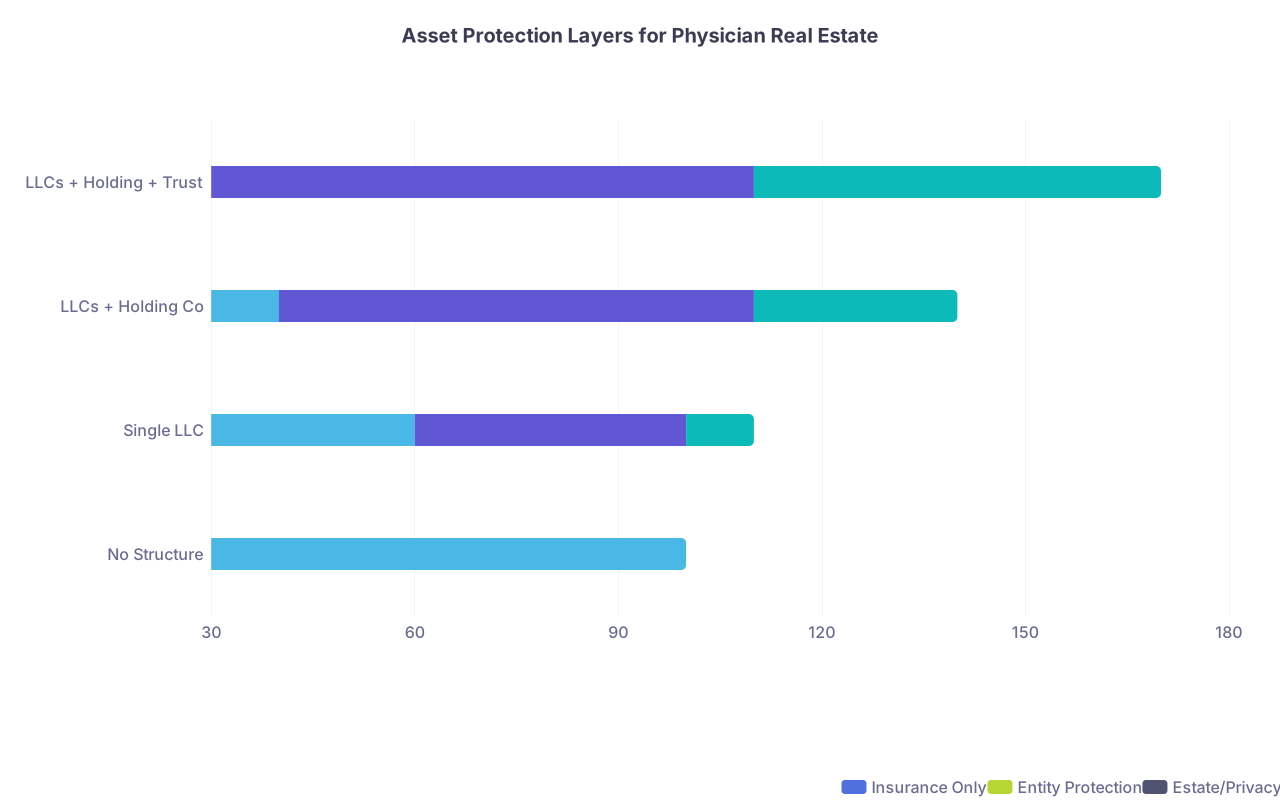
| Category | Insurance Only | Entity Protection | Estate/Privacy |
|---|---|---|---|
| No Structure | 100 | 0 | 0 |
| Single LLC | 60 | 40 | 10 |
| LLCs + Holding Co | 40 | 70 | 30 |
| LLCs + Holding + Trust | 30 | 80 | 60 |
7. What If You Get Sued for Malpractice? Outside-In Protection
Here’s your nightmare scenario:
You, a high-risk specialist, get hit with a verdict above your malpractice and umbrella limits. Plaintiff now has a big personal judgment against you.
The obvious question: Can they take your rentals?
Here’s how your structure helps:
If your rentals are in separate LLCs
- They’re not your personal assets; they’re assets of LLCs you own interests in.
- Plaintiff usually can’t directly seize the buildings.
What they can usually go after (varies by state):
- Your membership interest in LLCs
- Distributions coming from LLCs
- Possibly a charging order (right to receive distributions, but not manage/sell)
In states with strong charging order protection, a creditor might be stuck waiting, hoping you decide to distribute cash to yourself. That’s leverage for you in settlement talks.
This is where a well-informed local asset protection attorney earns their fee. Not the TikTok guy, a real one who reads case law.
8. Inside-Out: Tenant or Property Lawsuit
Other direction.
You have a tenant who falls, gets badly hurt, and sues. They name the landlord (your LLC) and maybe you personally if they can argue negligence.
If you’ve:
- Owned properly through a separate LLC
- Kept up decent corporate formalities
- Carried proper insurance
Then, worst case scenario tends to be:
- Claim is paid by insurance up to limits
- If above limits, they can try to get at LLC assets
- The damage is usually limited to what’s inside that LLC (that property, that bank account)
They do not automatically get your home, retirement accounts, or your other rentals in other LLCs.
This is the whole point of not throwing 15 doors into one entity.
9. Trusts: What They Help With (And What They Don’t)
A lot of physicians jump on “put it in a trust” advice without understanding what that means.
Two main categories:
Revocable Living Trust (RLT)
- You still control it. You can revoke it.
- Great for: avoiding probate, estate planning, keeping things smooth for your family.
- Terrible for: asset protection from your creditors. Courts treat assets as still yours.
Irrevocable Trust (domestic or offshore)
- Much stronger potential asset protection.
- But: you give up meaningful control, it’s complex, and timing matters (you can’t set this up after a lawsuit hits and expect it to work).
- Expensive to set up and maintain, and you need a real specialist.
For most high-risk physicians in the early and mid-build phase:
- Use an RLT as the final owner (for estate planning)
- Title chain looks like: Property -> Property LLC -> Holding LLC -> Your RLT -> You as grantor
If you’re in the ultra high-net-worth category or have specific fears, then you talk to a true asset protection attorney about domestic asset protection trusts or more advanced setups.
10. Practical Day-to-Day Rules So Your Structure Actually Holds
This is where people get lazy and blow their protection.
You should:
- Maintain separate bank accounts for each LLC or, at minimum, each major property LLC
- Sign everything properly: “John Smith, Manager, ABC Property LLC”
- Document loans between you and the LLC in writing
- Avoid using LLC accounts as your personal piggy bank
- Keep minutes / records for big decisions (purchase, sale, large rehab, partner changes)
Is this annoying? A bit. Is it more annoying than watching a plaintiff’s attorney tear your structure apart line by line on a projector? No.
11. Multistate Ownership: Where to Form the LLCs
Classic scenario: You’re an OB in California buying in Texas and Arizona.
Rules of thumb:
- The property LLC should almost always be formed in the state where the property is located
- Your holding LLC might be in your home state or a state with strong charging order laws (e.g., Wyoming)
- If your holding LLC “does business” in other states, you may need to register it as a foreign entity
Don’t try to hide California property behind a Delaware LLC without registering it in California. When something goes wrong, that façade collapses fast.
12. How Much Is “Enough” Protection for You?
Let me be blunt: you could spend $30k–$80k building the “perfect” fortress. Most physicians don’t need that.
You need something sane, defensible, and maintainable.
Very rough tiers:
You have: 1–2 rentals, <$1M equity total
- Probably fine with: 1–2 property LLCs, strong insurance, personal umbrella, RLT
You have: 3–10 doors, $1M–$3M equity, high-risk specialty
- Better: Property LLCs (1–3 total) + holding LLC + RLT + solid umbrella
You have: 10+ doors or >$3M equity, private practice income, high-risk specialty
- Strongly consider: One LLC per major asset or per building, holding LLC, RLT, possibly advanced trust planning, professional asset protection review every few years
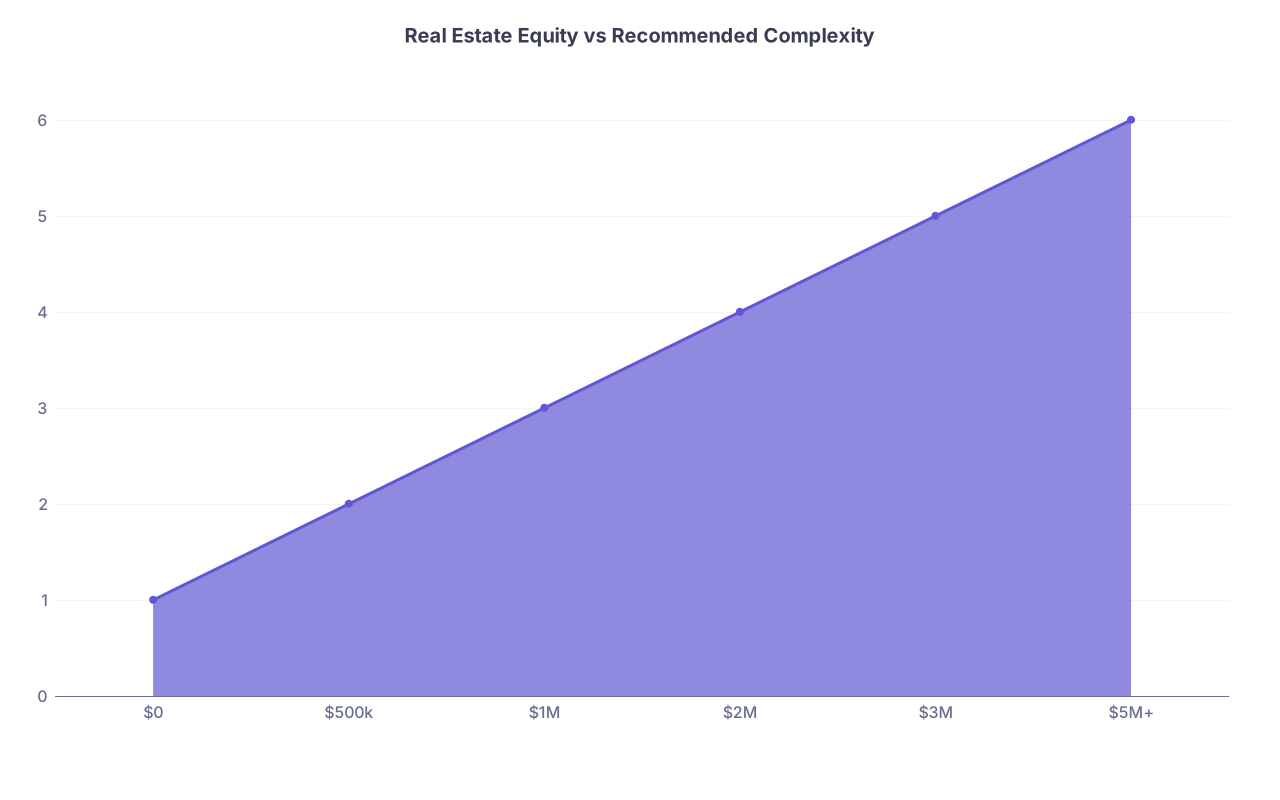
| Category | Value |
|---|---|
| $0 | 1 |
| $500k | 2 |
| $1M | 3 |
| $2M | 4 |
| $3M | 5 |
| $5M+ | 6 |
(Where “complexity level” = 1 is simple single LLC, 6 is multi-LLC + holding + trust + specialist counsel.)
13. How to Actually Move From Messy to Structured
If you’re reading this and thinking, “My stuff is already a mess,” here’s how you attack it without blowing up your life.
Step 1 – Inventory
List every property, current title, current loan, current insurance, current leases, and gross equity.
Step 2 – Priority order
Start with:
- Highest equity
- Highest liability exposure (multifamily, older buildings, properties with pools/stairs)
Step 3 – Local attorney + CPA
You want:
- A real estate attorney who does investor work (not just buying homes)
- CPA who understands passive real estate + your medical situation
You ask them specifically: “Here’s my risk profile as a [specialty]. How would you structure my properties if we’re optimizing for risk protection first, taxes second, convenience third?”
Step 4 – Implement in phases
Do not try to transfer 8 properties, set up 6 LLCs, and rewrite 12 leases in one weekend. You’ll make sloppy mistakes.
Move 1–2 assets at a time. Clean up bank accounts and leases as you go.
FAQ (4 Questions)
1. Is an umbrella policy enough, or do I really need LLCs as a high-risk specialist?
No, it is not enough. Umbrella coverage is fantastic and you should absolutely have it, but it’s still just an insurance policy with limits and exclusions. A catastrophic event or determined plaintiff can blow past limits or find coverage gaps. LLCs don’t replace umbrella insurance; they sit behind it and contain the damage when something beats the policy.
2. Should my spouse be an owner of the real estate LLCs for protection?
Maybe, but not blindly. In some states, tenancy by the entirety or similar structures can provide extra protection if only one spouse is sued. In others, it does almost nothing. Also, co-owning everything with a spouse can create problems in divorce or estate planning. This is state-specific—talk to a local attorney who actually understands marital property laws before you start tossing your spouse on deeds “for protection.”
3. Can I put my properties directly into my revocable living trust instead of using LLCs?
You can, but that’s not a substitute for LLC-level protection. A revocable living trust mainly solves probate and estate flow issues. It does not shield the underlying assets from your creditors the way an LLC might. The cleaner approach for most physician investors is: property in LLC, LLC interests owned by your RLT. That way you get both liability protection and estate planning benefits.
4. When should I consider more advanced tools like offshore trusts or domestic asset protection trusts?
Usually only when three things are true: you have several million in exposed assets, you’re in a truly high-risk or highly litigious specialty or business, and you’re willing to give up some control and pay meaningful annual costs to maintain the structure. These tools are not appropriate for the typical physician with a couple of rentals—they’re nuclear options for high-net-worth, high-risk situations and they must be set up well before any claim appears.
Open a blank document right now and list every property you own, how it’s titled, and what entity (if any) holds it—then circle the one with the most equity and start planning how to get that single asset into the right structure this month.