
It’s 10:30 p.m. Your clinic notes are half-done, but your mind is somewhere else. Your spouse just said the word “separation.” You own three rentals, one in your name, one jointly, one in an LLC. There’s equity. There’s cash flow. There’s also the creeping fear:
“Can I lose everything I built?”
You are not thinking about cap rates now. You’re thinking: Do I need to move money? Change titles? Call a lawyer? Will the judge force me to sell my best property?
This is the situation: you’re a physician, you’ve been building a rental portfolio, and divorce just crashed into your financial life. You do not have the luxury of pretending this is “just emotional.” Divorce is a financial war with emotional shrapnel.
Let’s walk through what you do, step by step, to protect your rental real estate without doing anything illegal, stupid, or that will backfire in court.
Step 1: Stop Winging It – Get the Right Lawyer, Fast
First move: hire an attorney who actually understands both high-income professional divorces and real estate assets. Not your friend’s cousin who “does some family law.”
You’re looking for someone who, when you say “triple net” or “cost segregation,” does not blink. Who understands:
- K‑1s from an LLC that holds property
- Depreciation, carryforward losses, capital accounts
- How to value a portfolio that’s leveraged and not just “Zillow minus mortgage”
Ask explicitly in the consult:
- How many cases have you handled where one spouse had multiple rental properties?
- How do courts in this state typically treat rental properties and LLCs?
- How are separate vs marital property handled here? (Community property vs equitable distribution.)
Do this before you start moving money or signing anything. I’ve seen physicians blow up their own case by “fixing” things on their own: retitling, transferring, “selling” to friends for $1. Judges hate that. Your spouse’s lawyer will make you look like a fraud.
If you’re already separated and no lawyer yet, that is your first priority within the week. Not more Zillow searches. Not more late-night spreadsheets.
Step 2: Get Clear on What’s Actually at Risk
You cannot protect what you do not understand. You need a complete, ugly, no-denial inventory of your real estate situation.
Make a document (not in a random Notes app—something you can share with your attorney):
- Each property
- How it’s titled
- When it was acquired (relative to marriage date)
- Source of down payment
- Current loan balance and terms
- Rough market value
- Monthly income and expenses
Something like this:
| Property | Title Type | Acquired | Down Payment Source | Rough Equity |
|---|---|---|---|---|
| 3‑unit near hospital | Joint (you + spouse) | During marriage | Marital savings | $250k |
| Single-family rental | Your name only | Before marriage | Your pre-marital funds | $150k |
| Short-term rental | LLC (you 70%, partner 30%) | During marriage | Mix of your pre-marital + marital savings | $200k |
Now, layer on your state’s rules:
- Community property state (e.g., CA, TX, AZ): Most assets acquired during marriage from earnings are presumed joint, regardless of title.
- Equitable distribution (most other states): Court divides assets “fairly,” not necessarily 50/50, and title and source of funds matter more.
Your lawyer will translate this into:
- What’s probably marital and fully in play
- What might be separate but with a marital claim to appreciation
- What’s clearly your separate property but may still influence negotiations (because you’re “the high earner with more assets”)
Do not assume, “It’s in my LLC so they can’t touch it.” That’s fantasy. The court cannot retitle the LLC interest the same way it can retitle a house deed, but your ownership interest in that LLC is absolutely a marital asset if acquired or grown during the marriage.
Step 3: Understand Separate vs Marital in Real Life, Not Theory
Here’s where most physicians get confused.
Scenario: You bought a condo in residency, five years before marriage. Good job. After marriage, you and your spouse used joint money to pay the mortgage and renovate the kitchen. It’s now worth double.
Likely reality:
- The condo itself may be your separate property (depending on your state).
- But at least part of the appreciation and paydown of the loan may be a marital asset. Courts look at contribution of marital funds and effort.
Second scenario: You had a rental in your own name. During marriage, you did a cash-out refi, used that cash to buy another property jointly with your spouse.
Now the first property is tainted with marital equity, and the new one is obviously marital. Tracing can still help you, but it’s messy. Judges don’t love messy.
Rough rule: if marital money, effort, or guarantees helped build or grow the asset, expect your spouse to have a claim on some slice of the value.
So what do you do with this?
- Stop casually commingling. Do not, during the divorce, start moving rental cash flow into joint accounts.
- Stop using marital accounts (joint checking, HELOC on marital home) to fix up “your” separate rentals without talking to your attorney.
- Gather proof of what came from where (closing statements, old bank records, emails with your lender).
You’re building a tracing narrative. It’s tedious, but for a physician with six-figure equity in pre-marriage rentals, it’s worth real money.
Step 4: Stabilize the Portfolio – No Drastic Moves
You might be tempted to go into “protect mode”: sell everything, pay down debt, or transfer to relatives. Don’t. That looks like hiding.
Most courts will issue some version of an automatic temporary restraining order (ATRO) or injunction once a divorce is filed, limiting transfers of assets except in the ordinary course (like paying bills). Violating that is a very fast way to tank your credibility.
What you should do instead:
- Keep everything current. Mortgages, taxes, insurance, HOA dues. Falling behind hurts both spouses and gives leverage to the one who’s more on top of it.
- Maintain normal operations. Keep renting, keep collecting rent, keep paying standard expenses.
- Document clearly. Create a simple tracker for each property with rent received and expenses. Saves time, legal fees, and headaches later.
Your goal is to show you’re acting like a responsible fiduciary over joint assets, not a panicked landlord trying to hide the ball.
Step 5: Decide Your Priority: Cash Flow, Equity, or Clean Exit
You rarely get everything you want in a divorce. With rentals, you need to pick what you actually care about.
Ask yourself:
- Do I need ongoing cash flow to support post-divorce life and possibly child support and alimony?
- Do I value simplicity and fewer moving parts over maximizing every dollar?
- Are there properties emotionally tied to the relationship that I frankly do not want to deal with anymore?
I’ve watched attending physicians make two very different choices:
- One gave up the marital home and retirement account gains to keep three rentals and all future cash flow.
- Another decided, “I’m done with tenants, toilets, and texts,” sold everything, took her half in cash, and poured it into low-drama index funds.
Both were rational—in context.
For you, rank your properties:
A. Must keep if possible (best long-term asset, best location, or major pre-marital contribution).
B. Negotiable.
C. Happy to trade or sell if needed.
Your attorney can negotiate better if you’re clear on those categories. If everything is “must keep,” you will lose badly somewhere.
Step 6: Use Structure Wisely – LLCs, Operating Agreements, and Buyouts
If you already have properties in LLCs with operating agreements, pull those documents now. Your attorney needs them. They matter.
Key questions:
- Are there other partners (besides your spouse)?
- Is your spouse a member of the LLC or not?
- What do the operating agreements say about transfers, buyouts, or valuation?
Courts can’t just shove your ex into a member spot in an LLC with third parties who never agreed to that. Instead, they’ll usually:
- Value your interest in the LLC (your ownership share).
- Award that LLC interest to you.
- Offset your spouse with other assets or a cash payment.
If your spouse is also a member, it gets trickier. One clean approach: you buy out their interest based on a mutually agreed or court-determined valuation.
You want this on your radar early, because financing a buyout takes planning.
Here’s a simple, realistic valuation breakdown:
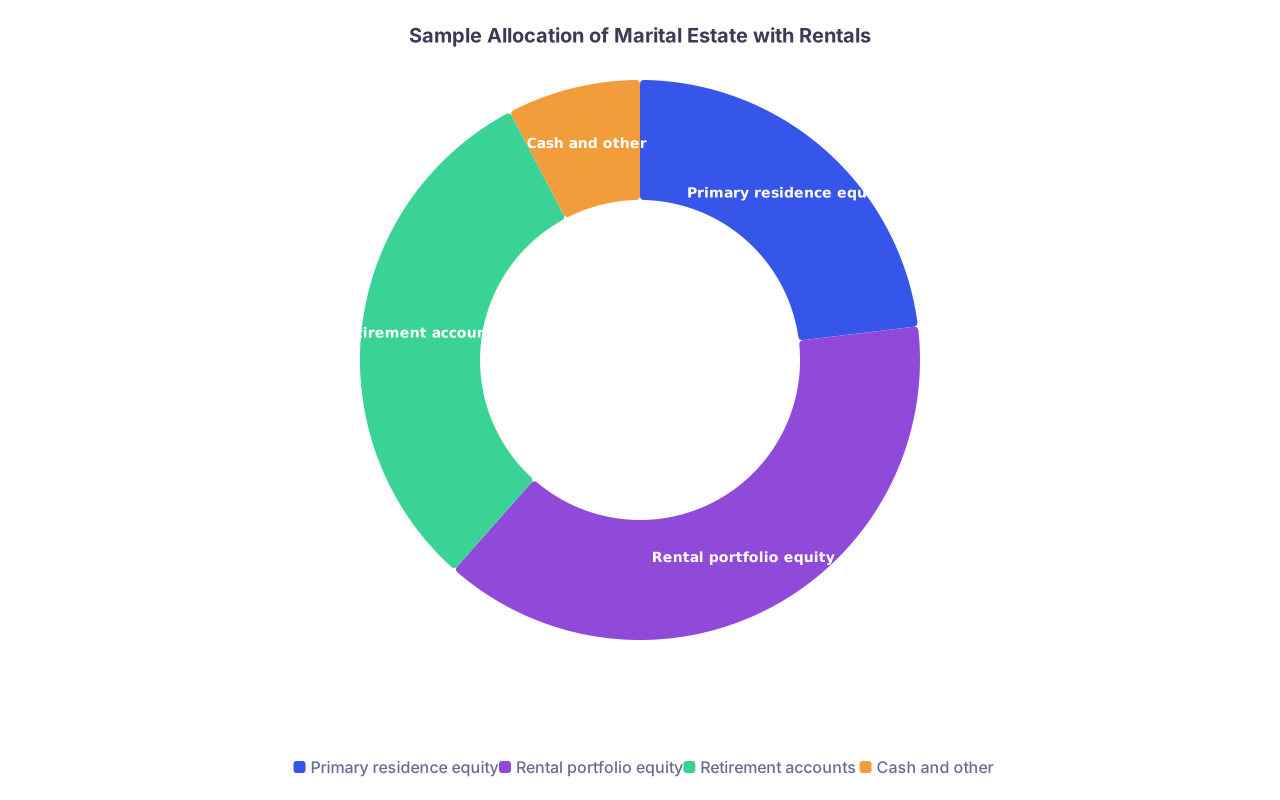
| Category | Value |
|---|---|
| Primary residence equity | 300000 |
| Rental portfolio equity | 500000 |
| Retirement accounts | 400000 |
| Cash and other | 100000 |
If half the “rental portfolio equity” is due to your spouse, you might end up keeping 100% of the properties and giving up more retirement or cash to equalize.
Point: if you want to keep the rentals, mentally prep to give on something else.
Step 7: Protect the Rentals Without Playing Dirty
Here’s what you should not do:
- Quietly under-report rent on disclosures. Your bank statements will contradict you.
- Delay repairs to tank appraisals. Looks petty and can backfire when a real estate expert testifies.
- Transfer properties to your LLC or your brother “for asset protection” after divorce discussions start. Judges see right through that.
What you can and should do:
- Make sure each property is properly insured. If something burns down in the middle of the divorce and you were underinsured, both of you lose and you look like an idiot.
- Confirm all entity documentation is clean and updated: correct members, registered agent, operating agreements signed.
- Lock down access: if your spouse had logins to property management portals, bank accounts, or mortgage sites, talk to your lawyer about securing them. You’re not hiding, you’re preventing sabotage.
If communication is tense, move to written-only for anything property-related (email, text, property management system messages). “Per our last discussion, I will schedule the HVAC repair at the duplex and pay from the rental account.” Paper trails save you.
Step 8: Cash Flow During Divorce – Who Gets the Rents?
Big practical question: what happens to rental income while the divorce drags on?
Every state and every judge handles this differently, but here’s what I’ve seen work:
- Rents continue to go into the existing rental account(s).
- Necessary operating expenses (mortgages, taxes, insurance, repairs, management) are paid from there.
- Net cash flow either sits in the account to be divided later, or a portion is periodically distributed to each of you by agreement or court order.
You do not just start pocketing all the net rent because “I manage the properties.” That’s cute, but a court will probably call that dissipation of marital assets.
If you’ve historically taken an “owner draw,” you may be able to continue, but make sure your attorney is on board and this is disclosed. Surprises in financial affidavits get punished.
For physicians with support obligations (temporary spousal or child), rental income absolutely counts. Courts look at all income sources when setting support. Do not try to pretend your rentals “barely break even” if your tax returns show steady Schedule E income.
Step 9: Planning for the End Game – Division Options That Actually Work
Let’s talk about realistic exit structures for the rental portfolio.
Common patterns I see:
You keep most or all rentals; spouse compensated elsewhere.
- You take 100% of LLC interest and several properties.
- Spouse gets more retirement, more liquid savings, or a cash buyout over time.
- This is typical when you’re the one who understands and wants the real estate.
Portfolio split: each takes some properties.
- Cleaner when there are multiple similar properties.
- Each of you becomes sole owner of certain assets.
- Needs careful review of loan assumptions, refinances, and title transfers.
Sell select properties and split proceeds.
- Used when there’s too much conflict to co-own and not enough other assets to offset.
- Triggers tax events—capital gains, depreciation recapture—so this should be modeled, not guessed.
Short-term co-ownership with end date.
- You agree to continue co-owning for X years (for tax reasons, market conditions, or loan constraints), then sell or buy out.
- Requires a detailed written agreement on management, distributions, decision-making, and dispute resolution.
If there’s a lot of real estate or complexity, swallow your pride and pay for a neutral financial or valuation expert. Judge is not going to understand your “BRRRR” strategy unless someone translates it.
A simple timeline of how this plays out:

| Step | Description |
|---|---|
| Step 1 | Decision to separate |
| Step 2 | Hire divorce attorney |
| Step 3 | Full asset inventory |
| Step 4 | Classify properties as marital or separate |
| Step 5 | Stabilize operations and cash flow |
| Step 6 | Negotiate property division options |
| Step 7 | Finalize agreement and retitle or refinance |
Your job is to drive this process, not be dragged by it.
Step 10: Mistakes I’ve Seen Physicians Make (So You Don’t Repeat Them)
You’re busy. You’re stressed. That’s when people make dumb moves. I’ve watched versions of these:
- Signing a temporary agreement giving the spouse the “house and some rentals” just to avoid conflict, then realizing later you gave away millions in future cash flow.
- Assuming the court will “be fair” without actually documenting tracing on pre-marital properties. Courts work with numbers and evidence, not vibes.
- Not refinancing a jointly titled property you were awarded, then having the ex stay on the mortgage for years—guaranteed future conflict.
- Ignoring tax consequences. Selling the one property with the most built-in gain because “it has the most equity,” then discovering the net after taxes is far lower than you thought.
Do not be the physician who knows every guideline in UpToDate but signs a global divorce settlement without reading the property schedules carefully.
Before you sign anything that divides real estate:
- Confirm each property’s fate: who owns, who’s on title, who’s on the loan, who gets the rents, who’s responsible for repairs.
- Confirm deadlines for refis or sales and what happens if they don’t happen on time.
- Get a basic tax projection from a CPA, especially if selling or swapping multiple properties.
Quick Reality Check: What If You’re Already Screwed Up the Setup?
Maybe you commingled everything. Maybe you “sold” a property to your sibling for cheap last year. Maybe you never kept records.
Fine. Start where you are.
You can still:
- Reconstruct as much as you can: old emails, prior tax returns, old bank statements from closed accounts (yes, you can often request them).
- Be honest with your lawyer about the sketchy stuff. They can’t help you if you hide it.
- Shift your focus from “win every inch” to “preserve the most important assets and rebuild.”
The worst combination is denial plus complexity. Own the mess, then clean it methodically.
Visual Snapshot: Where Your Net Worth Might Be Sitting
For a lot of physicians, rentals are a big chunk of the estate, whether you admit it or not.

| Category | Value |
|---|---|
| Practice/Job Equity | 200000 |
| Primary Home | 400000 |
| Rentals | 600000 |
| Retirement Accounts | 500000 |
| Cash/Other | 150000 |
That “Rentals” bar isn’t theoretical. That’s future college tuition, your own retirement buffer, and your safety net if you burn out. Fight intelligently for it.
Final Thoughts: What Actually Matters
You’re juggling medicine, a collapsing marriage, and a real estate portfolio. No one is coming to organize this for you. You have to drive.
Keep three things front and center:
- Get specialized help early. A divorce lawyer who understands real estate (and a CPA if needed) will save you more than they cost.
- Stabilize and document. Keep the rentals running cleanly, keep great records, and don’t play games with transfers or hidden income.
- Negotiate with priorities, not panic. Know which properties you must keep, which you can trade, and be ready to give elsewhere to protect long-term assets.
Do those, and your rentals become something you walk out of this with—stronger and more consolidated—rather than another thing you lost in the divorce.