
It is January 5th. You just finished a brutal stretch of holiday call. Your W-2s have not arrived yet, but your inbox is already filling with “Important Tax Document Available” emails from banks and brokerage accounts.
You own:
- A primary home with a big mortgage.
- A small stake in a syndicated apartment deal.
- One rental condo you bought during fellowship because “real estate is a great tax shelter for doctors.”
You know there are deductions. You have heard about depreciation, cost segregation, 1031 exchanges, real estate professional status. But right now it all feels like a blur. And April 15 is not that far away.
Here is the uncomfortable part: real estate tax planning is mostly a timeline problem, not a form problem. If you are making big decisions in March, you are already late. Certain elections, entity choices, and deadlines are unforgiving. Miss them, and the IRS does not care that you were on a 28‑hour call.
Let me walk you through the year, chronologically, the way I tell attendings and residents who own (or are about to own) real estate.
Big-Picture Timeline: Your Real Estate Tax Year at a Glance
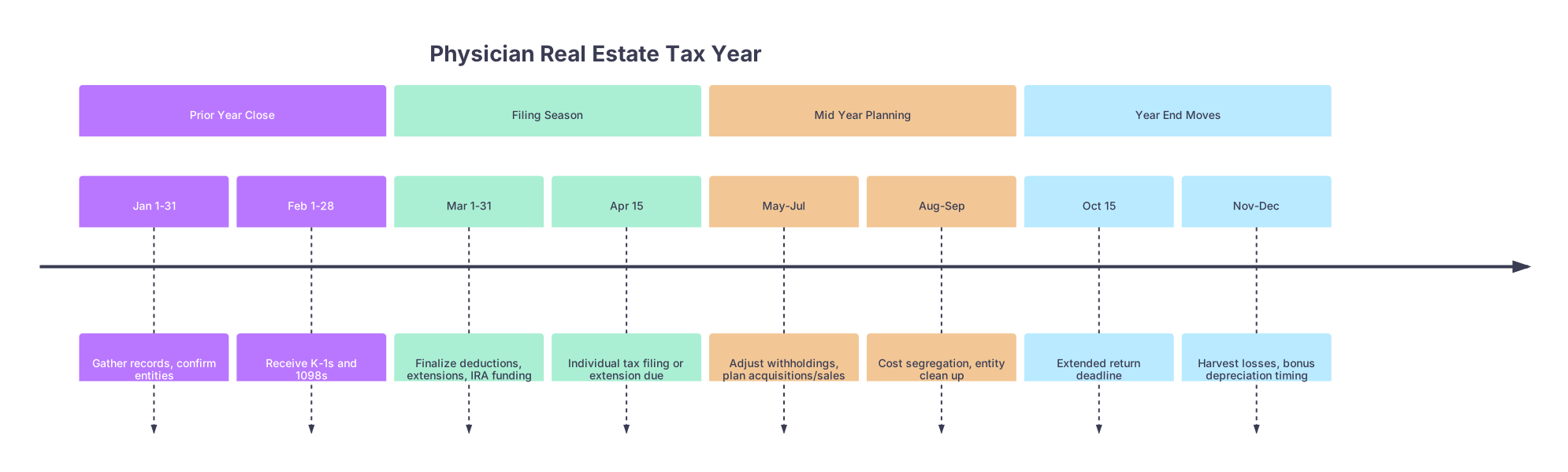
| Period | Event |
|---|---|
| Prior Year Close - Jan 1-31 | Gather records, confirm entities |
| Prior Year Close - Feb 1-28 | Receive K-1s and 1098s |
| Filing Season - Mar 1-31 | Finalize deductions, extensions, IRA funding |
| Filing Season - Apr 15 | Individual tax filing or extension due |
| Mid Year Planning - May-Jul | Adjust withholdings, plan acquisitions/sales |
| Mid Year Planning - Aug-Sep | Cost segregation, entity clean up |
| Year End Moves - Oct 15 | Extended return deadline |
| Year End Moves - Nov-Dec | Harvest losses, bonus depreciation timing |
You have three critical choke points:
- January–February: Data and document collection. If you fail here, everything else backs up.
- March–April: Elections, extensions, funding retirement accounts.
- October–December: Year‑end planning, especially around acquisitions, sales, and cost segregation.
Now, let us go month by month.
January–February: Set the Foundation for Real Estate Tax Season
At this point you should be in gather and organize mode, not “let me Google how depreciation works” mode.
By January 15: Lock in your professional help and structure
If you own more than:
- One rental, or
- One passive real estate syndication, or
- You are considering real estate professional status (REPS),
then doing your own return with basic software is usually a bad idea. I have watched too many physicians:
- Miss material participation hours.
- Fail to group activities correctly.
- Forget passive loss carryforwards for years.
By January 15, you should:
- Confirm or hire a CPA who actually works with physicians and real estate.
- Make sure all your real estate is listed and properly titled:
- Is the rental in your personal name, an LLC, or a partnership?
- Are you on the right returns? (Individual vs 1065 partnership vs S‑corp.)
- Verify your bookkeeping method:
- If you have even a couple of properties, use basic accounting software or at least dedicated spreadsheets.
- Real estate income/expenses scattered across 14 credit cards and Venmo is how deductions die.
Day-By-Day (Second Half of January):
- Day 1–3: Make a list of every real estate‑related asset or investment:
- Primary home (for Form 1098, property taxes, HELOC interest).
- Each rental property (address, date placed in service, acquisition cost).
- Each syndication or fund (name, year invested, fraction owned).
- Day 4–7: Request missing info:
- Property management year‑end statements.
- Closing statements for any properties bought or sold last year.
- Prior‑year tax returns and depreciation schedules (if changing CPAs).
- Day 8–15: Decide entity clean‑up:
- If you have random single‑member LLCs, confirm how they are reported.
- Do not start new entities in January “for tax savings” without a specific plan. Entity choice is a tax decision, not an aesthetic one.
Late January–February: Track the incoming documents
From late January through February, the documents start to land.
You should build a tracking list and not rely on your memory. A simple table like this, maintained as things come in, saves you from April panic.
| Document Type | Example Form / Source |
|---|---|
| Mortgage interest | Form 1098 from lender |
| Property tax bills | County / city tax authority |
| Rental income totals | Property manager year-end statement |
| Syndication income/loss | Schedule K-1 from partnership/LLC |
| Purchase/sale details | Closing disclosure (CD) / HUD-1 |
At this point you should:
- Create a dedicated 2025_TAX_REAL_ESTATE folder (or similar).
- As each Form 1098, K‑1, or statement arrives, save it there and update your checklist.
- For each property:
- Start a one‑page summary: rents collected, big repairs, major capital improvements.

If you invested in a real estate syndication last year:
K‑1s often arrive late (March, even April). Do not be surprised. Just track them. If they will be late, you are almost certainly filing an extension.
March–Mid April: Filing Decisions, Extensions, and Last-Minute Moves
By early March, your question shifts from “What do I own?” to “What moves can I still make for last year, and how do I avoid missing deadlines this year?”
Early March: Analyze your real estate position with your CPA
At this point you should schedule a 60–90 minute review with your CPA, not a 10‑minute document drop.
Topics to review:
- Rental activity summary by property
- Gross rents.
- Operating expenses.
- Net income or loss before depreciation.
- Depreciation and bonus depreciation
- Confirm that all properties acquired last year were “placed in service” correctly (date available for rent).
- If you did a cost segregation study last year, verify that bonus depreciation was applied as intended.
- Real estate professional status (if you or your spouse are pursuing it)
- Hours logs.
- Grouping election of rental activities.
- Material participation tests.
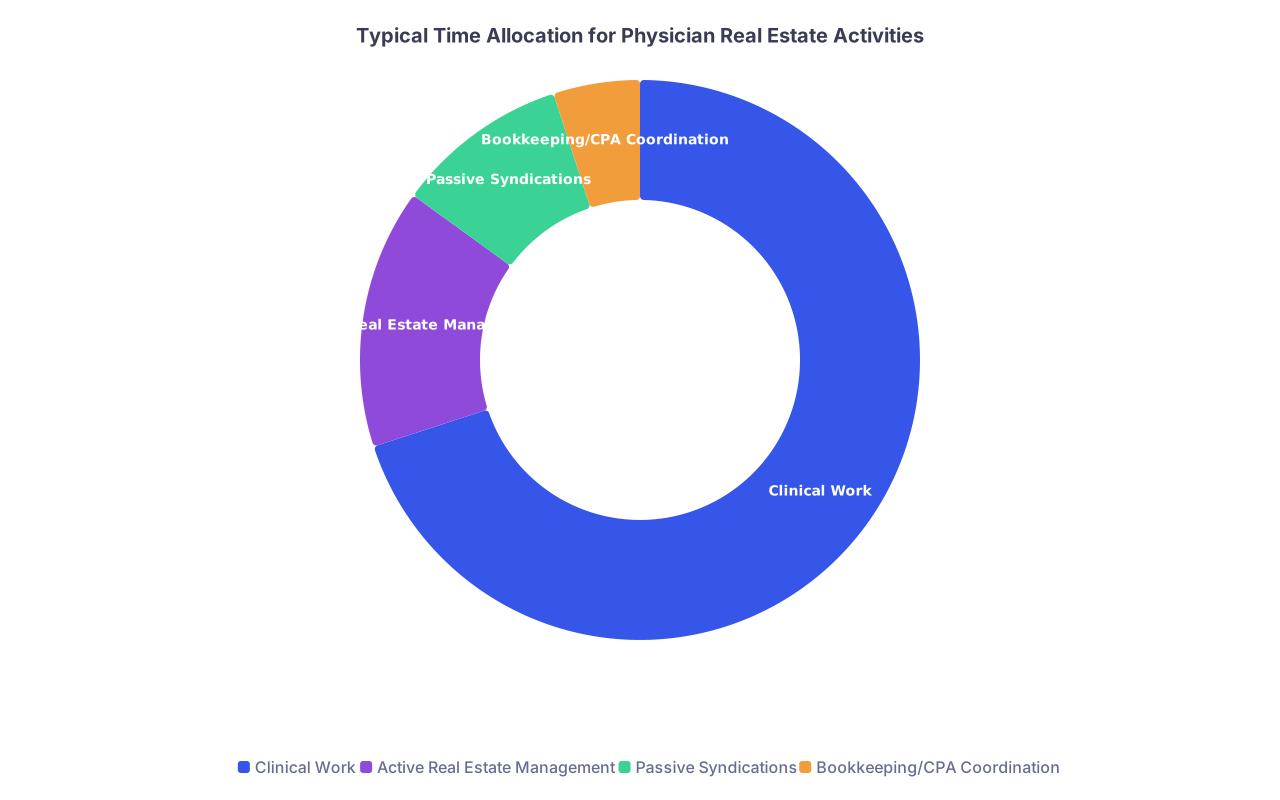
| Category | Value |
|---|---|
| Clinical Work | 70 |
| Active Real Estate Management | 15 |
| Passive Syndications | 10 |
| Bookkeeping/CPA Coordination | 5 |
If you are going for REPS and your CPA does not immediately start talking about:
- 750‑hour rule.
- More than half of personal services in real property trades.
- Grouping election.
Find another CPA. Quickly.
Mid–Late March: Decide on filing vs extension
Deadlines to keep front of mind:
- Individual return (Form 1040) due:
Usually April 15 (or next business day). - Extension (Form 4868) due:
Same day as regular filing deadline.
Key point:
An extension extends the time to file, not the time to pay. If you owe tax, it is still due by April 15, extension or not.
Real estate‑driven reasons to extend:
- K‑1s from syndications are delayed.
- You are still waiting on cost segregation results.
- You need more time to correctly model REPS and passive loss groupings.
At this point you should:
- Ask your CPA for:
- A rough draft of your return based on known data.
- A tax‑due estimate so you can pay by April 15 even if you extend.
- Decide:
- File by April 15 if you have all your documents, simple rentals, no late K‑1s.
- File an extension if your real estate picture is incomplete or complex.
Last Few Days Before April 15: Actions you can still take
There are very few “retroactive” moves that affect real estate taxes after December 31. However, you can still:
Fund certain retirement accounts for last year
- Traditional IRA / Roth IRA contributions (subject to income limits).
- SEP IRA for 1099 income (if applicable).
Indirect effect: these can push your taxable income down, improving the tax benefit of suspended passive losses in future years.
Pay your tax bill / make first estimated payment
- If you have significant rental or K‑1 income with no withholding, you may need quarterly estimates.
- Missing these can lead to underpayment penalties.

April 15–October 15: Extension Season and Mid‑Year Real Estate Planning
If you filed on time, this period is about adjusting for next year.
If you extended, this is your real work window.
Late April–May: Clean up your books and withholdings
At this point you should:
- Compare your actual tax bill vs what you expected.
- With your CPA, project the current year considering:
- Expected rental occupancy and rents.
- Planned property purchases or sales.
- Changes in your clinical income (new job, more/less 1099).
If last year:
- You had a surprise balance due driven by rental income or K‑1s → adjust withholding or start quarterly estimates.
- You had large passive losses suspended because you were not REPS → consider:
- Grouping elections for current year.
- Whether it is realistic to pursue REPS going forward.
June–August: Position for year‑end real estate moves
This is where serious physician investors separate themselves.
At this point you should:
- Plan acquisitions/sales with tax in mind, not as an afterthought:
- Buying a new short‑term rental? Timing it in Q4 gives you more control over bonus depreciation impact in the same tax year.
- Selling a highly appreciated rental? Decide:
- Straight sale and capital gains.
- 1031 exchange (which has its own strict deadlines, discussed below).
- Book your cost segregation studies early
- If you purchased a large property (or a big share of a syndication) last year or this year, and cost seg makes sense, do not wait until November.
- Study completion and implementation takes time. Rushing this in December is how mistakes happen.
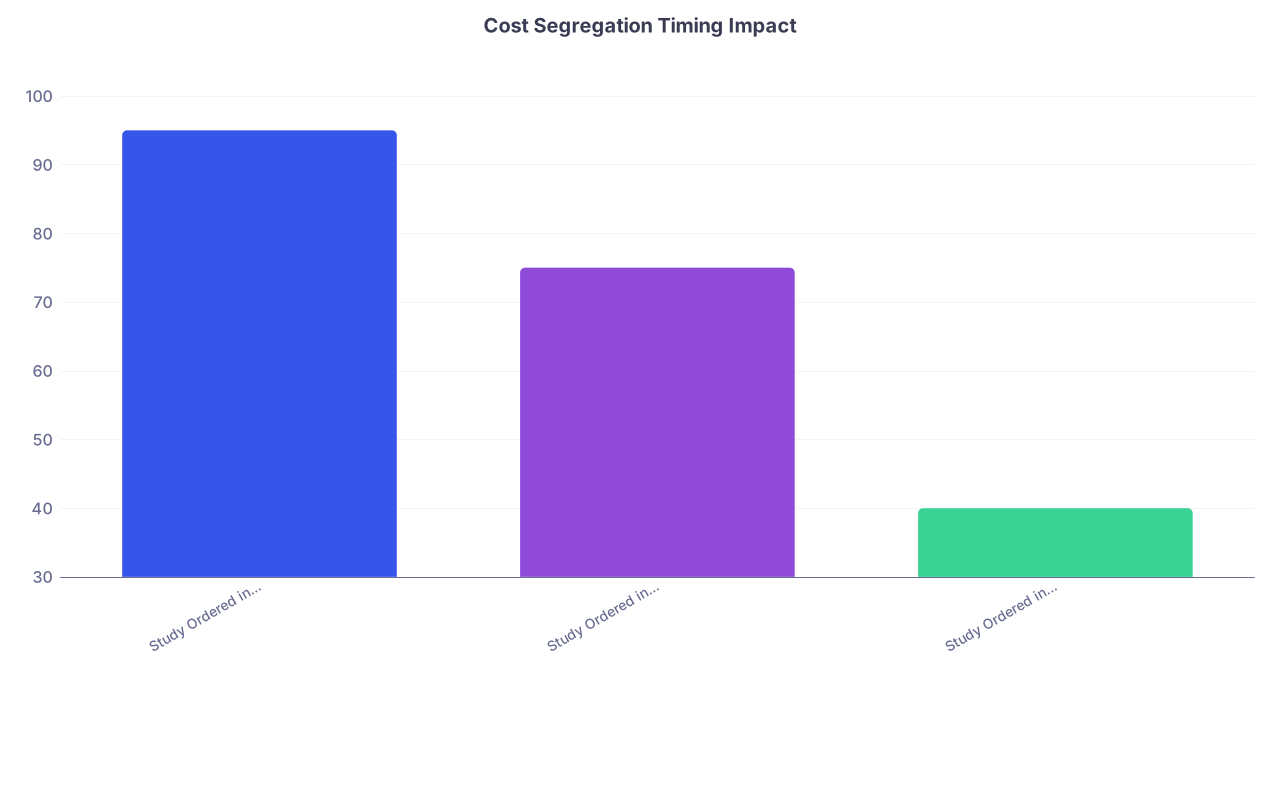
| Category | Value |
|---|---|
| Study Ordered in May | 95 |
| Study Ordered in September | 75 |
| Study Ordered in December | 40 |
(Think of those values as “percent chance everything is done correctly and on time.” Once you get to December, everything is compressed and sloppy.)
October 15: Final Extended Deadline
If you filed an extension back in April, this is your hard stop.
By early September, at the latest, you should:
- Have all K‑1s, cost seg results, and final property numbers.
- Have clarity on REPS status for the prior year.
- Have resolved any entity classification questions.
At this point you should:
- Sit with your CPA and walk through the full return, especially:
- Schedule E detail by property.
- Passive activity loss limitations.
- Suspended loss carryforwards.
- Grouping election statements (if used).
Once the return is filed by October 15, last year is locked for most real estate purposes. Do not assume you can go back and “tweak” grouping or REPS casually. The IRS takes those elections seriously.
Year-End (November–December): Position Next Year’s Tax Bill
Here is where many physicians wake up too late. They start thinking about tax planning in January, when the year has already closed. If you want real control, your calendar reminder should be November 1.
At this point you should:
1. Decide on acquisitions before December
If you want:
- Large depreciation via bonus depreciation from a new purchase.
- To qualify for REPS with sufficient hours on a new property.
- To capture losses to offset other income in the current year.
Then:
- The property must be placed in service (available for rent) before December 31.
- Not “under contract.” Not “closing next week.” Actually available for rent.
For short‑term rentals, this often means:
- Closing by late November.
- Getting furnishing and setup done quickly.
- Having the property listed and available (even if not heavily booked) before year‑end.
2. Consider tax loss harvesting and timing of sales
If you have:
- A property with a big built‑in gain you want to recognize.
- A property with a built‑in loss.
- Stock market losses you can harvest.
Coordinate:
- Which year those gains and losses hit.
- Whether you have suspended passive losses that will free up on sale of a fully disposed activity.
3. 1031 Exchange: Deal with its brutal timeline
If you are going to use a 1031 exchange on a property sale, the deadlines are non‑negotiable:
| Milestone | Deadline from Sale |
|---|---|
| Identify replacement properties | 45 days |
| Close on replacement | 180 days (or tax filing date, earlier) |
| Use qualified intermediary | Before closing on sale |
You do not start reading about 1031s after you close the sale.
You decide before you sell, and you engage a qualified intermediary before closing. Once you touch the cash, your exchange is dead.
How All This Feels Across a Full Year
Let me pull this together as a simplified, real‑world flow for a typical attending with:
- One W‑2 job.
- One rental single‑family home.
- Two real estate syndication investments.

| Step | Description |
|---|---|
| Step 1 | Jan - List properties and docs |
| Step 2 | Feb - Collect 1098 and K1s |
| Step 3 | Mar - Meet CPA, decide on extension |
| Step 4 | Apr 15 - File or extend and pay |
| Step 5 | May-Jun - Adjust withholdings |
| Step 6 | Jul-Aug - Plan new deals, cost seg |
| Step 7 | Sep - Finalize extended returns |
| Step 8 | Oct 15 - Extended deadline |
| Step 9 | Nov-Dec - Time acquisitions and sales |
You loop through this every year. The difference between a physician who constantly feels behind and one who is calm about real estate tax is not intelligence. It is simply:
- Knowing which month controls which decision.
- Not trying to do October’s work in March.
The Non‑Negotiable Real Estate Tax Deadlines Physicians Must Remember
Here is your short list. If you forget everything else, do not forget these:
| Date (Typical) | What It Controls |
|---|---|
| Jan 31 | Most 1099s and W-2s issued |
| Feb–Mar | Majority of K-1s for syndications (some later) |
| Apr 15 | File 1040 or extension; pay tax due; Q1 estimates |
| Jun 15 | Q2 estimated tax payment |
| Sep 15 | Q3 estimated tax; some entity returns (1065/1120S on extension) |
| Oct 15 | Final individual extended return deadline |
Layer on top of that:
- 45/180 days for 1031 exchanges (from sale date).
- December 31 for:
- Placing new rentals in service.
- Establishing REPS hours and participation.
- Locking in cost seg impacts for the year.
Miss those, and there is no “sorry, I was on trauma call” exception.
What You Should Do Today
You are here today, reading this, which means it is some date on the calendar and the next deadline is already approaching.
Your next step is not “learn everything about real estate tax.” That is too vague. Instead:
Do one concrete thing in the next 15 minutes:
- Open a new document titled:
“[YEAR] Real Estate Tax Checklist – [Your Name]” - List:
- Every property you own.
- Every syndication / fund interest.
- Your CPA’s name and email.
- Then write three headings:
- “Documents I already have”
- “Documents I am missing”
- “Questions for my CPA this year”
Fill in what you can right now. Save it.
Then send your CPA an email with that document attached and the subject line:
“Real Estate Tax Planning – Can we schedule time before [next key deadline]?”
That single action moves you from reactive to proactive on your tax season timeline. Everything else becomes much easier once that is in motion.